


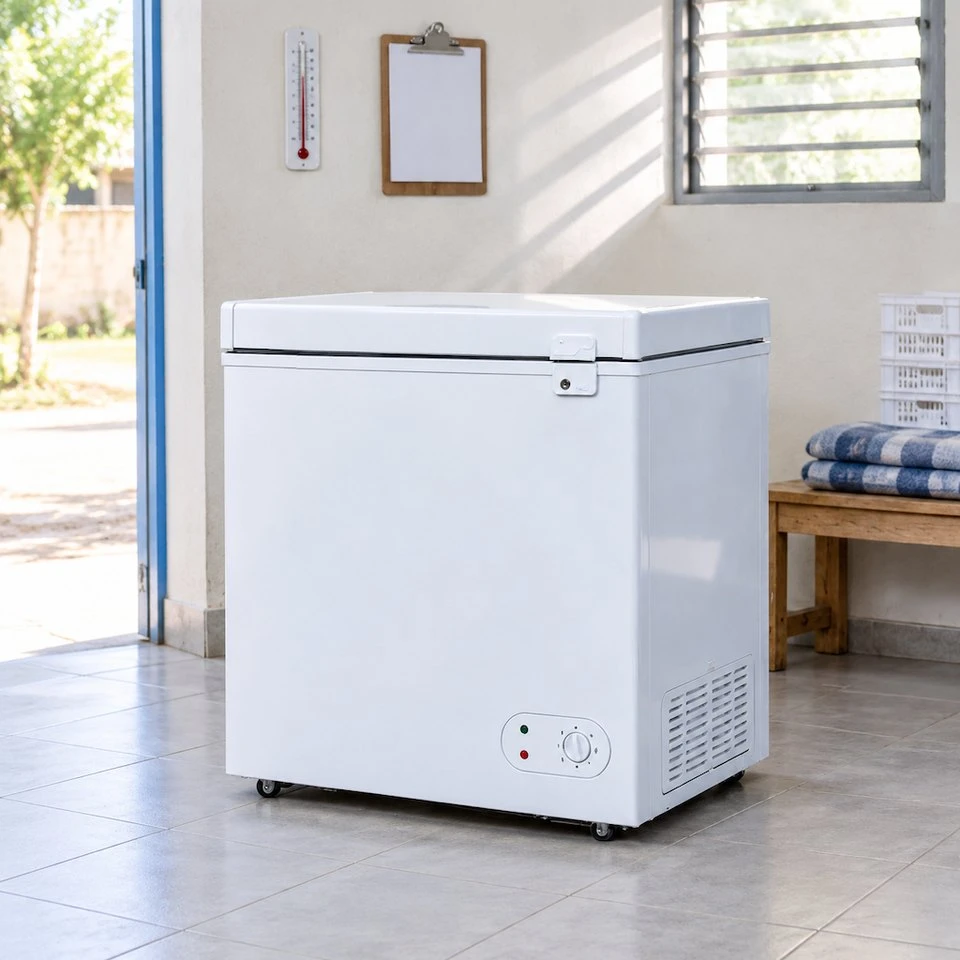

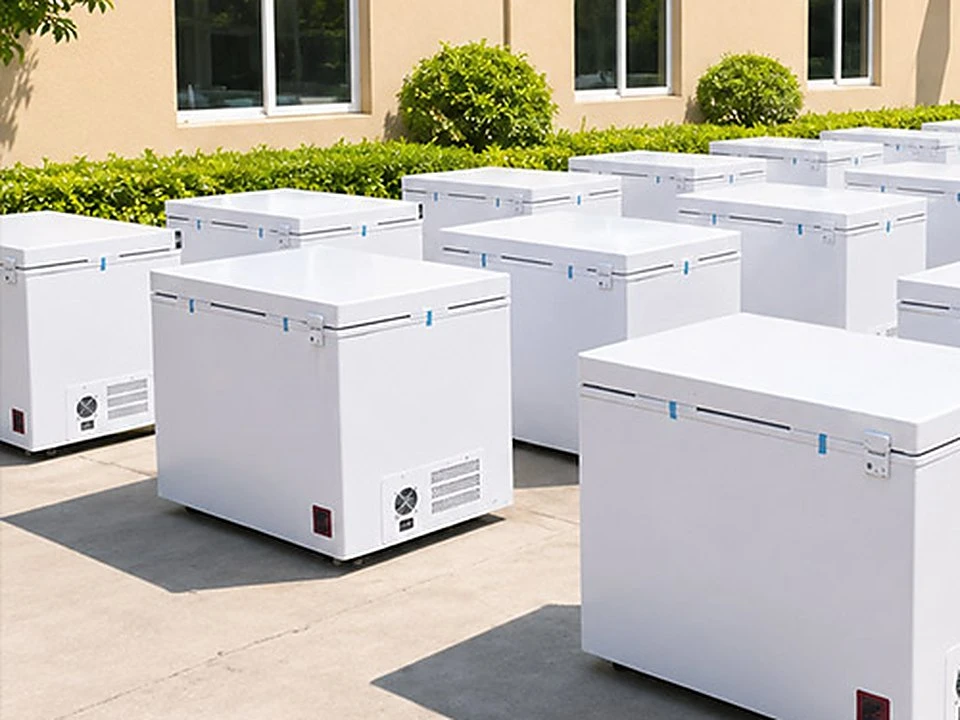
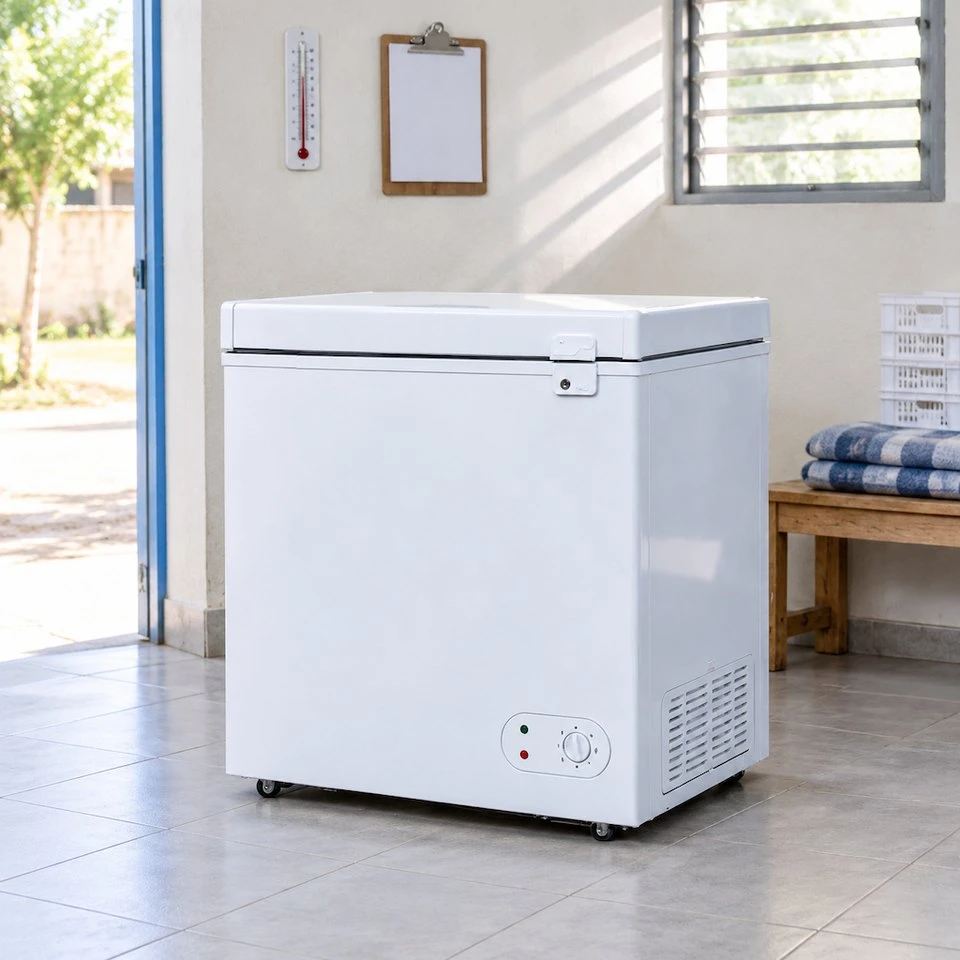
THE WHOLE PRODUCT IN ONE LINE - 88 litres at minus eighteen, 110 millimetres of foam in the walls, the floor and the lid, a compressor that draws 39 watts, a body 840 millimetres long, 661 deep and 640 high, 34 kilos net, and 132 of them to a single 40 ft HQ container.
This page is written as five sums, because a cabinet this small is bought with arithmetic rather than with adjectives. How much the extra 45 millimetres of wall actually saves, what 39 watts turns into at the battery, how much of the outside box the insulation eats, what a unit costs to move, and whether it will go through the door it has to live behind. Every figure in the working is taken from the plate at the closing lines of this page, and every assumption is written next to it so you can substitute your own.
Sum one: what the extra 45 millimetres is for
110 VERSUS 65 MILLIMETRES - the walls of this cabinet are the product
Our standard deep freeze range carries 65 millimetres of foam. This one carries 110, which is 45 millimetres more on every face - the wall, the floor, the lid. On a large cabinet that difference is one of several variables. On an 88 litre box it decides the whole specification, because the area it must insulate is small while the walls are unusually thick: the ratio of skin to volume is the wrong way round, and the extra depth is what makes a 39 watt compressor enough.
The practical consequence is that the cabinet holds temperature with very little running time, and a cabinet that runs less is a cabinet that can live on one panel and a modest battery instead of an array. It is also why the lid is heavy for its size: a 110 millimetre slab of foam bonded to two steel skins is a solid object, and the hinge and the lock hasp are sized for it.
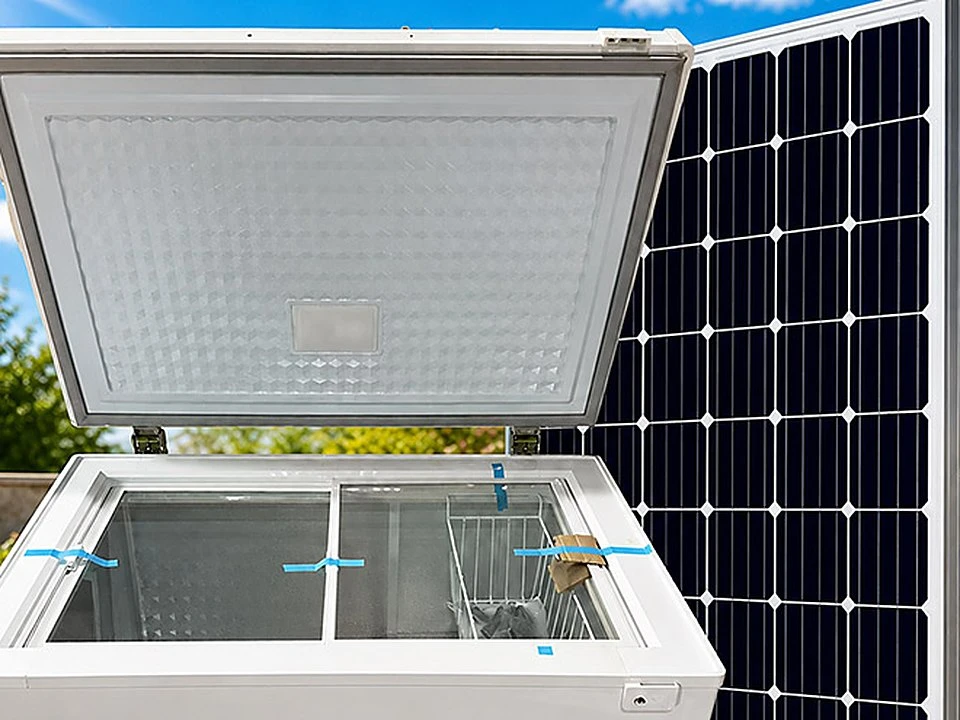
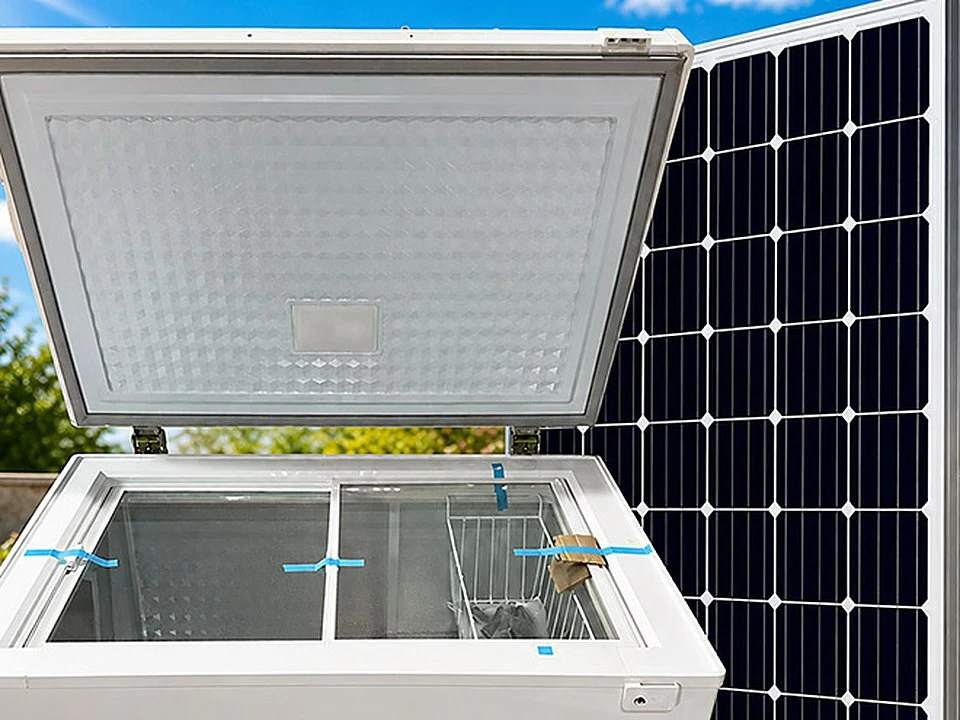
One point of honesty about the pattern you see on the inside of the lid. It is a structural bond poured in a jig, not a cosmetic finish. On a thick lid that bond is what stops the liner sagging away from the foam after a few hundred openings, which is the failure mode that quietly costs a small cabinet its efficiency.
Sum two: thirty-nine watts on a twelve or twenty-four volt bank
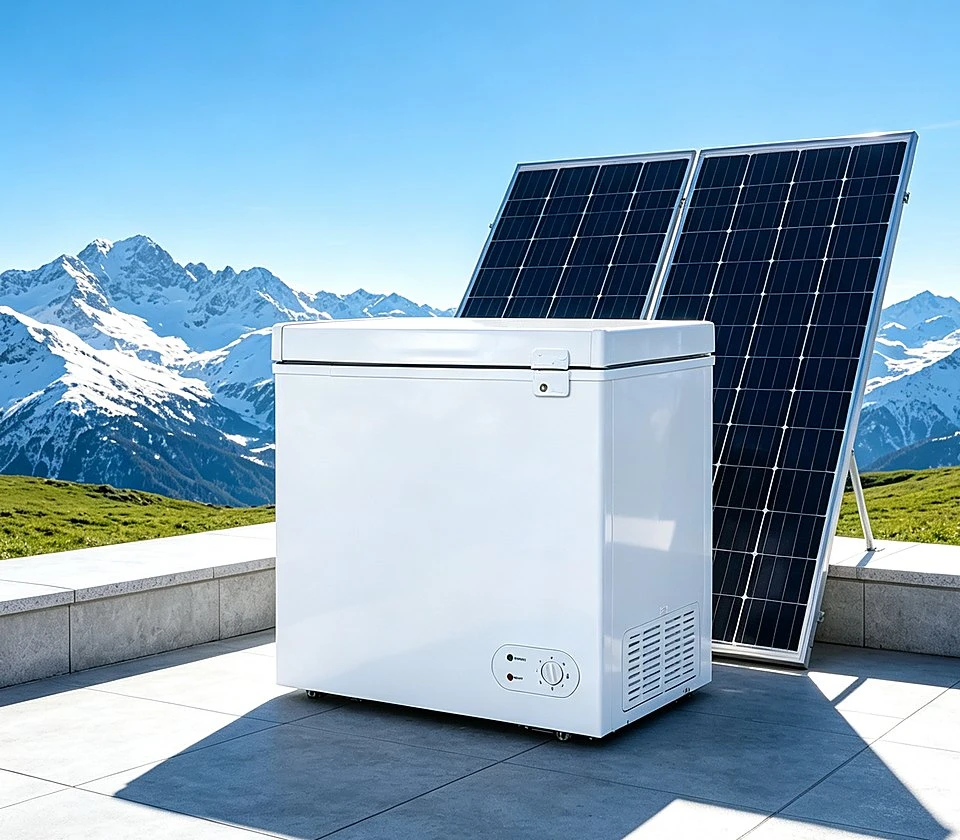
THE ARITHMETIC OF ONE PANEL - worked through, with the assumptions stated
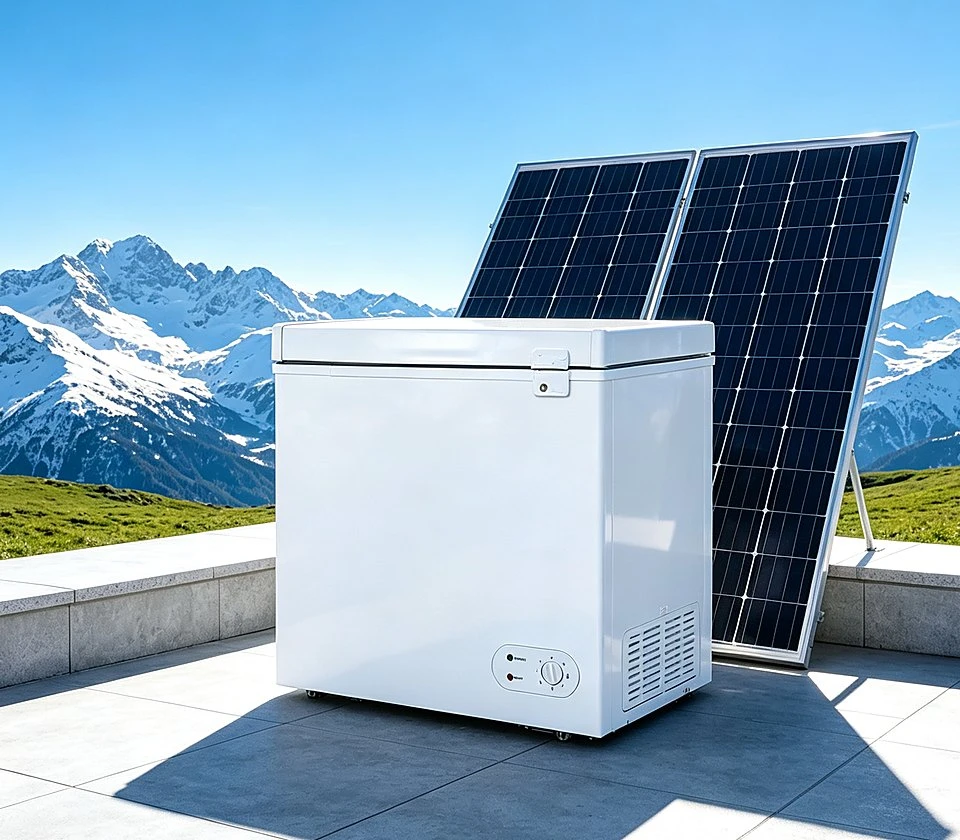
Thirty-nine watts is the running draw. At 12 volts that is 3.3 amps, at 24 volts 1.6 amps, and the terminals will accept a 12 volt bank, a 24 volt bank or a 48 volt installation directly, with no converter in the middle.
Now the daily sum. Assume the compressor runs 40 per cent of the day in a warm room - 9.6 hours - and the cabinet uses 374 watt hours. On a 12 volt bank that is 31 amp hours a day; on 24 volts, 15.6. A single 150 watt panel, in a site with 4.5 peak sun hours and a 0.75 allowance against heat, soiling and cable drop, returns about 506 watt hours a day, which covers 374 with room for a warm delivery. A 100 watt panel returns roughly 337 and is marginal in the worst month; if you are specifying a hot climate, go to two panels or a larger one.
The bank follows the same numbers. Three days of autonomy, two nights and a grey day: 94 amp hours at 12 volts, 47 at 24, so a 100 Ah pack at 12 volts or a 50 Ah pack at 24 volts is the shape of the answer, sized to the discharge depth you are prepared to run it to. Everything above assumes a well ventilated cabinet: put it in a closed cupboard and the duty cycle rises, and the panel that looked generous stops being enough.
| Quantity | Figure | Where it comes from |
| Running draw | 39 W | Nameplate figure |
| Current at 12 V / 24 V | 3.3 A / 1.6 A | Draw divided by bank voltage |
| Daily energy at 40 % running time | 374 Wh | 39 W × 9.6 hours |
| Yield, one 150 W panel, 4.5 sun hours, 0.75 derating | 506 Wh | 150 × 4.5 × 0.75 |
| Bank for two nights and one overcast day | 94 Ah at 12 V, 47 Ah at 24 V | Daily energy ÷ voltage × 3 |
| Carton volume | 0.409 m³ | 0.880 × 0.681 × 0.682 m |
| Cold volume in a single 40 ft HQ container | 11,616 L | 132 cabinets × 88 L |
That is the whole energy case on one page, and it is worth keeping next to the quotation. The two figures a buyer usually gets wrong are the running time and the derating: a 39 watt cabinet in a hot room runs far more than a third of the day, and a panel in a dusty yard delivers far less than its label. Both are assumptions, both are stated, and both can be replaced with your own numbers in five minutes.
Sum three: how much of the box the walls take
| Model | Volume L | Cabinet mm | Height mm | Draw W | Net kg | Per 40'HQ |
| BD/BC-68H | 68 | 670 × 661 × 640 | 640 | 37 | 30 | 153 |
| BD/BC-88H | 88 | 840 × 661 × 640 | 640 | 39 | 34 | 132 |
| BD/BC-108H | 108 | 670 × 661 × 840 | 840 | 47 | 36 | 153 |
THE SAME FAMILY, THREE SHAPES - and why the 88 is the flat one
Read the height column first. The 88H and the 68H are both 640 millimetres tall, which is the number that decides where they can stand: under an 850 millimetre counter lip, under a market table, on the floor of a vehicle, in a room where the only free wall is low. The 108H has the same footprint depth but stands 840 high, and it returns 20 more litres in a narrower body.
So there is a real trade inside this family. If litres per square metre of floor is the only measure, the tall 108H wins. If it must disappear under something, or be carried by two people up a step, the flat 88H is the only one that will do the job - and that, rather than volume, is usually why a buyer picks the 88. Our own view is that the flat body is the point of the model.
One figure in that table looks unflattering and we would rather explain it than hide it. Kilos per litre is worst at the small end, because a compressor, a control plate, a lock, a basket and two steel skins are a fixed cost in mass: 44 kilos per hundred litres at 68, 38.6 at 88, 33.3 at 108. The 88H is not heavy because it is badly built; it is heavy per litre because it is small. Judged on the same measure against the 65 millimetre range, every cabinet under 400 litres looks heavy.
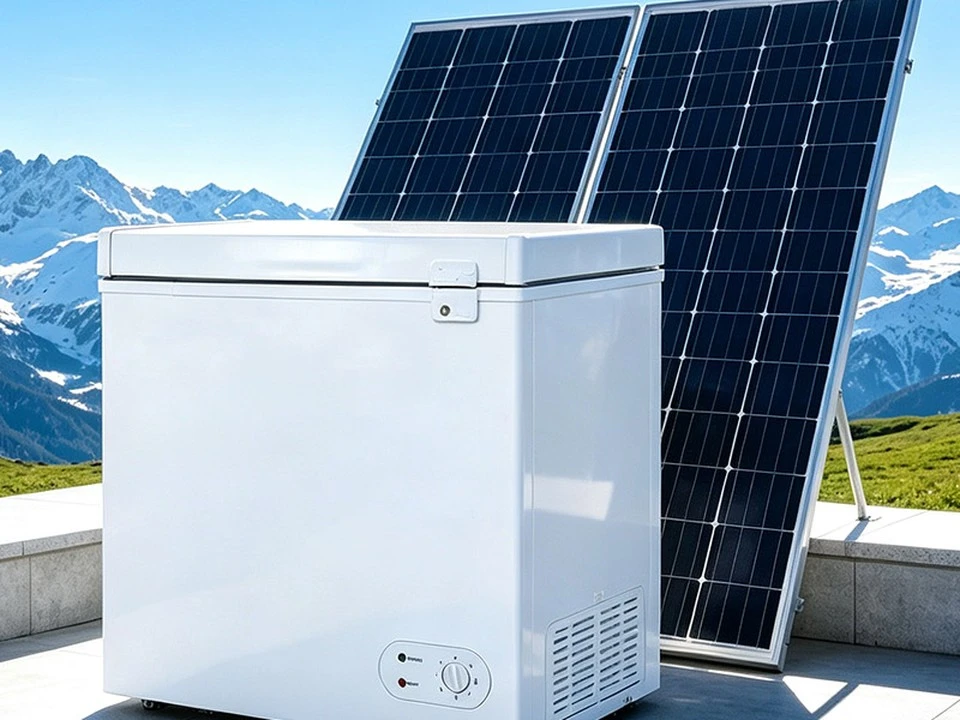
Sum four: what one unit costs to move
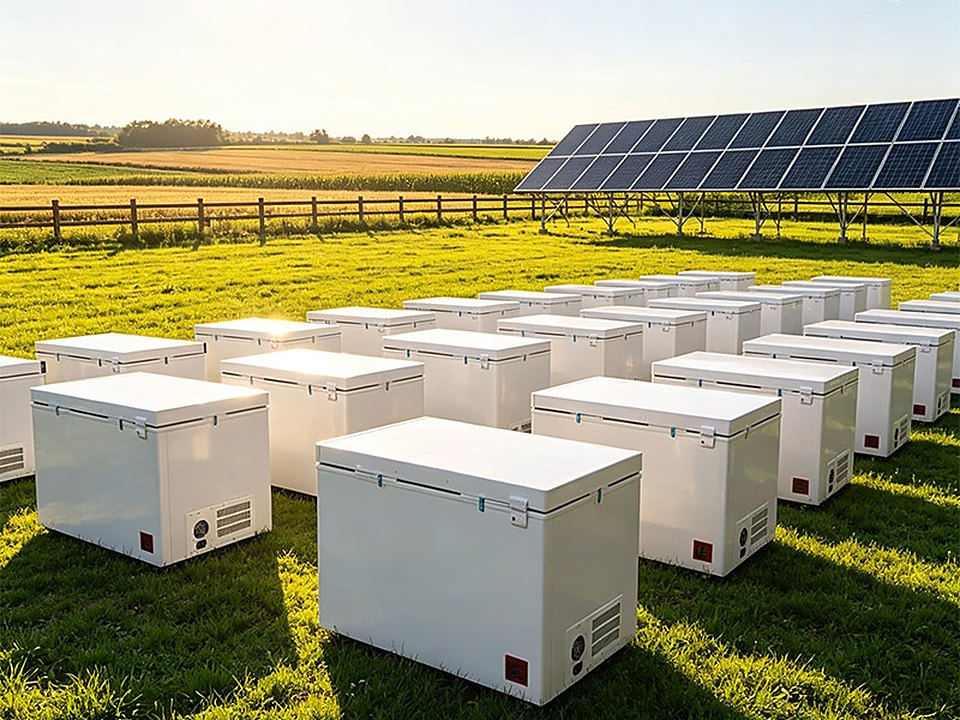
FREIGHT AT THE SMALL END - cartons, cubic metres and container maths
Each cabinet ships in a carton of 880 by 681 by 682 millimetres, which is 0.409 of a cubic metre, so a cubic metre holds two and a half cartons and a small consolidated order of twenty cabinets is a little over eight cubic metres. That is the number an LCL buyer needs before asking for a rate; the rest is weight, and at 38 kilos gross a carton you will run out of volume long before you run out of payload.
On a full container the arithmetic goes the other way. 132 cabinets fit a single 40 ft HQ container, which is 11,616 litres of cold volume in one box - for a product this small that is an unusual freight density, and it is the reason a distributor can put a container of 88s into a market where the big cabinets would never sell fast enough to justify one.
Two practical notes for a mixed order. The carton is small enough to travel with spares without re-planning the box, and the same box takes 68s and 108s: the 68 shares the footprint and the 108 stacks differently but loads at the same 153 units per container. A first order that mixes all three across a country is normal, and it usually beats a single-model box.
Sum five: fit, height and handling
THE MEASUREMENTS THAT DECIDE AN INSTALL - before the litres matter
The cabinet is 840 long, 661 deep and 640 high, and 34 kilos net. On a level floor one person can slide it; up a step, two people carry it comfortably, which is a different class of install from anything in our 65 millimetre range. The castors are small and they are for positioning, not for transport across a yard - if the route is rough, put it on a trolley.
Allow the rear face its gap. The condenser sits on the back of this cabinet, and a compact body pushed against a wall in a hot room is the classic reason a small freezer underperforms: the coil cannot shed heat, the duty cycle climbs, and the panel sizing worked out above stops being true. A hand's width is the minimum, a forearm is better, and the same applies above the cabinet if it sits under a shelf.
The lid needs its own room. It is a thick slab and it lifts and stands up, so nothing should be mounted directly above the front half of the cabinet; under a counter this is the detail that catches people out, and it is the reason we ask for the height of the space rather than only its width. Doorways are rarely a problem at this size: the body passes a standard 700 millimetre door frame with the carton off.
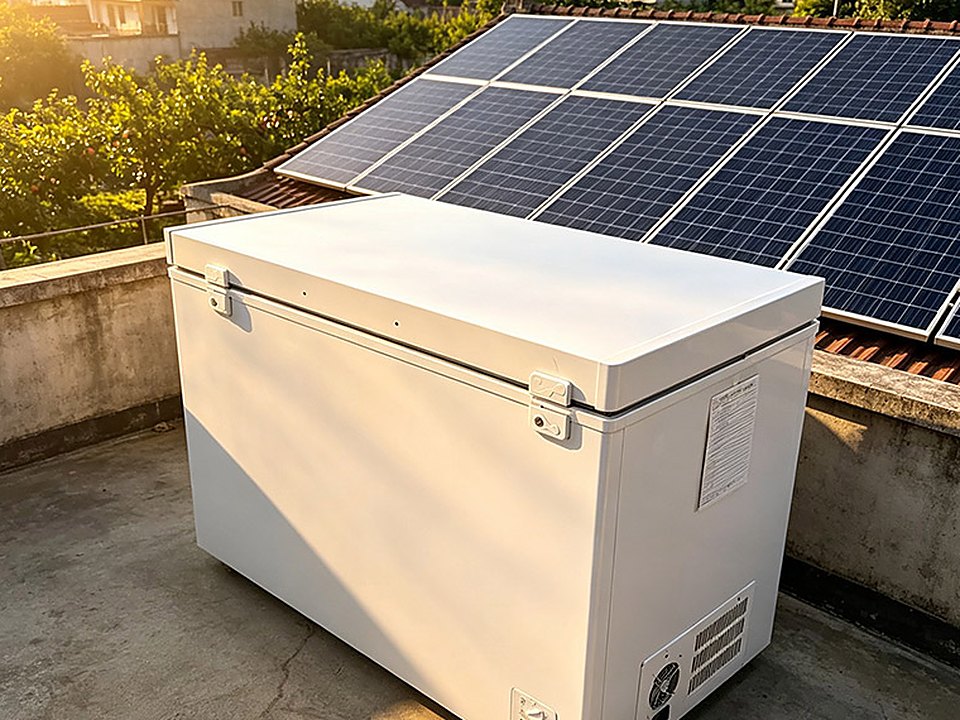
Where a cabinet this size earns its place
A village health post or a small clinic store, holding vaccines and ice packs where mains power is a few hours a day at best. A kiosk selling ice cream and frozen snacks, where 88 litres is a day and a half of trade rather than a week of stock. A pharmacy that needs a locked, temperature-stable cabinet behind the counter. A fishing boat or a safari camp, where the cabinet arrives in the back of a pickup and runs from the vehicle bank when it gets there.
It is also the cabinet for the places that cannot take a chest freezer: a room with a low free wall, a counter with 700 millimetres of clearance beneath it, a container shop where every centimetre of width is a shelf. And it is the model that suits a first order from a new distributor, because 132 units to a container means a small, cheap test of a market rather than a commitment to a fleet.
What it is not is a substitute for volume. A shop turning over 300 kilos of frozen product a day needs the 608 or the 798; the 88H would be opened continuously, would never recover, and would be blamed for the climate. We would rather say that here than sell the wrong box.
A day of stock, in eighty-eight litres
Eighty-eight litres sounds small until it is packed with a plan. The usable depth is the whole footprint, so the cabinet loads in one layer and nothing is buried: a basket at one end for the packs that move fastest, the bulk of the load spread flat across the floor of the box, and the lid closing on a surface that is level rather than heaped. A heap under a lid is the mistake that costs a small freezer its temperature, because the top packs press against the liner while the thermostat reads the wall behind them.
For a kiosk selling ice cream and frozen snacks, 88 litres is about a day and a half of trade, which is the right size: a stock that turns over quickly, a cabinet that is refilled from a store room rather than used as one. For a clinic, it is a vaccine load plus ice packs, and the packs go at the ends and along the walls where the cold is most stable, not on top of the boxes.
Pre-cooling earns its keep on a cabinet this size. Load a warm delivery into 88 litres and the whole box is above holding temperature within minutes; load it into a large cabinet and there is a cold mass around it to absorb the shock. So bring stock down in a cold room or overnight, keep the lids shut while the delivery is being sorted, and never leave the cabinet open while you look for a space.
Running it away from a wall socket
The 88H takes 10–50 V DC at the terminals, which means the same cabinet can be wired to a small solar bank at a clinic, to the 24 volt bank on a fishing boat, or to the auxiliary circuit of a vehicle. It does not need an inverter anywhere in that chain, and it does not care whether the bank is lead acid, gel or lithium, provided the voltage stays inside the window and the controller is set for the chemistry in use.
Cable is where small installations go wrong. At 12 volts a 39 watt load pulls 3.3 amps, and a long thin run between the battery and the cabinet will drop enough volts to matter: keep the run short, use a cable rated above the current rather than at it, and fuse at the battery end. The cabinet will run on a reduced voltage, but it will run longer, and the extra running time is invisible until the bank goes flat on a cloudy week.
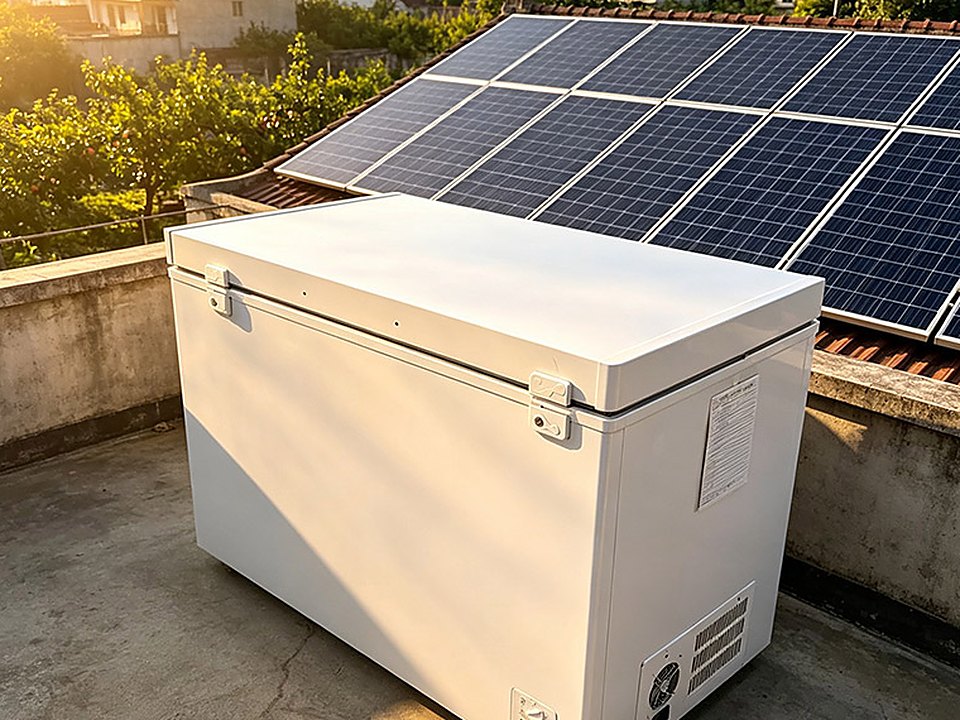
Position does more than any setting. A compact cabinet in direct sun on a metal deck or a concrete roof works against itself: the skin absorbs heat, the condenser has nowhere to dump it, and the draw climbs well above the nameplate. Shade the body, keep the back clear, and if it lives outdoors, give it a roof rather than a cover over the vents.
The details a repeat order comes from
FITTED AS STANDARD - and what it costs to leave them out
A key and a lock on the lid, which on a small cabinet is the difference between a stock item and a theft risk, and the reason clinics and pharmacies specify this model. An inner glass door over the load, so a customer or a nurse can see what is inside without lifting the lid and spilling the cold air - the cheapest efficiency upgrade on any chest freezer, and one that most suppliers leave out to hit a price.
A wire basket, a mechanical thermostat with a dial, manual defrost and a white painted body. Mechanical rather than electronic is deliberate: a dial has no board to fail in a humid room, it can be replaced with a screwdriver, and a local technician can calibrate it without a service laptop. Inner light is available as an option, and worth taking where the cabinet lives in a dim store room.
The service parts are catalogued the same way as on the large cabinets - gaskets, hinges, hasps, baskets, thermostats, fans and castors - because a cabinet in a clinic or on a boat is expected to last a decade and the parts list has to outlast the model year. Order them with the container; freight on one gasket bought later costs more than the gasket.
The plate, in full
| Field | BD/BC-88H |
| Description | Solar chest freezer, single lift lid, 110 mm super energy save body |
| Holding volume | 88 L gross |
| Cabinet envelope | 840 × 661 × 640 mm |
| Shipped envelope | 880 × 681 × 682 mm |
| Unit mass | 34 kg net, 38 kg gross |
| Foam thickness | 110 mm in the walls, the floor and the lid |
| Holding temperature | −18 °C and below, mechanical dial |
| Running draw | 39 W |
| Input voltage | 10–50 VDC, 12 V or 24 V bank, no inverter |
| Refrigerant | R134a / R600a, charged and sealed at the plant |
| Fitted | Key and lock, inner glass door, one wire basket, castors |
| Optional | Inner light, own label, destination-language manual |
| Defrost | Manual |
| Loadability | 132 cabinets in one 40 ft HQ |
| Delivery form | Built unit, or CKD / SKD kit for a local build partner |
Four rows on that plate carry the product. 110 millimetres is the specification; 39 watts is what it buys you in panel size; 640 millimetres is where it can stand; 34 kilos is who can move it. A receiving inspector will check the first, the fifth and the sixth rows with a tape and a clamp meter on arrival, and those are the three we would check too.
About the factory that builds the 88H
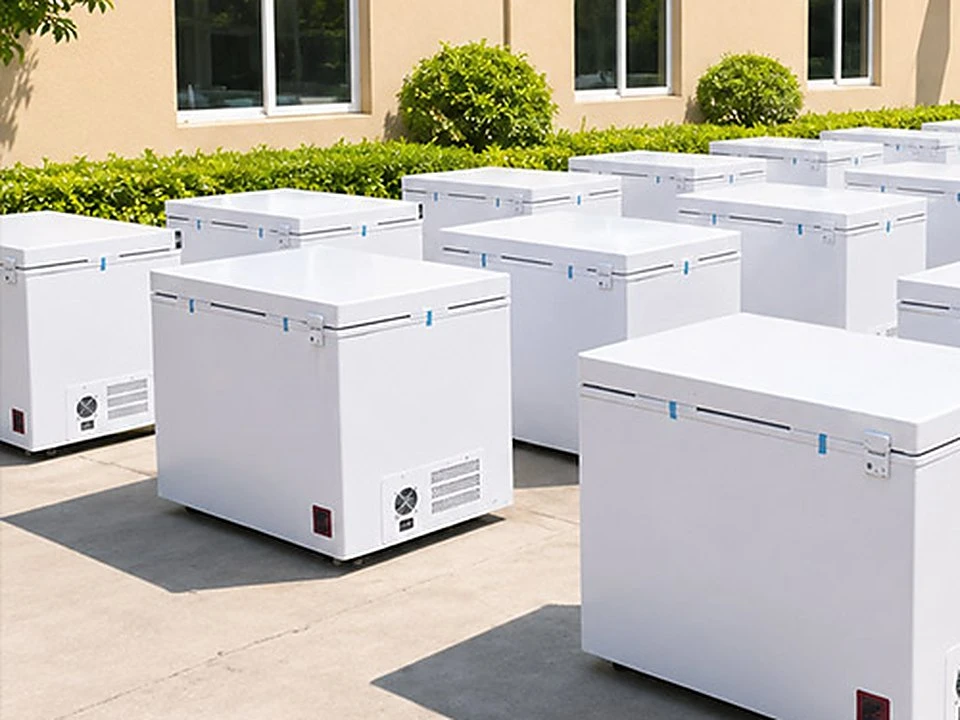
ZHEJIANG JUKA SOLAR TECHNOLOGY - the works behind this cabinet
Juka manufactures solar cold chain equipment in Zhejiang, China, and the catalogue is built on one idea: cooling that runs from a panel and a battery where mains power is absent, unreliable or too expensive to reach. The 88H sits at the small end of that range, below the 65 millimetre deep freezers that go from 608 litres up, and alongside the 68, 108 and 158 litre models that share its 110 millimetre body.
The reason a page on a small cabinet can talk about pour thickness, compressor draw and container counts is that the foaming, the panel assembly, the gas charging and the pull-down test all happen in our own shops. The tooling for lid, liner and frame belongs to the factory rather than to a supplier, which is also what makes a CKD programme possible: a kit is only as good as the factory that numbered its own panels.
Every unit is charged, leak tested, run and pulled down before it is boxed, and the reading from that pull-down is the one a receiving inspector should ask for on arrival: a cabinet that reaches holding temperature inside its stated time in a hot room is a cabinet whose gas charge and lid seal are right. It is a five-minute check and it saves a container of arguments.
Most of what leaves goes to sub-Saharan Africa, South and South East Asia, the Gulf and Latin America, to importers, project contractors, aid agencies and refrigeration distributors who service the cabinets in country. We build under our own label and as an OEM or ODM partner, with nameplates, manuals, packaging and documentation prepared for the destination market in the language it reads, and tenders are quoted with the technical file and packing list attached.
TELL US THE ROOM, NOT THE LITRES - the height of the space it must occupy, the width of the door it comes through, the bank voltage already on the floor, and the worst month of sun at the site. Those four answers decide whether an 88H is right, what array and battery it needs, and how many fit the container you are planning. If a taller cabinet would serve you better, the reply will say so.
Hot Tags: Portable Solar Freezer, China Portable Solar Freezer manufacturers, suppliers, factory


