


A Cabinet That Makes Ice In Batches - One Plate Stack, One Compressor, One Harvest, Repeated All Day
Ice is not a product you buy once. It is a batch you make, sell and make again, and the quality of the business depends on how many clean, dry, well-shaped blocks come out of the cabinet on a hot afternoon. That is the whole argument for a plate machine over an ice cube tray in a chest freezer: ten roll-bond plates hold ten trays of water at once, they are cooled directly by refrigerant rather than by air, and they release as a stack rather than one tray at a time.
The BD-198-10 is the tall version of that idea. Two hundred litres of cabinet on a 550 × 635 mm footprint, 1410 mm high, ten plate levels inside, a single door, a wire condenser on the back and a compressor at the bottom. It will run from 12 V or 24 V DC where there is no grid, or from 220 V AC where there is - the refrigeration circuit is the same, the electrical package is not.
Two things this page is going to be straight about. First, ice output is a function of water temperature, room temperature and how thick you cast the block, not a single number printed on a box. The factory quotes a cycle time for the tray set that ships with your order, and the honest way to plan production is to multiply that cycle by the number of plates you can actually turn over in a working day. Second, the ten plates are the capacity - the compressor is sized to pull the stack down once, not to freeze ten trays one after another in the same hour.
10 ROLL-BOND PLATES |
198 L CABINET VOLUME |
−18 °C WORKING RANGE |
123 PER 40′HQ |
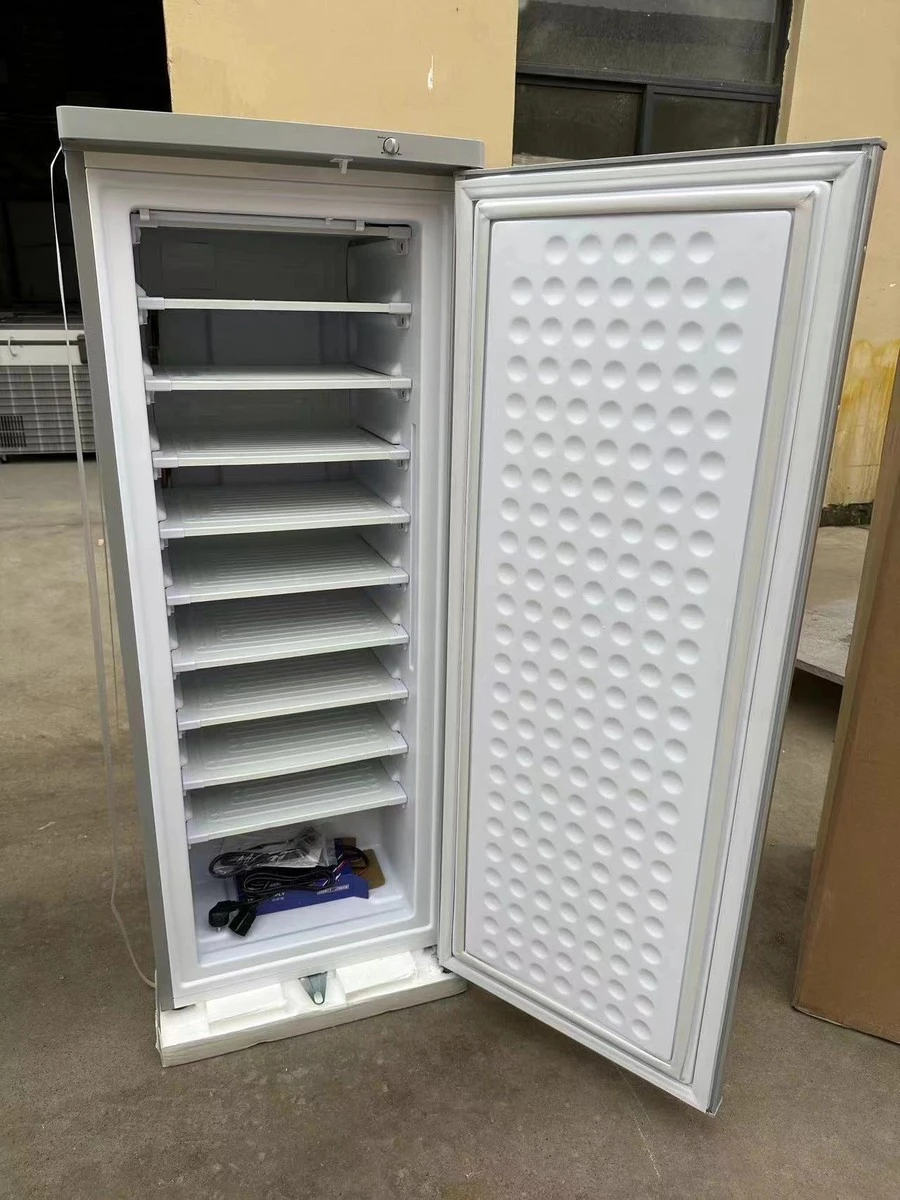
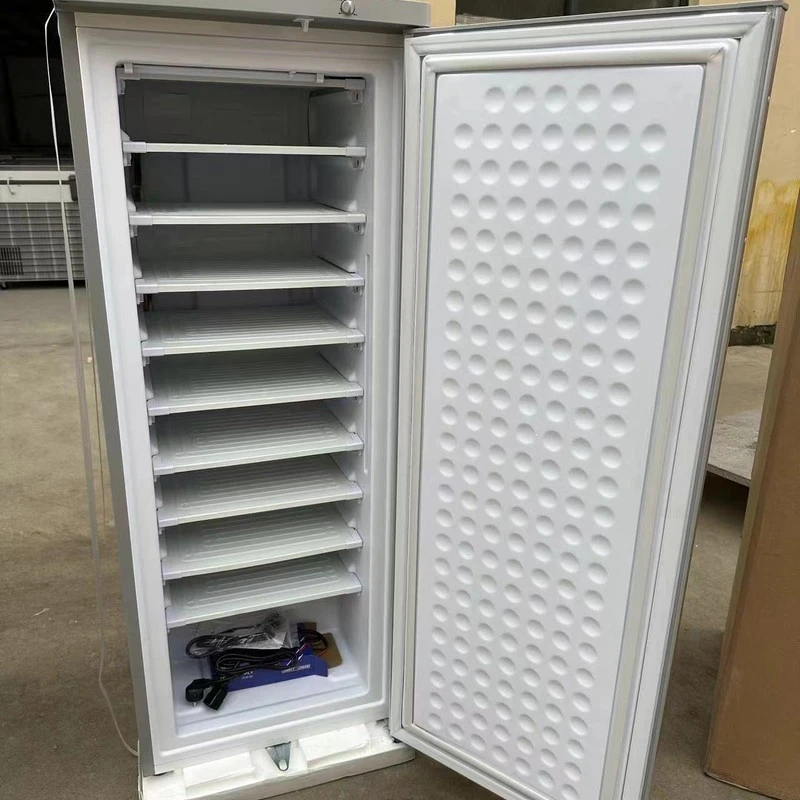
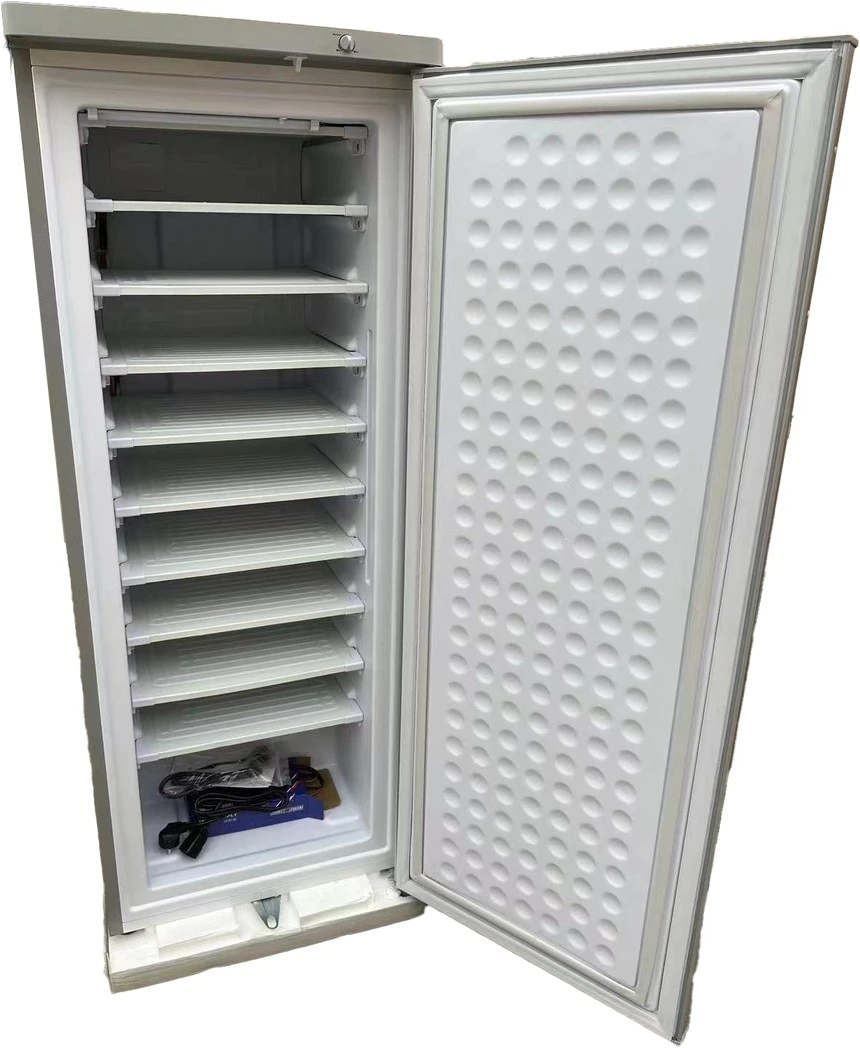
BD-198-10 with the door open on the factory floor: ten plate levels, the roll-bond evaporator visible as the dimpled liner on the inside of the door, and the compressor compartment below.
What Ten Plates Buy That One Big Freezer Does Not
A chest freezer full of ice is a storage problem. A plate machine is a production problem, and production is the thing that scales. Put the two side by side on the same floor and the difference is not litres, it is throughput: the freezer holds whatever you bought; the plate stack holds water that becomes stock on the next cycle.
The arithmetic of the cabinet is unusually clean. The footprint is 550 × 635 mm, about 0.35 m², and the height is 1410 mm - taller than a chest freezer and shorter than a domestic wardrobe. Against the 88 litre version of the same design, which stands 845 mm, the ten plate model converts the extra 565 mm of height almost entirely into plate levels. On a floor area the size of a doormat it holds 198 litres of working volume and ten separate freezing surfaces.
That vertical stack is why the machine suits places where floor is expensive and ice is not: a shop counter in a market, a drinks stall, a small fish landing site, a kitchen back room, a clinic that needs cold packs. The cabinet can be pushed against a wall, plugged into the wall socket that is already there or wired to a battery bank that is already charging, and it does not take a second person to move it - 49 kg net is one person and a hand truck.
What the stack does not do is make the machine a continuous producer. Every plate level is a separate freezing surface but they share one evaporator circuit and one compressor, so the cabinet pulls down as a block. Load ten trays and you freeze ten trays; load three and you still run the same compressor. That single sentence should decide how you schedule production.
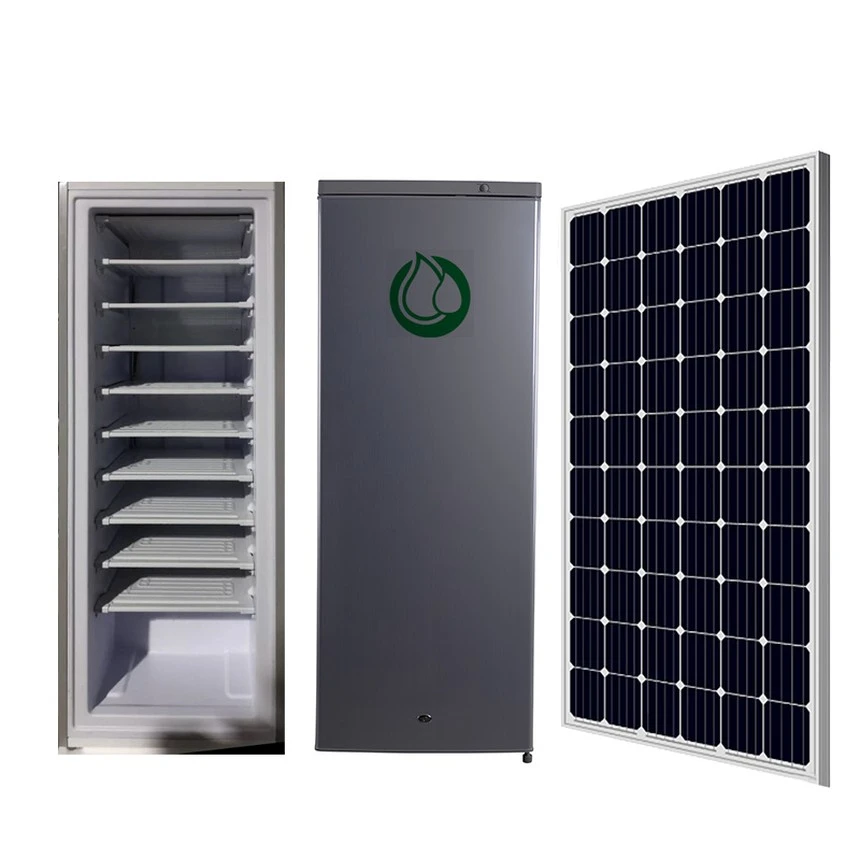
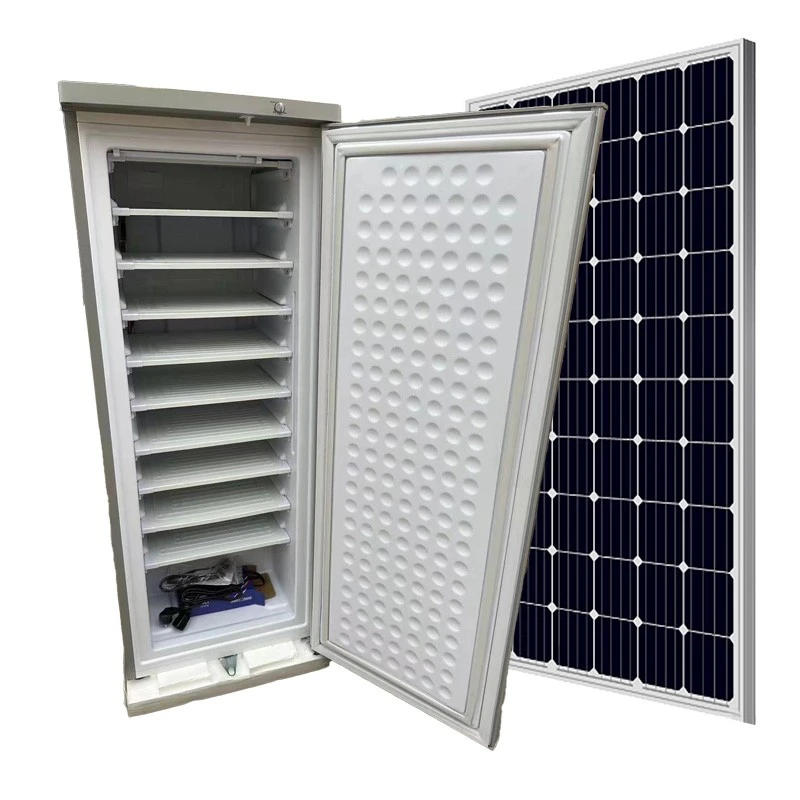
The same cabinet in three views: plate stack inside the open door, the closed body with the JUKA mark, and the PV panel that charges the DC version.
The Plate Is The Machine
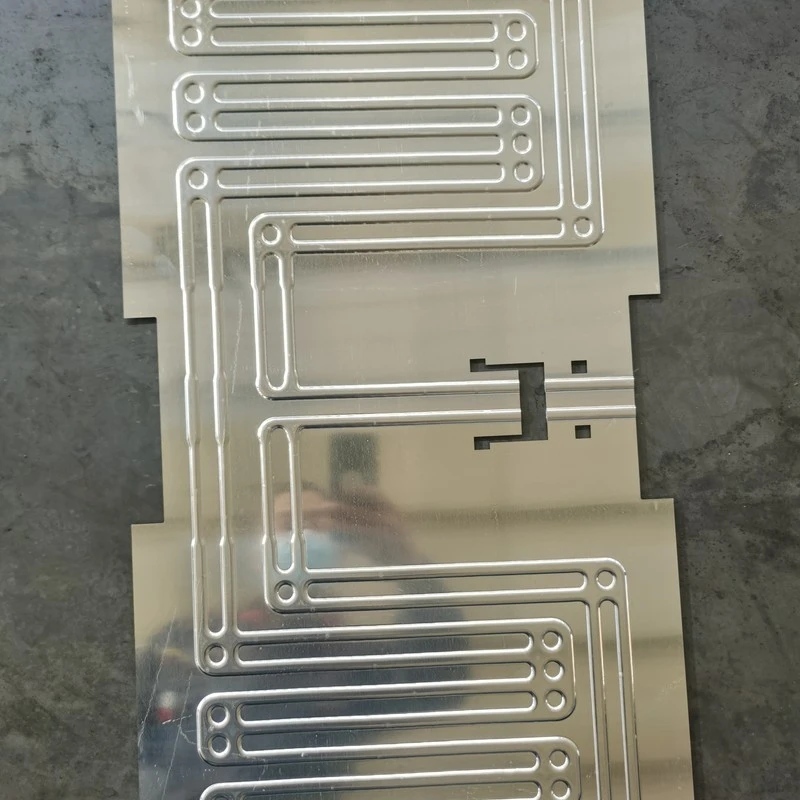
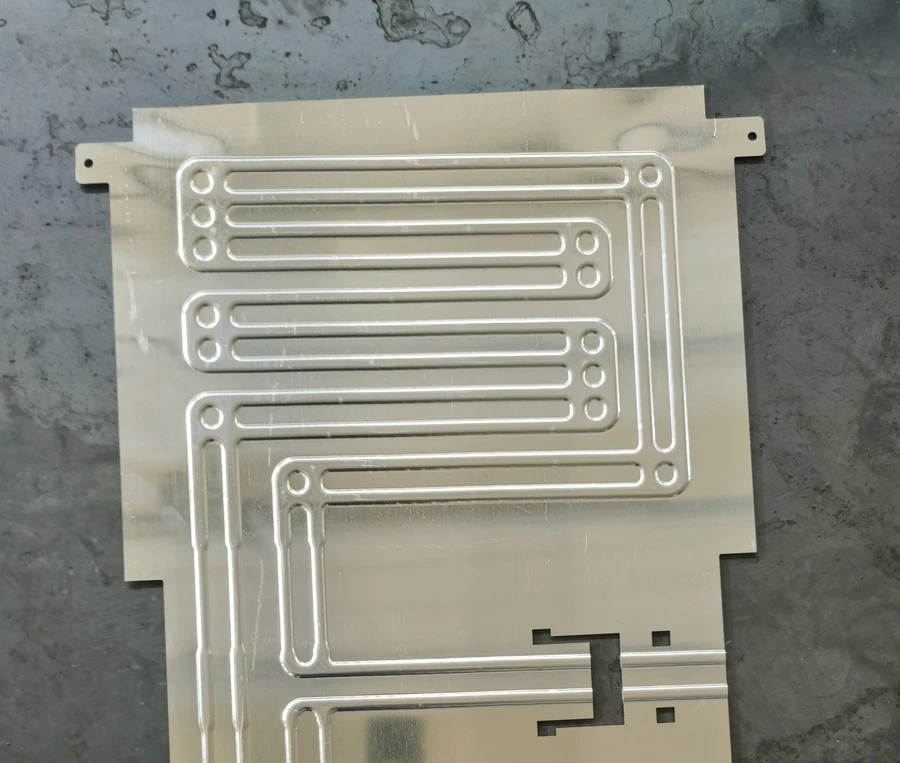
Everything else on this cabinet is a support structure for ten pieces of aluminium. A roll-bond evaporator is two aluminium sheets printed with a release pattern, rolled together, then inflated so the unprinted channels swell into a serpentine tube. Refrigerant runs through that tube; the flat plate around it becomes one continuous cold surface. There is no fin pack to clog, no fan to blow air across, no gap between the cold source and the tray.
The practical result is contact freezing. Water in a tray sitting directly on an inflated plate loses heat by conduction through the tray base, which is why the block freezes from the bottom up and why it releases cleanly when the plate is warmed for harvest. Air-cooled freezing has to chill the whole cabinet first and then wait for the block to give up its heat to that air. On a plate stack the cold goes where the water is.
It also explains the maintenance profile. There is no evaporator fan inside the food space, so nothing to seize, nothing to ice up into a block, and no air path to short-circuit when the cabinet is loaded badly. What does exist is the plate surface itself, and the rule for it is simple: do not scrape it. A plate that has been attacked with a knife or a chisel will still freeze water, but the tray will no longer sit flat, and a tray that does not sit flat freezes unevenly for the rest of the machine's life.
 |
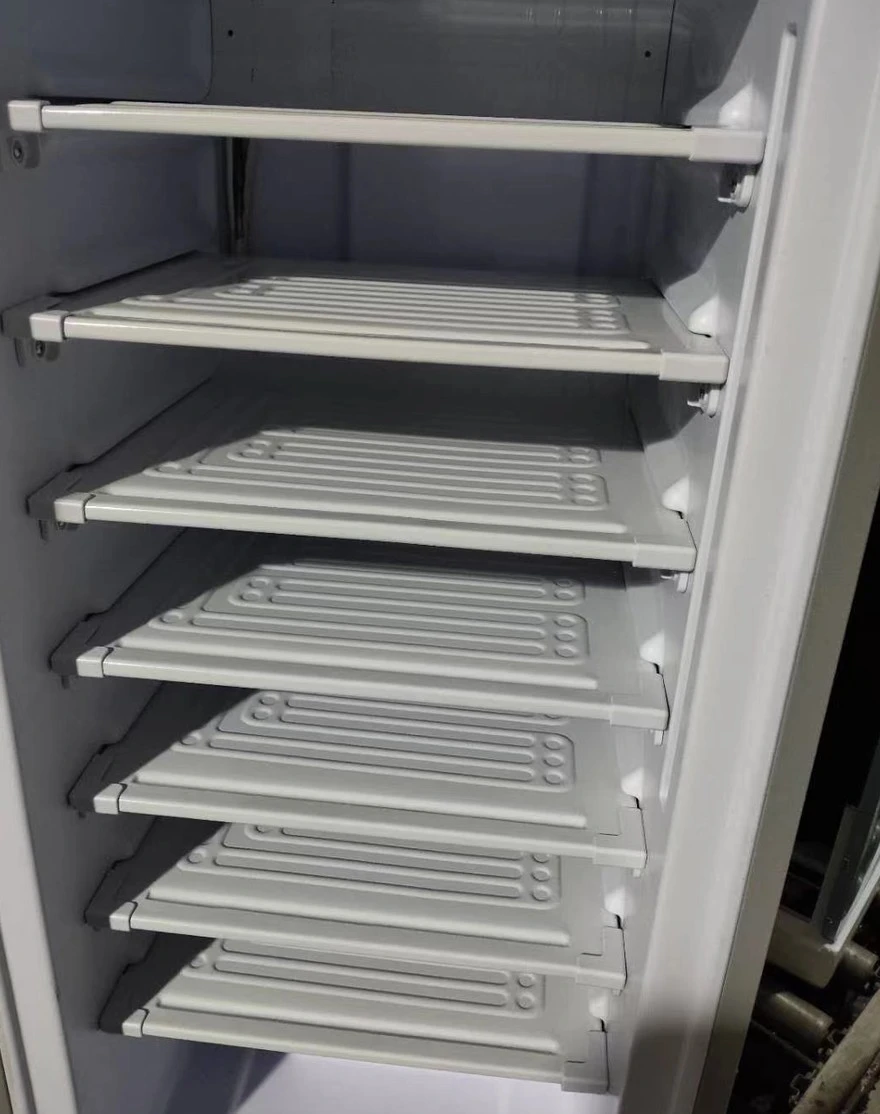 |
Left: a single roll-bond plate out of the cabinet, the serpentine channel visible as a raised line in the aluminium. Right: the same plates stacked at an angle inside the body, each one a separate freezing surface.
One Batch, From Fill To Release
Production on a plate machine is four moves repeated: fill the trays, freeze them, release them, take the blocks out. Everything that goes wrong in the field goes wrong in one of those four moves, and each has a habit worth knowing before the first batch.
Fill. Trays go in level, not full to the brim. Water expands as it freezes and a brim-full tray lifts its block into the plate above, where it welds itself to the aluminium. A 5 mm gap at the top costs nothing and prevents the single most annoying fault on this machine.
Freeze. The compressor runs until the block is solid to the centre. Thickness is the variable you control, and it is the one buyers underestimate: halve the block thickness and you more than halve the cycle, because heat has to travel out of the middle of the block and the middle is the slow part. Shops that sell ice by the bag run thin blocks on short cycles; shops that sell block ice to fishermen run thick ones.
Release. The plate is warmed for harvest, the block lets go, and the tray is lifted out. This is the moment the machine is most abused: prying with a screwdriver saves ninety seconds once and warps a plate permanently. If a block will not release, the plate has not warmed enough, or the tray was overfilled, or the tray base is no longer flat.
Take out. Blocks come off the plate wet. Drain them on a rack before bagging, otherwise you are selling water at ice prices and the bag freezes into a lump in the customer's freezer. A 10–15 minute drain on a slatted rack is the cheapest quality upgrade in the whole operation.
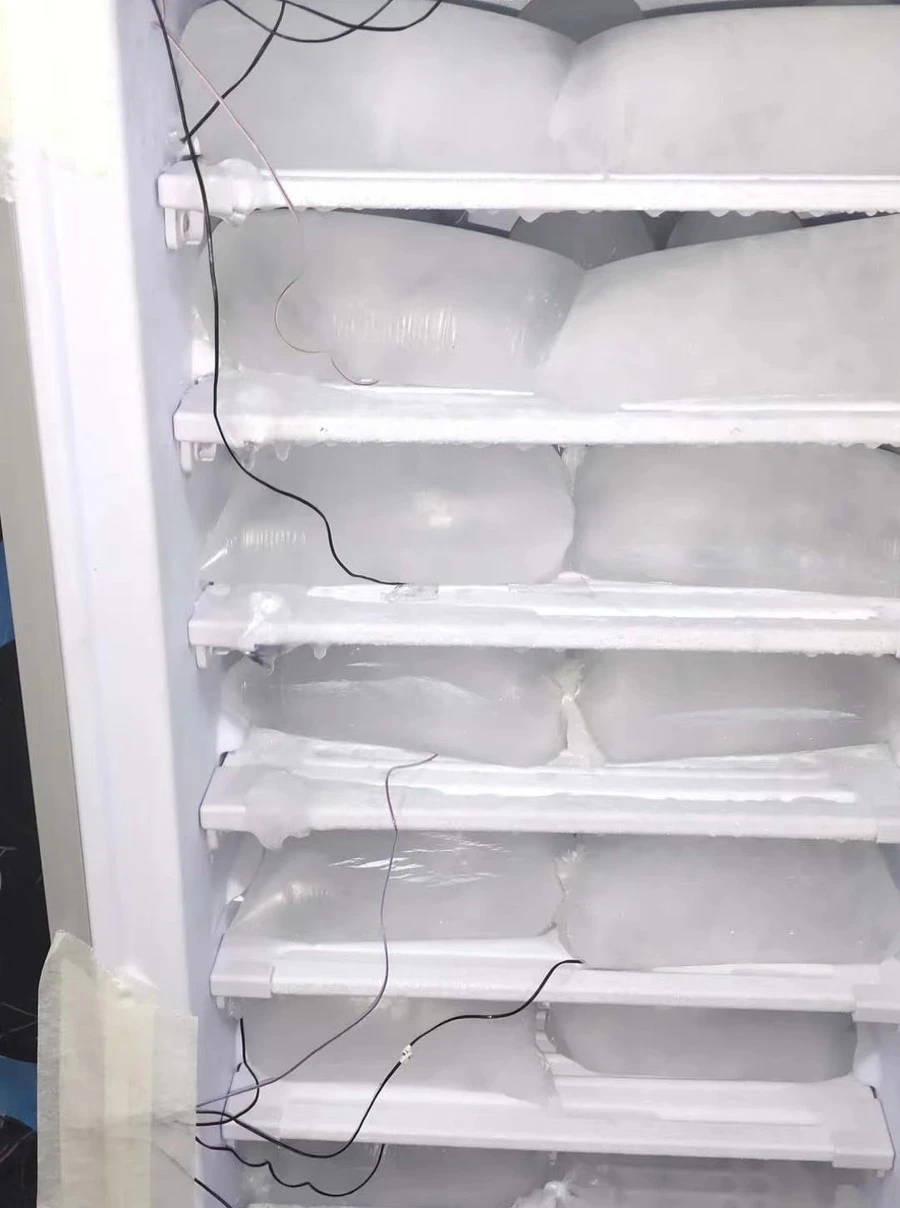
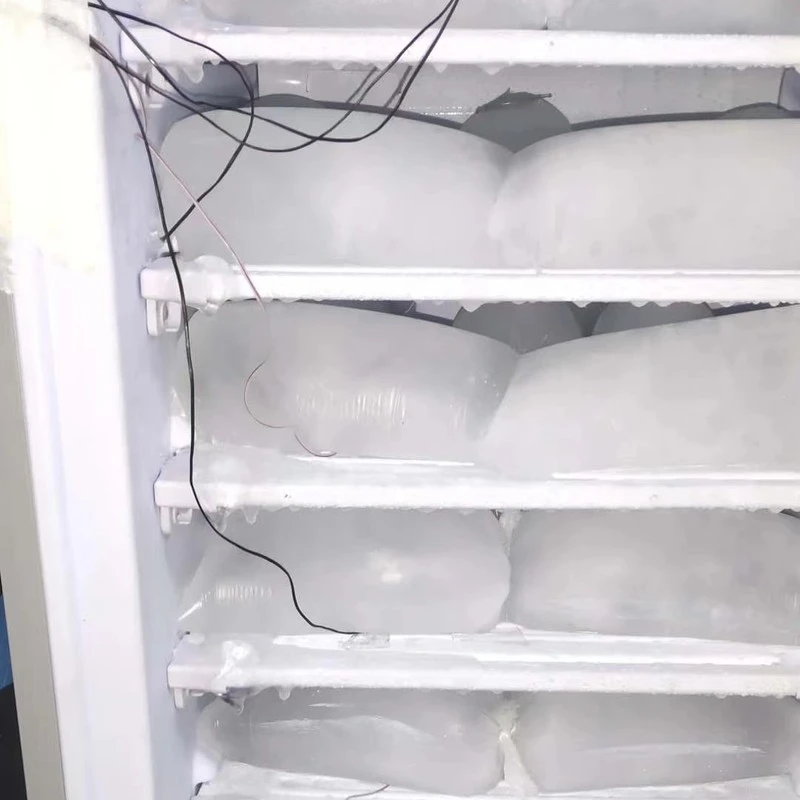
Ice formed on the plate stack: each level holds its own slab, released onto the plate below it as the cycle comes round.
Clear Ice, Cloudy Ice, And Why Buyers Judge With Their Eyes
 |
Two blocks frozen from the same water can look completely different, and the difference is dissolved air, not cleanliness. Water holds air in solution; as it freezes, that air comes out of solution and gets trapped, and a trapped bubble scatters light. That is the white core in the middle of an otherwise clear block. On a plate machine you have three levers. Start with colder water - it holds less dissolved air to begin with. Freeze from one side only, which the plate already does, so the air is pushed ahead of the freezing front rather than trapped in the middle. And do not stir: agitation puts air back in faster than the plate can push it out. A slow freeze gives clearer ice than a fast one, because the freezing front moves slowly enough for air to escape ahead of it. That is worth saying plainly: the setting that produces the most blocks per day is not the setting that produces the best-looking blocks. Decide which one you are selling. Hygiene matters more than clarity in most markets and costs nothing: potable water, a covered tray stack, a clean drain rack, and no ice scoop left standing in the product. The cabinet is a freezer, not a steriliser - whatever goes into the tray comes out in the block. |
12 V, 24 V Or 220 V - The Choice Is Made By The Cable, Not The Label
This model is built for 12 V / 24 V DC or 220 V AC, with R134a or R600a as the refrigerant depending on the build. Those are not three equal options with a different plug on the end. A compressor that pulls a ten plate stack down is a real load, and at 12 V the same power means roughly twice the current it means at 24 V. Twice the current through the same cable means four times the resistive loss and four times the voltage drop.
In practice: a 24 V installation tolerates a longer cable run from the battery than a 12 V one, and a 12 V installation is only comfortable when the battery is close - a vehicle, a cart, a small solar kit under the same roof. If the run is more than a few metres, the honest options are a 24 V system, a correctly sized DC converter, or the 220 V build with an inverter that is specified for the start current rather than the running current.
Where mains is available the 220 V build removes the battery entirely. It also removes a failure mode: no state of charge to watch, no low-voltage cut-out in the middle of a freeze cycle, no sulphated battery at the end of the second season. Sites that have a grid and a generator buy the AC build and use the generator for the compressor, not for a battery charger.
Rated input power and the ice yield per 24 hours are confirmed per build on the order confirmation, because both move with the compressor, the supply option and the tray set. This page will not print a wattage it cannot stand behind.
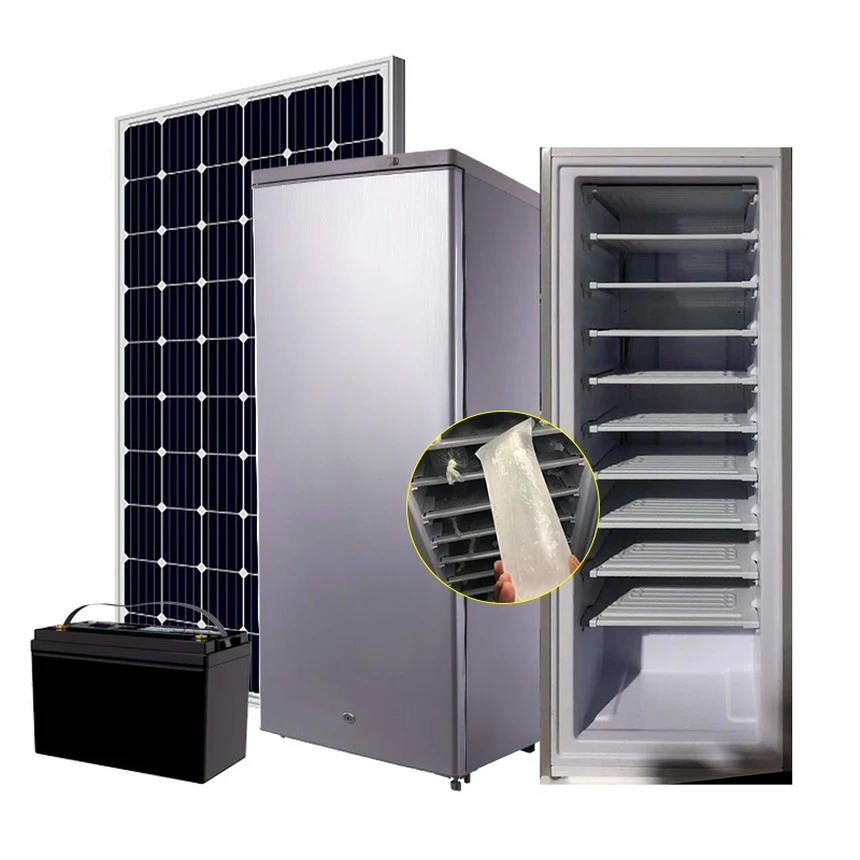
The DC build with its PV panel and battery: same cabinet, same plates, different electrical package.
The Back Wall, And The 100 mm Nobody Leaves
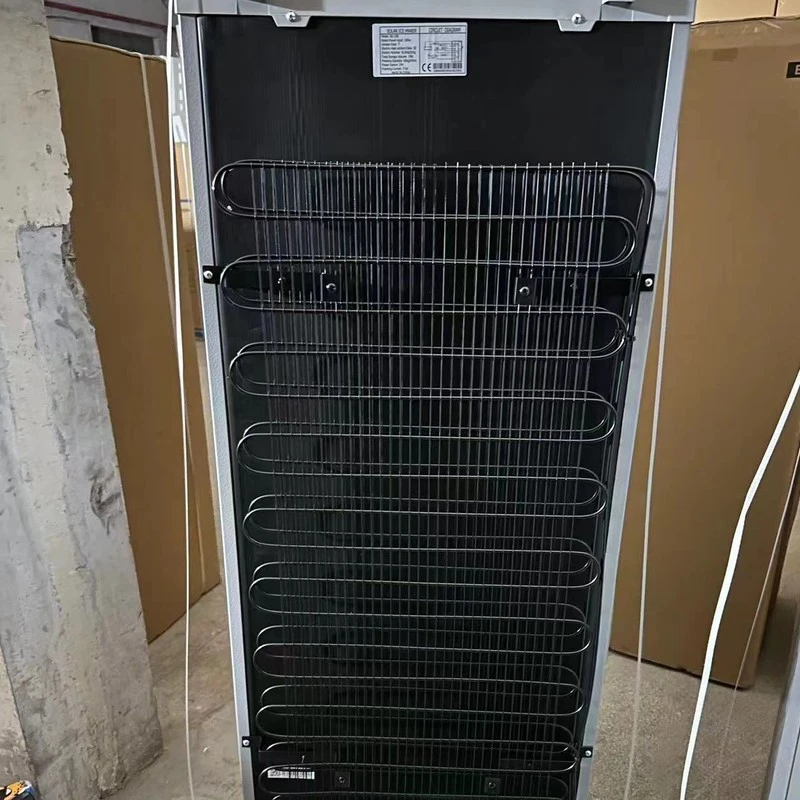
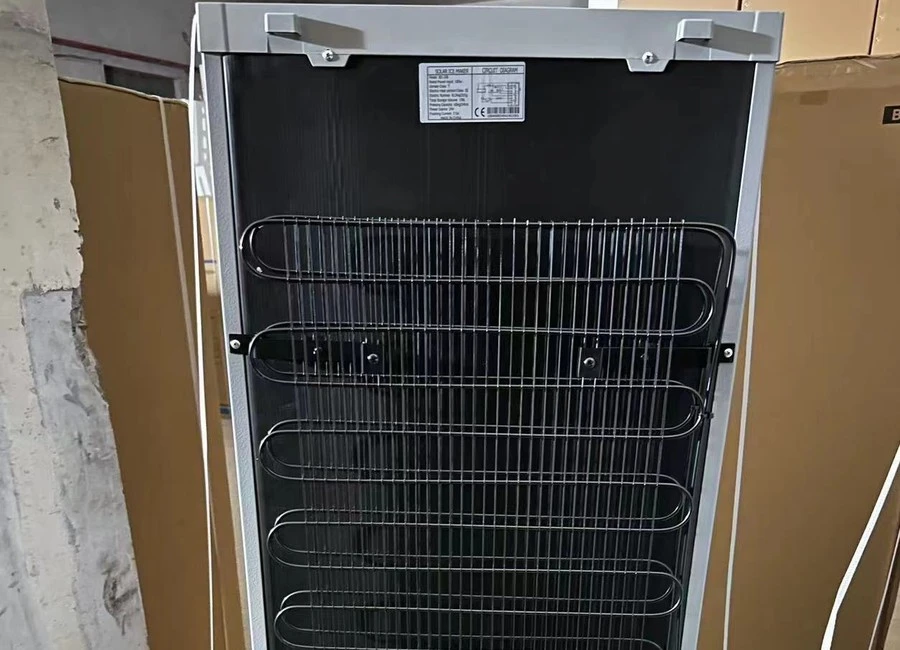
The condenser on this machine is an open wire coil on the rear face, not a hidden static condenser behind a panel. That is a deliberate choice for a machine that works in hot rooms: an open coil can be brushed clean in two minutes, and a clean coil is the difference between a compressor that keeps up in August and one that runs continuously and still loses temperature.
It also means the back of the cabinet is a working part of the installation. Pushed flat to a wall, the coil re-heats its own air, the head pressure climbs, the compressor runs longer, the ice comes slower and the electricity bill goes up. Leave a hand's width behind the cabinet, and treat that gap as part of the floor plan rather than something to negotiate on site.
The plinth does three jobs at once: it keeps wash water away from the compressor compartment, it hides the machinery behind vent slots, and it gives a 1410 mm cabinet a base that does not look like a box on wheels. The machine stands on levelling feet rather than castors, so the plates sit level - and level plates are what make trays sit flat, which is what makes blocks release cleanly.
 |
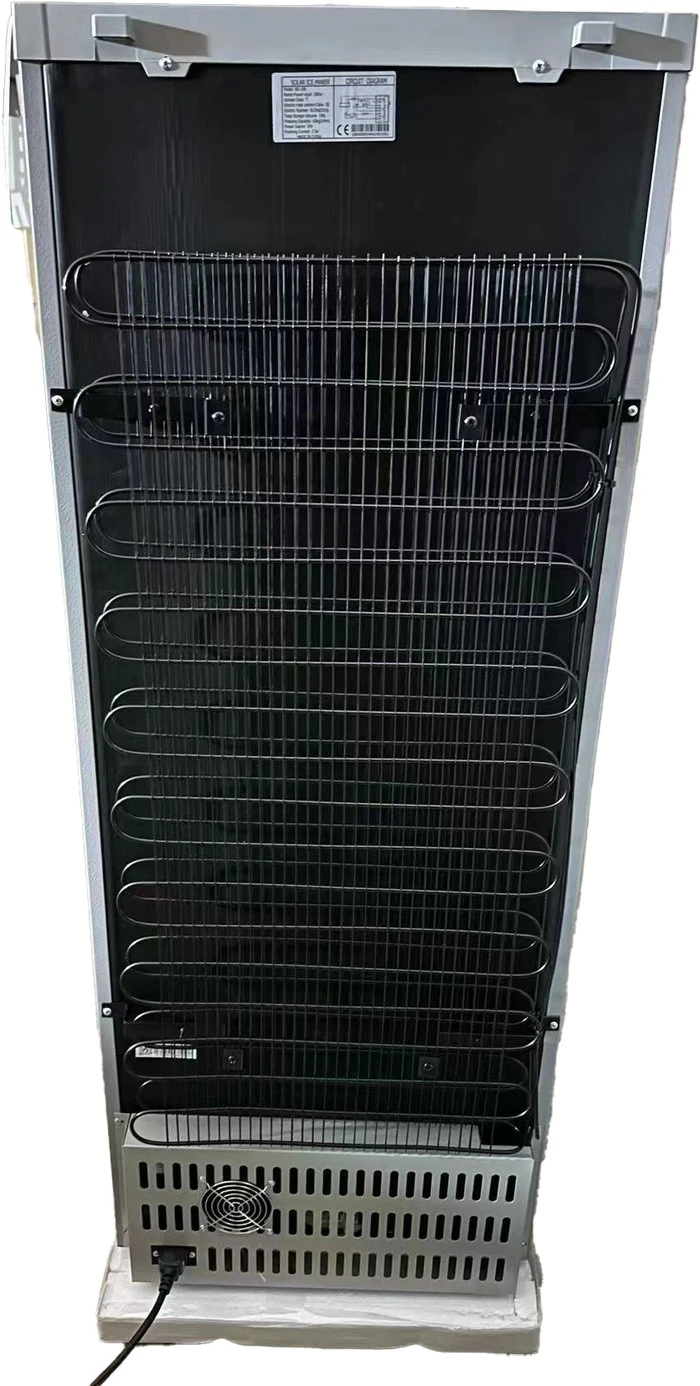 |
Left: the wire condenser on the rear face, in the factory, with the machine standing on its plinth. Right: the same rear assembly on a finished unit - coil, drain tray and compressor cover.
Where A Batch Machine Earns Its Space
A plate machine is bought by people who cannot rely on an ice supplier. That is the common thread, and it explains why the same cabinet turns up in seven very different rooms. What changes between them is the block thickness, the cycle setting and who takes the ice out - not the machine.
| Where | What the ice is for | What to get right |
| Drinks stall / kiosk | Ice for cups and cool boxes, sold or given with the drink | Thin blocks, short cycle, a drain rack you can reach from the serving side |
| Fish landing site | Packing fish for transport and display | Thick blocks, crushed after release, and a machine that can be run before the boats come in |
| Market butcher | Bedding display trays and keeping transport boxes cold | A covered stack and a strict scoop rule: ice never goes back into the cabinet once it has been out |
| Restaurant / bar | Backup supply when the delivery is late or short | Clear ice for drinks service, block ice for the cold room; two sizes out of one stack |
| Clinic / health post | Cold packs for vaccine carriers and injuries | Sealed packs rather than loose blocks, plus a written fill and release routine for staff |
| Ice reseller | Bags for shops and street vendors | Two cabinets rather than one: production never stops because a customer opened the door |
| Camp / remote site | Drinking ice and cold packs, off grid | 24 V rather than 12 V, panel and battery sized to the cycle, not to the label |
One machine, one setting per site. The block thickness that suits a fish landing site is wrong for a cocktail bar, and both are served by the same ten plates.
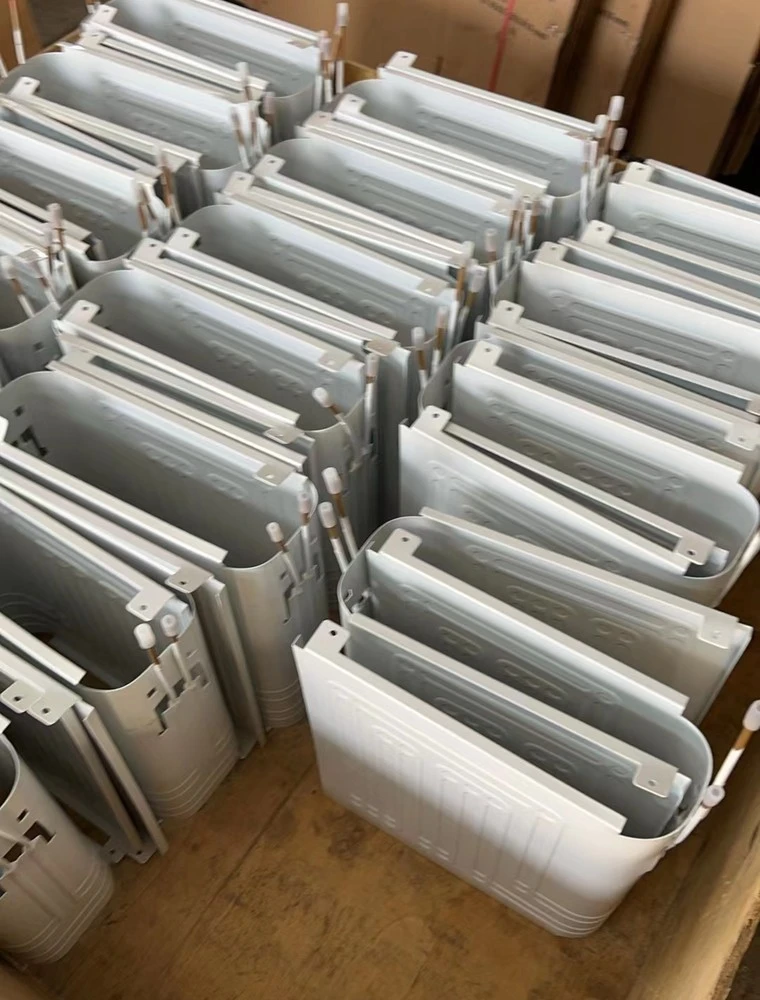
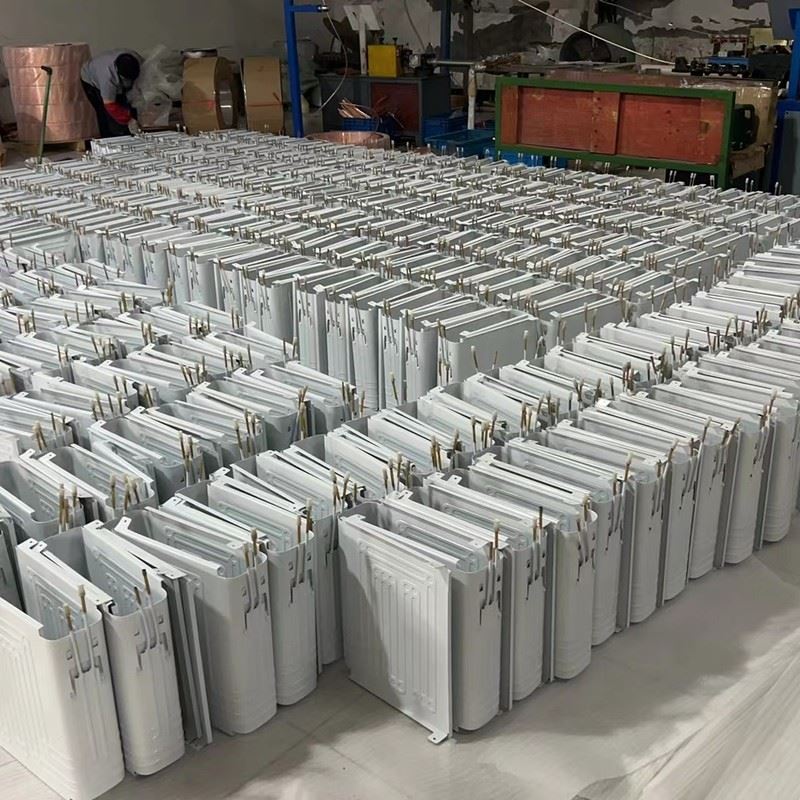
Freshly built plate stacks in the warehouse, each one pressure-tested before it goes into a cabinet.
Getting 1410 mm And 49 kg Into The Room
The cabinet is 550 mm wide and 635 mm deep, which is narrower than a domestic fridge and easier to route than most commercial equipment. The height is the constraint, not the weight: 1410 mm plus the door swing plus carton clearance means a doorway that clears 1.5 m and a corridor that turns.
|
Measure the route, not the door
Carton is 570 × 650 × 1465 mm. Steps, kerbs, a low beam over a back entrance and a tight turn at the top of a stair are what stop a delivery, not the doorway itself.
|
Stand it upright and wait
If the cabinet travelled on its side, stand it upright and leave it for at least four hours before switching on, so the oil drains back into the compressor.
|
|
Level it before the first tray
The plates are only as flat as the cabinet. Adjust the feet until the trays sit without rocking, then check again after the first cycle when the machine has settled.
|
Leave the back open
A hand's width behind the coil, and nothing stacked against the rear face. A machine that cannot reject heat will not make ice on the hottest day of the year - which is the day it matters.
|
|
Run it empty first
One full cycle with empty trays confirms the compressor, the thermostat and the harvest before you commit a day's water to it.
|
Write the routine down
Who fills, who releases, who drains, who cleans the coil. A batch machine fails from skipped routines far more often than from failed parts.
|
Four Things That Actually Go Wrong
Blocks that will not release. Nearly always overfilled trays or a plate that has not warmed enough before harvest. Check the tray line before blaming the thermostat.
Ice that stops forming in the afternoon. The rear coil is dusty or the cabinet is pushed against a wall. Brush the coil, move the cabinet out 100 mm, and the same machine recovers its cycle.
A wet cabinet and soft blocks. The door gasket has stopped sealing, warm air is being pulled in across the stack, and the compressor runs continuously. The paper test - a strip of paper trapped and pulled at several points around the door - shows which section has gone.
Cloudy blocks with a white core. Warm fill water, or a cycle set so fast that the freezing front outruns the air. Colder water and a slower setting, not a new machine.
123 Units, And Why That Number Matters To A Distributor
A 40′HQ takes 123 of these cabinets, cartoned. For a distributor that number is the whole commercial argument: one container is a full year of stock for a small dealer network, and the machine ships upright in a carton that stacks without a pallet frame. For an importer running mixed loads, the same 123 gives a loading plan that can be split between the 88 litre and 198 litre models without re-quoting the freight.
Protection in the carton is foam at the corners and a film wrap, because the two things that get damaged in transit are the door and the rear coil. Both are visible on arrival: check the door for square before signing, and check that the coil has not been pressed against the carton wall.
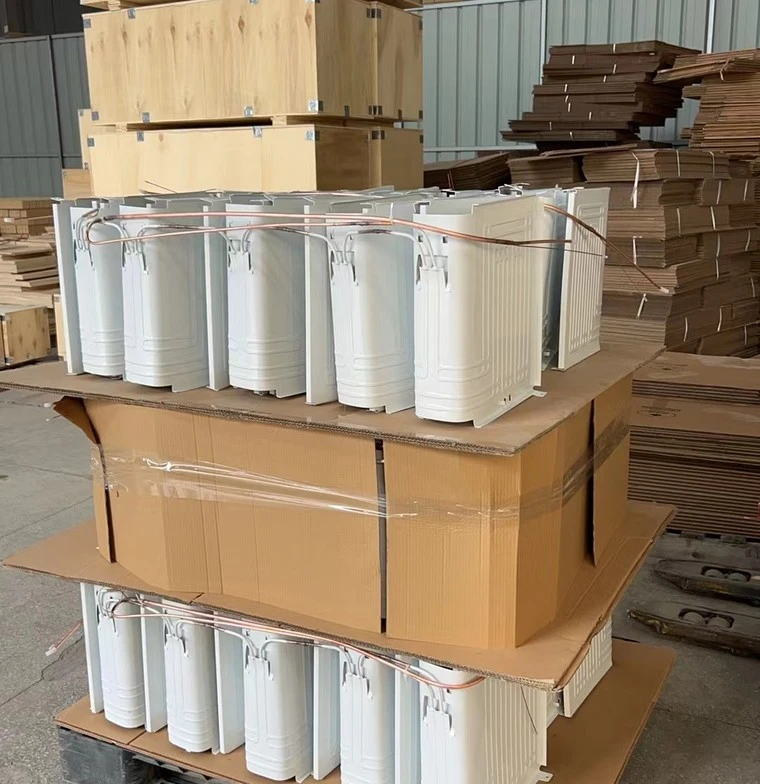
Cartoned units and plate stacks in the dispatch area, wrapped and stacked ready for a container loading plan.
Where The Plates Come From
The plate is the part that decides whether an ice machine lasts five years or fifteen, so it is worth knowing how it is made. Two aluminium sheets are printed with a graphite release pattern, rolled together and inflated under pressure until the unprinted channels swell into the serpentine that carries refrigerant. The pattern is what you see as a raised line on a finished plate, and it is why two plates from different suppliers can look identical and behave nothing alike.
Every plate is pressure-tested before assembly. A plate that leaks is not repairable in the field - the cabinet has to come apart - so the test happens at the factory, on the plate, before it becomes part of a stack.
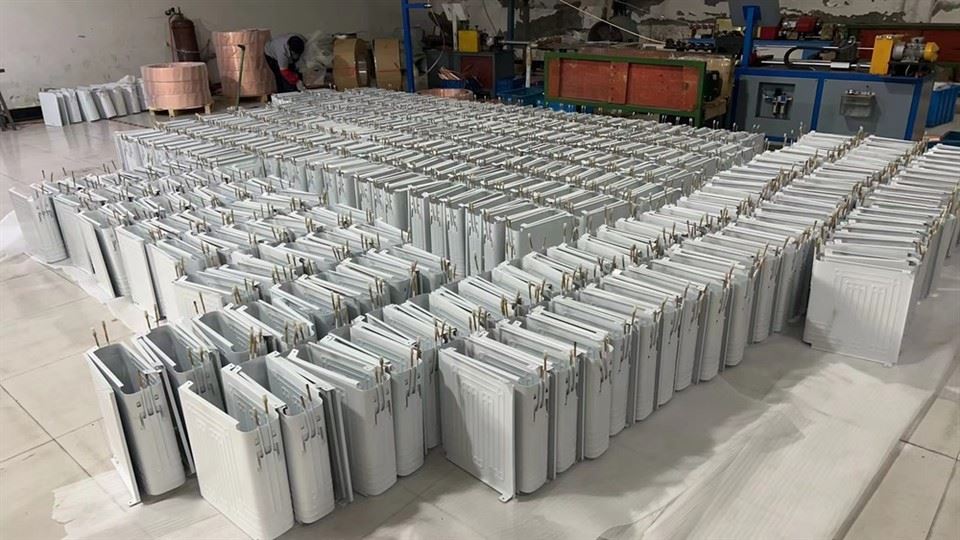
Finished cabinets on the floor before packing: the same plate stack, the same door, the same compressor layout, unit after unit.
Specification, BD-198-10
| Model | BD-198-10 |
| Type | Ice block making machine, single door, ten roll-bond plates |
| Plates | 10 levels of roll-bond (inflated) evaporator plate |
| Cabinet volume | 198 L |
| Temperature | Down to −18 °C |
| Product dimensions | 550 × 635 × 1410 mm (W × D × H) |
| Carton dimensions | 570 × 650 × 1465 mm |
| Gross / net weight | 52 kg / 49 kg |
| Power supply | 12 V / 24 V DC or 220 V AC |
| Rated input, ice yield | Confirmed per build on the order confirmation |
| Refrigerant | R134a or R600a |
| Condenser | Open wire coil on the rear face |
| Cabinet | White liner, white door frame, single hinged door with gasket |
| Base | Plinth with levelling feet, vented compressor compartment |
| Loading | 123 units per 40′HQ |
| Options | Tray set and block thickness, body colour, voltage and plug, solar panel and battery package, packaging |
This cabinet is listed as BD-198-10 in our own catalogue and is offered here under the same designation. Volume, dimensions and power options are identical either way.
Before You Order: Six Questions Buyers Ask
Inside the factory that builds this system
|
Hangzhou Juka Solar Technology was founded in 2015 around one problem: putting solar energy, new energy and smart control to work inside a refrigeration circuit. The range has since grown from a single DC chest freezer to solar refrigerators, solar ice makers, mobile ice-cream carts, delivery tricycles and beverage retail carts - all of them exported, most of them to Belt and Road markets. The work does not stop at the container. Partners in Ghana, Gabon, Cameroon, Nigeria, Kazakhstan and India are supported in setting up their own local production for retail and delivery refrigeration, which is how a cold chain becomes permanent rather than a series of one-off shipments. For a solar system this matters more than for a mains-only freezer. Panel sizing, controller rating and battery capacity all depend on cabinet volume and site conditions, so the cabinet and the electronics are engineered together instead of being bought separately by the importer. |

|
What is decided before the cabinet is built
|
Wall thickness is a production parameter 65 mm or 110 mm foam is set on the foaming line, not assigned in a brochure. Insulation that is specified but not achieved is the usual reason a solar cabinet underperforms in its first hot season. |
One bill of materials Panel, controller, battery and cabinet are listed together, so the importer receives a system whose parts were sized against each other rather than sourced independently. |
|
Voltage as an order option DC input, AC adapter voltage, plug type and control panel artwork are selected per market on the same platform - no separate tooling run for a different destination. |
Repeatable on the second container Foam thickness, fittings and controller model are held per customer, so a follow-up order matches the first one instead of drifting. |
Certification and test documentation
CE marking covers the electrical arrangement, and utility model patents cover the cabinet and the direct-drive control layout. Documents travel with the order so they can be presented at customs and to institutional or tender buyers.

CE - low voltage and EMC |

CE - supplementary schedule |

Utility model patent - cabinet structure |
On the floor

|

|

|

|
Six control points behind every cabinet
01 |
Foaming runs inside a constant 20-23 °C room, so the foam quality does not shift with the season. |
02 |
Condenser and evaporator are nitrogen purged before any pipe joint is made, keeping the internal circuit clean. |
03 |
Vacuum is pulled to below 20 Pa. A unit that does not reach spec is never charged with refrigerant. |
04 |
Two leak tests per cabinet with an INFICON detector - one unpowered, one running. |
05 |
A constant-temperature test room confirms refrigeration parameters under identical conditions all year. |
06 |
Production and quality control are separate departments. Only cabinets signed off by a QC inspector are packed and warehoused. |
Machines on the line
Equipment |
What it gives the buyer |
Automatic laser cutting machine |
Consistent panel geometry, tight tolerances, clean edges |
Punch press and bending machine |
Repeatable cabinet forming from unit to unit |
Dual-gun high-pressure foaming machine |
Even density across the whole cabinet, no thin spots |
CACL high-precision filling machine |
Precise refrigerant charge on every unit |
INFICON high-sensitivity leak detector |
Finds leaks that ordinary detectors pass |
OEM, ODM and local assembly
Cabinet-only supply, private label, SKD and CKD shipments are all available, together with technical guidance for partners who would rather assemble locally than import finished units. Helping partners build their own refrigeration business is the part of the work that outlasts a single purchase order.
What can be changed on a standard order:
✓ Customer logo and cabinet colour
✓ Voltage options and plug type
✓ Packaging design
✓ Product configuration, baskets and fittings
✓ Panel, controller and battery included, or cabinet supplied on its own
Hot Tags: ice block making machine, China ice block making machine manufacturers, suppliers, factory


