


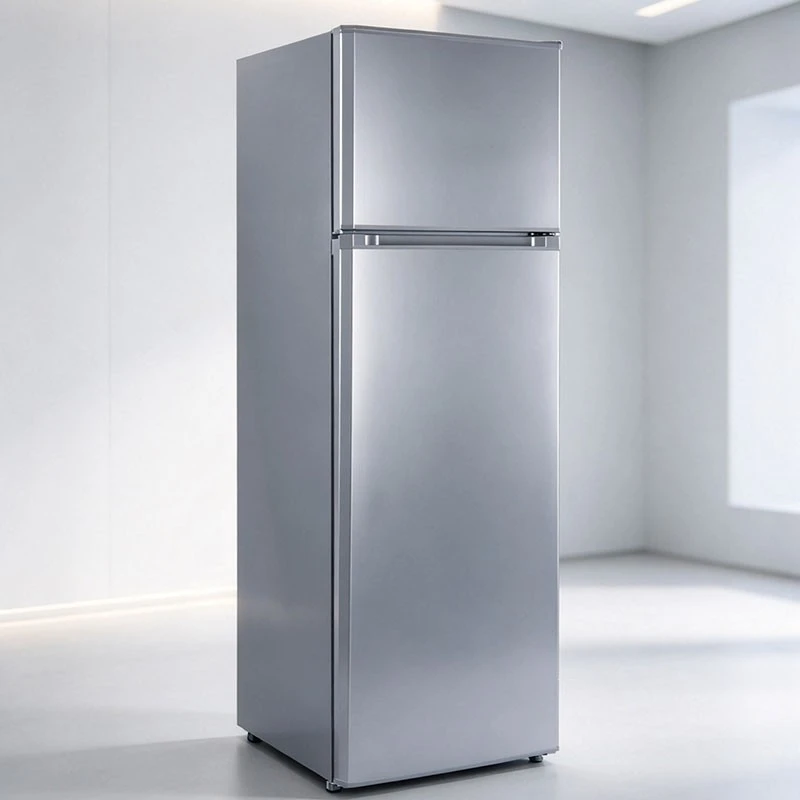
A standing refrigerator is the one appliance a household uses twenty times a day and thinks about twice a year. That is why the useful question about the BCD-268 is not how many litres it holds, but whether a family's ordinary week fits inside it. This cabinet answers with 268 litres split into a 216 litre fresh compartment held between 0 and 10 °C and a 52 litre top freezer held at -18 °C, running on a DC compressor rated 90 W that takes 12 V or 24 V straight from a battery.
It stands 1619 mm tall on a 550 × 570 mm footprint, which is the width of a standard kitchen gap rather than the width of a commercial unit. The body is steel plate, the doors close on magnetic gaskets, the thermostat is a mechanical capillary type, and defrost is manual. Nothing in the cabinet needs firmware, an app, or a service technician with a laptop.
The rest of this page is written as an owner's argument rather than a brochure: what the capacity actually holds, how to load it so the compressor is not asked to do work it cannot do, where it should stand in a house, and the three specific ways a solar refrigerator fails in the field - each of which is a wiring or loading problem before it is ever a refrigeration problem.
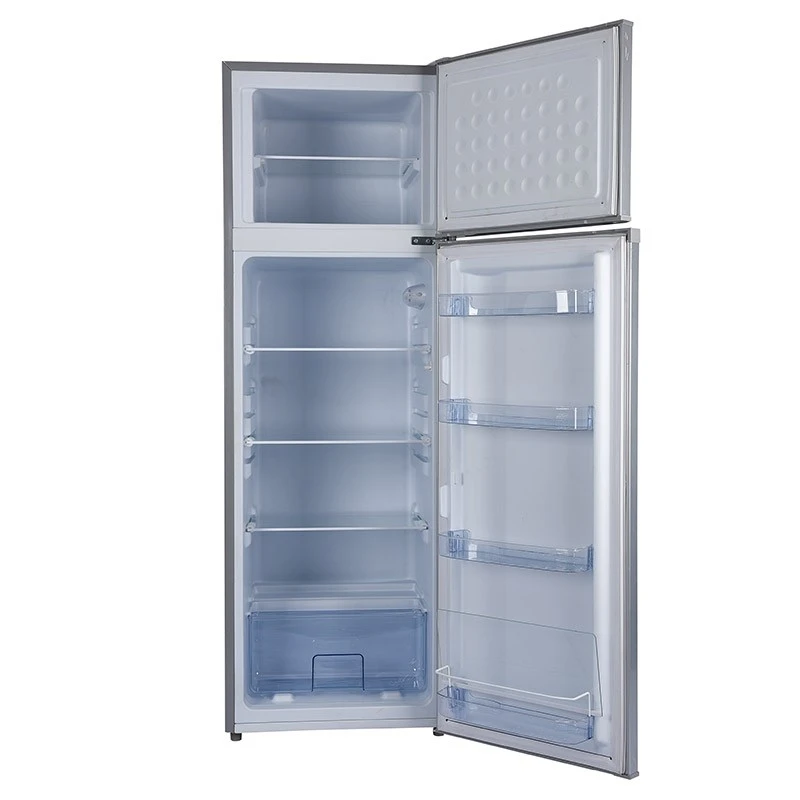
216 litres below, 52 litres above, one compressor. The divider between them is an insulated wall, not a plastic flap. |
What 268 litres means in foodLitres are a volume, and nobody shops in litres. The table below converts the two compartments into what a household actually puts in them, using a five person household as the reference.
In practice that is one large weekly shop plus a top-up: 216 litres of fresh food is a week to ten days for five people, and the freezer removes the need to shop for meat more than once a month. |
The 52 litre freezer is the smallest compartment and it works the hardestA top freezer in a household cabinet has an unfair job. It is opened less often than the fridge, but everything put into it arrives warm, and warm goods are the single largest load a compressor ever sees. Two habits decide whether the 52 litres behave like a real freezer or like a cold cupboard. Pre-chill before you freeze. A pot of stew at 60 °C carries roughly twenty times the heat of the same pot at 5 °C. Letting it spend the night in the fresh compartment means the freezer only has to remove the last few degrees, and the compressor runs for minutes instead of an hour. Freeze flat, stack upright. Meat and fish frozen flat then stacked like books leave air channels between packages. Cold air moving down those channels is what keeps the whole box at -18 °C instead of -12 °C at the front and -20 °C at the back. The wire rack lifts out in one movement, which matters more than it sounds: defrosting takes twenty minutes instead of an afternoon, and nobody is tempted to speed it up with a knife. |
The freezer box holds 52 litres and about 25 to 30 kg of frozen goods once packed flat. |
Loading discipline beats compressor size
Six rules, each one written because we have seen the opposite in the field. None of them cost anything, and together they are worth more than a bigger panel.
Do this | Because |
| Fill, but do not pack solid | A full cabinet holds cold better than an empty one; a packed one blocks the air path and cools unevenly. |
| Leave 20 mm behind the back wall | The evaporator is behind the liner. Goods pressed against it freeze and then thaw against the door. |
| Keep liquids on the door, not the top shelf | Heavy glass on a glass shelf is how shelves break; the balconies are designed for it. |
| Cover cooked food | Moisture from open dishes condenses on the evaporator and becomes frost within weeks. |
| Load in the morning, not at night | A morning shop lets the array carry the extra heat the same day instead of the battery carrying it overnight. |
| One door opening, one decision | Standing with the door open while deciding is the most expensive habit in any kitchen; every minute costs the compressor several minutes of running. |
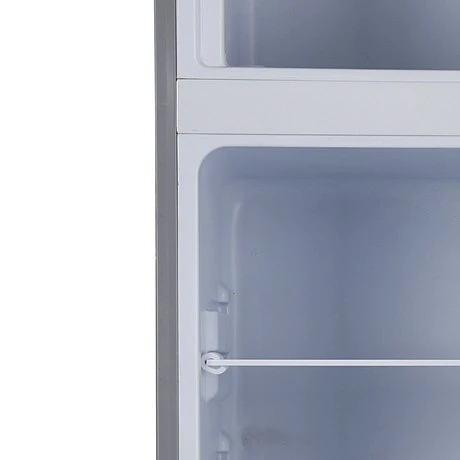
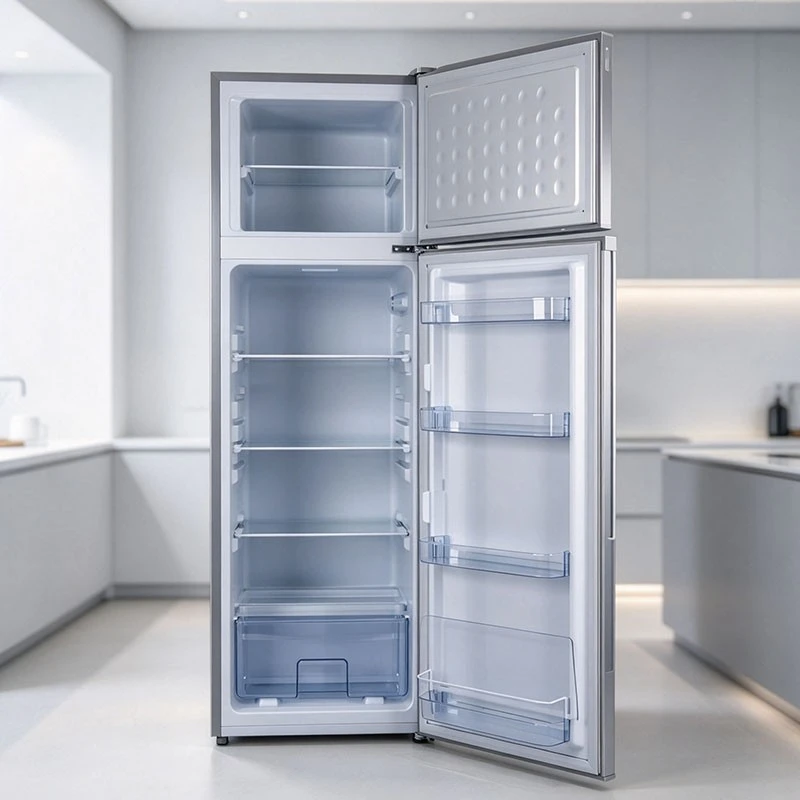
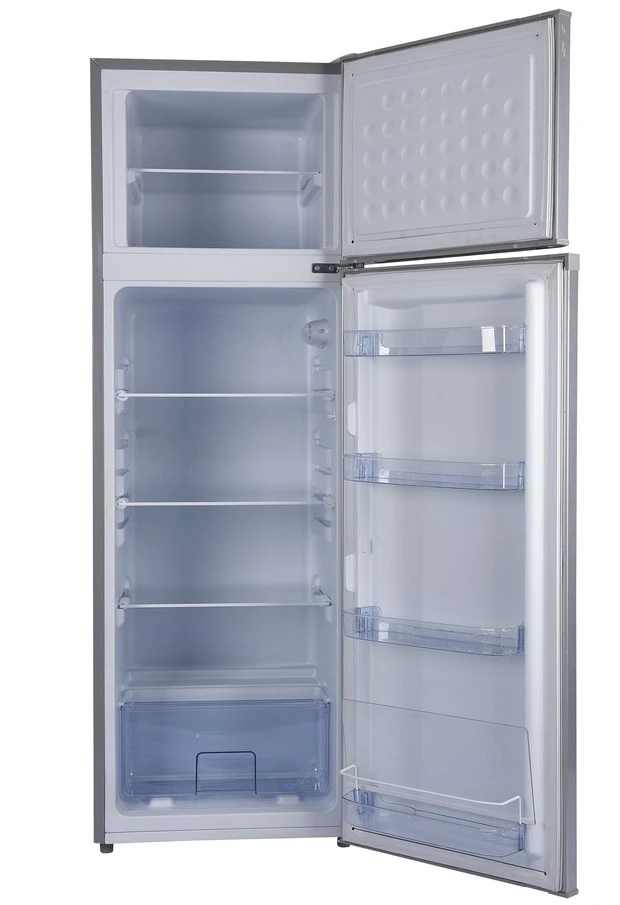
Three glass shelves, spill rims. |
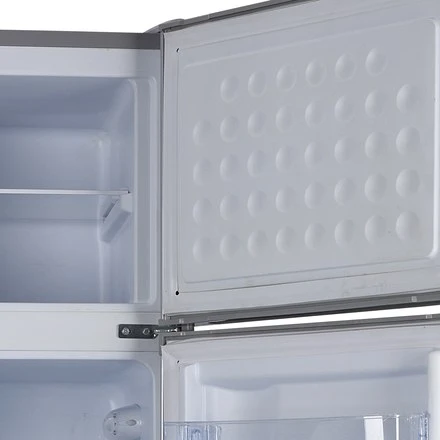
Four balconies with retainers. |
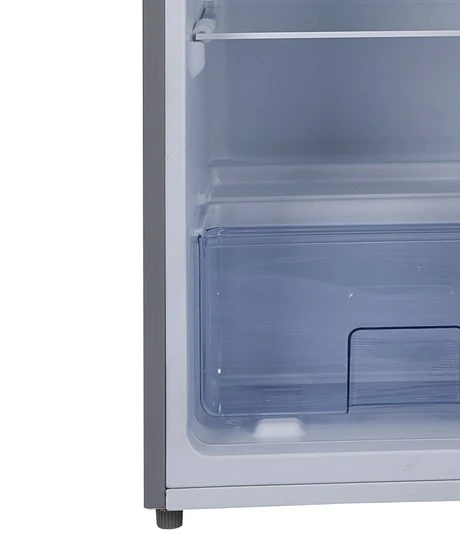
Full width crisper with cover. |
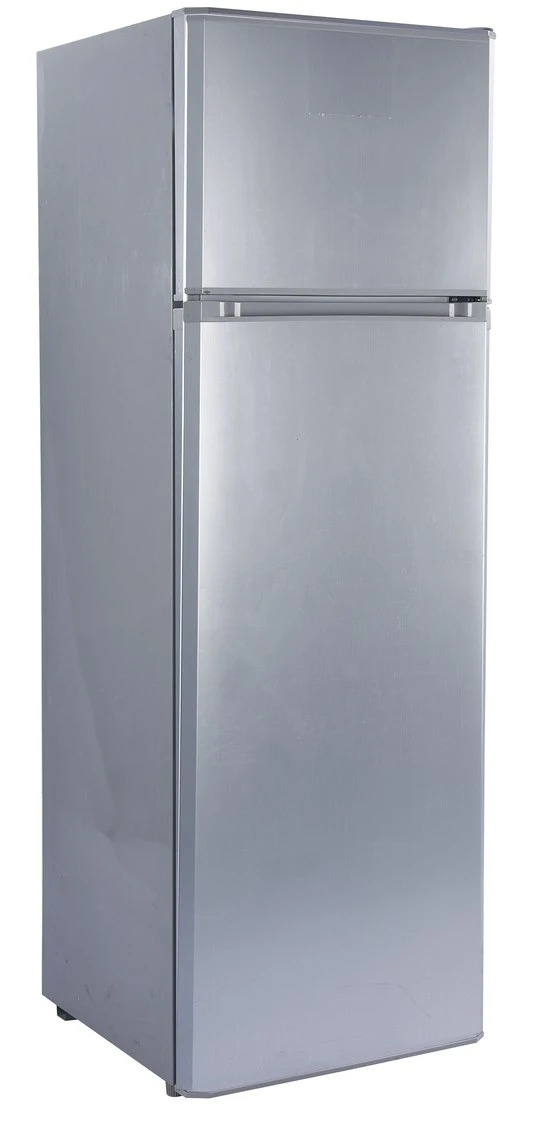
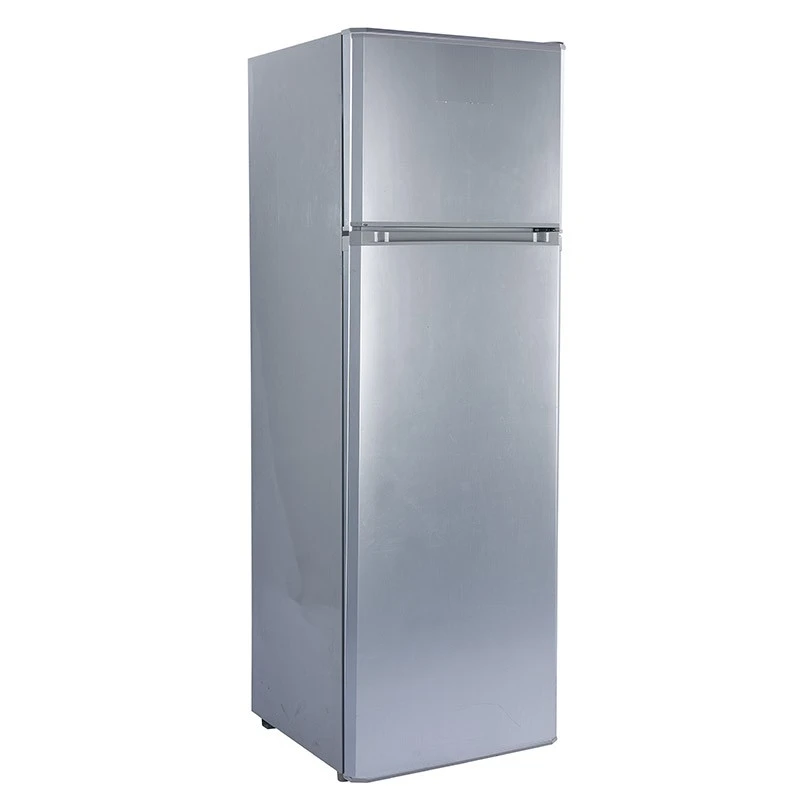
550 mm wide, 1619 mm tall. |
Where the cabinet standsA refrigerator removes heat; it has to put that heat somewhere. In a solar house the somewhere is usually a small room, which is why placement decides the duty cycle more than the insulation does.
Both doors open to the right as delivered and can be reversed at installation. The hinge covers come off with a flat screwdriver and the opposite holes are pre-punched, so a cabinet bought for one kitchen can be rehung for the next. |
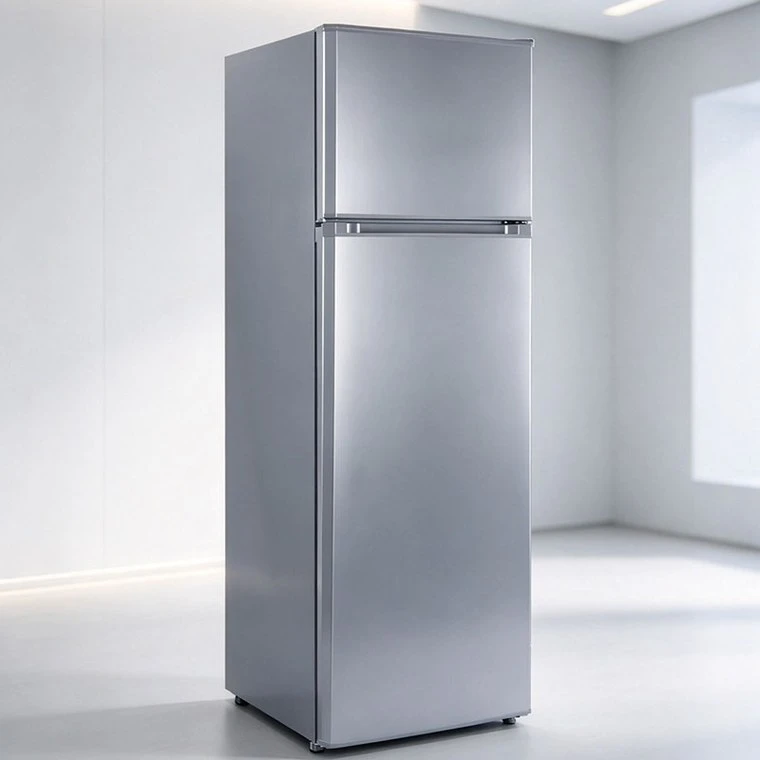
Free air behind the cabinet matters more than the room temperature. |
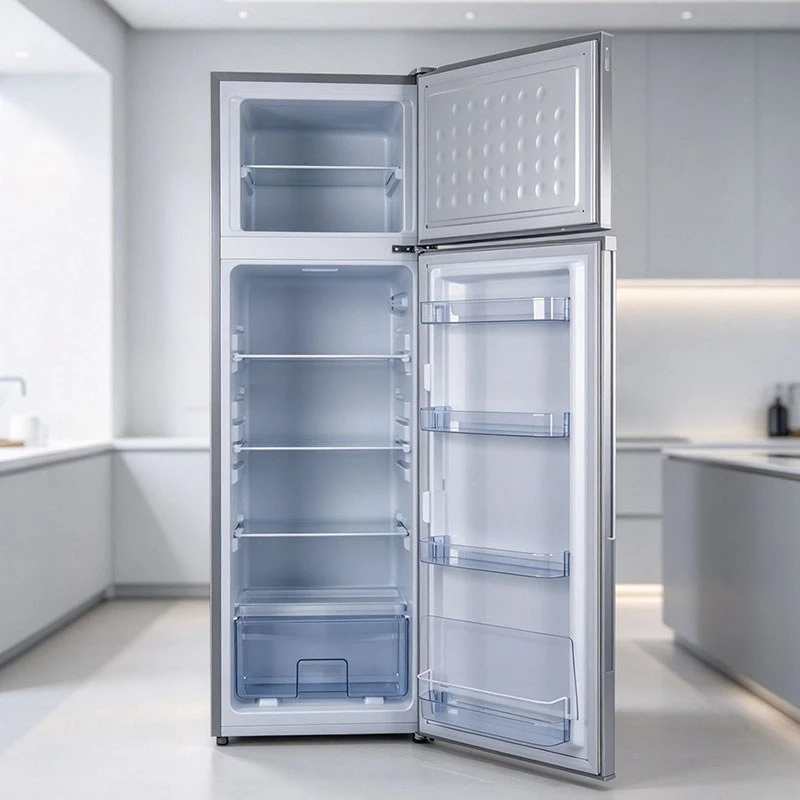
550 mm wide: it fits a standard kitchen gap without a specialist installation. |
A domestic footprint, a non-domestic supplyMost DC refrigerators on the market are either too small to be a household's only fridge or shaped like a commercial unit. The BCD-268 keeps the proportions of an ordinary kitchen appliance and moves the complexity into the electrical side, where it belongs. That means a 550 mm body, a 1619 mm height that clears standard wall cabinets, reversible doors, and a supply that accepts 12 V or 24 V without a converter box bolted to the wall behind it. |
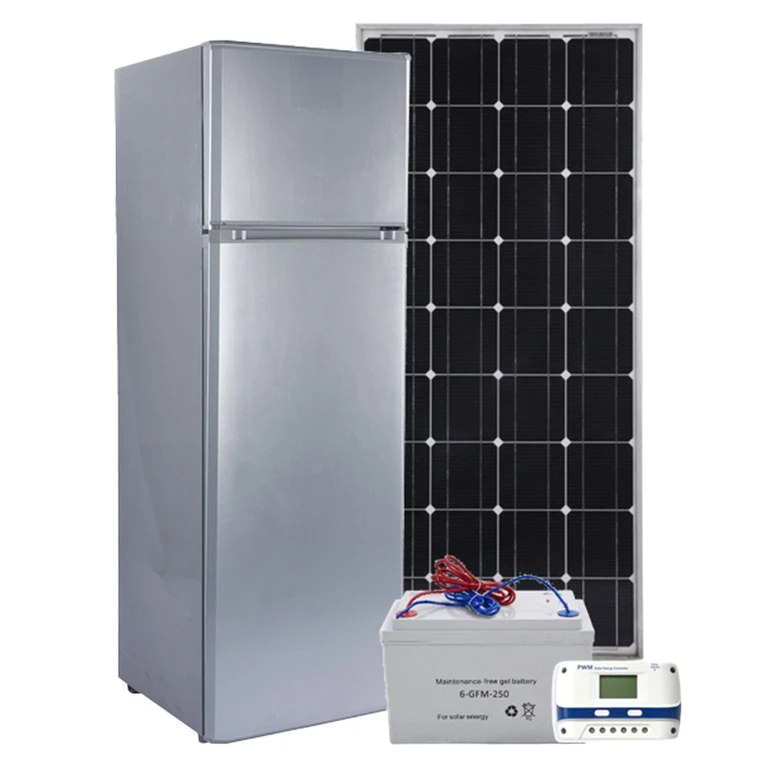
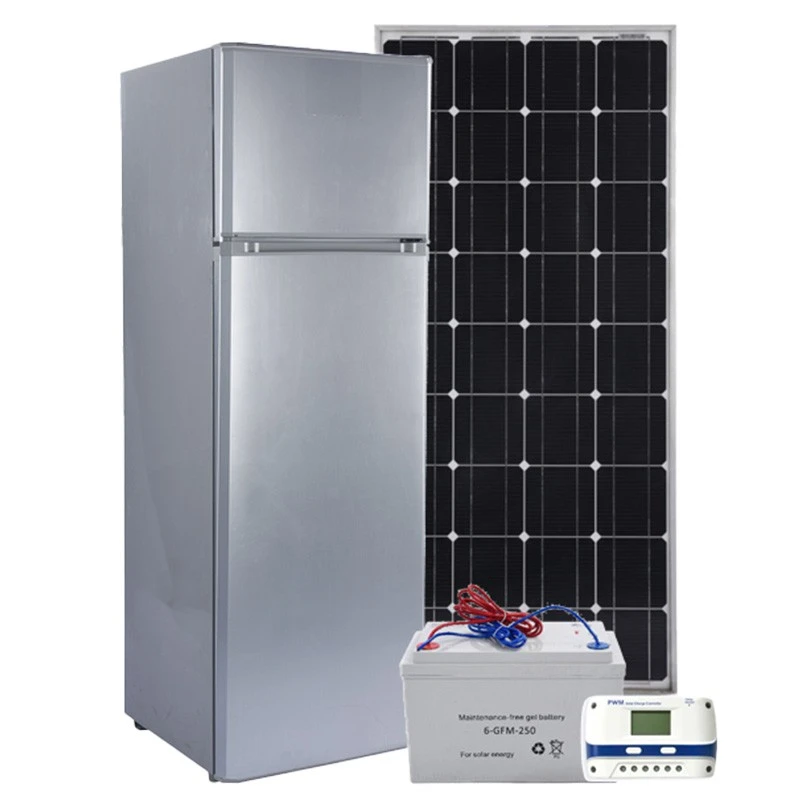
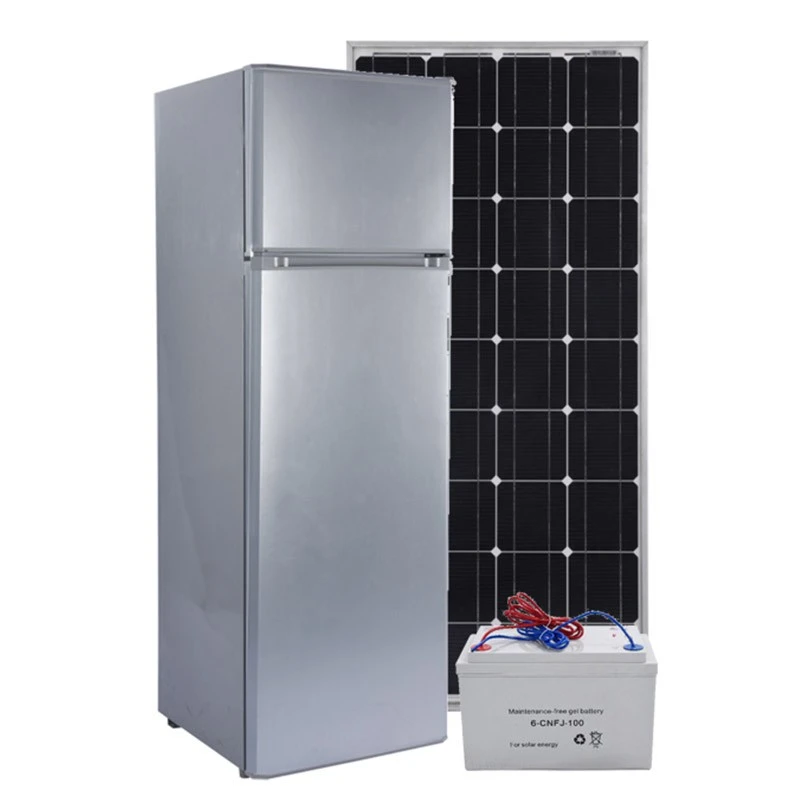
Panel, controller, battery, cabinet. The compressor is rarely the part that fails first. |
90 W, and the three ways a solar refrigerator actually failsNinety watts at 12 V is 7.5 A. That is a modest current, and it is also the number that exposes the wiring: a 7.5 A load on an undersized cable loses voltage in the run, not in the cabinet, and the owner blames the refrigerator.
All three are diagnosed with a multimeter and a paper strip in under ten minutes. None of them require opening the refrigeration circuit. |
Cable, not panel: the sizing mistake that costs the most
At 7.5 A and 12 V, a 10 metre run on 2.5 mm² cable drops more than a volt before the current reaches the cabinet. The compressor still runs - badly - and the owner concludes that a 90 W refrigerator cannot hold temperature. The table gives the drop for the lengths that occur in real houses; keep it under 3 per cent and the cabinet behaves as specified.
Cable (both cores) |
5 m run |
10 m run |
Verdict |
| 2.5 mm² | 0.53 V | 1.05 V | Only for very short runs |
| 4 mm² | 0.33 V | 0.66 V | The practical minimum |
| 6 mm² | 0.22 V | 0.44 V | Use for 10 m and beyond |
| 10 mm² | 0.13 V | 0.26 V | Long runs to a distant room |
Fuse at the battery, not at the cabinet: a 15 A blade fuse in the positive lead within 300 mm of the battery terminal protects the cable, which is the part that overheats. The cabinet itself draws 7.5 A and needs no protection beyond that.
Manual defrost, done properly
Manual defrost is not a cost reduction on this model, it is a decision: no heater, no timer, no fan in the freezer means nothing in that circuit can fail quietly and drain a battery overnight. The price is that frost has to be removed by a person, roughly every two to four months depending on humidity.
| 01 | Move frozen goods to a cool box with a blanket over it. A full freezer holds temperature for two to three hours with the lid closed. |
| 02 | Switch the cabinet off at the thermostat, not at the fuse, and leave both doors open. |
| 03 | Put a towel and a shallow tray under the freezer; melt water leaves through the drain channel at the rear. |
| 04 | Let it melt. A bowl of warm water on the rack speeds it up; a knife or a screwdriver will puncture the evaporator and write off the cabinet. |
| 05 | Wipe dry, close up, run empty for an hour, then reload. Reloading a wet freezer is how the next frost layer starts. |
What wears out, and what it costs to replace
A refrigerator this size should last a decade. Whether it does depends on whether the parts that fail are standard parts. Every wear item on the BCD-268 is a catalogue component rather than a proprietary assembly.
| Part | Type | Typical life |
| Door gasket | Magnetic profile, push-fit | 5 to 8 years in humid climates |
| Thermostat | Mechanical capillary, universal | 10 years or more |
| Compressor | DC rotary, external rotor | 10 to 15 years |
| Interior light | DC lamp, tool-free replacement | Replace as needed |
| Shelves and drawers | Tempered glass and ABS, individually replaceable | Indefinite if not overloaded |
Reference specification - BCD-268
| Model | BCD-268 |
| Type | Standing refrigerator freezer, double doors, top freezer |
| Total capacity | 268 L (fresh food 216 L + freezer 52 L) |
| Temperature range | 0 to 10 °C fresh food / -18 °C and below freezer |
| Input voltage | DC 12 V / 24 V; AC through adapter on request |
| Rated consumption | 90 W while the compressor runs |
| Control | Mechanical thermostat, capillary type |
| Defrost | Manual, freezer compartment |
| Climate class | N (16 to 32 °C ambient) |
| Material | Steel plate body, ABS interior liner |
| Product size | 550 × 570 × 1619 mm (W × D × H) |
| Carton size | 570 × 600 × 1880 mm |
| N.W. / G.W. | 45 kg / 50 kg |
| Certification | CE, SASO |
| HS code | 8418211000 |
| Included | Three glass shelves, crisper drawer with cover, four door balconies, freezer wire rack, ice tray, instruction sheet |
| Optional | AC adapter, DC cable set with 15 A fuse, solar panel and battery kit, OEM carton and rating label |
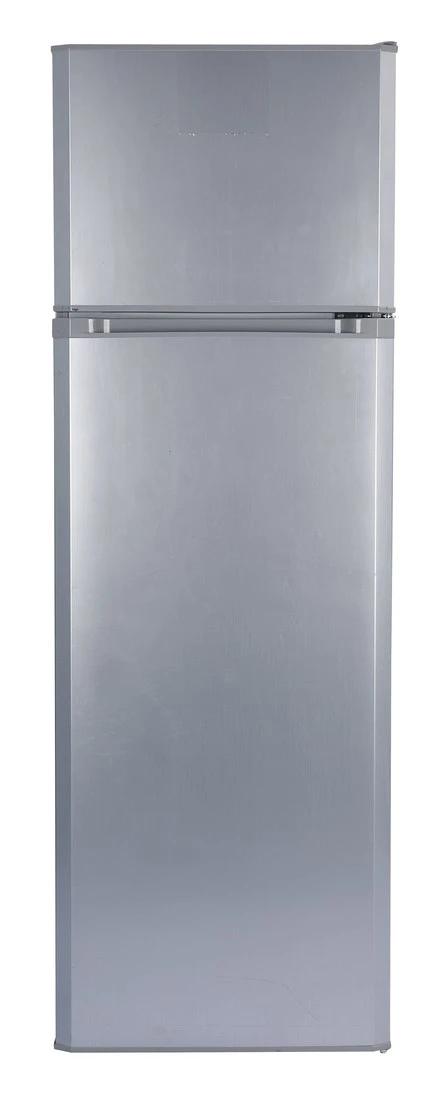
1619 mm tall, 550 mm wide, 570 mm deep. Carton adds 20 to 30 mm per side. |
Packing, delivery and private labelEach cabinet ships in a printed export carton with foam corner blocks and a cardboard base, strapped, and marked with model, serial number and net and gross weight. Shelves, drawer and rack travel inside the fresh food compartment so nothing shifts. Loading is planned with the carton dimensions above: the cabinet stands upright in the container, and a mixed load with smaller models is quoted per order once the mix is known. For distributors, the door panel, carton print, rating label and instruction sheet are customizable from 100 units. A CKD or SKD kit is available for assembly in the destination country, which is usually the cheapest route where import duty on finished appliances is high. Where a market requires a different refrigerant, the specification is agreed at order stage and declared on the rating label - tell us the destination and we will quote the version that clears customs there. |
Questions buyers ask before ordering this model
Can it be the only refrigerator in a house?Yes, for up to about five people. 216 litres of fresh food is a week to ten days of shopping and 52 litres of freezer is a month of meat. For a household that cooks from frozen daily, the 268 is the smallest size we would recommend. |
How long will a 100 Ah battery carry it?At 90 W and a 35 per cent duty cycle the cabinet uses about 0.75 kWh a day, roughly 63 Ah at 12 V. A 100 Ah battery therefore gives one full night plus a reserve - enough to ride out a cloudy day, not enough to ride out a week without sun. |
Is a 24 V system better?For long cable runs, yes: the same power at double the voltage halves the current, which halves the voltage drop for the same cable. For a short run in a small house, 12 V is simpler because the rest of the installation - lights, pump, phone charging - is usually 12 V. |
What is the difference between this and the BCD-218?Fifty litres and 200 mm of height. The 218 is 1395 mm tall for smaller kitchens and couples; the 268 is 1619 mm and adds 43 litres of fresh food and 7 litres of freezer, at about 10 W more running power. |
Can it run directly from a panel without a battery?It can run from a panel through a controller while the sun is up, but a refrigerator is not a load that can wait for sunrise. Without a battery the cabinet warms overnight and the compressor works twice as hard the next morning to recover. We do not recommend it. |
|
BCD-268 standing solar refrigerator - 268 L, 12 V / 24 V, double door Send us the household size, the sun hours at the site and whether a grid connection exists. We will come back with the cabinet, the array, the battery and the cable schedule as one quotation, and mark on it which parts are needed on day one and which can wait. |
Inside the factory that builds this system
|
Hangzhou Juka Solar Technology was founded in 2015 around one problem: putting solar energy, new energy and smart control to work inside a refrigeration circuit. The range has since grown from a single DC chest freezer to solar refrigerators, solar ice makers, mobile ice-cream carts, delivery tricycles and beverage retail carts - all of them exported, most of them to Belt and Road markets. The work does not stop at the container. Partners in Ghana, Gabon, Cameroon, Nigeria, Kazakhstan and India are supported in setting up their own local production for retail and delivery refrigeration, which is how a cold chain becomes permanent rather than a series of one-off shipments. For a solar system this matters more than for a mains-only freezer. Panel sizing, controller rating and battery capacity all depend on cabinet volume and site conditions, so the cabinet and the electronics are engineered together instead of being bought separately by the importer. |

|
What is decided before the cabinet is built
|
Wall thickness is a production parameter 65 mm or 110 mm foam is set on the foaming line, not assigned in a brochure. Insulation that is specified but not achieved is the usual reason a solar cabinet underperforms in its first hot season. |
One bill of materials Panel, controller, battery and cabinet are listed together, so the importer receives a system whose parts were sized against each other rather than sourced independently. |
|
Voltage as an order option DC input, AC adapter voltage, plug type and control panel artwork are selected per market on the same platform - no separate tooling run for a different destination. |
Repeatable on the second container Foam thickness, fittings and controller model are held per customer, so a follow-up order matches the first one instead of drifting. |
Certification and test documentation
CE marking covers the electrical arrangement, and utility model patents cover the cabinet and the direct-drive control layout. Documents travel with the order so they can be presented at customs and to institutional or tender buyers.

CE - low voltage and EMC |

CE - supplementary schedule |

Utility model patent - cabinet structure |
On the floor

|

|

|

|
Six control points behind every cabinet
01 |
Foaming runs inside a constant 20-23 °C room, so the foam quality does not shift with the season. |
02 |
Condenser and evaporator are nitrogen purged before any pipe joint is made, keeping the internal circuit clean. |
03 |
Vacuum is pulled to below 20 Pa. A unit that does not reach spec is never charged with refrigerant. |
04 |
Two leak tests per cabinet with an INFICON detector - one unpowered, one running. |
05 |
A constant-temperature test room confirms refrigeration parameters under identical conditions all year. |
06 |
Production and quality control are separate departments. Only cabinets signed off by a QC inspector are packed and warehoused. |
Machines on the line
Equipment |
What it gives the buyer |
Automatic laser cutting machine |
Consistent panel geometry, tight tolerances, clean edges |
Punch press and bending machine |
Repeatable cabinet forming from unit to unit |
Dual-gun high-pressure foaming machine |
Even density across the whole cabinet, no thin spots |
CACL high-precision filling machine |
Precise refrigerant charge on every unit |
INFICON high-sensitivity leak detector |
Finds leaks that ordinary detectors pass |
OEM, ODM and local assembly
Cabinet-only supply, private label, SKD and CKD shipments are all available, together with technical guidance for partners who would rather assemble locally than import finished units. Helping partners build their own refrigeration business is the part of the work that outlasts a single purchase order.
What can be changed on a standard order:
✓ Customer logo and cabinet colour
✓ Voltage options and plug type
✓ Packaging design
✓ Product configuration, baskets and fittings
✓ Panel, controller and battery included, or cabinet supplied on its own
Hot Tags: standing freezer for home, China standing freezer for home manufacturers, suppliers, factory


