

Hey there, folks! As a supplier of on grid hybrid solar air conditioners, I often get asked this question: Are on grid hybrid solar air conditioners more expensive to operate than traditional air conditioners? Well, let's dive into this topic and break it down.
First off, let's understand what on grid hybrid solar air conditioners are. These are air conditioners that can run on both solar power and grid electricity. They have a built - in solar panel system that captures sunlight and converts it into electricity. When there's enough sunlight, the air conditioner runs on solar power. But when the sun isn't shining bright enough, it can switch over to grid electricity.
Now, let's talk about traditional air conditioners. These are the ones you're probably familiar with. They rely solely on grid electricity to function. You plug them in, and they start cooling your space. But here's the catch: grid electricity isn't always cheap.
Let's look at the cost of electricity. In many areas, the cost of grid electricity can vary significantly. Some places have high electricity rates, especially during peak hours. For traditional air conditioners, this means that running them can be quite costly, especially if you use them for long periods. On the other hand, solar power is essentially free once you've made the initial investment in the solar panels.
When we purchase an on grid hybrid solar air conditioner, the upfront cost might be higher compared to traditional air conditioners. You're not just paying for the air - conditioning unit but also for the solar panel system and the hybrid technology. However, in the long run, the operating costs can be much lower.
Let's consider an example. Say you have a 9000btu air conditioner. A 9000btu Solar Air Conditioner On Grid Hybrid Solar Air Conditioner can make use of solar power during the day. Let's assume that on a sunny day, it operates for 8 hours on solar power alone. That's 8 hours of free cooling!
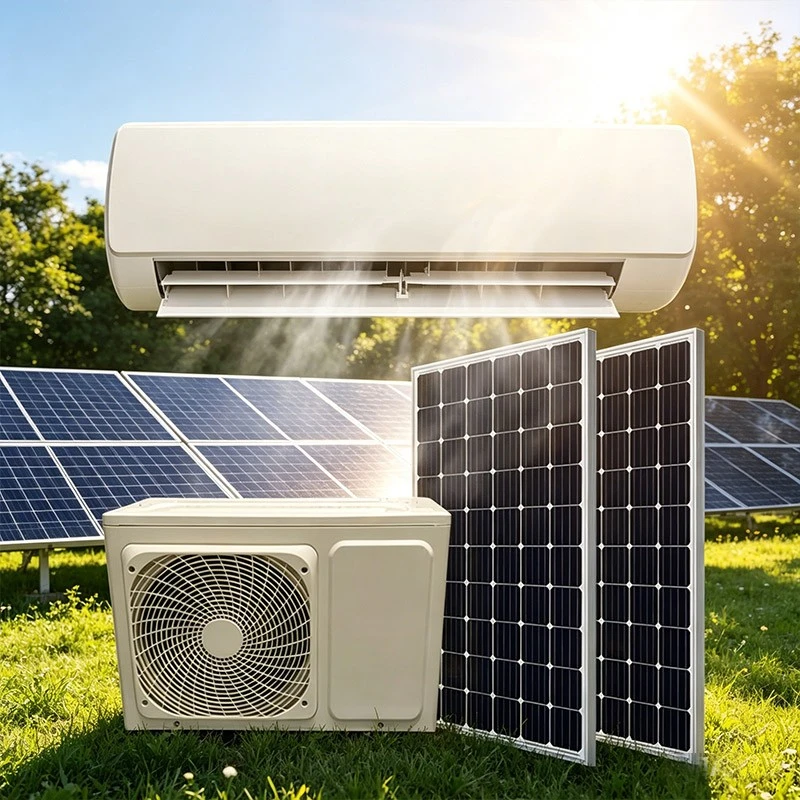
The hybrid split runs 9,000 to 24,000 BTU; the outdoor board takes DC from the array first and falls back to the grid after dark, which is the window the running-cost argument depends on.
In contrast, a traditional 9000btu air conditioner will be drawing electricity from the grid for the entire duration of its operation. The amount of electricity it consumes will depend on its energy efficiency ratio (EER). A typical traditional air conditioner might have an EER of around 8 - 10. While on grid hybrid solar air conditioners, with the addition of solar power, can effectively reduce the load on the grid and thus save on electricity bills.
Another aspect to consider is the environmental factor. Traditional air conditioners contribute to a higher carbon footprint as they rely on grid electricity, which is often generated from non - renewable sources like coal and natural gas. On grid hybrid solar air conditioners, on the other hand, use clean and renewable solar energy. This not only helps in reducing electricity costs but also makes a positive impact on the environment.
Some might argue that the reliability of solar power is an issue. After all, the sun doesn't shine 24/7. But that's where the on grid hybrid feature comes in. When the solar power isn't sufficient, the air conditioner can smoothly switch to grid electricity, ensuring that your space remains cool at all times.
Now, let's talk about maintenance. Traditional air conditioners and on grid hybrid solar air conditioners both require regular maintenance. The air filters need to be cleaned or replaced, and the unit needs to be inspected for any signs of wear and tear. However, the solar panel system in on grid hybrid air conditioners generally has a long lifespan with minimal maintenance. You might just need to clean the panels occasionally to ensure maximum sunlight absorption.
In terms of government incentives, many governments around the world are promoting the use of renewable energy. This means that you might be eligible for tax credits or rebates when you purchase an on grid hybrid solar air conditioner. These incentives can significantly offset the initial high cost of the unit, making it a more attractive option in the long term.
Let's take a look at the return on investment (ROI). For a traditional air conditioner, the ROI is mainly based on its energy - saving features, but the savings are limited as it depends on grid electricity. For an on grid hybrid solar air conditioner, the ROI can be much higher. Over time, the savings on electricity bills can be substantial, and the value of using clean energy is also an added bonus.

If you live in an area with a lot of sunlight, the savings can be even more significant. For instance, in sunny regions like Arizona or California in the United States, an on grid hybrid solar air conditioner can operate on solar power for a large part of the day. This can lead to a dramatic reduction in electricity bills, making it much more cost - effective to operate compared to traditional air conditioners.
In addition, the technology of on grid hybrid solar air conditioners is constantly improving. Newer models are becoming more energy - efficient, and the integration of solar panels and the air - conditioning unit is getting better. This means that the performance and cost - effectiveness of these units are only going to increase in the future.
So, are on grid hybrid solar air conditioners more expensive to operate than traditional air conditioners? The answer is a big no, especially in the long run. Sure, the upfront cost might be higher, but the savings on electricity bills, the positive environmental impact, and the potential government incentives make them a much better option.
If you're considering purchasing an air conditioner, I highly recommend looking into on grid hybrid solar air conditioners. They offer a sustainable and cost - effective solution for cooling your spaces. Whether you're a homeowner looking to reduce your energy bills or a business owner aiming to make your operations more environmentally friendly, these units are a great choice.
If you're interested in learning more or are ready to make a purchase, feel free to reach out. We're here to answer all your questions and help you find the perfect on grid hybrid solar air conditioner for your needs. Let's start a conversation and see how we can work together to keep you cool and save you money at the same time.
Who builds these units
The hybrid split comes out of JUKA's own plant in Zhejiang, the same works that builds the solar freezers and ice makers. Sheet metal is cut, punched and bent on automatic lines, cabinets are foamed on a dual-gun high-pressure machine, and every sealed circuit is checked with an INFICON leak detector before packing.
Units carry CE certification, the company holds 2 invention patents and 17 utility model patents, and warranty runs one year on the machine with three years on the compressor. CKD and SKD programmes are already running with partners in Ghana, Nigeria, Cameroon, Laos, Kazakhstan and India.

Laser cutting on the plant floor - the same line feeds air conditioner chassis and freezer cabinets.
If a project needs a different capacity, a 110 V version, or the same unit in kit form for local assembly, send the expected running hours per day and we will size the panel and battery side with it.
References
- Energy Efficiency Standards for Solar and Hybrid Air - Conditioning Systems, International Energy Agency.
- Cost - Benefit Analysis of Renewable Energy in Residential Cooling, Journal of Sustainable Energy.
- Government Incentives for Clean Energy Adoption, National Renewable Energy Database.