

Hey there! As a supplier of on grid hybrid solar air conditioners, I've been getting a lot of questions lately about the energy - saving potential of these amazing units over a year. So, I thought I'd sit down and break it all down for you.
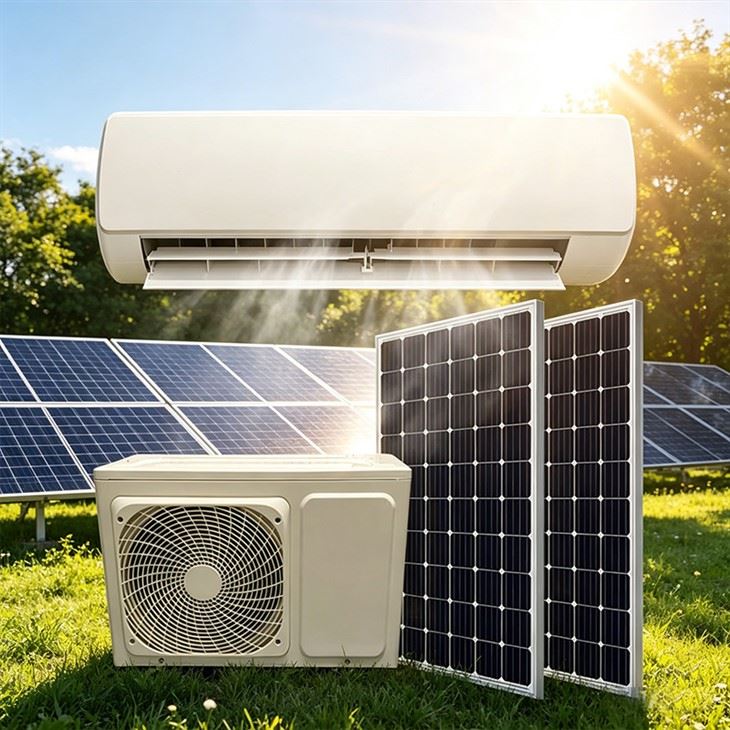
Let's start with the basics. An on grid hybrid solar air conditioner is a pretty nifty piece of tech. It combines the power of solar energy with the grid power. During the day, when the sun is shining bright, the solar panels on the unit soak up that solar energy and use it to cool your space. And when the sun goes down or when the solar power isn't enough, it can seamlessly switch to grid power. This dual - power system is what gives it such great energy - saving capabilities.
How It Works
First off, let's talk about how this thing actually works. The solar panels on the on grid hybrid solar air conditioner collect sunlight and convert it into electricity. This electricity is then used to run the compressor and other components of the air conditioner. The beauty of it is that when the solar power generated is more than what the air conditioner needs, the excess power can be fed back into the grid. In some cases, you might even get credits from your utility company for this extra power.
Now, let's dig into the energy - saving potential over a year. The amount of energy you can save depends on a few factors. One of the biggest ones is your location. If you live in an area with lots of sunny days, like the Southwest in the United States or parts of Australia, you're in luck. You'll have more sunlight to power your air conditioner, which means less reliance on grid power.
For example, let's say you have a 9000btu Solar Air Conditioner On Grid Hybrid Solar Air Conditioner. This unit is designed to be energy - efficient, and in a sunny location, it can run mostly on solar power during the peak cooling months. During the summer, when you're using your air conditioner the most, the solar panels can do a lot of the heavy lifting.
Let's assume you live in a place where you get about 200 sunny days a year. On each of these sunny days, the solar panels on your on grid hybrid air conditioner can generate a significant amount of power. If the air conditioner runs for an average of 8 hours a day during the summer, a good portion of that time can be powered by solar energy.
Calculating the Savings
To give you a rough idea of the energy - saving potential, let's do some simple math. Let's say your traditional air conditioner consumes about 1.5 kWh per hour. If you run it for 8 hours a day during the summer months (let's say 3 months or about 90 days), it would consume 1.5 kWh x 8 hours x 90 days = 1080 kWh.
Now, if your on grid hybrid solar air conditioner can run on solar power for about 60% of that time, it would only need to draw 40% of its power from the grid. So, the grid - power consumption would be 0.4 x 1080 kWh = 432 kWh. That's a huge difference!
Over the course of a year, the savings can really add up. Even during the non - summer months, the solar air conditioner can still use solar power when the sun is out, reducing your overall electricity bill.
Another factor that affects the energy - saving potential is the efficiency of the air conditioner itself. Our on grid hybrid solar air conditioners are designed with the latest technology to ensure maximum efficiency. The compressors are more energy - efficient, and the overall system is optimized to use as little power as possible while still providing great cooling.
Environmental Impact
It's not just about saving money on your electricity bill. Using an on grid hybrid solar air conditioner also has a positive impact on the environment. By relying more on solar power, you're reducing your carbon footprint. Traditional air conditioners that run solely on grid power often rely on electricity generated from fossil fuels, which release greenhouse gases into the atmosphere.
With a solar air conditioner, you're using a clean and renewable energy source. This means you're doing your part to help fight climate change and create a more sustainable future.
Long - Term Benefits
In the long run, the energy - saving potential of an on grid hybrid solar air conditioner can lead to significant cost savings. The initial investment in the unit might be a bit higher than a traditional air conditioner, but over time, the money you save on your electricity bill will more than make up for it.
Plus, as energy prices continue to rise, having a solar - powered air conditioner gives you some protection against these increases. You're not as dependent on the grid, so you're less affected by fluctuations in electricity prices.
Why Choose Our On Grid Hybrid Solar Air Conditioners
As a supplier, I can tell you that our on grid hybrid solar air conditioners are top - notch. We've spent a lot of time researching and developing these units to ensure they're reliable, efficient, and easy to use.

Our team of experts is always on hand to answer any questions you might have and to help you choose the right unit for your needs. Whether you have a small apartment or a large commercial space, we have an air conditioner that will work for you.
Let's Talk Business
If you're interested in learning more about the energy - saving potential of our on grid hybrid solar air conditioners or if you're ready to make a purchase, I'd love to hear from you. We can have a chat about your specific situation, and I can give you a more accurate estimate of how much you could save over a year.
Contact us today to start the conversation. Let's work together to make your space cooler and more energy - efficient!
Where These Units Are Built
Juka Solar builds the 9000, 12000 and 18000 BTU hybrid units in Zhejiang, China, where sheet metal work, coil assembly, refrigerant charging and final run testing all happen under one roof. Every air conditioner is leak tested before packing, and both the 48V DC off grid and the on grid hybrid versions are CE certified.
Compressors carry a 3 year warranty and complete units 1 year. The same range ships as CKD and SKD kits, so distributors can move lighter packages and assemble locally.
References
- "Solar Energy Basics", U.S. Department of Energy
- "Energy Efficiency in Air Conditioning Systems", International Energy Agency