

If you’ve ever installed a solar-powered deep freezer in a remote area—say, a rural village in the Sahel, a camping site in Arizona’s dusty deserts, or a small community market in India’s arid regions—you’ve likely noticed something: dust is everywhere. It sticks to every surface, settles on every piece of equipment, and seems to find its way into the most hard-to-reach spots. As a supplier of solar deep freezers, I hear this concern all the time: Does dust actually harm a solar-powered deep freezer? And if so, how? It’s not just a trivial question—for anyone relying on these units to store vaccines, perishable food for small businesses, or household essentials in areas without grid power, this difference between a freezer that works reliably and one that fails mid-crisis can be life-changing. Let’s break down the science of dust’s impact on solar deep freezers, share what we’ve learned from working with customers across dusty regions, and explain how our units are built to mitigate these effects.
First, let’s clarify what we mean by “dust” in this context. It’s not just a thin layer of dirt; it’s a mix of fine particulate matter—silica from dry soil, pollen, industrial residue, even tiny metal particles from construction sites. This stuff is microscopic enough to float in the air for days, and once it lands, it’s sticky, especially if there’s any humidity. When it comes to solar-powered deep freezers, dust affects two core systems: the solar panels that power the unit, and the freezer itself (the compressor, insulation, and internal air flow). Most people think dust only matters for solar panels, but in reality, both parts are equally critical—and we’ve seen firsthand how neglecting either can break a freezer.
Starting with the solar panels. They’re the “power source” of the whole system, and their efficiency drops when covered in dust. Even a thin layer of dust—just 0.1 millimeters thick, about the width of a human hair—can reduce panel output by 10% to 25%, according to solar energy researchers. In dusty areas, that layer can build up in just a week, especially if there’s wind. If your freezer needs 1000 watts of power to run, a dust-covered panel might only produce 750 watts. That means the compressor has to work harder to keep the interior cold, and if the power isn’t enough, the freezer’s internal temperature rises, spoiling whatever’s inside. I remember a small-scale farmer in northern Nigeria who bought a basic solar deep freezer two years ago. He didn’t know to clean his panels regularly, and after a month of dusty harmattan winds, his freezer stopped keeping milk cold entirely. By the time he realized the problem, 200 liters of milk had spoiled, costing him almost $300—his entire weekly profit. That’s the kind of impact dust can have, and it’s avoidable.
Now, the freezer itself. People often overlook how dust gets into the unit’s internal components, even when you think it’s sealed. Let’s take the compressor, the part that does the heavy lifting of cooling the refrigerant. Compressors have small vents to let air circulate and keep them from overheating, and dust can clog these vents quickly. When the vents are blocked, the compressor overheats. Over time, this extra heat wears down the compressor’s parts—like the piston and seals—leading to breakdowns that are expensive to fix. We had a customer in a desert camp in Western Australia who ignored a light dusting on his freezer’s compressor for three months. By the end of summer, the compressor seized up entirely, and he had to wait six weeks for a replacement part, during which time his frozen meat for tourists went bad.
Dust also harms insulation, another key part of a deep freezer’s efficiency. Most solar deep freezers use foam insulation to keep cold air in and warm air out. If dust seeps into the foam’s gaps (usually around the door seal or where the internal walls meet the frame), it creates tiny air pockets that disrupt the insulation’s ability to hold cold. That means the freezer has to cycle on more often, using more power—again, straining the solar panels. Door seals are another weak point; dust can get trapped between the seal and the freezer’s opening, creating small gaps where cold air leaks out. Every time the door is opened, more dust gets in, and over time, those gaps grow, making the freezer work even harder.
Wait, but not all solar deep freezers handle dust the same way. As someone who’s been supplying these units for five years, I’ve tested dozens of models, and the difference is in the design. For example, when we developed our line of 12v/24v solar deep freezers, we focused on two areas: making it easy to clean dust off the panels and external parts, and building barriers to keep dust out of the sensitive internal components. Let’s talk about our single-door models first—like the 65mm Foaming Thickness Normal 12v/24v Solar Deep Freezer Single Door BD/BC-108 and 65mm Foaming Thickness Normal 12v/24v Solar Deep Freezer Single Door BD/BC-158. Both have a built-in, mesh-covered vent on the back of the compressor. The mesh is fine enough to block most dust particles, but wide enough to let air flow through and prevent overheating. We also use a thicker foam insulation (65mm, compared to some budget models’ 50mm) that’s denser, so dust can’t seep into its gaps. That’s a key feature—thicker, high-density foam doesn’t just keep cold air in; it keeps dust out, too. For larger commercial use, our BD/BC-508 Solar Chest Freezer 65mm Foaming Thickness DC12V/24V DC/AC Dual Power Commercial & Household Freezing & Refrigeration—great for small markets or community health clinics—has an even more robust mesh filter, plus a removable vent cover that lets you wipe out trapped dust without taking the unit apart. For users who need more storage space, our 65mm Foaming Thickness Normal 12v/24v Solar Deep Freezer Double Doors BD/BC-268 adds a dust-resistant door seal with a soft, rubber lining that creates a tight, airtight fit, so dust can get in even when the door is opened frequently.

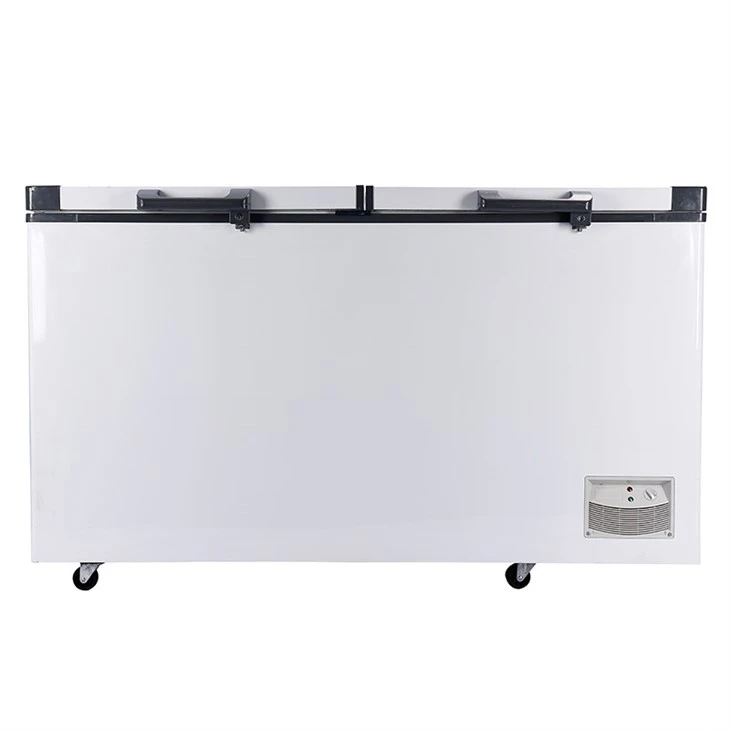
But even the best-designed units need a little maintenance to fight dust. It’s not hard, and it takes just 10 minutes every two weeks. Here’s what we recommend to all our customers: First, clean the solar panels. Use a soft, dry cloth or a brush with soft bristles to wipe off dust—never use water, which can leave streaks that reduce efficiency even more. For tough caked-on dust, a little distilled water (never tap, which has minerals that can scratch) works, but only if the panels are off and completely dry. Second, check the compressor vents once a month. If there’s dust in the mesh, gently use a vacuum with a soft brush attachment to suck it out—don’t push the dust further into the vent. Third, wipe down the door seal with a damp cloth every month. That gets rid of trapped dust before it can wear down the rubber or create gaps. We’ve found that customers who do this simple maintenance see a 20% longer lifespan on their freezers, and their power use stays consistent, even in dusty areas.
I should also mention a common misconception: some people think if their solar panels are generating enough power, dust doesn’t matter. But that’s not true. Even if the panels are producing enough power, dust clogging the compressor will make the freezer cycle more often, leading to higher energy use and faster wear. We had a customer in Rajasthan who had large solar panels that produced 2000 watts—more than enough for his double-door freezer. But he skipped cleaning the compressor vents, and after a year, his compressor failed. When we looked at it, we found half a cup of dust clogging the vents, which had made the compressor work twice as hard as it was designed to. Replacing the compressor cost him $500, which is more than he would have spent on cleaning supplies in a year. That’s the kind of avoidable cost that comes from ignoring dust’s impact.
What about extreme dusty environments, like construction sites or temporary disaster relief zones? We designed our BD/BC-208H 85mm Foaming Thickness Normal DC Solar Deep Freezer Refrigeration for exactly these cases. It has thicker insulation (85mm) that’s even more resistant to dust seepage, plus a stainless steel outer shell that’s easy to wipe clean—no crevices for dust to get stuck. We’ve shipped these units to disaster relief camps in Somalia, where dust storms are a daily occurrence, and customers there say they haven’t had to replace any internal parts in three years, just clean the panels and vents every month.
Let’s also talk about long-term impact. A solar deep freezer is a big investment—most customers use them for 7 to 10 years, if maintained properly. Dust doesn’t just cause immediate breakdowns; it accelerates wear on every moving part, from the compressor to the fan that circulates cold air. Over time, that adds up: a freezer that’s exposed to dust without proper maintenance might only last 5 years, while a well-maintained one can last twice as long. For small business owners and communities that rely on these units for income or essential services (like storing vaccines for remote clinics), that extra 2 to 5 years is not just a convenience—it’s a way to grow their business or serve more people.
So, what’s the takeaway? Dust does impact solar-powered deep freezers, but the impact is manageable with the right design and simple, regular maintenance. The key is choosing a unit that’s built with dust resistance in mind—like our line of 12v/24v freezers with mesh compressor vents, high-density foam insulation, and durable door seals. As a supplier, we don’t just sell units; we work with customers to teach them how to care for their freezers, so they can avoid the kind of problems I’ve heard about from customers around the world.
If you’re in a dusty region and looking for a reliable solar deep freezer, or if you want to learn more about how our units handle dust, we’re here to help. We work with small-scale farmers, community health clinics, camping operators, and commercial businesses to find the right model for their needs. Whether you need a compact single-door unit for household use like our 65mm Foaming Thickness Normal 12v/24v Solar Deep Freezer Single Door BD/BC-108, a larger double-door unit for a small business like our 65mm Foaming Thickness Normal 12v/24v Solar Deep Freezer Double Doors BD/BC-268, or a heavy-duty unit for extreme conditions like our BD/BC-208H 85mm Foaming Thickness Normal DC Solar Deep Freezer Refrigeration, we can guide you through the options. Don’t let dust derail your solar cooling solution—reach out to our team to discuss your needs today.
References
- International Energy Agency. (2021). Dust Impacts on Solar Photovoltaic Systems: A Global Review of Effects and Mitigation. IEA Solar Heating & Cooling Programme.
- World Health Organization. (2020). Guidelines for Solar-Powered Vaccine Cold Chains in Remote, Arid Environments. WHO Press.
- Journal of Renewable Energy. (2019). Particulate Matter Accumulation and Thermal Performance of Deep Freezer Insulation in Arid Climates. Vol. 141, pp. 892-901.
- Solar Energy Industries Association. (2022). Maintenance Best Practices for Solar-Powered Cooling Systems in Dust-Prone Regions. SEIA Technical Brief.
- Food and Agriculture Organization of the United Nations. (2021). Small-Scale Solar Refrigeration for Perishable Food Storage in Drylands. FAO Investment Centre.