


12,000 BTU NOMINAL 3.5 kW cooling class | 2 POWER INPUTS PV direct current and grid AC | 1 WALL HEAD single fan condenser outside | 24/7 COOLING WINDOW sun by day, grid after dark |
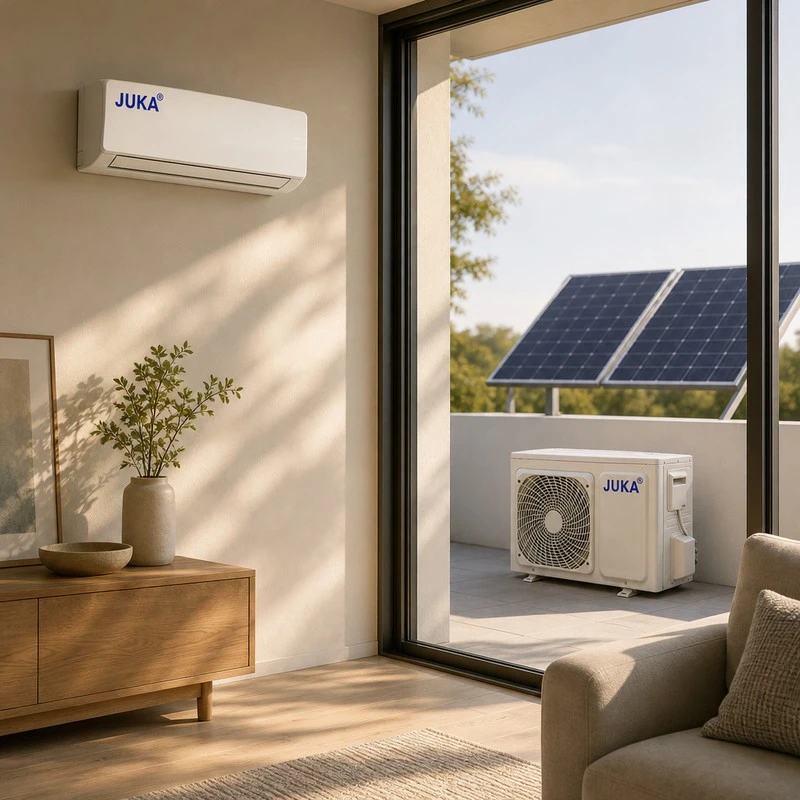
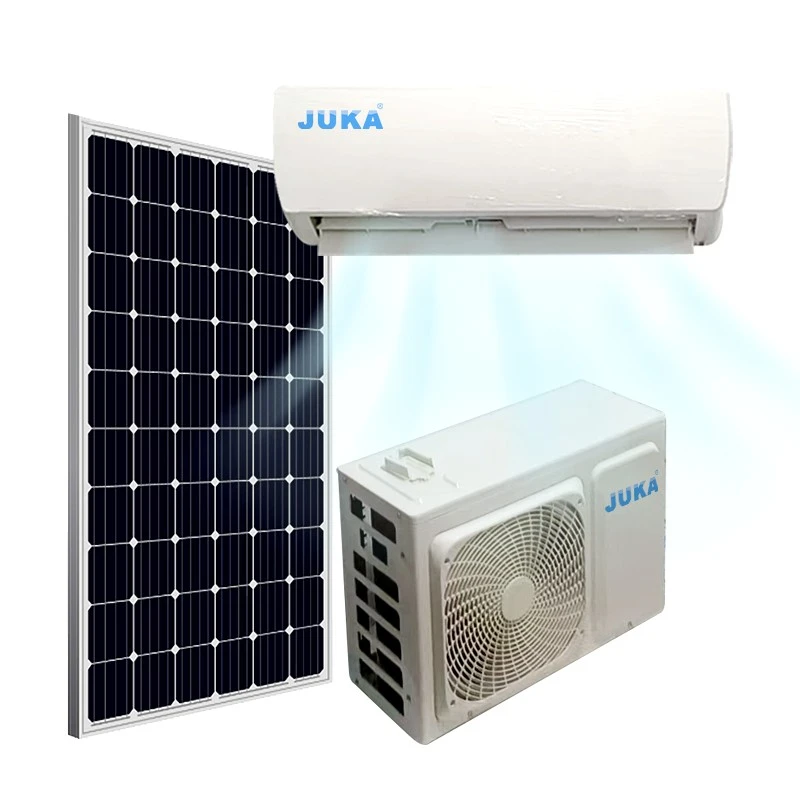
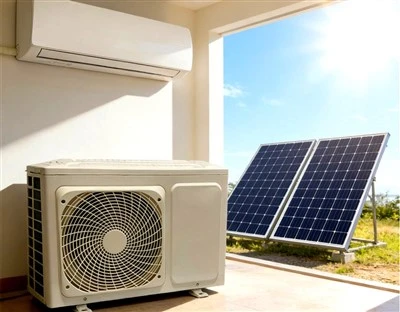
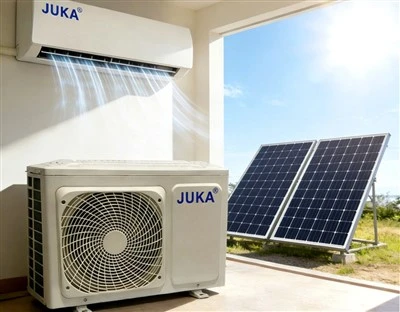
The KF-35GWS is a 12,000 BTU wall-mounted split air conditioner built around an on-grid hybrid power stage. It accepts DC from a photovoltaic array and AC from the local grid, and it will run on either one. In a house that already has panels on the roof, that removes the two things that make solar cooling expensive: a battery bank big enough to survive a cloudy week, and an inverter large enough to start a compressor on its own.
Nothing about the room changes. The head is an ordinary wall split - a louvre, a filter, a drain and a remote control. What changes is where the electricity comes from between eight in the morning and five in the afternoon, and who pays for the hours after sunset. This page explains the architecture, the installation sequence and the decisions that have to be made before the unit is ordered, because those decisions are what separate a hybrid that saves money from a hybrid that simply has two cables.
The handover is the product, not the box
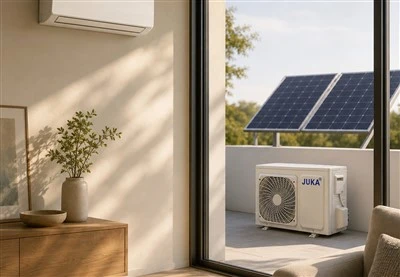
Two sources do not make a product on their own. What makes the KF-35GWS a hybrid is the stage that sits between them: the array feeds DC into the power section, the grid feeds AC into the same section, and the compressor and fan motors draw from whichever is available at that moment. The installer does not wire a manual changeover switch and the occupant does not walk outside to move a breaker.
The practical result is a cooling system whose running cost tracks the weather rather than the tariff. While the array is producing, the room is cooled by sunlight. When it is not, the grid supplies the difference, and the unit keeps running instead of dropping out at the first cloud.
That is also why the specification table on this page is shorter than you might expect. A hybrid split is not defined by one number; it is defined by the pair - capacity on one side, array and grid arrangement on the other - and the second half is set per site.
Keeping the grid connected changes the battery maths
In a pure off-grid build, the battery is sized for the worst case: several consecutive overcast days, a hot room, and a compressor that still has to run at night. That bank is often larger and more expensive than the air conditioner it serves.
With the grid left in the circuit, the bank only has to carry the gap between what the array produced during the day and what the room needs after dark. In many installations that means a modest bank, or none at all during the cooling season, with the grid acting as the night-time source and the array as the daytime one.
It also makes the system behave sensibly during a long outage if a battery is fitted: the unit keeps cooling from the array and the bank, then returns to grid supply when the line comes back. Nothing has to be reconfigured at the wall.
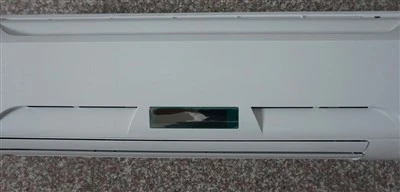
Inside the wall head: what the installer touches
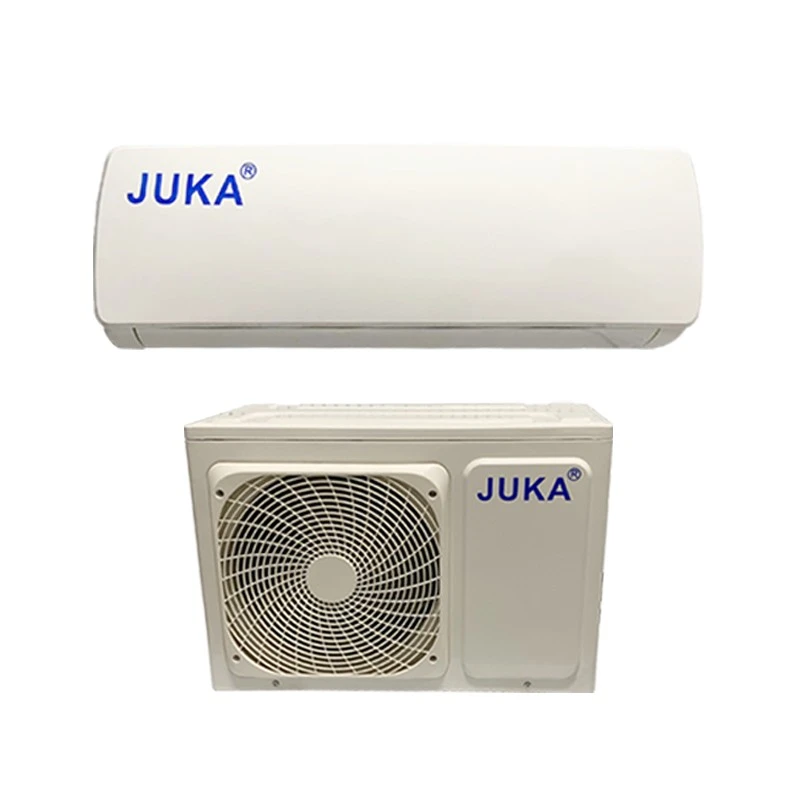
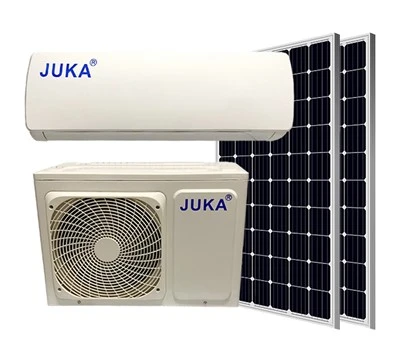
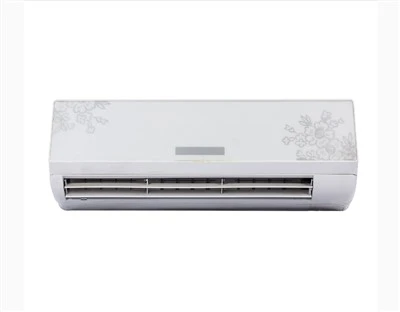
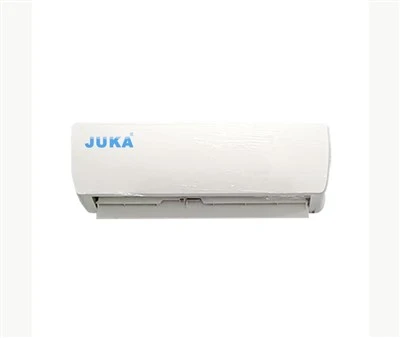
The indoor unit is the part the customer sees, so it is worth describing honestly. A steel back plate is fixed to the wall with four expansion screws. Behind the head there are two flare connections and a condensate outlet; the interconnecting pipes, the electrical cable and the drain tube are wrapped together in protective tape and passed through the same wall penetration before the head is hung on the plate.
The louvre is adjustable and the discharge is wide, which matters in a 3.5 kW class unit: a narrow jet feels cold at six metres and does nothing at two. The display window carries the set point and the operating mode, and the receiver for the handset sits behind it.
Two things are decided here rather than at the outdoor unit. First, the height of the head above the floor - high enough to throw air across the room, low enough to leave space for the filter to be removed. Second, the fall of the drain: a condensate line that runs uphill will drip inside the wall, and no amount of refrigerant charge will fix that.
The condenser is where the hybrid label is earned
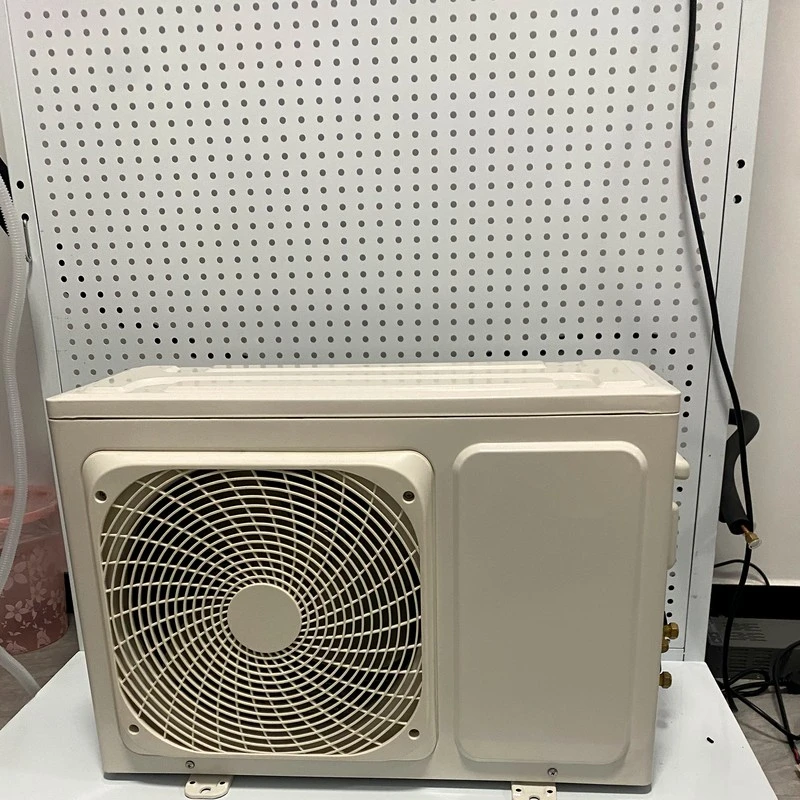
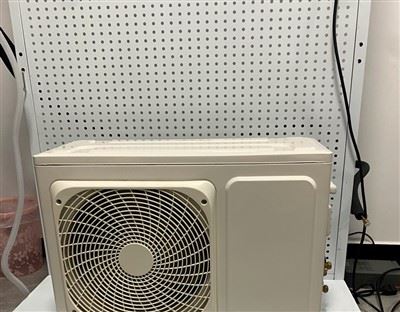
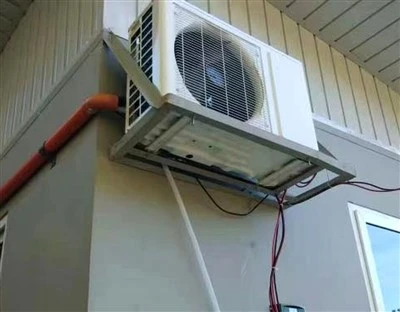
Outside, the unit is a single-fan condenser with a louvred service cover on the right-hand cheek. Behind that cover are the terminal block and the power section, which is also where the DC input from the array and the AC input from the grid meet. Two service valves - a small one on top for the liquid line, a larger one below for the suction line - take the flare nuts from the interconnecting pipes.
Mounting height and clearance matter more than they look. The condenser rejects heat from the room plus the work of the compressor; if it is boxed into a recess or set too close to a wall, the head pressure climbs, the unit draws more current and the cooling capacity quietly falls away exactly when the afternoon is hottest.
The condenser also carries the nameplate. That plate, not this page, is the final authority on refrigerant type and charge, rated current and operating limits for a specific build, because those values are set when the order is configured.
SWITCH 05
A day measured in two currencies
Hybrid systems are usually sold with a diagram. A schedule is more useful. The table below is the operating logic of a PV plus grid installation across a normal hot day, in the order the equipment actually meets it.
| Window | Source in play | What happens in the room | What the installer verifies |
06:00 - 09:00 | Grid AC | The room is already warm and the array is still low. The grid carries the pull-down and the array contributes as soon as it can. | Check that the unit starts and reaches set point on grid alone. |
09:00 - 12:00 | Array, rising | Production climbs past the load. The array takes over; the grid contribution falls away on its own, without a changeover command. | Check DC input voltage and current at the controller. |
12:00 - 16:00 | Array, surplus | The hardest hours of the day are also the best hours for the roof. If a battery is fitted, surplus charges it for the evening. | Check panel tilt and that no new shading appeared. |
16:00 - 19:00 | Array, falling | Production drops below the load. The grid picks up the difference gradually rather than in one step, which keeps the compressor stable. | Check that cooling is uninterrupted through the transition. |
19:00 - 06:00 | Grid, or battery | Night cooling runs from the grid, or from the bank if one was specified and sized for overnight running. | Check that the bank is not being taken below its design depth of discharge. |
Times are illustrative and shift with latitude and season. What does not shift is the shape of the curve: a midday surplus and two shoulders, one in the morning and one in the evening, where the grid does the work.
Sizing the array around a 3.5 kW load
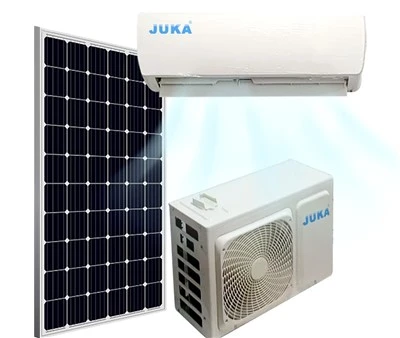
A 12,000 BTU head draws a modest but not trivial load. Sizing starts from the compressor, not from the roof: work out the daily cooling hours, multiply by the running current printed on the nameplate, and add a margin for pull-down after a hot afternoon. The result is a daily energy figure in kilowatt hours, and that figure - not the size of the air conditioner - sets the array.
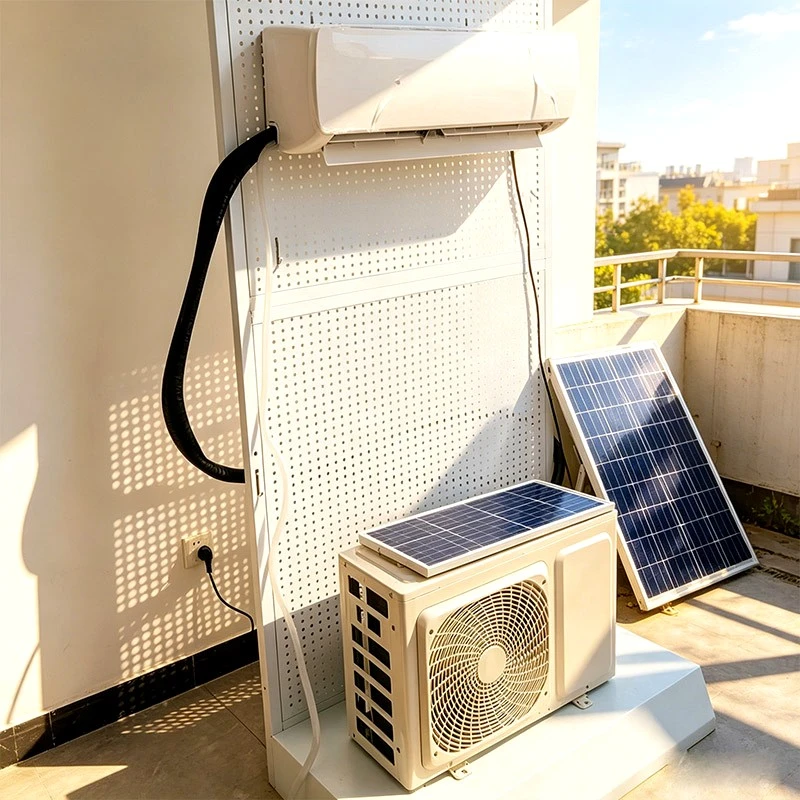
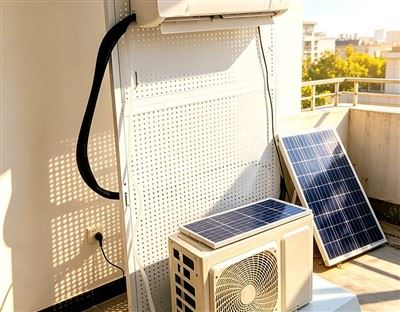
Panels are wired in pairs. A pair of positives is brought together and a pair of negatives is brought together at a distribution header, so two panels form one group and the groups are then paralleled. Tilt is set by bracket position and adjusted for the season; in most installations the useful setting is steeper than the roof pitch, because the load peaks in the middle of the day rather than across the whole year.
Every panel in the array must face the sun. One panel shaded by a water tank will drag its whole group down, and the air conditioner will start leaning on the grid in the middle of the afternoon without anything appearing to be broken.
The changeover you can defend to an inspector
Hybrid does not mean unsupervised. The DC side of a system with a battery is a battery system and is protected like one: a 40 A DC circuit breaker on the cable between the battery and the solar charge controller, two 4 mm² cables from that controller to the battery cabinet, and a second 40 A breaker on the cable between the controller and the array. Both breakers are there so that a technician can isolate a section without working live.
At the controller, three sets of conductors land on the same terminals: the array, the battery and the DC feed to the air conditioner. Labelling those three cables at both ends is the difference between a ten-minute service call and an afternoon of ringing out wires.
The AC side is ordinary single-phase work: a dedicated circuit, an isolator within sight of the outdoor unit, and an earth connection at the condenser. If the unit is installed where the grid is unstable, an automatic voltage stabiliser is worth discussing before the unit ships rather than after it trips.
The installation, in the order it has to happen
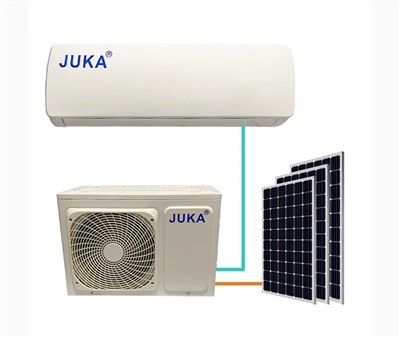
A hybrid split is installed in a sequence, and the sequence is not negotiable. Refrigerant work cannot be done before the plate is level, and the electrical work cannot be finished before the vacuum is pulled. Doing it in the right order is what keeps a two-day job from turning into a return visit.
The guide that ships with the unit covers the whole path from unpacking to first start. The table below is its spine, in order, with the reason each step exists.
| # | Step | Why it is done in this order |
01 | Mount the back plate | Four expansion screws, drilled to a level line. A plate that is out of level shows up later as a head that does not sit flush with the wall. |
02 | Loosen the flare nuts | Two copper nuts and the drain tube sit at the back of the indoor unit. They are loosened so the interconnecting pipes can be flared and connected. |
03 | Connect the two pipes | Small line to the liquid side, large line to the suction side. Caps are removed only when the connection is about to be made, never earlier. |
04 | Fit the drain | The plastic drain tube is pushed onto the indoor outlet, and the electrical cable is lifted in the same direction so both leave the wall through one sleeve. |
05 | Wrap and hang | Pipes, cable and drain are wrapped together in protective tape, passed through the wall, and the head is hung on the plate. |
06 | Set and fix the array | Panels go on brackets with an adjustable angle, wired positive to positive and negative to negative in pairs, groups paralleled at a header. |
07 | Pipe the condenser | Small copper pipe to the top valve, large pipe to the lower valve, gauge hose on the large valve, pump on the gauge, vacuum for about ten minutes. |
08 | Open, test, commission | Valves opened with an Allen wrench, soap solution on every joint, then a first run from the remote control to confirm cooling and check for noise. |
What happens to the unit before it is boxed
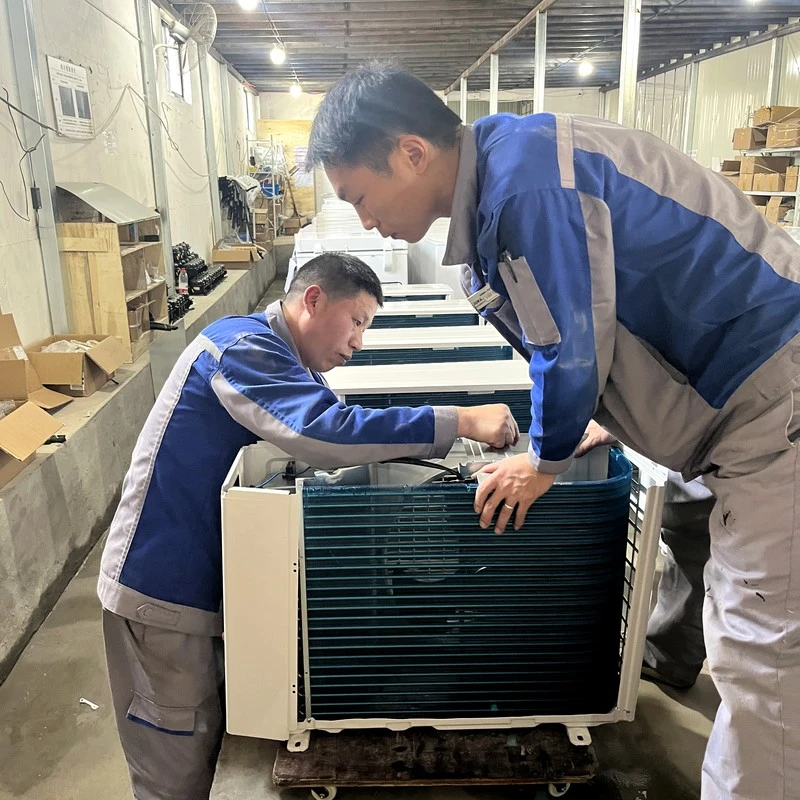
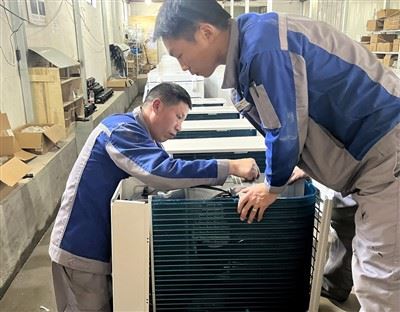
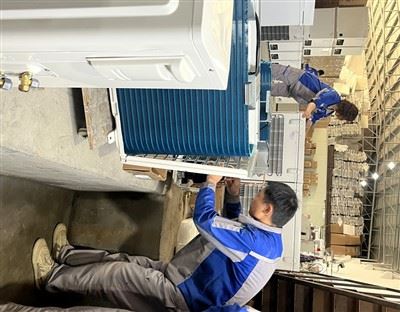
A split air conditioner is assembled, evacuated, charged and run before it leaves the building. The stages that matter to a buyer are the ones that cannot be inspected on arrival: the leak test, the charge weight and the electrical test.
At the charging station the refrigerant is weighed in, not estimated by pressure, because a unit that is short by fifty grams will still cool on a mild day and will disappoint in a heatwave. After charging, every joint is checked with a detector, the wiring is verified against the wiring code, and the unit is run long enough to confirm that the compressor starts cleanly and the fan does not rub.
Production and quality control are separate functions. A unit is packed only after a QC inspector signs it off, and the packing list is checked against the order configuration - because the most common shipping dispute on split systems is not damage, it is a unit built for the wrong market.
What is in the crate, and what is not
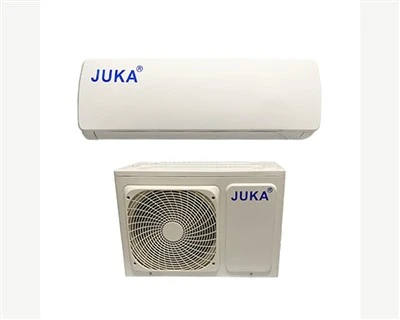
The carton contains the indoor head and the outdoor condenser, each in its own protective bag and foam. The indoor unit is the lighter of the two and is usually carried up first, still in its packaging, because the louvre is the first thing to be damaged on a stairwell.
What is not in the carton by default is the array, the mounting brackets, the battery and the interconnecting pipe. Those are site-specific: the pipe length is set by the distance between the head and the condenser, and the array is set by the load calculation in SWITCH 06.
This is deliberate. Sending a fixed kit to a site with a different roof and a different pipe run produces either waste or a second shipment, and both cost more than agreeing the bill of materials at the quotation stage.
| Item | Status | Note |
Indoor wall-mounted head | Included | Bagged, foam packed, louvre protected. |
Outdoor condenser unit | Included | Single fan, service valves capped, feet fitted. |
Remote control | Included | Used for the first start and for commissioning checks. |
Wall plate and expansion screws | Included | Four screws, one plate, sized for the head. |
Drain tube and pipe insulation | Included | For the condensate run and the line set wrapping. |
Interconnecting pipe set | Optional | Length and flare size agreed per installation. |
Photovoltaic panels and brackets | Optional | Count and tilt per site, see SWITCH 06. |
Charge controller and DC breakers | Optional | Required where a battery is installed. |
Battery bank | Optional | Sized for the night load, not for the air conditioner alone. |
The first week decides whether the site is happy
Most complaints about solar air conditioning arrive in the first seven days, and most of them are not faults. They are commissioning issues: a system left with air in the lines, a drain that runs backwards, a condenser in a corner that cannot breathe, or an array that is shaded at exactly the hour the load peaks.
Ten minutes of vacuum is the minimum in the guide, not a target. If the gauge does not hold after the pump is isolated, there is a leak and no amount of extra pumping will remove it. Soap solution on every flare is faster than a detector and finds the joint that was tightened by hand rather than by spanner.
After the first run, note the room temperature, the set point and the time taken to reach it. That single line in the handover document is what lets a technician tell a real fault from a hot week six months later.
| Check | What good looks like |
Vacuum and hold | Reach the vacuum stated in the guide, isolate the pump, watch the gauge for drift. |
Leak check | Soap solution on every flare and valve cap, then re-check after the first hour of running. |
Drain flow | Pour water into the indoor tray and confirm it leaves the wall, not the room. |
Airflow path | Confirm the condenser has clear space in front of the fan and behind the coil. |
Electrical | Dedicated circuit, isolator in sight, earth at the condenser, breakers labelled. |
First run | Start from the remote, check cooling, listen for fan rub or compressor noise. |
Three ways to specify the same unit
Because the unit takes two inputs, the same model can be quoted three ways. The difference is not in the air conditioner; it is in how much of the night you want the roof to cover.
Daylight-only is the cheapest configuration and the easiest to justify: the array offsets cooling during the hours when cooling is needed most, and the grid does the rest. A small bank adds resilience for short outages. A larger bank starts to make sense where the tariff at night is high or where outages are long and frequent - and at that point the battery, not the air conditioner, is the main line item.
Our recommendation is usually to specify daylight-first and leave space and cable for a bank to be added later. A hybrid that is over-batteried on day one is the most common way a solar cooling project stops making financial sense.
| Configuration | What is supplied | Effect on running cost | Suits | Relative cost |
A. Daylight only | Array plus hybrid unit | Displaces grid cooling through the middle of the day | Homes and shops with a stable grid and a daytime load | Lowest first cost |
B. Daylight plus small bank | Array, unit, controller, small battery | Adds ride-through for short outages and carries part of the evening | Areas with frequent short interruptions | Moderate; pays back on tariff |
C. Daylight plus full bank | Array, unit, controller, battery sized for the night | Cools overnight from the roof | Off-grid sites and places with long outages | Highest; justified by avoided diesel or downtime |
Where a 12,000 BTU hybrid does not belong
A page that only lists advantages is not much use to a buyer who has to defend the decision to a partner. The KF-35GWS is the smallest size in the family, and there are rooms it should not be specified for.
A single head is the wrong answer for an open-plan shop floor above roughly forty square metres, for a room with a glazed wall facing the afternoon sun and no shading, and for any space where the door stands open all day. In those cases two smaller heads, or the 24,000 BTU model, will use less energy for the same comfort - a single unit running flat out is the least efficient way to cool a large volume.
The same applies to the array. If the roof cannot carry a small array at all, a hybrid unit becomes an ordinary grid air conditioner with extra electronics, and the buyer should know that before signing rather than after the first bill.
Service, spares and the second container
Split systems are serviced by local technicians, so the parts that fail have to be ordinary parts. Filters, fan motors, capacitors, control boards and remotes are held as service items, and the wiring layout is the same across the range so that a technician who has opened one unit knows where the terminals are in the next.
For distributors, the second container is the real test. Cabinets, controllers and packaging are held per customer, so a repeat order matches the first one instead of drifting - which matters when the first order has already been sold into a market with its own expectations about plugs, labels and documentation.
Private label, OEM and ODM are available on this platform, together with SKD and CKD supply for partners who assemble locally. What can be changed without new tooling is listed at the bottom of this page.
Matching the head to the room, not to the brochure
As a rule of thumb, a 12,000 BTU head is asked to cool somewhere between twenty-five and forty square metres, and the width of that range is the whole point. Insulation, ceiling height, glazing and occupancy move the answer by more than the difference between one model size and the next.
A well insulated bedroom with one shaded window sits at the low end. A shop with a glass front, a tin roof and a door that opens fifty times a day sits at the high end, and often beyond it. Computing equipment, kitchen heat and west-facing glazing all push the requirement up; a white roof, deep eaves and cross ventilation pull it down.
Because a hybrid unit is judged on running cost as much as on comfort, oversizing is not free. A unit that is too large cycles on and off, dehumidifies poorly and draws its pull-down current more often. The right answer is the smallest head that holds the room on the hottest afternoon of the year.
What we need from you before the unit is built
Because capacity is fixed but the power arrangement is not, an enquiry that arrives with five numbers can be quoted the same day. Without them, the quotation is a guess and the shipment is a risk.
The list below is short on purpose. Everything on it changes something physical about the build: the voltage of the power stage, the flare size of the line set, the language on the remote, the plug on the cable, the artwork on the carton.
Send the site country and the intended room, and we will come back with a configuration and the accessories that go with it, rather than a unit that has to be adapted on arrival.
| Information | Why we ask for it |
Destination country and port | Voltage, plug type, documentation language and certification expectation. |
Room size, ceiling height, glazing | Whether 12,000 BTU is the right size at all. |
Daytime cooling hours | Daily energy figure that sets the array. |
Array size available, or roof area | Panel count and tilt, or a recommendation. |
Battery: none, small, or full night | Which of the three configurations applies. |
Line set length | Pipe length and flare size for the interconnecting set. |
Single or split shipment | Whether the array and battery ship with the unit. |
SPECIFICATION
KF-35GWS at a glance
Values that are fixed on the platform are stated. Values that are set when the order is configured are marked as such - a hybrid unit is configured, not picked off a shelf, and pretending otherwise is how buyers end up with the wrong power stage.
| Parameter | KF-35GWS |
Model | KF-35GWS |
Product type | Wall-mounted split air conditioner, on-grid hybrid power |
Nominal cooling capacity | 12,000 BTU/h (about 3.5 kW cooling class) |
Power architecture | PV DC input and grid AC input, hybrid operation |
Indoor unit | Wall-mounted head, adjustable louvre, washable filter, display window |
Outdoor unit | Single-fan condenser, louvred service cover, two service valves |
Control | Handset remote control supplied with each set |
Refrigerant | Type and charge printed on the unit nameplate; confirmed per build |
Rated current and power input | Per build; stated on the nameplate and the order confirmation |
Operating temperature range | Per build; see nameplate and installation guide |
Dimensions and weight | Indoor and outdoor, net and gross, confirmed on the order confirmation |
Packing | Foam and bag packed, one carton per unit; carton size confirmed per order |
Line set | Two flare connections, liquid and suction; length agreed per installation |
Electrical protection | Dedicated AC circuit and isolator; DC breakers where a battery is fitted |
Certification | CE for the electrical arrangement; documentation travels with the order |
Branding | JUKA as standard; private label available |
Why some cells say "confirmed per build": the capacity of this unit is fixed at 12,000 BTU, but the power stage, refrigerant and line set are selected against the destination market and the site. Publishing a single figure for all of them would be accurate for one build and wrong for the rest. The nameplate on the unit you receive is the binding document.
QUESTIONS
What buyers ask before the first container
Hangzhou Juka Solar: eleven years of putting photovoltaics inside a cooling circuit
Juka was founded in Hangzhou in 2015 with a narrow brief: use solar energy, new energy and smart control inside refrigeration equipment rather than bolted onto it. The product range grew from one DC chest freezer to solar refrigerators, ice makers, ice-cream carts, delivery tricycles and retail carts, and then to air conditioning - the same problem in a different enclosure, where the load follows the sun and the compressor has to survive the moment the sun goes.
That history explains why an air conditioner from this factory is specified differently. The array, the controller and the unit are quoted together, because a head that is sized in isolation and an array that is sized in isolation will not agree with each other on site.
2015 FOUNDED IN HANGZHOU | 2 + 17 INVENTION AND UTILITY MODEL PATENTS | CE ELECTRICAL ARRANGEMENT CERTIFIED |
Four points that decide whether a split works
Evacuation, not purging | Lines are evacuated before charging. A system left with air and moisture cools badly in the first hot week and fails in the first hot season, and the unit is blamed rather than the installation. |
Weighed charge | Refrigerant goes in by weight at the charging station, not by feel on a gauge. Fifty grams short is invisible on a mild day and obvious at forty degrees. |
Separate inspection | Production and quality control are different departments. A unit is packed only after a QC inspector signs the check sheet. |
Configuration held per customer | Panel count, controller rating, plug type, remote artwork and carton print are held against the customer record, so the second container matches the first. |
Documents that travel with the order
CE covers the electrical arrangement of the equipment. Utility model patents cover the cabinet and the direct-drive control layout. The documents are supplied with the shipment so they can be presented at customs, to an installer or to a tender committee without a second request.
 CE - low voltage and EMC |
 CE - supplementary schedule |
 Utility model patent |
On the floor
 |
 |
OEM, ODM and local assembly
Private label, SKD and CKD supply are available on this platform, with technical guidance for partners who would rather assemble locally than import finished units. Partners in Ghana, Gabon, Cameroon, Nigeria, Kazakhstan and India have taken that route on the refrigeration range, and the same support applies to the air conditioner line.
✓ Customer logo, cabinet colour and remote control artwork
✓ Voltage, plug type and documentation language
✓ Packaging design and carton print
✓ Array, controller and battery included, or unit supplied on its own
✓ Mixed containers with other models from the range
Hot Tags: 12000 btu solar air conditioner, China 12000 btu solar air conditioner manufacturers, suppliers, factory, hybrid solar air conditioner, low power air conditioner solar, off grid air conditioner, solar mini split system, solar powered split ac unit, solar split unit


