




Freezer At The Bottom, Fridge At Eye Level, Frost Free, Runs On 12 V Or 24 V DC
Most solar refrigerators are bought for a gap in the market: the small cabinet that fits under a counter, the 200 litre unit for a cabin, the compact box that a family can run from one panel. The BCD-338 exists for the other case - the household or the site that wants a normal-sized refrigerator, with a normal freezer, and does not want to accept a grid connection to get one.
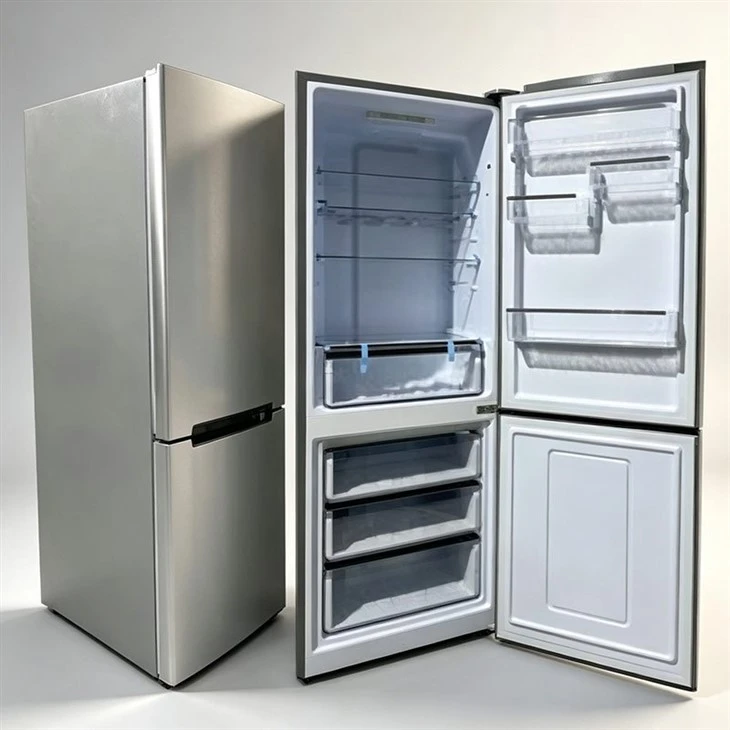
At 338 litres it is the largest cabinet in our direct-current range. The volume is arranged the way a European kitchen arranges it: the fresh-food compartment occupies the top two thirds at eye level, and the freezer sits underneath as a stack of drawers. That single decision changes how the appliance is used every day. Nothing in daily use requires bending to the floor, and the frozen stock - the part that is checked least often and spoils most expensively - pulls out towards you instead of being buried behind a door shelf.
Electrically it is a pure DC machine. There is no compressor-driven inverter stage and no need for one: the compressor runs from 12 V or 24 V directly, and the terminal block on the back accepts both with a stated window of 9.6 to 17 V and 21.3 to 31.5 V. Rated input is 130 W and the terminal is rated for 20 A, so a 24 V installation carries roughly half the current of the same load at 12 V - which is the difference between a cable run that works and one that browns out on start.
|
338 L
TOTAL VOLUME
|
130 W
RATED INPUT
|
4.5 kg
FREEZING / 24 H
|
1860 mm
HEIGHT
|
What 338 litres looks like in a room
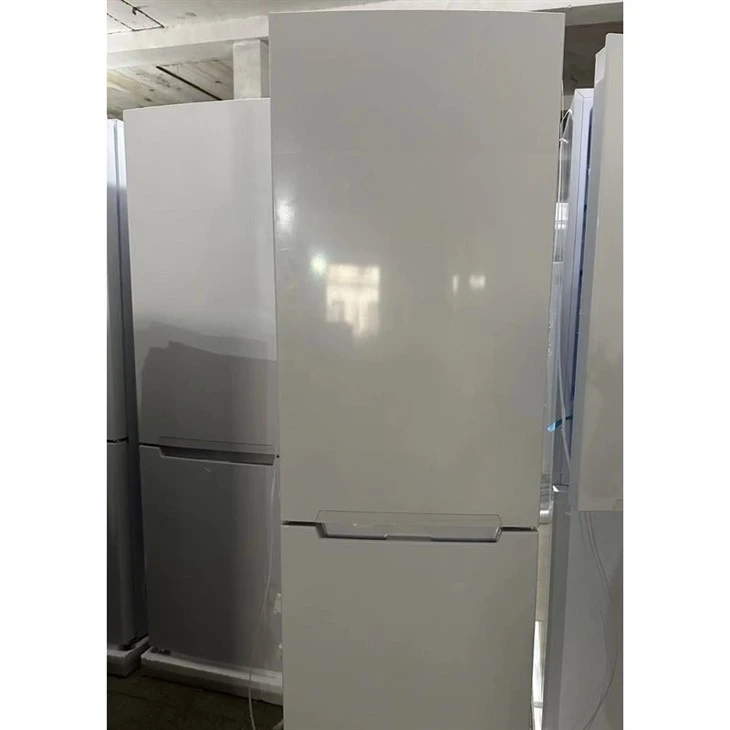
Footprint is 595 mm wide by 695 mm deep, which is the same width as a standard 600 mm kitchen unit and slightly deeper because of the condenser and the door swing clearance behind the frame. At 1860 mm tall the cabinet reaches above the average worktop and sits close to the height of a standard tall larder unit, so in a run of kitchen furniture it does not look like an appliance that has been added afterwards.
The doors hinge on the right as standard. Because the cabinet is tall and the two doors are separate, the fresh-food door is the one that gets opened constantly and the freezer drawers are opened independently - there is no shared air path that dumps the freezer temperature every time somebody takes out a bottle of water.
Net weight is 64 kg and gross 75 kg in the export carton. Two people can walk it through a standard doorway on a strap, and it stands on adjustable feet that take up 20 mm of floor variation, which matters in a cabin or a converted outbuilding where the slab is not level.
|
MODULE 02
Two compartments, two different jobsThe upper compartment is the working volume: 240 litres on three epoxy-coated wire shelves with a clear crisper bin below them, plus three moulded bins in the door. Wire rather than glass is a deliberate choice on a DC cabinet. Cold air is delivered from the evaporator at the top rear and has to travel down through the load; open shelving lets it pass, and it also means the shelves lift out for washing without tools. The lower compartment is 98 litres split across three clear drawers on telescopic runners. Clear fronts matter more than they sound: in a bottom freezer you are looking down into the compartment, and being able to see what is in each drawer without pulling all three is the difference between a freezer that gets used and one that fills up with unidentified bags. Both compartments are frost free. The evaporator is a finned coil behind a cover, a fan circulates air across it, and a timer defrosts the fins and drains the melt water to a pan around the compressor where it evaporates. Nobody has to empty a tray or chip ice off a wall. |
 |
| Compartment | Volume | Fitted with | Holds, in household terms |
|---|---|---|---|
| Fresh food, top | 240 L | Three wire shelves, one clear crisper bin, three door bins | A full weekly shop for four people, plus drinks |
| Freezer, bottom | 98 L | Three clear drawers | About 70 kg of frozen food, in three sorted drawers |
| Freezing capacity | 4.5 kg / 24 h | Rated on the rating plate | Enough to freeze a fresh delivery without warming the stock |
Capacities are the usable volumes declared for the model. Freezer volume is the net figure after the drawer runners and evaporator cover are accounted for.
The electrical side, read straight off the rating plate
Solar refrigeration gets sold on the panel and dies on the wiring. So the useful specification is not "12 V / 24 V"; it is the voltage window the control board will actually tolerate, the current the terminal will take, and what happens at the ends of that window. Every figure below is printed on the plate of the production units, and the plate is reproduced further down this page.
| Plate marking | Value | What it means in an installation |
|---|---|---|
| Rated voltage | DC 12 V / 24 V | One cabinet, two system voltages; selected by which pair of terminals is fed |
| Input power | 130 W | Compressor running load, not a continuous draw |
| Terminal rating | 20 A max | Sets the fuse and the minimum cable cross-section |
| 12 V window | 9.6 – 17 V | Survives charging voltages and a discharging bank |
| 24 V window | 21.3 – 31.5 V | Accepts equalisation and absorption from a 24 V array |
| Freezing capacity | 4.5 kg / 24 h | The rate at which fresh food can be frozen safely |
| Refrigerant | R600a, 54 g | Small hydrocarbon charge; no field charging in normal service |
| Net weight | 64 kg | Two-person handling, plus 11 kg of carton and packing |

Rating plate of a production BCD-338F unit: 130 W, DC 12 V / 24 V, R600a 54 g, 64 kg net.
|
MODULE 04
Six terminals and a colour codeThe connection box on the back of the cabinet is a proper terminal block rather than a flying lead. That matters for two reasons: a solar installation is inspected, and a screw terminal with a labelled cover is what an inspector, an insurer or a marine surveyor expects to see; and a block lets you run the correct cable size rather than being limited to whatever was moulded onto the end of a factory lead. Under the cover there are three positions marked GND, minus and plus, with SP and ST busbars behind them. The label above the block repeats the numbers: Power Input DC 12 V (9.6–17 V), DC 24 V (21.3–31.5 V), Current 20 A MAX. The cabinet ships with a pair of heavy-duty battery clamps for bench testing or temporary connection to a vehicle battery, and they are rated for that kind of load rather than being a token accessory. For a permanent installation, land the supply on the terminal block, fit an inline fuse sized to the conductor at the battery end, and keep the run as short as the layout allows. On a 12 V system every tenth of an ohm counts: 20 A through four metres of undersized cable will lose enough voltage to make the compressor stall and restart, and the symptom looks like a control-board fault rather than a cable fault. |
 |
12 V or 24 V: choosing the system voltage
The same cabinet runs on either system, so the choice is made once, for the whole site, and it is worth making deliberately. The cost of a DC installation is dominated by copper and by the battery bank, and both scale with current rather than with power.
| Decision | 12 V system | 24 V system |
|---|---|---|
| Current for the same 130 W | Roughly 11 A while running | Roughly 5.5 A while running |
| Cable run | Keep under a few metres, or go up two sizes | Comfortable over longer runs to a battery shed |
| Where it fits | Caravans, vehicles, small cabins, portable battery boxes | Fixed off-grid houses, farm systems, clinic stores |
| Existing hardware | Most 12 V accessories and inverters already on board | Most larger MPPT controllers have a 24 V setting |
| Practical rule | One or two appliances on a small bank | Refrigeration plus lighting and pumps on one bank |
Figures are calculated from the 130 W rated input at each nominal voltage and rounded; actual running current varies with compressor speed, ambient temperature and load.
 |
 |
What the display is telling you
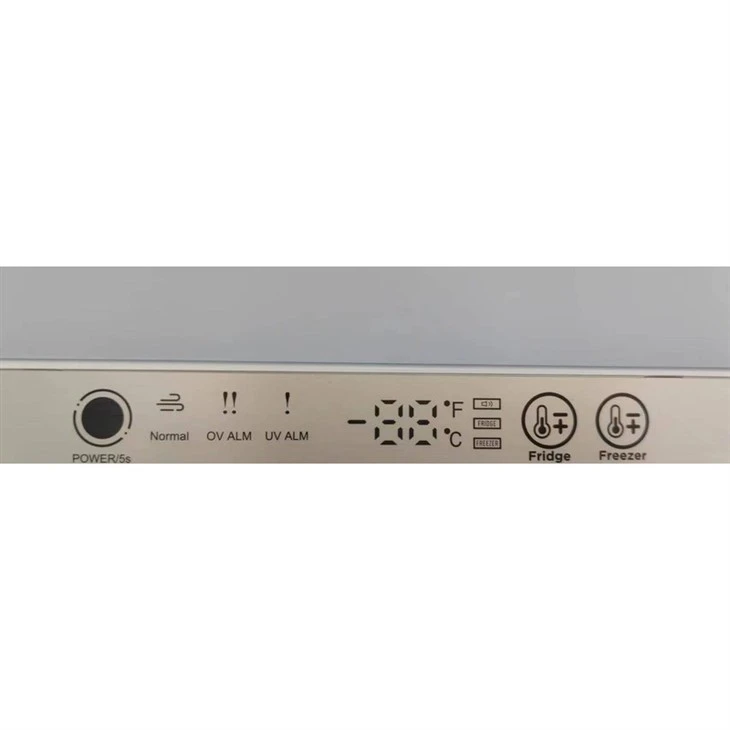
The control strip sits inside the fresh-food compartment at the top, behind the door. It is a membrane panel with a power button, an indicator row and two adjustment keys, and the indicator row is the part worth understanding because it is the cabinet's own diagnostic channel.
Normal is the steady run state. OV ALM means an over-voltage alarm: the supply has gone above the top of the window, which on a solar system usually means a charge controller set for the wrong battery type or a disconnected battery with the array still connected. UV ALM means under-voltage: the bank has fallen to the bottom of the window and the compressor has been stopped to protect itself. Both alarms tell you something about the installation, not about the refrigerator, and both are visible without a laptop or a service tool.
The two keys switch the display between fresh-food and freezer setpoints, and the reading shows in whichever unit the panel is configured for. Hold the power key for five seconds to switch the cabinet off without unplugging it - the useful routine before a long tow or a season in storage.

| Indicator | Meaning | What to do about it |
|---|---|---|
| Normal | Running within the voltage window | Nothing; log the reading at commissioning |
| OV ALM | Supply above 17 V (12 V) or 31.5 V (24 V) | Check controller battery setting; confirm a battery is connected |
| UV ALM | Supply below 9.6 V (12 V) or 21.3 V (24 V) | Bank is flat or the cable is dropping voltage; recharge and measure at the terminal |
 |
MODULE 07
Inside the fresh-food compartmentThree wire shelves, a clear crisper bin at the bottom and three moulded door bins: that is the whole furniture of the upper compartment. The wire is epoxy coated, which matters in a humid coastal site where bare steel would bloom within a season. The rear wall carries the evaporator cover and the air outlet. Nothing should be pressed against it: the return air travels down the back and forward under the bottom shelf, so a shelf loaded flush to the wall blocks the coldest part of the circuit. Leave a hand's width clear at the back of every shelf. The thermostat sensor and the display board sit behind the trim at the top, which is why the compartment reads the air temperature rather than the wall temperature. On first pull-down the display will fall faster than the food does; trust a probe in a glass of water if you need a true product temperature. |
|
MODULE 08
Three drawers instead of one boxA 98 litre freezer built as one open box is a chest freezer standing on end: everything ends up in a single heap and the oldest bag is always at the bottom. Split into three drawers, the compartment gets an order imposed on it - meat and fish in one, vegetables and fruit in the second, bread and leftovers in the third - and each drawer can be pulled out on its runners to the working height of the door opening. The drawers are clear polycarbonate on steel runners, with a stop at the end of travel so a full drawer cannot be pulled out onto the floor by accident. They lift out completely for washing. Thermal recovery is the practical benefit. Opening one drawer exposes roughly a third of the freezer volume for a few seconds; opening a single door exposes all of it for as long as somebody is searching. On a cabinet running from a battery, that difference shows up directly in the running hours. |
 |
Where a 338 litre DC cabinet is the right answer
Below about 200 litres, a solar refrigerator is a compromise: you shop every second day and the freezer is a token compartment. The BCD-338 is the size at which a household stops adapting its habits to the appliance. These are the installations it is most often specified for.
| Installation | Why the size works | System it usually pairs with |
|---|---|---|
| Off-grid house | Full weekly shop for four; freezer holds a bulk buy | 24 V array, 400–800 Ah bank |
| Cabin or holiday home | Runs unattended for weeks; frost free means no defrost visit | 24 V array with AGM or lithium bank |
| Rural clinic or health post | Cold chain in the freezer drawers, dressings and samples above | 24 V with a defined low-voltage cut-out |
| Village shop or guest house | Display volume plus frozen lines without a generator | 24 V array, larger bank for evening trade |
| Boat or long-stay vehicle | Bottom freezer keeps weight low in the hull; 12 V native | 12 V service bank with short cable runs |
Bank sizes are indicative starting points for sizing conversations, not quotations. Ambient temperature, door openings and the mix of frozen to fresh load move the number significantly.
Commissioning a tall cabinet
At 1860 mm the cabinet will pass through a standard 1980 mm door frame upright, but not with packing still on the top. Measure the route before the unit leaves the pallet: the tight spot is usually a stairwell turn or a low bulkhead, not the doorway itself. If the unit has travelled on its side, stand it upright and leave it for at least four hours before switching on so the compressor oil drains back to the sump.
Allow 100 mm of clear space behind the rear panel for the condenser, and do not push the cabinet into a recess that is closed at the top: the warm air has to escape upwards. On a 130 W machine the heat rejected is modest, but a cabinet that re-breathes its own exhaust will run long hours and, on a battery, will look like a power problem rather than an airflow problem.
Then run it empty for a few hours, check that the freezer reaches temperature and that the display holds the setpoint, and only then load it. Loading warm product into an empty cabinet on the first afternoon is the most common reason a new installation looks weak in its first week.
 |
 |
BCD-338 cabinets on the line before packing. Every unit is run and leak-tested before the carton is closed.
|
MODULE 11
Service, spares and the second ownerThere is very little to wear out. The compressor is a sealed DC unit, the fans are the only moving parts outside it, and the control board is a plug-in module behind the top trim. The parts that do age are the door gaskets and the drawer runners, and both are stocked as spares because a cabinet of this size is usually bought to last a decade rather than a season. Cleaning is the routine that keeps a frost-free cabinet efficient: wipe the gasket line, lift the wire shelves and wash them, and check that the drain channel at the back of the fresh-food compartment is clear. If the channel blocks, melt water from the defrost cycle ends up in the bottom of the compartment instead of the pan. The instruction manual travels with every unit and covers both the BCD-338F and the shorter BCD-298F, since the two share a control system. It is written for the installer as well as the user, with the wiring terminals, the alarm codes and the defrost sequence described in the same language as the plate on the back. |
 |
| Item | Value |
|---|---|
| Model | BCD-338 (BCD-338F) |
| Total capacity | 338 L - 240 L fresh food, 98 L freezer |
| Temperature range | 0 to 10 °C fresh food, −18 °C or below in the freezer |
| Product dimensions | 595 × 695 × 1860 mm (W × D × H) |
| Carton dimensions | 650 × 735 × 1950 mm |
| Gross / net weight | 75 kg / 64 kg |
| Input voltage | DC 12 V (9.6–17 V) and DC 24 V (21.3–31.5 V) |
| Rated input power | 130 W |
| Terminal rating | 20 A maximum |
| Freezing capacity | 4.5 kg / 24 h |
| Refrigerant | R600a, 54 g charge |
| Climate class | ST |
| Defrost | Frost free, automatic |
| Door | Two doors, right hinge as standard, reversible to order |
Buyer questions on this model
No. It is the load while the compressor is running. Over a day the compressor cycles, so the energy used is the running power multiplied by running hours, which depends on ambient temperature and how often the door is opened. Size the bank against running hours, not against 24 hours of 130 W.
The cabinet is a DC appliance. If a site has mains only, a suitably rated power supply of the correct voltage and current can feed the terminal block, but the installation then has two conversion stages and is less efficient than the same cabinet on a battery. Tell us the site and we will quote the right configuration rather than leaving the adapter to chance.
Yes, provided the charge controller is configured for the chemistry and the low-voltage cut-out is set high enough to leave the battery above its own protection threshold. The 9.6 V and 21.3 V lower limits on the plate are the cabinet's protection, not the battery's; the battery protection setting is what saves the bank.
The carton is 650 × 735 × 1950 mm and the gross weight 75 kg. Loading quantity depends on how the container is planned, so we confirm it per order rather than quoting a single figure that may not hold for mixed loads.
This cabinet is built as a bottom-freezer. If the layout of a kitchen or a vehicle makes a top-freezer cabinet easier, the BCD-288 is the same family at 288 litres with the freezer above the fresh-food compartment.

Send us the lowest ambient temperature the cabinet will see, the hours per day the site has no sun, and whether the bank is 12 V or 24 V. We will come back with the cabinet configuration, the cable and fuse sizes for the run, and the battery capacity that covers the overnight load with margin. Samples are available from stock in the export carton listed above, and OEM badging is routine for this model.
Inside the factory that builds this system
|
Hangzhou Juka Solar Technology was founded in 2015 around one problem: putting solar energy, new energy and smart control to work inside a refrigeration circuit. The range has since grown from a single DC chest freezer to solar refrigerators, solar ice makers, mobile ice-cream carts, delivery tricycles and beverage retail carts - all of them exported, most of them to Belt and Road markets. The work does not stop at the container. Partners in Ghana, Gabon, Cameroon, Nigeria, Kazakhstan and India are supported in setting up their own local production for retail and delivery refrigeration, which is how a cold chain becomes permanent rather than a series of one-off shipments. For a solar system this matters more than for a mains-only freezer. Panel sizing, controller rating and battery capacity all depend on cabinet volume and site conditions, so the cabinet and the electronics are engineered together instead of being bought separately by the importer. |
 |
What is decided before the cabinet is built
|
Wall thickness is a production parameter 65 mm or 110 mm foam is set on the foaming line, not assigned in a brochure. Insulation that is specified but not achieved is the usual reason a solar cabinet underperforms in its first hot season. |
One bill of materials Panel, controller, battery and cabinet are listed together, so the importer receives a system whose parts were sized against each other rather than sourced independently. |
|
Voltage as an order option DC input, AC adapter voltage, plug type and control panel artwork are selected per market on the same platform - no separate tooling run for a different destination. |
Repeatable on the second container Foam thickness, fittings and controller model are held per customer, so a follow-up order matches the first one instead of drifting. |
Certification and test documentation
CE marking covers the electrical arrangement, and utility model patents cover the cabinet and the direct-drive control layout. Documents travel with the order so they can be presented at customs and to institutional or tender buyers.

CE - low voltage and EMC |

CE - supplementary schedule |

Utility model patent - cabinet structure |
On the floor
 |
 |
 |
 |
Six control points behind every cabinet
|
01 |
Foaming runs inside a constant 20-23 °C room, so the foam quality does not shift with the season. |
|
02 |
Condenser and evaporator are nitrogen purged before any pipe joint is made, keeping the internal circuit clean. |
|
03 |
Vacuum is pulled to below 20 Pa. A unit that does not reach spec is never charged with refrigerant. |
|
04 |
Two leak tests per cabinet with an INFICON detector - one unpowered, one running. |
|
05 |
A constant-temperature test room confirms refrigeration parameters under identical conditions all year. |
|
06 |
Production and quality control are separate departments. Only cabinets signed off by a QC inspector are packed and warehoused. |
Machines on the line
|
Equipment |
What it gives the buyer |
|
Automatic laser cutting machine |
Consistent panel geometry, tight tolerances, clean edges |
|
Punch press and bending machine |
Repeatable cabinet forming from unit to unit |
|
Dual-gun high-pressure foaming machine |
Even density across the whole cabinet, no thin spots |
|
CACL high-precision filling machine |
Precise refrigerant charge on every unit |
|
INFICON high-sensitivity leak detector |
Finds leaks that ordinary detectors pass |
OEM, ODM and local assembly
Cabinet-only supply, private label, SKD and CKD shipments are all available, together with technical guidance for partners who would rather assemble locally than import finished units. Helping partners build their own refrigeration business is the part of the work that outlasts a single purchase order.
What can be changed on a standard order:
✓ Customer logo and cabinet colour
✓ Voltage options and plug type
✓ Packaging design
✓ Product configuration, baskets and fittings
✓ Panel, controller and battery included, or cabinet supplied on its own
Hot Tags: solar powered portable fridge freezer refrigerator, China solar powered portable fridge freezer refrigerator manufacturers, suppliers, factory


