


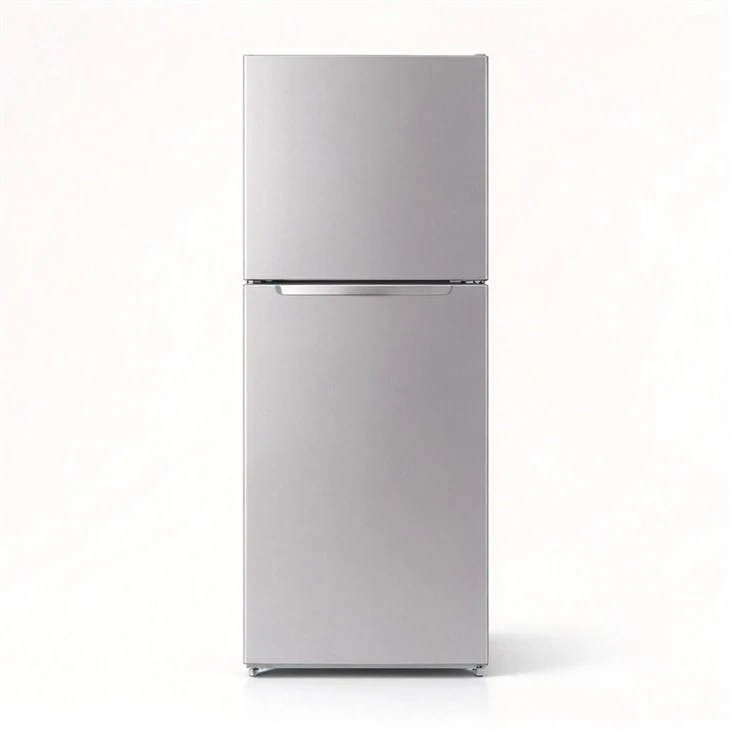


Top Freezer, Frost Free, 12 V / 24 V DC And 220 V AC - Built To Be Plugged In Where The Event Is
An outdoor event has a short, unforgiving timetable. The truck arrives at six, the guests at four, the last plate goes out at eleven, and somewhere between those hours a hundred kilograms of food has to stay below four degrees without a single wall socket within reach. Most refrigeration fails this test not because it cannot get cold, but because it was designed around a building.
The BCD-288 is designed around the truck instead. It is a 288 litre two-door cabinet with the freezer on top, and it will run from a 12 V vehicle circuit, a 24 V solar battery bank, or a normal 220 V supply, chosen at the plug rather than at the factory. There is no inverter to buy, no separate changeover box to wire, and no moment during setup when somebody has to decide which power system the site is going to use.
Everything else in this page is about the two questions that actually decide whether a unit survives a season of events: how much food it holds at a workable temperature, and how little power it needs to hold it. The cabinet is 1520 mm tall on a 606 by 680 mm footprint, so it passes through a standard 700 mm service door and stands against the back wall of a catering tent without blocking the line.
|
288 L
TOTAL VOLUME
|
12 / 24 V
DC INPUT
|
220 V
AC INPUT
|
Frost free
NO MANUAL DEFROST
|
The cabinet in one paragraph
A freestanding two-door refrigerator with the freezer compartment on top, the fresh-food compartment below, and a single moulded divider carrying a recessed grip where both doors meet. The doors hinge on the right as standard. The interior is built from epoxy-coated wire shelves rather than sealed drawers, because wire shelves let cold air move through the cabinet and because they can be lifted out and hosed down at the end of a service - a real advantage when the load has been sitting in a field.
The cooling system is a DC variable-speed compressor matched to a fan-cooled condenser at the rear and a finned evaporator behind a cover at the top of the fresh-food section. Frost-free operation comes from circulating air across that coil and cycling the compressor off on a timer to melt what collects on the fins, so the walls of both compartments stay dry and no ice sheet ever reaches the door gasket. The melt water runs to a pan around the compressor and is evaporated by the hot discharge pipe.
Power is the part that separates this cabinet from an ordinary domestic refrigerator. The compressor is a direct-current unit, so a 12 V or 24 V battery can feed it without an inverter in the path. A separate 220 V input covers sites that do have mains, and a small automatic changeover inside the cabinet selects whichever supply is present. That means the same unit can leave the warehouse on 220 V, run from the van battery during transit stops, and finish the event on a solar battery bank - with nothing to reconfigure between the three.
|
MODULE 02
Three ways to plug it inA 12 V lead is the simplest connection and the one most event crews use first. It plugs into a vehicle auxiliary socket, a caravan distribution board or a portable battery box, and the compressor starts drawing at whatever speed the thermostat asks for. Because the compressor is a DC machine, the current path is battery, fuse, cabinet - no inverter, no idle draw, no heat sink in a sealed box. A 24 V bank is the same connection with twice the voltage. Current halves, cable losses fall by three quarters for the same conductor size, and the run from a battery shed to a marquee can be longer than a 12 V system comfortably allows. This is the setting for a solar array on a farm, a permanent off-grid kitchen, or a battery bank sized for a multi-day festival. The 220 V inlet covers everything else: a generator on a film set, a site distribution board, or a normal wall socket during storage. Switching between DC and AC is automatic, so a generator that stops at midnight does not take the cabinet down as long as a battery is still connected. |
 |
| Supply | Typical source on site | What it is good for | Watch out for |
|---|---|---|---|
| 12 V DC | Vehicle auxiliary socket, portable battery box, caravan board | Day trips, market stalls, single-day events | Cable length; keep the run short and fused |
| 24 V DC | Solar array with battery bank, off-grid kitchen | Multi-day festivals, farm stays, remote sites | Bank must be sized for the night load, not the array |
| 220 V AC | Generator, site distribution board, wall socket | Prep kitchens, film sets, storage and display | Generator must be rated for compressor starting |
Only one supply feeds the compressor at a time; the internal changeover selects the live source. Do not connect DC and AC simultaneously unless the installation has been checked for it.
How 288 litres is actually split
Capacity on a label and capacity in a service are two different numbers. A cabinet rated at 288 L only helps a caterer if the shelves take the trays they own, and if the cold air can reach the middle of a full load. The BCD-288 solves this with a top-freezer layout and open shelving, which trades a little theoretical volume for a lot of practical access.

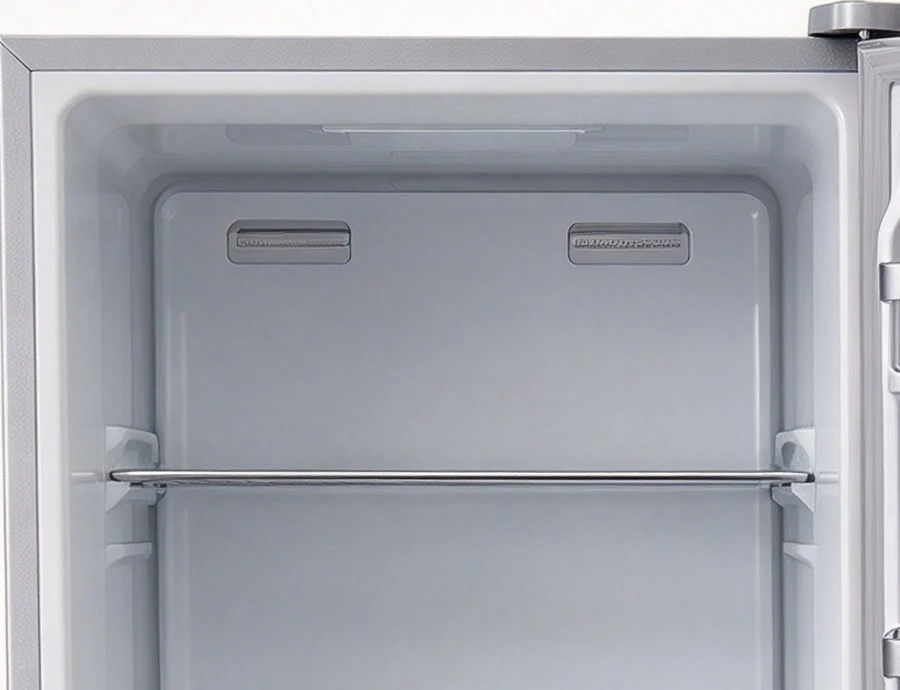
BCD-288 with both doors open on site. Fresh-food compartment below, 75 L freezer above.
| Zone | Volume | Fitted with | Holds, in catering terms |
|---|---|---|---|
| Freezer, top | 75 L | Wire shelf above a clear lower bin | About 55 to 60 kg of frozen product in cartons |
| Fresh food, lower | 213 L | Three wire shelves plus a bottom bin | Two full 1/1 gastronorm trays per shelf level |
| Door bins | Counted in total | Moulded shelves on both inner door panels | Bottles, dressings, garnishes, service dairy |
 |
MODULE 04
Wire shelving is the right choice outdoorsGlass shelves look better in a showroom and behave worse in a field. They block airflow, they crack when a tray is dropped on a cold corner, and they cannot be cleaned with a hose. The BCD-288 uses epoxy-coated steel wire on every level of both compartments, with a clear bin at the bottom of each section to catch anything that leaks. The consequence is a cabinet that cools evenly from the top down instead of stratifying into a cold bottom and a warm middle. Air leaves the evaporator, travels down the back duct, passes through the wire shelves and returns along the door side. A full load therefore cools in roughly the same time as a half load, which matters when a delivery lands ninety minutes before service. All shelves lift out without tools. At the end of an event the interior can be emptied, the wire racks pulled, and the whole cabinet washed down and left to dry with the doors open - the maintenance routine that keeps a rental fleet from developing smells. |
Frost free, for the reason that matters at an event
Every manual-defrost cabinet fails on the same schedule. Moisture comes in with the air and with the food, condenses on the coldest surface inside, and freezes. The ice insulates the coil, the compressor runs longer to hold the same temperature, the running hours climb, and by the third day of a humid outdoor job the freezer door will not close on its gasket. Somebody then spends an hour with a scraper and a bowl while the load sits in the sun.
The BCD-288 never gets there. The evaporator is a finned coil behind a cover, not a plate welded to the inner wall, so it can be held well below freezing while the food zone above the bin stays between 0 and 10 °C. A fan pulls air across the fins and pushes it through the cabinet. Because that air is continuously dried across the coil, the inner walls stay above the dew point and no ice sheet forms on them. A timer then stops the compressor at fixed intervals, the fins warm, the frost on them melts, and the water runs down a channel into the pan around the compressor where the discharge pipe evaporates it away.
Nothing is collected. Nothing is poured out. No one has to be on site for it. For a unit that may be loaded, driven, unloaded and reloaded four times in a week, that is the single most valuable feature on the specification.
| Situation | Manual-defrost cabinet | BCD-288 frost free |
|---|---|---|
| Third day of a humid outdoor event | Ice on freezer walls, door seal lifting | Walls dry, seal clean, no action needed |
| Power budget on a battery bank | Running hours rise as ice builds | Duty cycle stays stable across the season |
| Between events, in storage | Must be defrosted and dried before parking | Switch off, prop the doors, done |
| Hygiene inspection | Melt water and food residue in the base | Water drains to the pan and evaporates outside |
| Labour | Scheduled defrost shift, scraper, towels | None |
|
MODULE 06
Temperature, and what the thermostat is really doingThe fresh-food compartment is set to run between 0 and 10 °C. That band is wide on purpose. A catering unit is opened dozens of times an hour during service, and each opening dumps warm humid air onto the shelves. A cabinet set to 2 °C with a fixed-speed compressor spends the whole evening trying to recover, while a unit that rides inside a defined band with a variable-speed compressor simply increases speed for a few minutes and then settles back. The freezer holds −18 °C or colder, which is the temperature frozen product is legally expected to travel and be stored at in most markets. Because the two compartments share one compressor but not one evaporator circuit, the freezer is cooled first and the fresh-food section is fed from the return air, which is why the freezer recovers fastest after a door opening. A mechanical thermostat with an interior dial controls the band; there is no touch panel to fail in the rain. Set it once, note the position, and check it against a probe thermometer at the start of each event rather than trusting the dial. |
 |
Six events, one cabinet
The same 288 litres gets loaded differently depending on the job. These are the configurations our customers actually run, with the power source each one tends to use.
| Event | What goes in | Supply used | Typical duration |
|---|---|---|---|
| Beach or garden wedding | Canapes, cream desserts, ice for the bar, white wine | 12 V battery box | 1 day |
| Food festival stall | Prepped proteins, sauces, garnishes, back-up stock | 24 V solar bank | 3 to 5 days |
| Farmers market | Dairy, cheese, chilled produce for display and sale | 12 V or 24 V | Weekly, recurring |
| Film or production set | Craft service, chilled drinks, medication, samples | 220 V generator | 2 to 12 weeks |
| Remote clinic or aid post | Vaccines and cold-chain packs in the freezer, dressings below | 24 V solar bank | Continuous |
| Farm stay or glamping kitchen | Guest breakfast stock, frozen bread, drinks | 24 V array, AC backup | Season-long |
Loads are indicative. Ambient temperature, door openings and how much unfrozen product goes in at once all move the duty cycle, which is why we size battery banks against the worst day of the season rather than the average.
Sizing the power for a real event day
Refrigeration is the easiest load on an off-grid site to plan, because it is a duty cycle rather than a continuous draw. The compressor runs until the thermostat is satisfied and then rests. The question is never the instantaneous current; it is how many hours of running the compressor needs across a 24 hour period, and how much of that the battery can supply without the array's help.
Three things push the duty cycle up. Ambient temperature first: a cabinet standing in a marquee at 34 °C sheds heat far more slowly than one in a 22 °C kitchen. Door openings second: a service where the door is opened forty times an hour effectively resets the thermostat forty times, and the compressor spends the evening catching up. Warm product third: a load of room-temperature drinks put in at four in the afternoon will keep the compressor busy for hours, and it also warms whatever is already inside.

Coastal site running from a small solar array. Shade and airflow around the condenser matter more than panel wattage on a hot day.
| Change on site | Effect on running hours | Practical countermeasure |
|---|---|---|
| Cabinet in direct sun | Rises sharply; condenser cannot reject heat | Shade the cabinet, leave 100 mm at the rear |
| Frequent door openings | Rises with each opening during service | Pre-plate; keep a small service fridge up front |
| Warm product loaded | Long continuous run for several hours | Chill in a 220 V prep kitchen before loading |
| Freezer held at −18 °C in summer | Higher than the fresh-food section alone | Size the bank for the freezer, not the average |
| Undersized DC cable | Voltage drop causes the compressor to stall and restart | Keep the run short; check drop at the cabinet terminals |
 |
MODULE 09
Airflow is the specification nobody readsA frost-free cabinet moves cold air deliberately. From the evaporator the air is pushed along the rear duct, released between the wire shelves, drawn forward across the food and returned down the door side to be cooled again. That circuit is why a wire shelf outperforms a solid shelf in a full cabinet: the load is cooled from all four faces instead of only from above. It is also why the block of the cabinet matters. Leave 100 mm clear behind the rear panel, keep the condenser fins free of dust and straw, and do not push the unit into a corner where it re-breathes its own warm exhaust. A cabinet packed in against a tarpaulin wall will run twice as long as the same cabinet standing in the open. Loading matters too. Cold air has to fall. Do not overfill the top shelf so that it seals against the duct outlets, and do not press product against the rear wall where the return air travels. Both mistakes make a good cabinet look weak. |
Moving it, packing it, shipping it
An event refrigerator spends more of its life being handled than a kitchen refrigerator ever does. The BCD-288 is built accordingly: a one-piece steel shell with a foamed-in frame, doors that latch positively rather than relying on magnetics alone, and levelling feet that can be wound up for transport without removing anything.
| Item | Value |
|---|---|
| Model | BCD-288 |
| Total capacity | 288 L - 213 L fresh food, 75 L freezer |
| Input voltage | 12 V / 24 V DC and 220 V AC |
| Temperature range | 0 to 10 °C fresh food, −18 °C or below in the freezer |
| Product dimensions | 606 × 680 × 1520 mm (W × D × H) |
| Carton dimensions | 625 × 735 × 1575 mm |
| Gross / net weight | 60 kg / 54 kg |
| Loading quantity, 40' HQ | 79 units |
| Refrigerant | R600a |
| Defrost | Frost free, automatic |
79 units per 40' HQ makes the model practical for rental fleets and for distributors who need a full container of one size rather than a mixed load. Dimensions and weights are nominal; confirm against the drawing for a specific order.
 |
MODULE 11
The first twenty-four hoursA refrigerator that has been on a truck should stand upright for a few hours before it is switched on, so the oil settles back into the compressor sump. Transport in a horizontal position, if unavoidable, needs a longer rest - overnight is safest. Connect the supply and let the cabinet run empty until the freezer reaches temperature. Loading a warm cabinet with product delays the pull-down and, on a battery, drains the bank during the worst possible hours. Check the door seals with a sheet of paper: closed on a strip, the paper should resist a steady pull all the way round. For a solar site, start the cabinet on the battery bank in the morning so the array can carry the pull-down. For an AC site, confirm the generator accepts the compressor start without the voltage collapsing - if lights dip on start, the generator is too small for the load. |
Questions buyers ask before the first order
Yes, from the auxiliary circuit at 12 V, provided the circuit is fused and the cable is adequate for the run. A vehicle socket is not designed for long continuous loads, so a dedicated feed from the battery through a fuse is the correct installation for anything longer than a short transfer.
No. The compressor is a DC unit and runs directly from the 12 V or 24 V bank. An inverter is only relevant if you want to use the 220 V inlet from a battery system, which is a less efficient route and is not necessary here.
A low-voltage cut-out protects the battery from deep discharge by stopping the compressor. Fit a controller with a defined cut-out and restart threshold, and treat the cut-out as an alarm rather than a normal operating state - a cabinet that trips every night needs a bigger bank.
Yes, at the factory for a confirmed order. Reversing in the field is possible but not recommended for a rental fleet, because the hinge plates and the door latch are matched as a pair.
It is, and a large share of these units go into homes that have no grid connection at all. The event framing on this page is simply the harshest version of the same duty: high ambient, frequent openings, and a power source that has to be planned.
The cabinet, the DC and AC leads for the configuration ordered, the interior wire shelves and bins as listed, and the instruction set. Battery, panel and controller are quoted separately so that the system matches the site rather than a fixed kit.
 |
 |
BCD-288 closed and open. The recessed grip sits in the divider between the two doors, so nothing projects from the front face.
 |
 |
 |
MODULE 13
Getting a quote for your siteTell us three things and we can size the system around the event rather than around the cabinet: the highest ambient temperature the unit will work in, the number of hours per day the site is without mains, and the volume of frozen product you need to hold. From there we quote the cabinet, the DC lead length you need, and the battery capacity that covers the overnight load with margin. Mixed containers, OEM badging and rental-fleet batches are all routine orders for this model. Samples for evaluation are available from stock, packed in the export carton listed above. |
Inside the factory that builds this system
|
Hangzhou Juka Solar Technology was founded in 2015 around one problem: putting solar energy, new energy and smart control to work inside a refrigeration circuit. The range has since grown from a single DC chest freezer to solar refrigerators, solar ice makers, mobile ice-cream carts, delivery tricycles and beverage retail carts - all of them exported, most of them to Belt and Road markets. The work does not stop at the container. Partners in Ghana, Gabon, Cameroon, Nigeria, Kazakhstan and India are supported in setting up their own local production for retail and delivery refrigeration, which is how a cold chain becomes permanent rather than a series of one-off shipments. For a solar system this matters more than for a mains-only freezer. Panel sizing, controller rating and battery capacity all depend on cabinet volume and site conditions, so the cabinet and the electronics are engineered together instead of being bought separately by the importer. |
 |
What is decided before the cabinet is built
|
Wall thickness is a production parameter 65 mm or 110 mm foam is set on the foaming line, not assigned in a brochure. Insulation that is specified but not achieved is the usual reason a solar cabinet underperforms in its first hot season. |
One bill of materials Panel, controller, battery and cabinet are listed together, so the importer receives a system whose parts were sized against each other rather than sourced independently. |
|
Voltage as an order option DC input, AC adapter voltage, plug type and control panel artwork are selected per market on the same platform - no separate tooling run for a different destination. |
Repeatable on the second container Foam thickness, fittings and controller model are held per customer, so a follow-up order matches the first one instead of drifting. |
Certification and test documentation
CE marking covers the electrical arrangement, and utility model patents cover the cabinet and the direct-drive control layout. Documents travel with the order so they can be presented at customs and to institutional or tender buyers.

CE - low voltage and EMC |

CE - supplementary schedule |

Utility model patent - cabinet structure |
On the floor
 |
 |
 |
 |
Six control points behind every cabinet
|
01 |
Foaming runs inside a constant 20-23 °C room, so the foam quality does not shift with the season. |
|
02 |
Condenser and evaporator are nitrogen purged before any pipe joint is made, keeping the internal circuit clean. |
|
03 |
Vacuum is pulled to below 20 Pa. A unit that does not reach spec is never charged with refrigerant. |
|
04 |
Two leak tests per cabinet with an INFICON detector - one unpowered, one running. |
|
05 |
A constant-temperature test room confirms refrigeration parameters under identical conditions all year. |
|
06 |
Production and quality control are separate departments. Only cabinets signed off by a QC inspector are packed and warehoused. |
Machines on the line
|
Equipment |
What it gives the buyer |
|
Automatic laser cutting machine |
Consistent panel geometry, tight tolerances, clean edges |
|
Punch press and bending machine |
Repeatable cabinet forming from unit to unit |
|
Dual-gun high-pressure foaming machine |
Even density across the whole cabinet, no thin spots |
|
CACL high-precision filling machine |
Precise refrigerant charge on every unit |
|
INFICON high-sensitivity leak detector |
Finds leaks that ordinary detectors pass |
OEM, ODM and local assembly
Cabinet-only supply, private label, SKD and CKD shipments are all available, together with technical guidance for partners who would rather assemble locally than import finished units. Helping partners build their own refrigeration business is the part of the work that outlasts a single purchase order.
What can be changed on a standard order:
✓ Customer logo and cabinet colour
✓ Voltage options and plug type
✓ Packaging design
✓ Product configuration, baskets and fittings
✓ Panel, controller and battery included, or cabinet supplied on its own
Hot Tags: solar for plugging fridge for outdoor event, China solar for plugging fridge for outdoor event manufacturers, suppliers, factory


