


Top Fresh-Food Compartment, Bottom Freezer, 12 V / 24 V DC, Supplied With PV Panel And Battery
A frost-free refrigerator earns its price in one specific way: nobody has to defrost it. In a grid-connected kitchen that is a convenience. In an off-grid kitchen, a lodge, a clinic store room or a container site, it is the difference between an appliance that quietly runs for years and an appliance that gets switched off because the ice finally reached the door seal and the drawers will not slide.
The BCD-298 is the frost-free member of our two-door solar family. Cold air is pushed through a finned evaporator and circulated around both compartments by a fan, so the surfaces inside the cabinet stay dry and the freezer walls never build a layer of ice. The defrost cycle runs on a timer, the melt water drains to the compressor pan and is evaporated by the warm discharge pipe. No chipping. No drip tray to empty. No calendar on the wall.
Everything else follows from that decision. Because the cabinet has to move air, the interior is built with open glass shelves and clear drawers rather than sealed boxes, and the cabinet walls are insulated to keep the fan-and-compressor duty cycle short. And because the machine is designed to live on a solar kit, the compressor is a DC unit that runs directly from a 12 V or 24 V battery bank - there is no inverter between the battery and the motor, so nothing is lost converting DC to AC and back again.
|
298 L
TOTAL CAPACITY
|
99 W
RATED INPUT
|
12 / 24 V
DC INPUT
|
Frost free
AIR-COOLED
|
What this cabinet is, in one paragraph
A freestanding two-door solar refrigerator, 1525 mm tall, with the fresh-food compartment on top and the freezer below. Both doors hinge on the right as standard and can be reversed at the factory. The doors carry no protruding handles - a recessed grip strip is moulded into the horizontal divider, which keeps the front face flat and makes the cabinet easier to move through a narrow doorway without snagging.
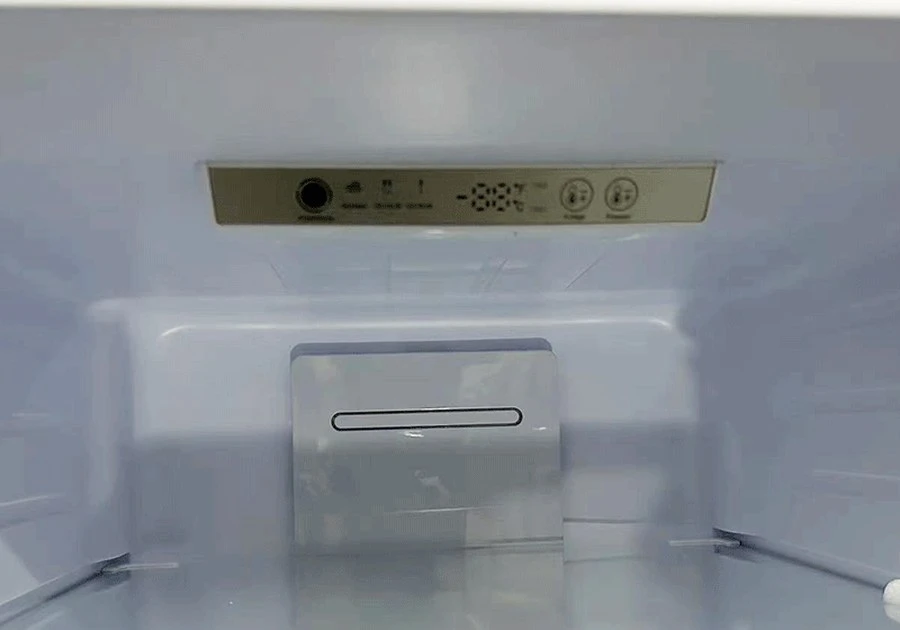
The compressor is a DC variable-speed unit fed from a 12 V or 24 V battery bank, drawing a rated 99 W when running. A small fan sits behind the evaporator cover in the fresh-food compartment and a second fan cools the condenser at the rear. The thermostat and its display sit in the ceiling of the upper compartment, where they are easy to reach without emptying a shelf.
It is supplied as a working kit, not a bare cabinet: one photovoltaic panel, one sealed gel battery, the controller and the interconnection hardware travel with the refrigerator so that the installer does not have to source compatible DC parts locally.
|
MODULE 02
Where frost comes from, and how the cabinet avoids itEvery manual-defrost refrigerator has the same weak point. Moisture enters with the air and with the food, condenses on the coldest surface - the evaporator - and freezes there. The ice insulates the coil, the compressor runs longer to reach the same temperature, and the cycle feeds itself. Eventually the ice reaches the door gasket and the drawers stop sliding. This cabinet breaks the cycle in two places. First, the evaporator is a finned block mounted behind a cover at the top of the fresh-food compartment, not a plate welded to the inner wall, so it can be kept below freezing while the food zone stays at 0 to 10 °C. A fan draws air across the fins and returns it through ducts along the back and sides. Because the air is constantly moving and being dried across the coil, the inner walls stay above the dew point and no ice sheet forms on them. Second, a timer interrupts the compressor for a short defrost period at fixed intervals. The fins warm, the frost on them melts, the water runs down a channel to the pan around the compressor, and the hot discharge pipe evaporates it into the room. Nothing is collected, nothing is poured away, and nobody has to be on site for it to happen. |
 |
| Consequence | Manual-defrost cabinet | BCD-298 frost-free cabinet |
|---|---|---|
| Ice removal | Ice has to be chipped or melted out, typically every few weeks in humid climates. | Automatic cycle; no manual work at any interval. |
| Temperature spread | Coldest against the inner wall, warmest at the door; a 5 to 8 °C spread is normal. | Air is circulated, so the spread across a shelf is narrow and the door area stays cold. |
| Drawer movement | Freezer drawers seize as ice bridges the runners. | Runners stay clear; drawers open with one hand. |
| Water handling | A drip tray or a floor cloth; overflow is a real risk if the site is unattended. | Condensate evaporates from the compressor pan; no tray to empty. |
| Long absences | The cabinet must be emptied and switched off before a seasonal closure. | Can be left running on the solar kit through a closed season. |
 |
MODULE 03
A DC drivetrain with nothing in the middleMost solar refrigeration on the market is an AC refrigerator with an inverter bolted in front of it. That arrangement works, but it adds a conversion stage, an extra point of failure and a standby drain that never switches off. The BCD-298 takes the other route: the compressor motor is wound for direct current and the controller inside the cabinet accepts 12 V or 24 V from the battery bank. Two benefits follow. Efficiency first - the energy that leaves the battery arrives at the motor instead of being converted twice. Simplicity second - there is one cable pair between the battery and the refrigerator, protected by one fuse, and no inverter to over-size, ventilate or replace. The variable-speed controller also softens the load. Instead of starting and stopping at full torque, the compressor ramps up, holds a steady speed while the cabinet pulls down, then idles at low speed to hold temperature. On a small array this matters more than the headline wattage: a soft start keeps the battery voltage from collapsing at the moment of startup. |
| Electrical data | Value |
|---|---|
| Input voltage | DC 12 V / 24 V (auto-detecting controller) |
| Rated input power | 99 W |
| Compressor | DC variable-speed, single unit |
| Refrigerant | R134a or R600, charged at the factory |
| Defrost | Automatic, timed, air-cooled evaporator |
| Interior light | LED strip in the fresh-food ceiling |
| Control | Thermostat with display, mounted in the upper compartment ceiling |
The kit: one panel, one battery, one controller
 |
The cabinet is offered with the photovoltaic side of the system attached, because a DC refrigerator sold without a panel and a battery leaves the buyer to guess at three numbers that decide whether the installation works: array wattage, battery capacity and controller current. Getting any of the three wrong produces the same symptom - a refrigerator that is cold in the afternoon and warm by midnight. The standard kit pairs the BCD-298 with one rigid monocrystalline panel, one sealed maintenance-free gel battery of the 100 Ah class and a charge controller. Panel wattage and battery capacity are confirmed on the order, because the right answer depends on where the cabinet will stand: a site at 15° latitude with eight hours of sun needs less array than a site at 40° with four, and a kitchen that opens all day needs more stored energy than a store room opened twice. Gel is the deliberate choice over flooded lead-acid. The battery sits indoors next to the appliance in most installations, and a sealed gel block needs no water top-up, vents no acid mist and tolerates partial-state-of-charge cycling far better than a conventional wet battery. |
| Item | Standard supply | Notes |
|---|---|---|
| Refrigerator | 1 unit, BCD-298, 298 L | Carton packed |
| PV panel | 1 rigid monocrystalline module | Wattage per order |
| Battery | 1 sealed gel battery, 100 Ah class | Capacity per order |
| Controller | Charge controller matched to the array | PWM or MPPT on request |
| Wiring and protection | Battery cable set, fuse holder, terminals | Length per order |
| Documentation | Wiring schematic and commissioning sheet | English as standard |
Cabinet alone, panel alone or battery alone can be quoted separately if the customer already owns part of the system.
Work the numbers before you order, not after
The compressor is rated 99 W when running, but it does not run continuously. Consumption is the rated power multiplied by the duty cycle, and the duty cycle is set by ambient temperature, how often the door opens and how much warm food is loaded at once. A worked example makes the arithmetic concrete: at a 40 % duty cycle the compressor runs about 9.6 hours a day, which is 99 W × 9.6 h ≈ 0.95 kWh per day before controller losses. Add roughly 8 % for the controller and cabling, and the figure to design against is about 1.03 kWh per day.
From there the array follows the local peak-sun hours, and the battery follows the number of sunless days you want to ride through. Those two inputs are site data, not product data - send us the location and the hours of daily sun and we will return a panel and battery combination instead of leaving the sizing to chance.
229 litres of fresh food, arranged for air
 |
Because the cold comes from circulating air rather than from the walls, the shelf layout is open. Tempered glass shelves with a moulded front lip sit on adjustable runners so the spacing can be changed without tools; the lip stops a spilled bottle from running the full depth of the cabinet. A full-width crisper drawer sits at the base of the compartment, above the divider, with a humidity lid that can be slid closed for leaf vegetables and opened for fruit. In a frost-free cabinet the crisper needs the lid: moving air is drying air, and the drawer is what keeps a bunch of herbs from wilting in two days. The door carries three full-width balconies and one shorter shelf at the top for tubes and small jars. The LED strip runs across the ceiling, so the whole compartment is lit when the door opens rather than just the front half. |
| Adjustable glass shelves Tempered, spill lip at the front, repositionable on moulded runners. |
Humidity crisper Full width, sliding lid, sized for a week of vegetables for four people. |
Door balconies Three full-width plus one half shelf; removable for cleaning. |
| Return-air ducts Moulded into the rear wall so shelves never block the circulation path. |
Ceiling control panel Thermostat and display in reach, clear of the food zone. |
LED strip Low-current lighting, no heat load inside the cabinet. |
|
MODULE 06
69 litres of freezer, all of it reachableThe freezer is a drawer box, not a chest cavity. Three clear polypropylene drawers stack on runners, each one shallow enough to reach the back without unpacking it. Clear fronts matter more than they sound: in a freezer, food goes in and is forgotten, and a drawer that hides its contents turns into a block of unidentified bags by the end of the season. The compartment holds ≤ −18 °C with a thermostat that is shared with the upper compartment and set on the ceiling panel. Because the evaporator sits in the fresh-food section, the freezer receives its cold air through a dedicated duct and returns it through a second one; the two ducts are the reason the freezer stays dry and the reason the drawers never ice to the runners. Practically, 69 L takes a 3 kg chicken, four 1 kg bags of portions, a tray of fish and a few ice trays with the drawers still sliding. For households freezing a whole lamb at once, the 98 L freezer of the BCD-338 is the better fit - same footprint family, same frost-free system. |
 |
Cabinet, doors and the details that age well
 |
 |
The cabinet is a single-piece foamed body with a stainless-look silver finish on the doors and a white interior liner. The door gasket is a magnetic profile that runs the full perimeter of both doors and can be replaced without dismantling the door - in dusty locations a gasket is the first part to lose its seal, and the second is the hinge.
The divider between the compartments carries the recessed handle: a moulded pocket that you reach into from above, wide enough for a gloved hand. Because the handle does not protrude, the cabinet's depth stays inside the 666 mm figure and the front face sits flush with a kitchen run when it is pushed back against a wall.
Four adjustable feet level the cabinet on an uneven floor. Levelling is not cosmetic on a frost-free unit: a cabinet leaning forward lets the doors swing open on their own, and a cabinet leaning back lets warm air fall out of the compartment every time the door is used.
Where to put it
 |
 |
| Clearance | Minimum | Why |
|---|---|---|
| Behind the cabinet | 100 mm | The condenser is on the rear panel; without an air gap it re-cools its own heat. |
| Either side | 50 mm | Door swing and heat release; also keeps the cabinet out of contact with a hot wall. |
| Above | 100 mm | A cupboard directly above traps the rising warm air. |
| In front of the door | 900 mm | Enough to open the lower door fully and pull a loaded drawer clear. |
Three placements to avoid: direct afternoon sun on the door, next to an oven or a cooking range, and an unventilated cupboard built around the cabinet. Each one raises the condensing temperature, and a solar refrigerator that runs hot simply runs longer - the cold is still produced, but the battery pays for it.
The cabinet is rated for indoor use. Under a roof with airflow, in a shaded veranda or inside a shop, it behaves as specified. Standing in open rain or in a coastal salt spray zone requires the outdoor variant of the enclosure - tell us at the enquiry stage.
What actually moves the daily consumption
Two identical cabinets in two locations can differ by 40 % in daily energy and neither is faulty. The variables are known, and most of them are decisions rather than defects.
| Variable | Effect on consumption | What to do |
|---|---|---|
| Ambient temperature | Largest single factor; a 10 °C rise in room temperature typically adds a quarter to a third to runtime. | Shade the cabinet, ventilate the room, keep it off a west-facing wall. |
| Door openings | Each opening spills cold air; twenty openings a day is a different duty cycle from five. | Decide before opening; use the door bins for the items used most. |
| Warm loads | A 5 kg load at room temperature can cost several hours of extra running. | Cool food before loading where the climate allows; spread loads across days. |
| Thermostat setting | Running the fresh-food zone at 1 °C instead of 4 °C is a real cost with no food-safety benefit. | 4 °C in the fresh zone and −18 °C in the freezer is the efficient pair. |
| Dust on the condenser | A matted rear coil can add a fifth to runtime within a year in a dusty site. | Brush or vacuum the rear panel twice a year. |
| Battery voltage sag | An undersized cable drops voltage under load and the controller derates the compressor. | Size the cable to the run; keep the battery as close to the cabinet as practical. |
 |
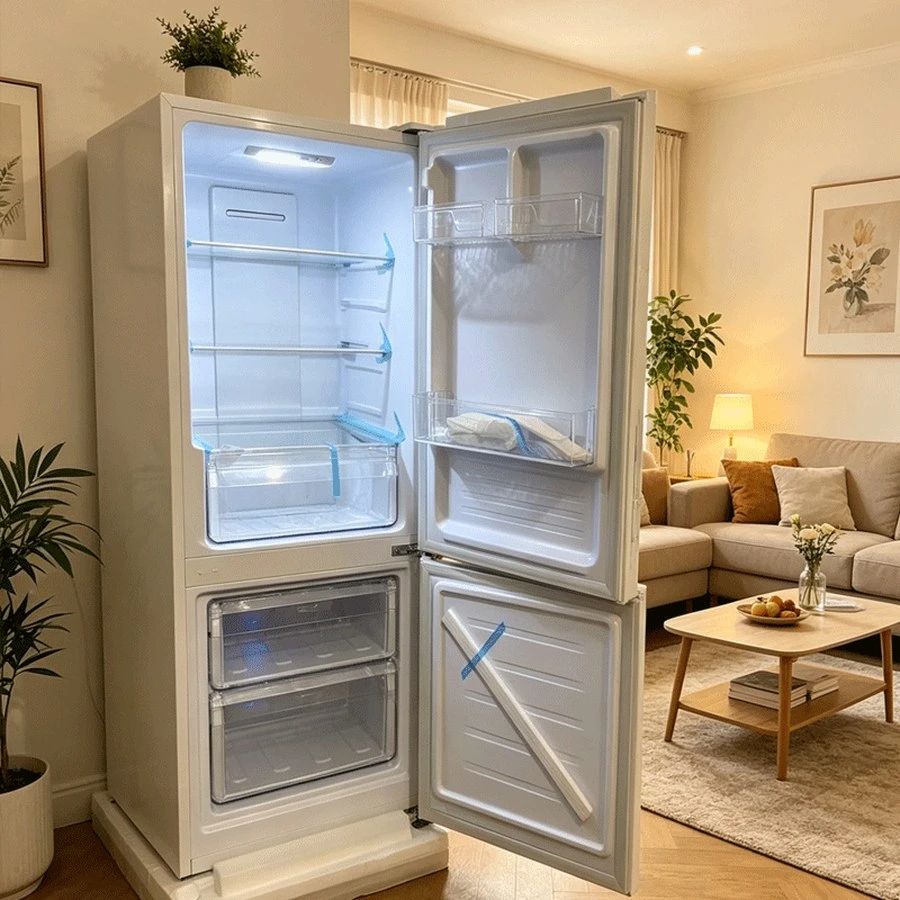
The interior above is a production unit with both doors open: fresh-food compartment with three glass shelves, the crisper at the base, the door balconies, and below the divider the three clear freezer drawers. The blue tape is factory masking on the shelf retainers and comes off before delivery. Notice what is not there - no ice box, no evaporator plate bolted to the back wall, no drip channel on the floor of the compartment. Those parts are absent because the frost never forms where the user can see it. |
Full technical data, BCD-298
| Model | BCD-298 |
| Configuration | Two doors, fresh food above, freezer below, frost free |
| Total capacity | 298 L |
| Fresh-food compartment | 229 L |
| Freezer compartment | 69 L |
| Temperature range | 0 to 10 °C fresh food / ≤ −18 °C freezer |
| Product dimensions (W × D × H) | 595 × 666 × 1525 mm |
| Carton dimensions (W × D × H) | 625 × 705 × 1575 mm |
| Gross / net weight | 64 kg / 60 kg |
| Power input | DC 12 V / 24 V |
| Rated power | 99 W |
| Refrigerant | R134a or R600, factory charged |
| Defrost | Automatic (air-cooled evaporator, timed cycle) |
| Shelving | Tempered glass shelves, full-width crisper, 4 door balconies |
| Freezer storage | 3 clear drawers on runners |
| Door | Reversible, recessed flush handle, magnetic gasket |
| Finish | Silver stainless-look doors, white interior liner |
| Installation | Freestanding, indoor, four adjustable feet |
| Supplied with | 1 PV panel, 1 sealed gel battery, controller, cable and fuse set |
| Loading | Container quantity confirmed on the order confirmation against the carton above |
Panel wattage, battery capacity, cable length and controller type are agreed at order stage; the figures above are the cabinet's own data. Alternative door colours, 220 V AC input and larger battery banks are available on request.
Commissioning in ten steps
|

Sealed gel battery, 100 Ah class. Maintenance free, no water top-up, suitable for indoor installation beside the cabinet.
|
Service schedule for a frost-free cabinet
There is no defrost task on this list - that is the point. What remains is the short list of jobs that keep the air circuit and the electrical side healthy.
| Interval | Task | Reason |
|---|---|---|
| Monthly | Wipe the door gasket and check it seals against a sheet of paper. | A leaking gasket is the most common cause of a cabinet that suddenly runs constantly. |
| Monthly | Look at the controller display for battery voltage and charge state. | A falling trend points at a shaded panel or a tired battery, weeks before it fails. |
| Every 3 months | Clean the return-air grilles inside the fresh-food compartment. | Dust on the grilles shortens the air path and warms the top shelf. |
| Every 6 months | Brush or vacuum the rear condenser and the compressor compartment. | Restores the original duty cycle in dusty conditions. |
| Every 6 months | Clean the panel glass with water; check the mounting bolts. | Soiling and loose fixings both cost yield. |
| Yearly | Check battery terminal torque and clean any white corrosion. | A loose terminal adds resistance exactly where the compressor needs current. |
| Before a long closure | Empty, clean, dry and leave both doors ajar. | Prevents odour and mould in the gasket fold. |
Choosing between the frost-free models
| Model | Freezer | Dimensions (mm) | G.W./N.W. | Defrost |
|---|---|---|---|---|
| BCD-198 | 80 L | 520 × 550 × 1515 | 47 / 42 kg | Manual |
| BCD-218 | 45 L | 550 × 575 × 1390 | 45 / 40 kg | Manual |
| BCD-268 | 55 L | 550 × 570 × 1619 | 50 / 45 kg | Manual |
| BCD-298 | 69 L | 595 × 666 × 1525 | 64 / 60 kg | Frost free |
| BCD-338 | 98 L | 595 × 695 × 1860 | 75 / 65 kg | Frost free |
All models share the 0 to 10 °C / ≤ −18 °C range and DC 12 V / 24 V operation. Choose BCD-298 when the freezer demand is moderate and the cabinet has to fit a 600 mm kitchen run; choose BCD-338 when the freezer is the main reason for the purchase.
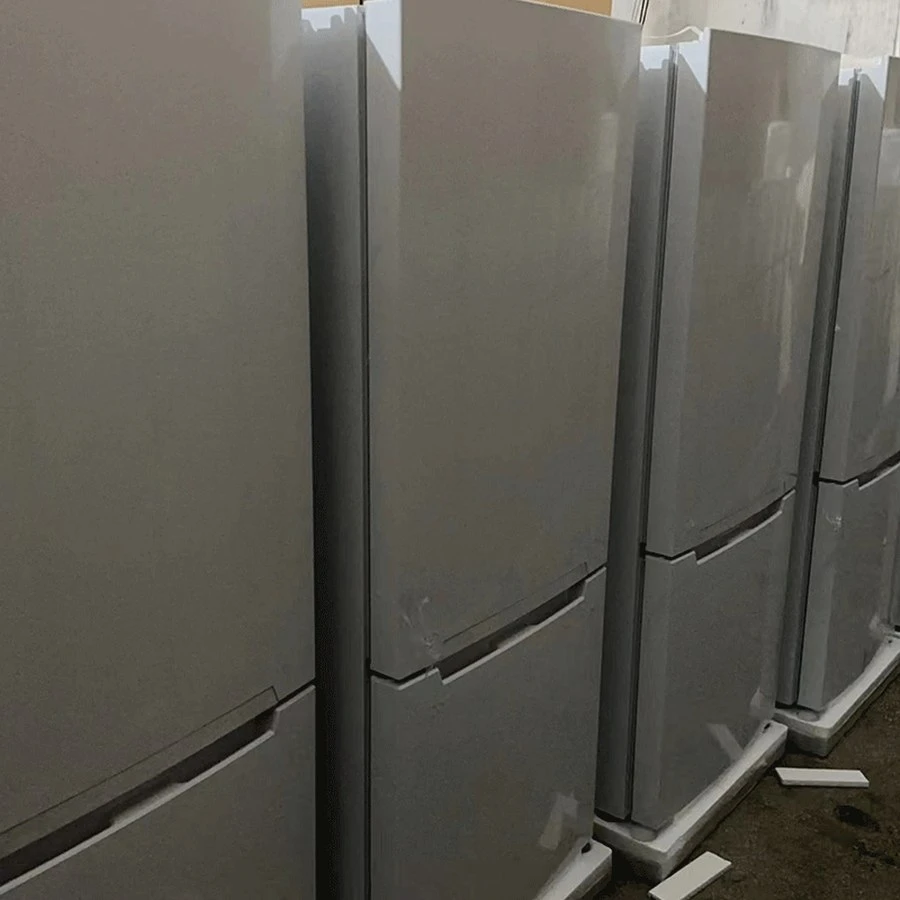
Production units on the assembly line, same cabinet family. Every unit is pressure tested, run for a full cooling cycle and inspected at the door seal before packing.
|
Questions buyers ask before ordering
Tell us where the cabinet will stand, how many sunless days the site has to ride through and what the freezer will hold. We will come back with a panel wattage, a battery capacity and a container plan - and a quotation for the cabinet on its own if you already own the solar side.
Inside the factory that builds this system
|
Hangzhou Juka Solar Technology was founded in 2015 around one problem: putting solar energy, new energy and smart control to work inside a refrigeration circuit. The range has since grown from a single DC chest freezer to solar refrigerators, solar ice makers, mobile ice-cream carts, delivery tricycles and beverage retail carts - all of them exported, most of them to Belt and Road markets. The work does not stop at the container. Partners in Ghana, Gabon, Cameroon, Nigeria, Kazakhstan and India are supported in setting up their own local production for retail and delivery refrigeration, which is how a cold chain becomes permanent rather than a series of one-off shipments. For a solar system this matters more than for a mains-only freezer. Panel sizing, controller rating and battery capacity all depend on cabinet volume and site conditions, so the cabinet and the electronics are engineered together instead of being bought separately by the importer. |
 |
What is decided before the cabinet is built
|
Wall thickness is a production parameter 65 mm or 110 mm foam is set on the foaming line, not assigned in a brochure. Insulation that is specified but not achieved is the usual reason a solar cabinet underperforms in its first hot season. |
One bill of materials Panel, controller, battery and cabinet are listed together, so the importer receives a system whose parts were sized against each other rather than sourced independently. |
|
Voltage as an order option DC input, AC adapter voltage, plug type and control panel artwork are selected per market on the same platform - no separate tooling run for a different destination. |
Repeatable on the second container Foam thickness, fittings and controller model are held per customer, so a follow-up order matches the first one instead of drifting. |
Certification and test documentation
CE marking covers the electrical arrangement, and utility model patents cover the cabinet and the direct-drive control layout. Documents travel with the order so they can be presented at customs and to institutional or tender buyers.

CE - low voltage and EMC |

CE - supplementary schedule |

Utility model patent - cabinet structure |
On the floor
 |
 |
 |
 |
Six control points behind every cabinet
|
01 |
Foaming runs inside a constant 20-23 °C room, so the foam quality does not shift with the season. |
|
02 |
Condenser and evaporator are nitrogen purged before any pipe joint is made, keeping the internal circuit clean. |
|
03 |
Vacuum is pulled to below 20 Pa. A unit that does not reach spec is never charged with refrigerant. |
|
04 |
Two leak tests per cabinet with an INFICON detector - one unpowered, one running. |
|
05 |
A constant-temperature test room confirms refrigeration parameters under identical conditions all year. |
|
06 |
Production and quality control are separate departments. Only cabinets signed off by a QC inspector are packed and warehoused. |
Machines on the line
|
Equipment |
What it gives the buyer |
|
Automatic laser cutting machine |
Consistent panel geometry, tight tolerances, clean edges |
|
Punch press and bending machine |
Repeatable cabinet forming from unit to unit |
|
Dual-gun high-pressure foaming machine |
Even density across the whole cabinet, no thin spots |
|
CACL high-precision filling machine |
Precise refrigerant charge on every unit |
|
INFICON high-sensitivity leak detector |
Finds leaks that ordinary detectors pass |
OEM, ODM and local assembly
Cabinet-only supply, private label, SKD and CKD shipments are all available, together with technical guidance for partners who would rather assemble locally than import finished units. Helping partners build their own refrigeration business is the part of the work that outlasts a single purchase order.
What can be changed on a standard order:
✓ Customer logo and cabinet colour
✓ Voltage options and plug type
✓ Packaging design
✓ Product configuration, baskets and fittings
✓ Panel, controller and battery included, or cabinet supplied on its own
Hot Tags: solar refrigerator with panel and battery, China solar refrigerator with panel and battery manufacturers, suppliers, factory


