




A Trading Day, Hour By Hour,
Inside 108 Litres
A chest freezer is not judged in a showroom. It is judged at 13:20 on a hot afternoon, with the lid opening every few minutes, the ice melting in the tray and the sun already past its best angle. So this page is not arranged by feature. It is arranged by clock.
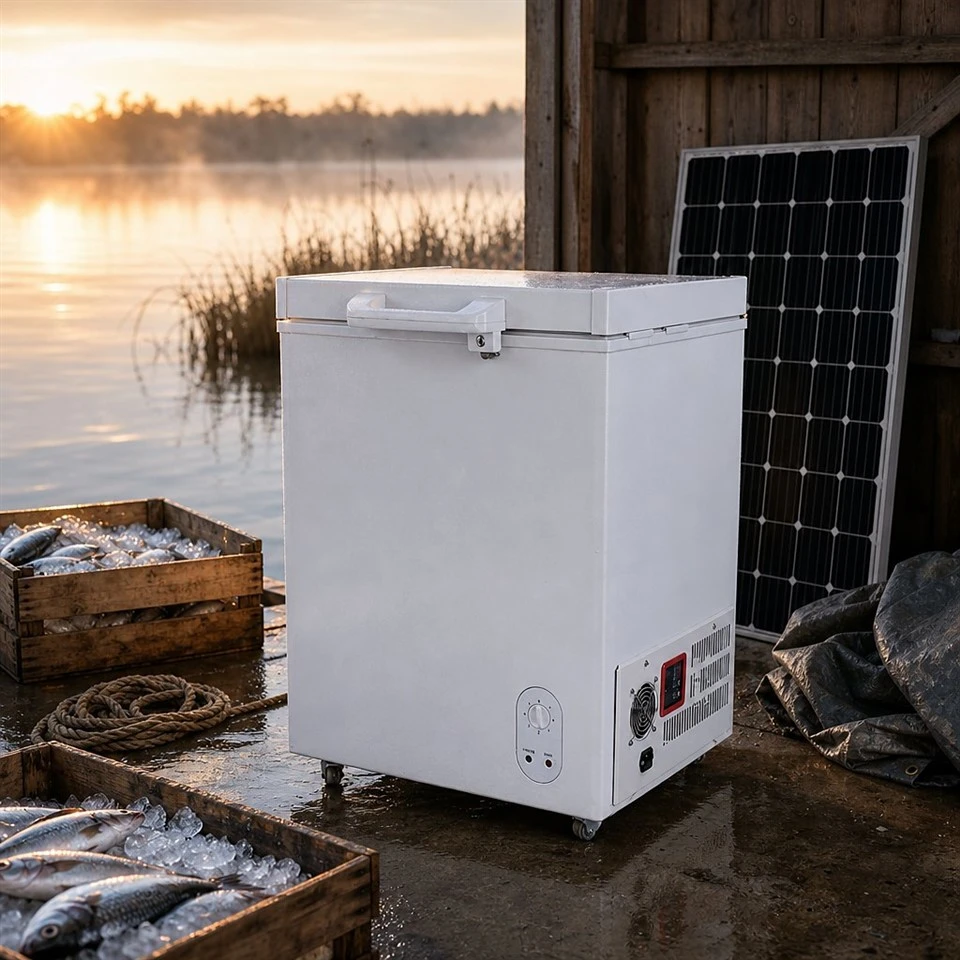
BD/BC-108 at first light: 108 litres, one lid, 65 mm of foam, and a panel that has not started work yet.
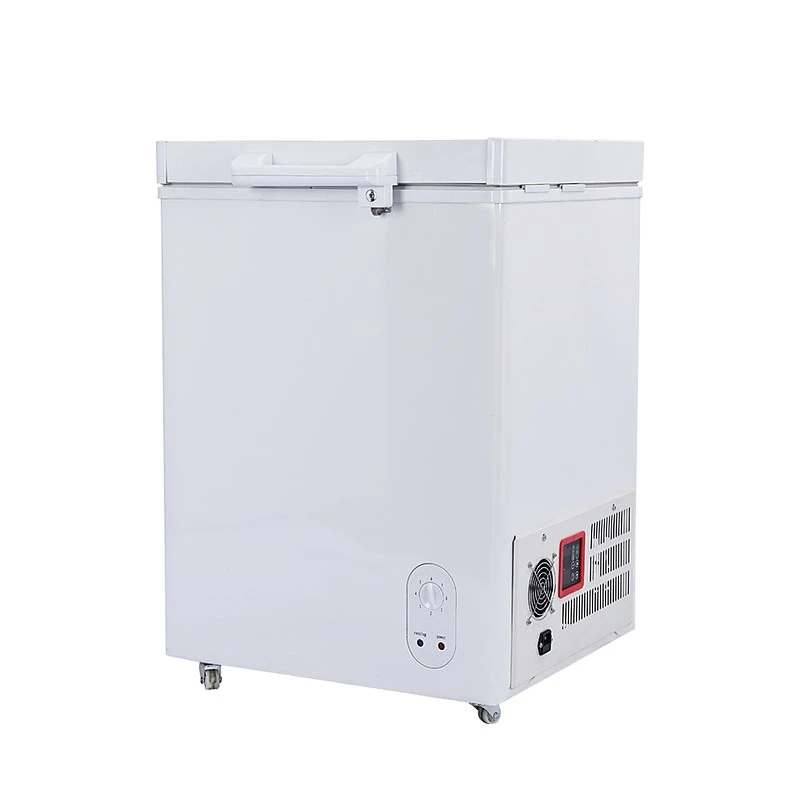
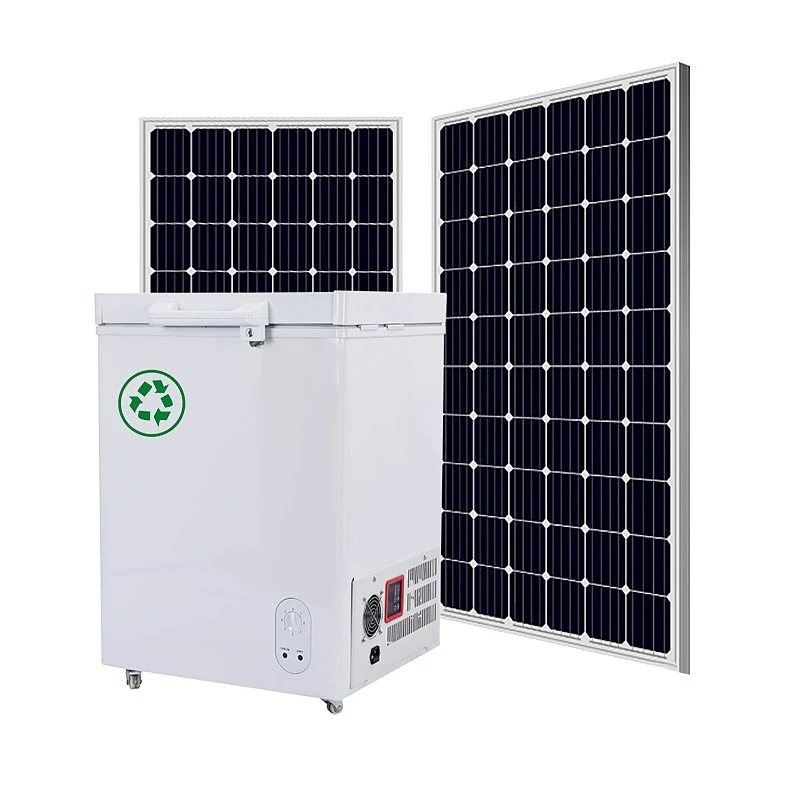
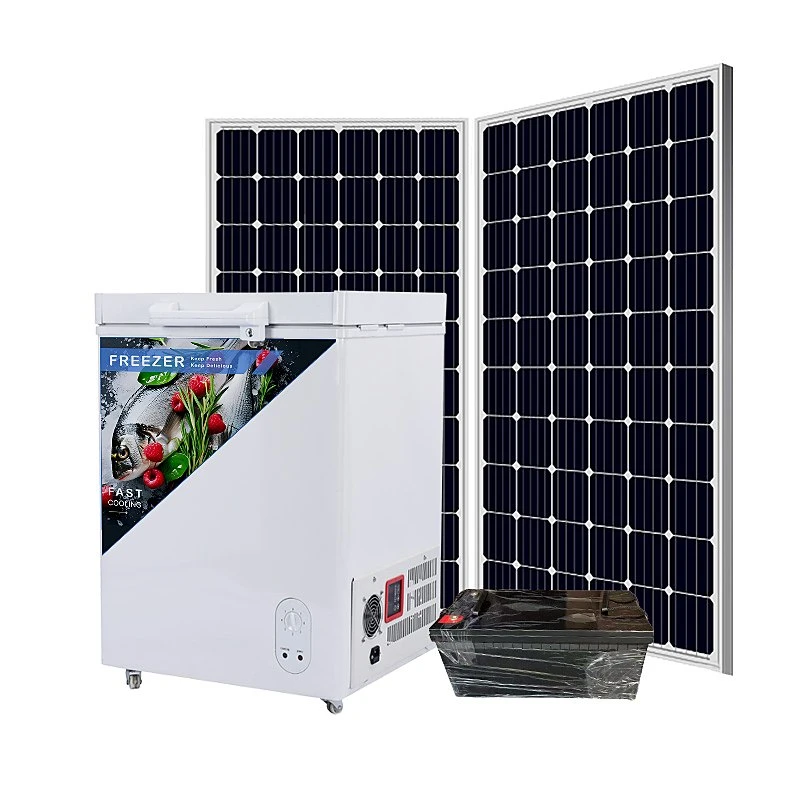
BD/BC-108 is the 108 litre member of our 65 mm single-door solar chest freezer family: one top lid, one compressor, one thermostat, and a cabinet sized for the shop that sells out and restocks twice a day. It is built to run from a battery bank or a small solar array anywhere between 10 and 50 volts DC, with 12 V and 24 V as the nominal settings most installations use, and it will hold −18 °C in a 43 °C room without asking the grid for permission.
The numbers that come off the cabinet itself
Every figure below is taken from the plate riveted to the back of this cabinet, cross-checked against our 65 mm model sheet. Nothing here is a marketing estimate. If a value is not on this table, it is not a promise we make.
| Item | Value | What it means when the shop is open |
|---|---|---|
| Model | BD/BC-108 | Single-door chest freezer, 65 mm foamed cabinet |
| Total storage volume | 108 L | Roughly 60 kg of mixed frozen goods, packed for sale |
| Rated power input | 70 W | Compressor load while running, not an average over 24 h |
| Power source | 12 V / 24 V nominal, 10-50 VDC input | Battery, panel-plus-controller, or a DC adapter |
| Rated current | 5.8 A at 12 V / 2.9 A at 24 V | Sets your fuse, cable and controller rating |
| Electricity consumption | 1.2 kWh / 24 h | Measured cycle consumption under rated conditions |
| Climate class | T | Rated for ambient up to 43 °C |
| Protection class | III | Safety class for low-voltage DC appliances |
| Refrigerant | R134a, 90 g charge | Serviceable gas, common in most markets |
| Foam thickness | 65 mm | Cabinet wall, lid included |
| Product size | 580 × 555 × 840 mm | Narrow footprint, tall body: fits a 600 mm gap |
| Carton size | 620 × 580 × 875 mm | Single-wall export carton, palletisable |
| Gross / net weight | 30 / 27 kg | One person can move it on its castors |
| Loading | 228 pcs per 40'HQ | Full container, cartons only |
Plate values are the contract. Where an installation differs from the plate, the installation is what changes, not the plate.
Ten timestamps follow, from the first lid lift at 06:10 to the overnight hold at 23:00. Each one is a real moment in a shop, a stall or a market kitchen, and each one puts a different part of the cabinet under load. The engineering sections come after the day is over: foam, energy, wiring, limits, and the people who build it.
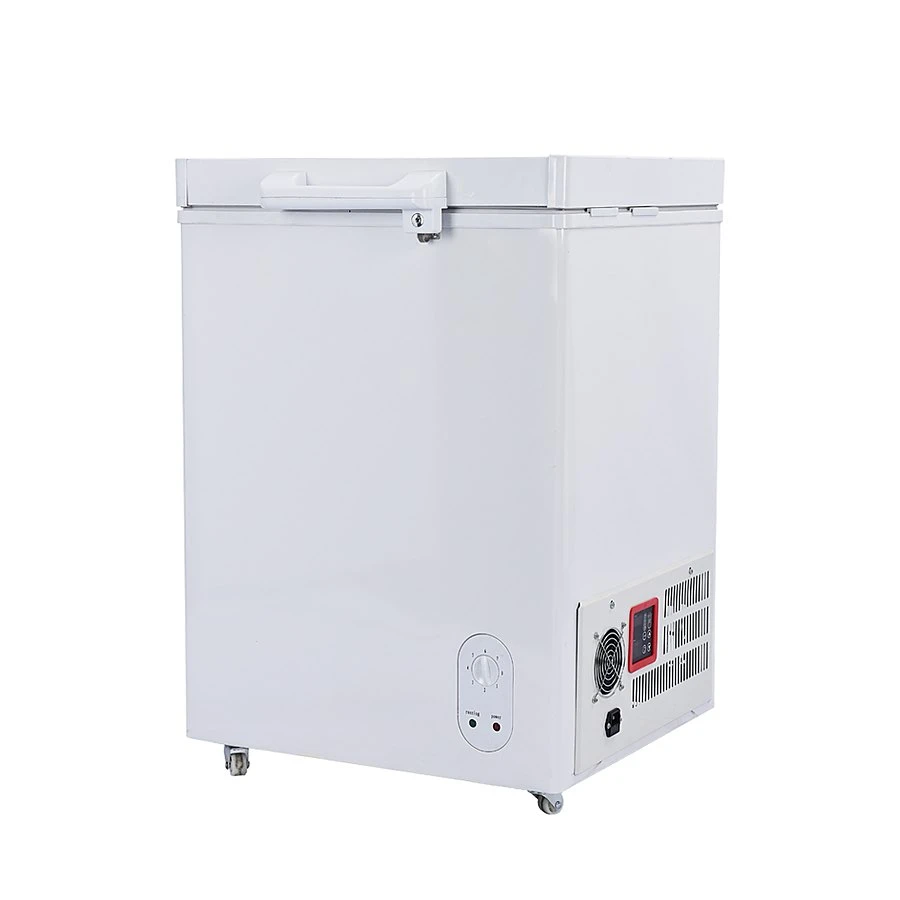
The door opens before the sun is properly up. Someone lifts the lid, stands in the cold that spills out, and starts pulling trays. In a chest freezer the cold does not fall out the way it does in an upright: it stays low, in the body, and only the top layer is disturbed. That is the single biggest structural reason we build this cabinet as a chest and not as a glass-door upright.
The lid itself is 65 mm of foamed insulation with a full-perimeter gasket and a gravity latch. It closes on its own weight, so a busy hand that lets go does not leave a two-centimetre gap running all afternoon. The gasket seat is a moulded channel, not a glued strip, which matters in a coastal market where humidity attacks adhesive first.
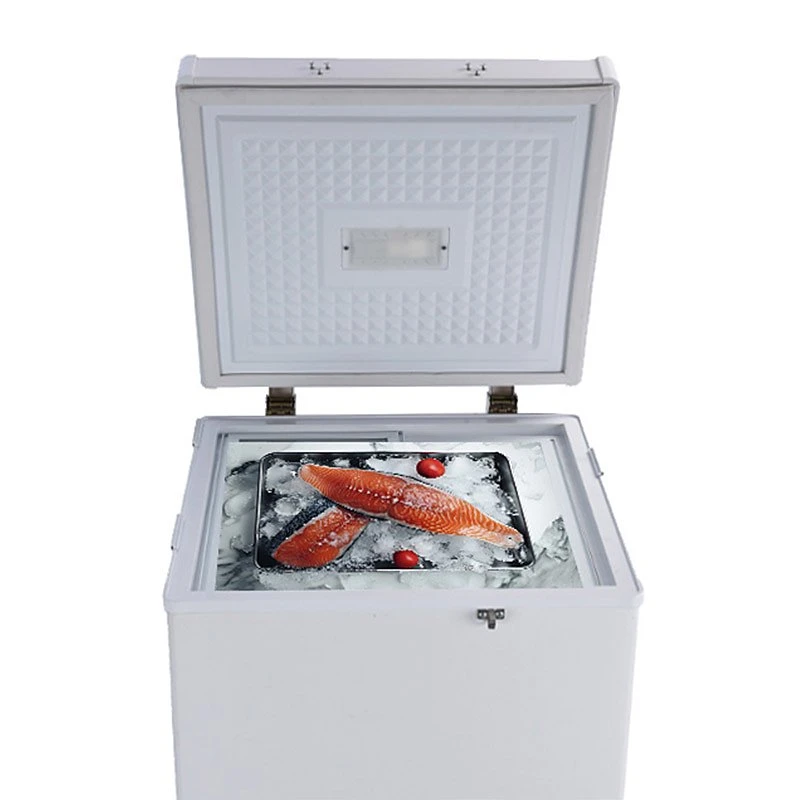
Stock arrives in insulated boxes, still cold from the depot. The temptation is to fill the cabinet to the rim and shut it. A chest freezer at 108 litres will take that load, but the compressor needs air around the goods, not a solid block of packaging touching every wall.
The wire basket in this cabinet is not decoration. It creates a top layer that the evaporator can pull heat from, so the pull-down after a stock-in starts on the basket and works down through the body. Leave the basket in, load under it, and the recovery curve stays flat instead of climbing for an hour.
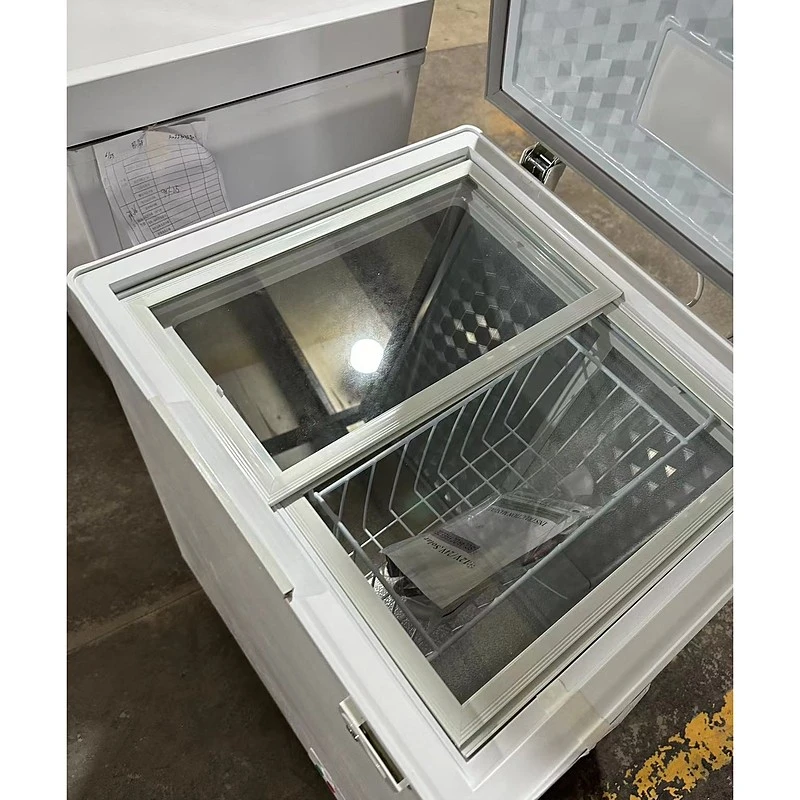
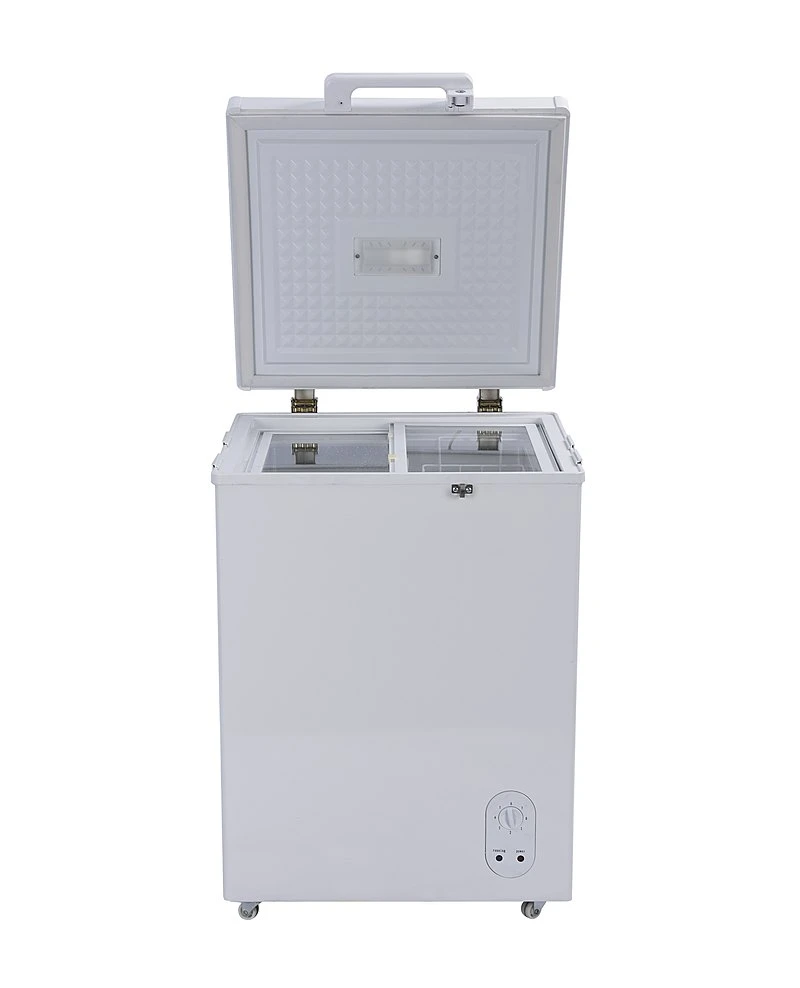
The two sliding glass lids under the main lid are the second half of this argument. Once the basket is loaded, staff serve from the glass panels without lifting the insulated lid at all. The main lid stays shut for the rest of the morning.
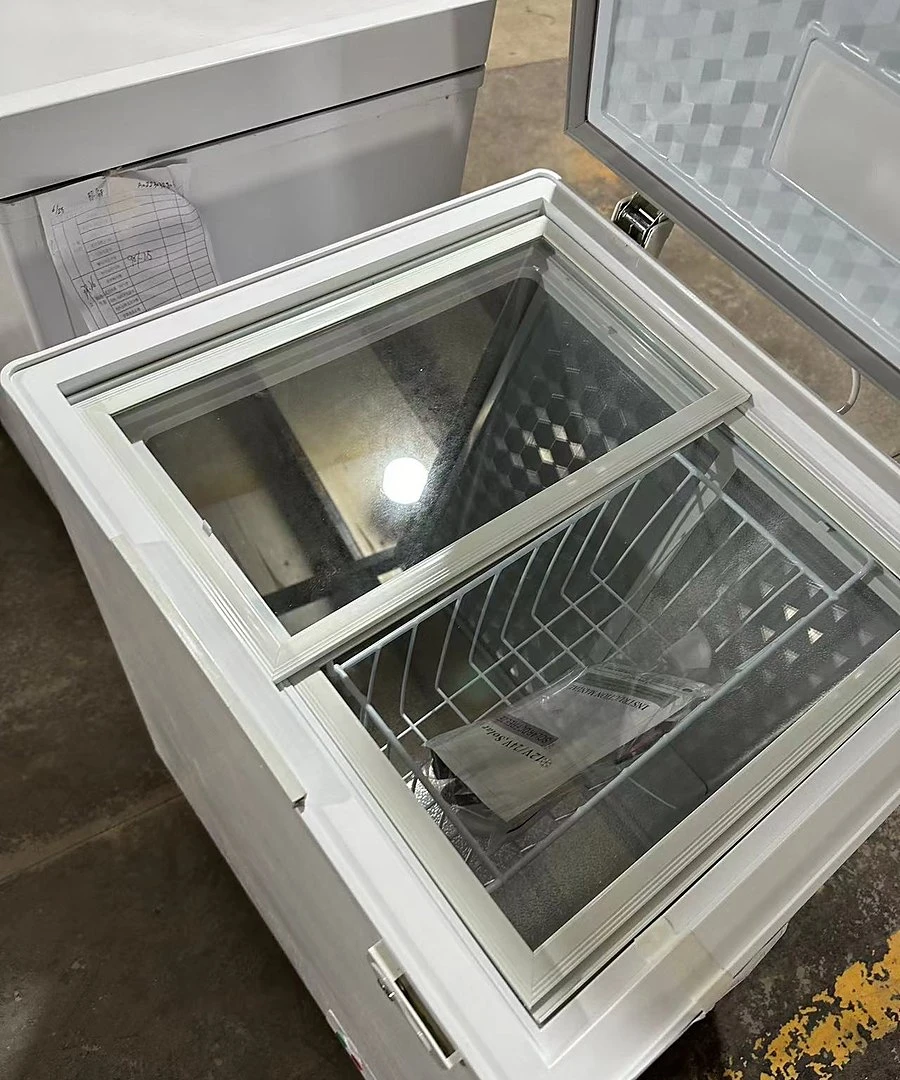
The first rush is where a single-lid freezer loses its advantage. Every sale means a full lid lift, and by the fifth customer the cabinet has taken on more warm air than the compressor can clear before the next one arrives. The sliding glass panels solve that with a movement of one wrist: 40 % of the opening area, half a second of exposure.
They also change how the shop is laid out. A customer can see the product without the staff standing up from the counter. In a market stall that is worth more than any energy label, because it converts a question into a sale. The glass is tempered and set in an aluminium frame with a plastic edge, so it takes a knock from a serving scoop without chipping the insulation behind it.
Detail: the sliding glass serving panels sit inside the foamed top frame, above the basket. The insulated lid closes over both.
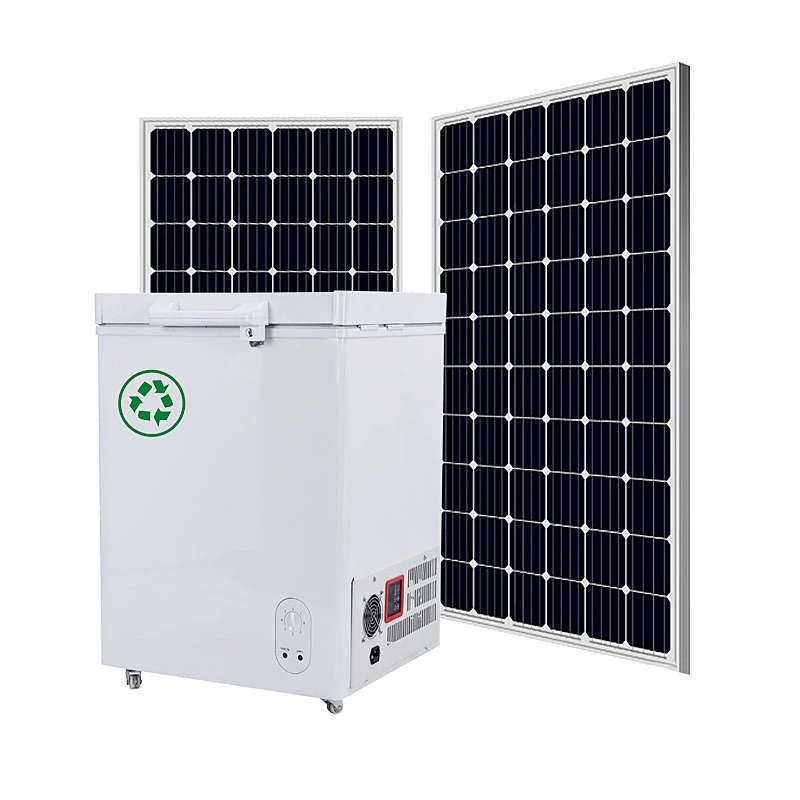
By eleven the array is at its best angle of the day and the controller is in absorption. This is the window where a solar freezer pays for itself: the cabinet pulls its heaviest load while the panels are strongest, and the battery is asked to do almost nothing.
Because the input window is 10 to 50 volts DC, the same cabinet can sit on a 12 V starter battery, a 24 V bank, or a 48 V pack through a step-down controller without a different compressor. That flexibility is not a brochure line; it is what lets a buyer start with two panels and one battery and add capacity three years later without replacing the appliance.
Rated current tells the installer what to size: 5.8 A on a 12 V system, 2.9 A on 24 V. Add the controller's own consumption, keep the cable run short, and the voltage at the cabinet stays above the low-voltage cut-out through the whole absorption window.
At half past one the shop is at its warmest: door traffic, body heat, an unshaded wall. Climate class T is the rating that matters here, because it defines the ambient the cabinet is measured at. Forty-three degrees is not a comfortable number for a compressor, and most failed solar freezers in the field did not fail in the cold room. They failed in the afternoon.
A 65 mm wall buys back the difference. Each additional millimetre of foam is resistance between the goods and the room, and the 65 mm body keeps the daily cycle short enough that a 70 W compressor can finish it before the sun goes. That is why this cabinet is heavier than a thin-wall import of the same volume, and why the gross-to-net weight gap on the carton is only three kilograms: the density is in the walls, not the packaging.
For the installer, the practical rule is ventilation. Leave a hand's width behind the condenser, keep the cabinet off a west-facing wall, and never box it into a counter with a closed back. The machine rejects heat; give it somewhere to put it.
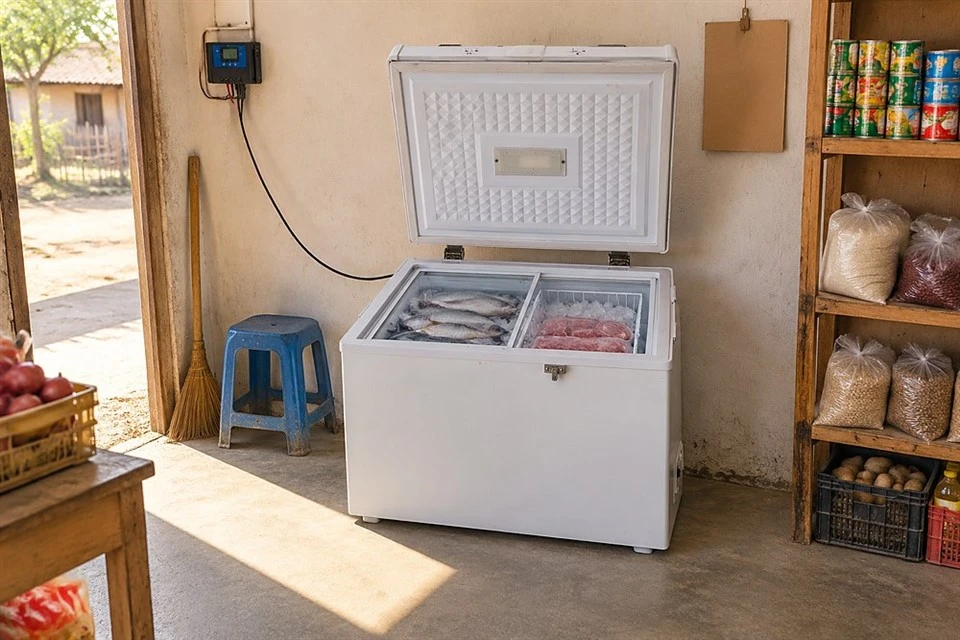
In most of the markets this cabinet ships to, the outage does not arrive as a storm. It arrives as a schedule. Three o'clock, four hours, sometimes six, and the shop has to decide whether to close or to keep selling. A DC chest freezer answers that question by simply not noticing.
Once the cabinet is at temperature, the load it takes to stay there is a fraction of the pull-down load. Held at −18 °C with the lid shut and the glass panels in place, the daily 1.2 kWh is spread across hours of short compressor runs. A single 100 Ah 12 V battery holds roughly the same energy as one full day of that cycle, which is why a modest bank carries a shop through an evening of no grid at all.
The cabinet is not a battery charger and it is not a hybrid inverter. It is a load with a low-voltage cut-out, and that cut-out is a feature: it abandons the battery before the battery is damaged, then restarts when the panels come back.
The afternoon delivery is always the warmer one: the van has been in the sun, the boxes have been on a tailgate, and the ice around the fish has started to go clear. This is the moment a thin cabinet shows itself, because it has to remove heat from goods and from itself at once.
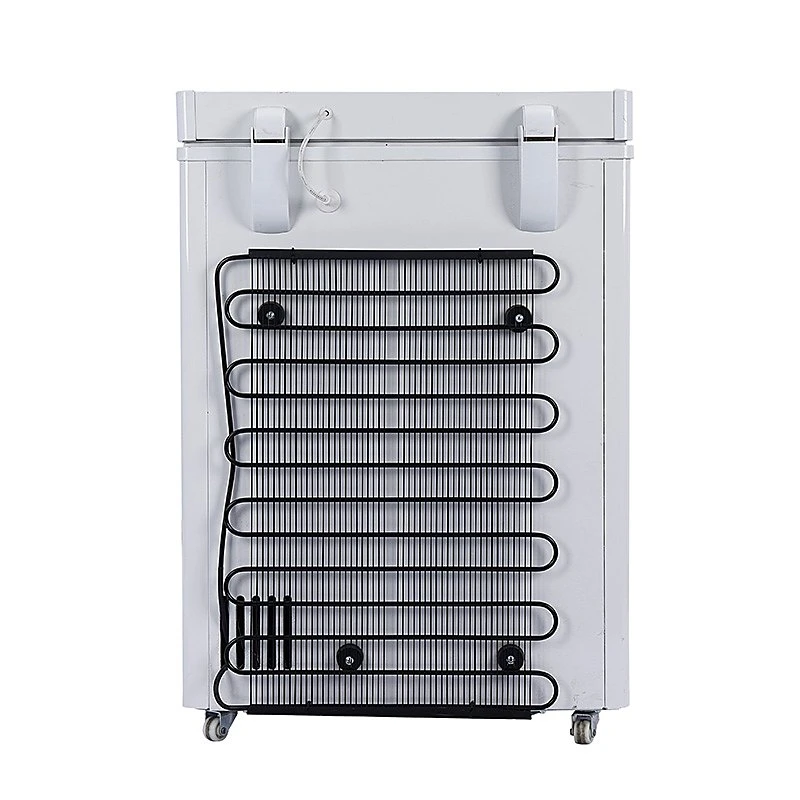
The condenser at the back is the part nobody photographs and everybody depends on. On this cabinet it is a coated steel wire grid, mounted clear of the body so air can move behind it, with the fan on the compressor side pulling across the coils. In dusty markets it is the first thing to clean and the first reason a cabinet gets blamed for a compressor fault.
Practically: brush the grid once a month, keep sacks and cardboard from leaning against it, and check the four castors are still free. A cabinet pushed flat against a wall in a hot room will run longer than the plate says, and no amount of foam can fix an airflow problem.
The condenser grid stands off the back panel so air can pass behind it. In dusty markets, this is the monthly maintenance task that matters most.
The lights are on, the door is propped, and the ambient has not dropped as much as the clock suggests. This is the second serving peak, and in a market it is the one that empties the cabinet. Two-thirds of the day's sales can happen in these two hours.
Because the goods are moving, the compressor is running against a cabinet that is half empty by nine. That is an easier load than a full one: less mass to hold, but more air to cool each time a panel slides. The glass lids earn their keep here, because they let a customer point at what they want instead of the staff digging.
A practical note for the shop: serve from the glass, restock from the lid, and never leave the insulated lid open while you count money. The two habits cost nothing and they are the difference between a cabinet that holds overnight and one that starts the morning at −8 °C.
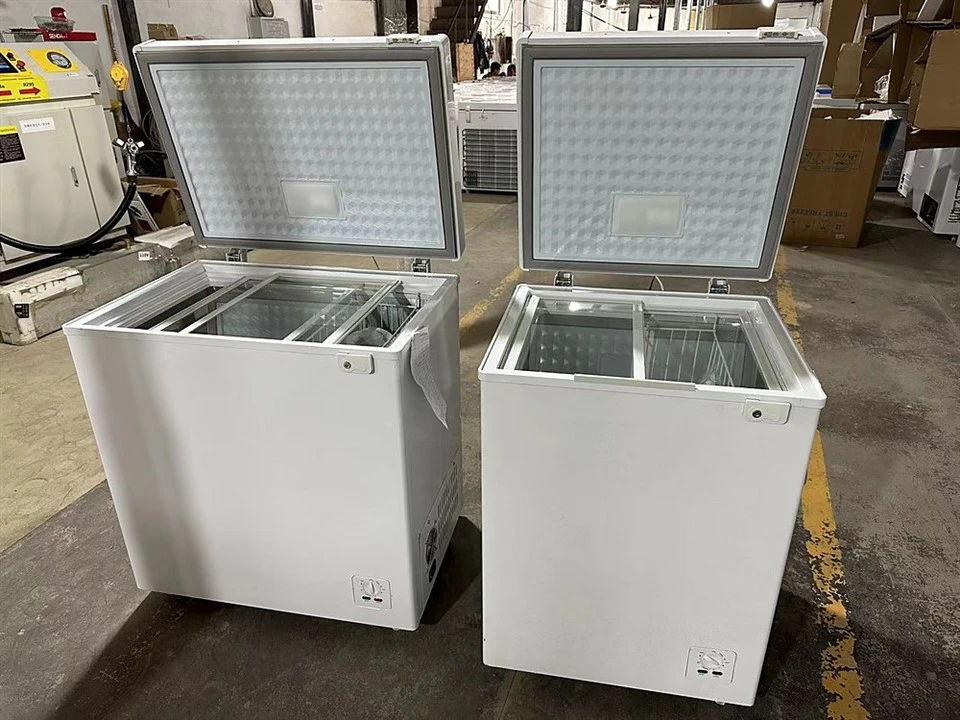
Before the shutter comes down, someone counts what is left and decides what to order. In a one-cabinet shop that count is also a thermal decision: a cabinet left two-thirds full holds temperature far more cheaply overnight than one left with twenty per cent of its volume and a lot of warm air.
If the cabinet is going to run light, consolidate. Move what is left into the basket area, close the glass, close the lid, and let the latch do its work. A chest freezer with a full lid and an empty body is still a sealed box, and a sealed box at −18 °C is the cheapest thing in the shop to run.
This is also the point where the size choice is felt. A 108 litre cabinet is small enough to fill, which is the whole argument for it: a shop that can fill its freezer every night is a shop with a fast stock turn, and fast stock turn is what a frozen goods business actually sells.
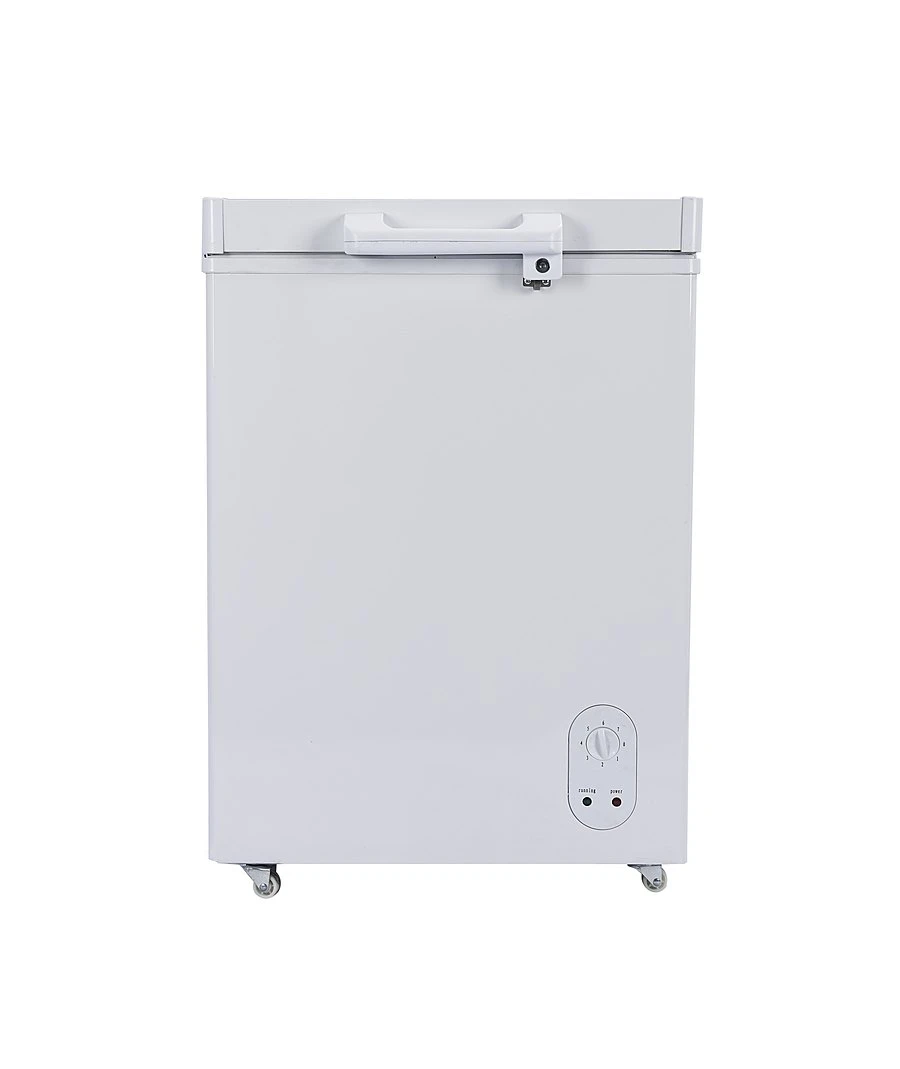
The shutter is down, the panel is dark, and the only thing keeping the goods is the cabinet and whatever is in the battery. For the next seven hours nothing opens, nothing is served, and the compressor works in short, quiet cycles.
Overnight is where the foam does most of its work. A 65 mm wall loses less heat per degree of difference, so the compressor has less to remove each time it starts. Multiply that saving by every night of the year and you get the number that matters to the buyer: not the rated wattage, but how much of the array is left over for the lights, the phone charger and the second freezer the shop will want next year.
In the morning, the first person in checks the cabinet before the coffee. If the lid is cold to the touch and the goods are hard, the night worked. That is the entire acceptance test, and it is the one this cabinet is built to pass.
Why 108 litres is a shop number, not a warehouse number
A 108 litre chest freezer is roughly the volume of two full market crates of mixed frozen goods. That is a deliberate size. It sits between the 88 litre cabinet that a single stall can fill and the 158 litre unit that only makes sense once a shop has a delivery route. The 108 is the size that a family business can fill, sell and refill inside a week, which is why it is the volume we get asked for most often in West Africa and South-East Asia.
| Model | Volume | Cabinet W×D×H (mm) | Carton (mm) | G.W. / N.W. | 40'HQ |
|---|---|---|---|---|---|
| BD/BC-88 | 88 L | 750 × 555 × 640 | 785 × 580 × 690 | 31 / 28 kg | 229 pcs |
| BD/BC-108 | 108 L | 580 × 555 × 840 | 620 × 580 × 875 | 30 / 27 kg | 228 pcs |
| BD/BC-158 | 158 L | 750 × 555 × 840 | 790 × 580 × 880 | 35 / 32 kg | 180 pcs |
| BD/BC-208 | 208 L | 906 × 555 × 840 | 946 × 580 × 885 | 39 / 36 kg | 148 pcs |
Note the footprint: the 108 is 580 mm wide and 840 mm tall. It fits a 600 mm gap between two shelves and stands at counter height, so a shopkeeper can serve from it without bending. The 158 and 208 grow in width, which is why they need a wall rather than a gap. If you are replacing a drinks fridge on a narrow footprint, the 108 is the drop-in.
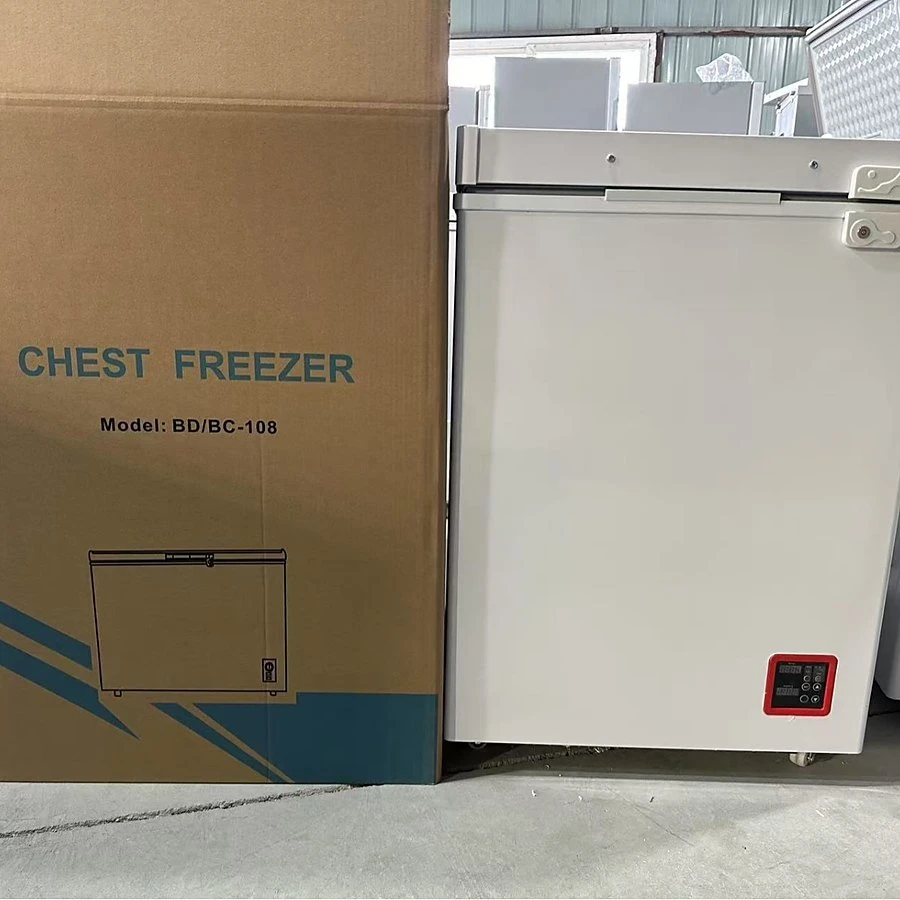
Single-wall export carton, printed with the model and handling marks. 228 cartons fill a 40'HQ with room for pallets at the door end.
Sixty-five millimetres, measured from the outside in
Foam thickness is the least photogenic specification on any freezer and the one that decides how the cabinet behaves in year three. A 65 mm wall is poured as one foamed body around the liner, cured in a jig, then trimmed. The lid is foamed separately to the same thickness so the top face does not become the weak point of an otherwise thick box.
- Foamed-in-place polyurethane body, 65 mm on walls, base and lid, with the liner bonded to the foam rather than held by tape.
- Moulded gasket channel around the full lid perimeter: no adhesive line to fail in humid air.
- Gravity latch plus a keyed lock, so the lid closes on its own weight and stays closed in transit.
- Coated steel outer skin, white, with the condenser grid mounted clear of the back panel.
- Two sliding tempered-glass serving panels and one wire basket inside, both removable for cleaning.
- Four castors with two braked, so a loaded cabinet can be moved by one person and then parked.
The practical consequence is weight. At 30 kg gross the 108 is light enough for two people to carry up a stair, but the density is in the walls; a thin-wall cabinet of the same volume typically weighs less and runs longer. If a supplier quotes you a 108 litre chest freezer at 22 kg, the difference is foam, and you will pay for it every afternoon.
The daily energy arithmetic
The plate says 1.2 kWh per 24 hours and 70 W rated input. Those two numbers describe different things: the wattage is what the compressor draws while it runs, and the daily figure is what the cycle costs when the cabinet is held at temperature in a rated room. The gap between them is duty cycle, and the duty cycle is what your array has to fund.
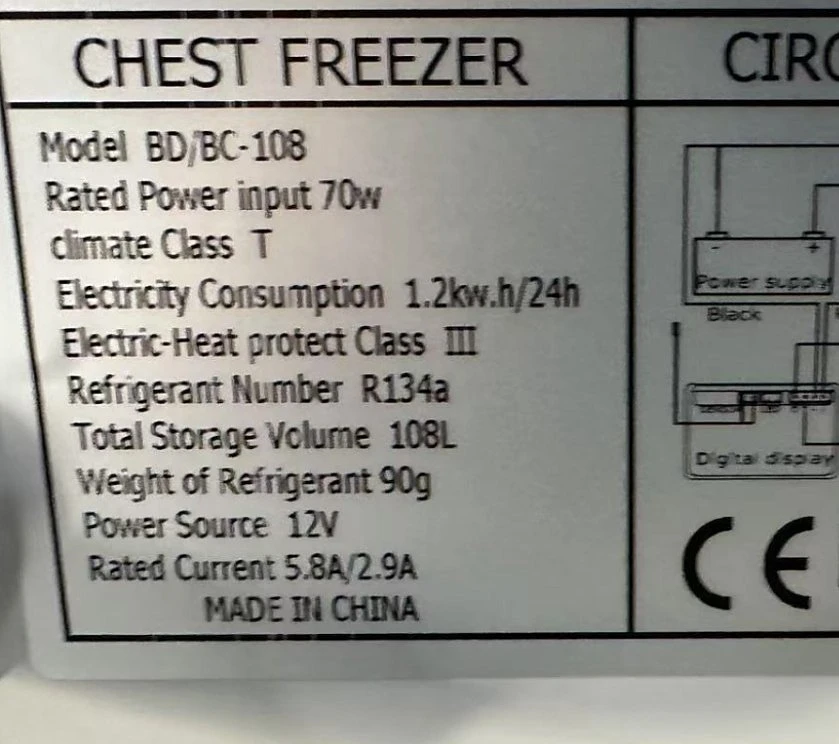
Rated power input 70 W, electricity consumption 1.2 kWh/24 h, R134a 90 g, climate class T, protection class III.
| If your day looks like this | Working figure | What it implies for the system |
|---|---|---|
| Cabinet consumption | 1.2 kWh / 24 h | The load your array and battery must cover |
| Peak sun hours (typical, 4 h) | 4.0 h | Array size ≈ 1.2 ÷ 4 = 300 W, before margin |
| Array with 30 % margin | ≈ 400 W | Two 200 W panels, or one 400 W panel |
| 12 V lead-acid bank at 50 % depth | 100 Ah ≈ 0.6 kWh usable | About half a day of autonomy |
| 12 V LiFePO4 bank at 80 % depth | 100 Ah ≈ 0.96 kWh usable | Roughly a full day of autonomy |
| Rated current at 12 V / 24 V | 5.8 A / 2.9 A | Sizes the fuse, cable and controller |
The number worth remembering is the ratio: a 70 W compressor that runs a third of the day is a 24 W average, which is less than a pair of LED shop lights. That is what 65 mm of foam buys you, and it is why the same cabinet can be sold into a market with three hours of grid a day and still make sense.
Wiring it without guesswork
The cabinet is a load, not a system. Everything upstream of the DC plug is your installation, and the order below is the one that avoids the two classic failures: reversed polarity and a battery flattened below recovery.
Three ways to power the same cabinet
The 10-50 VDC input is not a single system. It is a window that lets three quite different installations use one appliance, and the choice between them decides the bill more than the cabinet does. Below is how each one behaves in practice, written from the questions we get at quotation stage rather than from a datasheet.
| Option | What it needs on site | Best for | Watch out for |
|---|---|---|---|
| Solar array + controller + battery | 400 W of panel, MPPT controller, 100 Ah 12 V bank, fused cable run | No grid, or a grid that is off every afternoon | Undersized array in the rainy season; battery depth of discharge set too low |
| Grid + DC adapter | 220 V supply and the supplied DC adapter at the cabinet | Shops with a stable supply that want a cheap appliance | Outages stop the cabinet; an adapter that sags under start-up current |
| Hybrid AC/DC | Adapter plus array and controller on the same DC bus | Shops with a weak grid and a small panel | Two sources fighting at the bus; controller must be set as the priority source |
In all three cases the cabinet itself is identical: same compressor, same thermostat, same 65 mm body. What changes is the box on the wall. That is deliberate, because it means a buyer who starts on grid can add a panel later without replacing the freezer, and a buyer who starts on solar can move the cabinet to a second shop and re-use the same controller.
Six buyers, one cabinet
We ship this size into very different trades, and the reason it suits all of them is the same: enough volume to run a real stock, small enough to fill and empty every week. The six situations below are the ones that come up most often in enquiries.
What this cabinet will not do
- It is not a blast freezer. Loading 40 kg of warm product will raise the cabinet temperature for hours; pre-chill or split the load.
- It is not rated for an unventilated enclosure. The condenser needs air, and a closed counter will void the performance you paid the foam for.
- It will not hold −18 °C on a battery that is already below its cut-out, whatever the panel says at noon.
- It is a single-temperature cabinet. If you need a chill compartment plus a freeze compartment, the dual-temperature BCD range is the correct product, not this one.
- It is not a display cabinet. The glass panels are for serving, not for merchandising to a street; for that, the flat glass-door range is the right family.
The maintenance calendar
A DC chest freezer in a hot market does not fail because of the compressor. It fails because nobody looked at the condenser, the gasket or the battery terminals for a year. The schedule below is what we put in the handover sheet, and it is deliberately short so that a shop with one employee can actually follow it.
| When | What to do | Why it matters |
|---|---|---|
| Every morning | Check the lid sits flat and the latch catches; look at the goods, not the display | A lid left ajar overnight is the most common cause of a soft cabinet at opening |
| Weekly | Wipe the gasket channel and the glass panels; check nothing is leaning on the condenser | Salt, dust and cardboard all shorten the life of the seal and the airflow |
| Monthly | Brush the condenser grid front to back; check the castors turn freely | Dust on the coils is what makes a 70 W cabinet behave like a 120 W one |
| Quarterly | Look at the battery terminals for corrosion; confirm the controller cut-out setting | A corroded terminal reads as a flat battery and stops the cabinet for no reason |
| Seasonally | Clean the drain area, check the door gasket for hardening, log the pull-down time | Pull-down time drifting upward is the earliest signal of a refrigerant or airflow fault |
| Annually | Service the compressor compartment, replace the gasket if it has hardened | Cheap parts, changed before failure, keep a seven-year cabinet out of the scrap yard |
Two of these tasks cost nothing at all: keep the back clear and keep the lid shut. In the field reports we collect, those two account for more recovered performance than any component swap.
From the carton to the first cold night
The cabinet leaves the hall on castors inside a single-wall export carton, with the glass panels fitted and the basket loose inside. Loading is straightforward: cartons stand upright, two high at most, strapped to the container wall. Never lay a chest freezer on its side for a sea freight leg, because the compressor oil migrates and the first start after unpacking will be a dry one.
Sizing worksheet
The five lines below are the whole conversation. Send them with your enquiry and the quotation comes back with a cabinet, an array and a battery that belong together, instead of three separate guesses.
| Line | What to write | Why we ask |
|---|---|---|
| Grid hours | Average hours of mains power per day, and when the outage usually starts | Decides whether the cabinet needs a battery at all, and how big |
| Stock weight | Kilos of frozen goods sold on a busy day; kilos held overnight | Confirms 108 litres is the right size, or moves you to 158 |
| Room | Ambient at the hottest hour, and whether the cabinet faces the sun | Climate class T covers 43 °C; a west-facing wall effectively adds degrees |
| Existing equipment | Panels, controller, battery already on site, with ratings | We size the cabinet around what you own rather than selling you a second system |
| Destination | Country, port, and whether the order is mixed with other models | Sets the plug, the plate language, the carton print and the loading plan |
The people and the lines behind it
This cabinet is foamed, assembled and run-tested on our own lines, not bought in and rebadged. The photographs below are from the hall where the 65 mm bodies are foamed and where finished units are run before packing. Every cabinet gets a pull-down check and a plate inspection before the carton goes on.
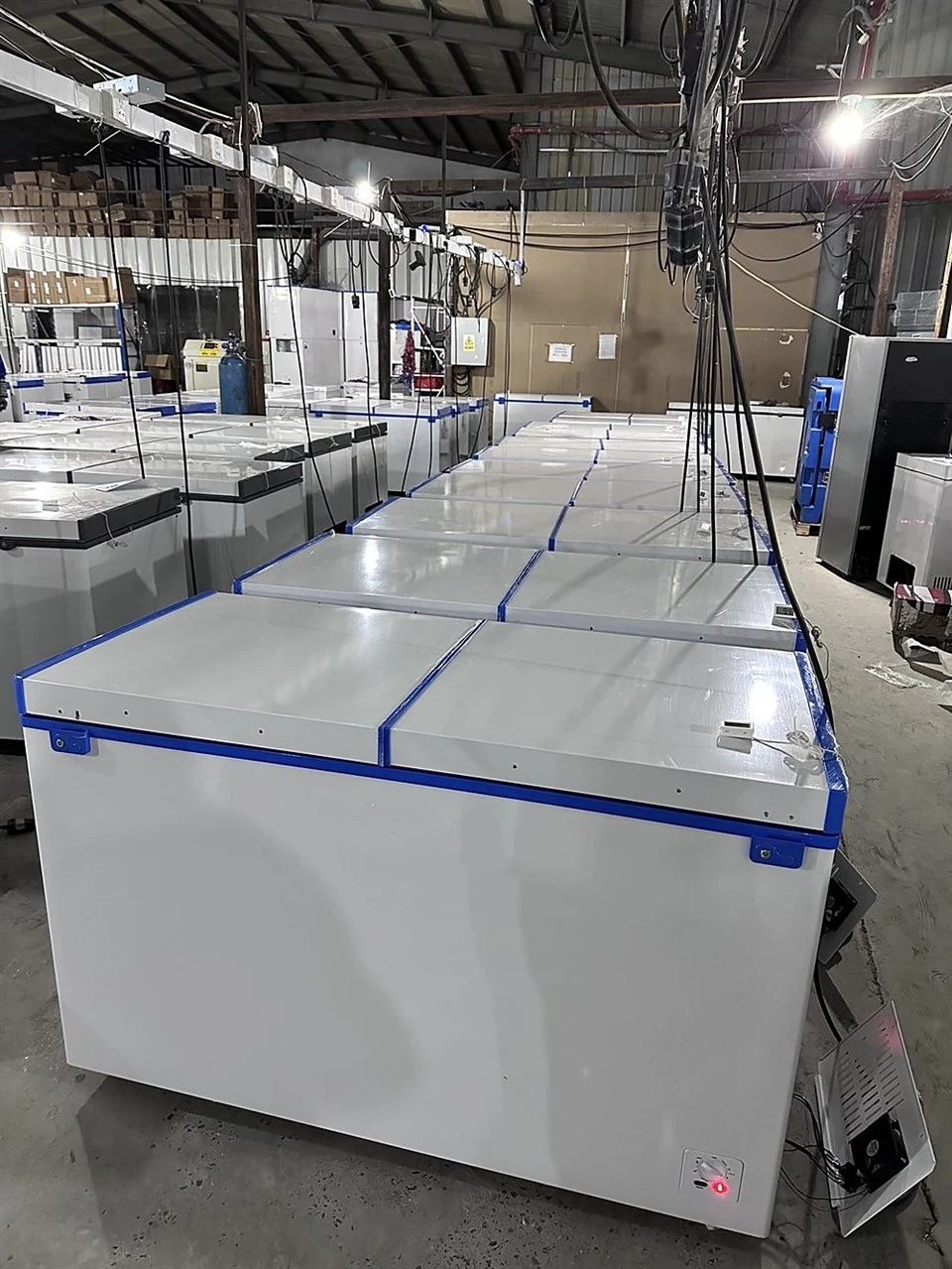

Bodies are foamed in jigs, trimmed, then moved to assembly and test. Units are packed only after the pull-down check.
We supply the 65 mm single-door range from 68 to 508 litres on the same platform, so a distributor can build a catalogue without four different suppliers. OEM work is standard: panel colour, voltage setting, controller type, sticker set, packaging print and carton marking are all configurable, and the rating plate is printed for the destination market.
| Document | What it covers |
|---|---|
| Rating plate and circuit diagram | The values on the cabinet, with the wiring schematic |
| Model selection sheet | Full 65 mm range: volume, dimensions, weights, loading |
| Packing and loading data | Carton dimensions, pallet pattern, container quantities |
| Spare parts list | Compressor, thermostat, controller, gasket, castors, glass panels |
| Warranty statement | Terms by component, with the service procedure |
| Certificate of origin | Issued for the shipment, with the invoice reference |
Questions buyers actually ask
We will come back with the cabinet size, the array and battery that match it, and the container loading for your order. OEM panels, voltage settings, controllers and packaging are quoted at the same time, not after.
Hot Tags: solar powered deep freezer, China solar powered deep freezer manufacturers, suppliers, factory


