


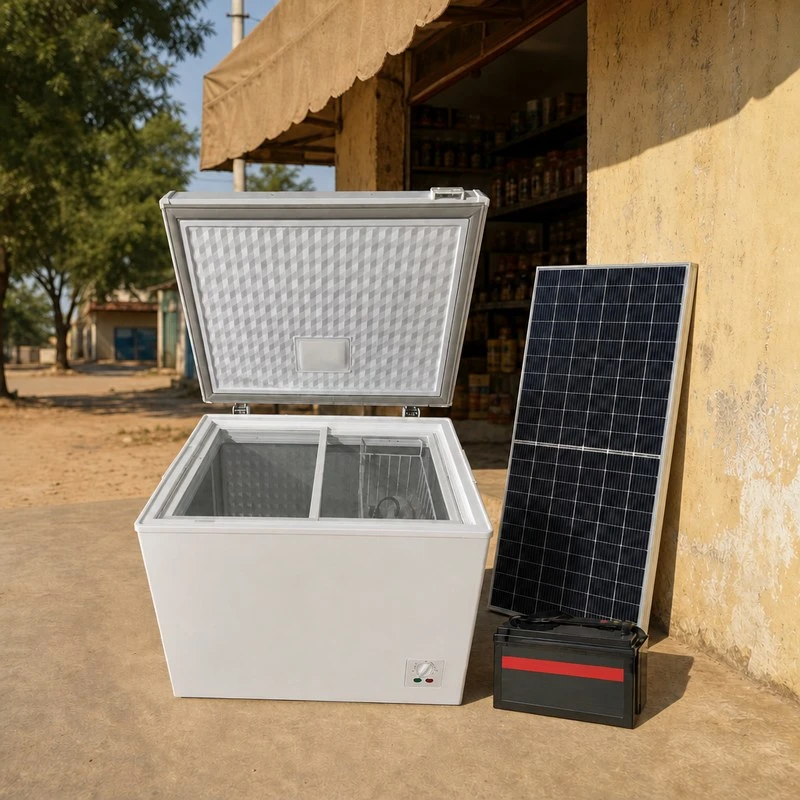


The Nameplate Is The Most Honest Page In The Brochure
Every freezer page on the internet is written by somebody who is selling. The sticker on the back of the cabinet is written by somebody who has to answer to a test house. We would rather start there, because a plate is the only part of a product description that cannot be improved by a copywriter.
BD/BC-88 is an 88 litre single-lid chest freezer with a 65 mm foamed cabinet, a 63 W DC compressor and an input window that runs from 10 to 50 volts DC. That last line is the one that decides whether a cabinet survives a bad solar week, and it is also the line most suppliers leave off the page. The rest of this page is an annotated reading of the sticker: what each line means, where it stops being useful, and which decisions it hands back to you.
Read The Sticker Before The Sales Copy
Below is the plate taken off a production unit on our line, not a mock-up. Ten lines. Between them they describe the whole machine: how much it holds, how hard it works, how much refrigerant it carries, what it draws, and what it is legally allowed to be connected to. If you only read one part of this page, read the table under the photo and skip the prose.

| Line on the plate | What it reads | What it actually decides |
|---|---|---|
| Model | BD/BC-88 | The cabinet family and the volume class. Any spare part, drawing or test record we hold is filed under this string, so quote it in every message. |
| Total storage volume | 88 L | Gross declared volume of the inner liner, not a usable-load promise. Baskets, the compressor step and air space around packs all come out of it. |
| Rated power input | 63 W | Electrical input at rated conditions, which is the number a panel and a battery have to be sized against - not a marketing wattage. |
| Electricity consumption | 1.21 kW.h/24h | Energy per 24 hours under the standard test regime. It is a laboratory figure; your shop will not match it and nobody honest claims otherwise. |
| Climate class | ST | The ambient band the cabinet is designed and tested for: a hot climate class, not a temperate one. |
| Electric-heat protect class | III | Protection class III, i.e. safety by extra-low voltage. There is no mains potential in the cabinet at all. |
| Refrigerant number | R134a | The gas the sealed circuit is charged with, which sets the service procedure and the recovery requirement. |
| Weight of refrigerant | 105 g | The factory charge. Small enough that a leak is a repair job, not a contamination event. |
| Power source | 12 V / 24 V | The nominal DC systems the compressor is built around. The controller accepts far more than this - see the input section below. |
| Rated current | 5.3 A / 2.7 A | Current at 12 V and at 24 V respectively. Multiply them out and you land back on the 63 W above, which is how you know the plate is internally consistent. |

Eighty-eight litres is a working size, not a show size. It is small enough that one person can carry the unit on a hand truck through a shop door, and large enough that a vendor selling frozen packs, ice and a little chilled stock does not have to restock twice a day.
The liner is split by a divider, with a wire basket over one side. That layout is not decoration: the basket holds the fast-moving product that gets touched fifty times a day, and the deep side holds the stock that should stay cold and stay shut. Every time the lid opens, cold air leaves the top layer first, so the goods you touch least belong at the bottom.
| Load pattern a buyer usually has in mind | How 88 L behaves | What we say about it |
|---|---|---|
| Frozen packs and ice, single operator | The natural load. Stock sits below the basket line and turns over daily. | Comfortable. This is the case the cabinet was sized for. |
| Mixed frozen and chilled in one cabinet | Chilled goods need a different set point than frozen packs. | Workable only if you accept frozen temperatures throughout. A single-lid chest freezer has one zone, not two. |
| Ice cream only, high turnover | Frequent opening lifts the top layer temperature between cycles. | Fine for display stock; keep reserve cartons underneath and open the lid with a plan. |
| Bulk frozen food, low turnover | Volume is adequate, but every opening costs more because the load is deep. | Efficient. Fewer openings is exactly what a cabinet this shape rewards. |
| Beverage cooling, ambient 35 C+ | Cooling warm cans is a pull-down job, not a holding job. | Possible, slow. Size the panel for pull-down, not for holding, or pre-chill before loading. |
The most expensive component in a chest freezer is the part that is not there. A 65 mm foamed wall is the reason this cabinet can hold temperature through a cloudy afternoon while the compressor sits idle, and it is the reason it weighs what it weighs.
We build thin-wall cabinets and we build 110 mm cabinets, and we will tell you plainly that 65 mm is the middle of our own range. It is chosen for markets where the sun is strong, the grid is absent or unreliable, and the unit has to bridge a night on stored cold rather than on stored electricity.
What thickness buys you is time, not temperature. A thicker wall does not make the cabinet colder; it makes the cabinet stay cold for longer between compressor runs. That is the number a shopkeeper actually feels: how long the ice cream survives a power cut, not how fast the unit freezes.

| What 65 mm changes | Direction | How to think about it |
|---|---|---|
| Holdover after the compressor stops | Up | More cold stored in the foam and liner mass, so a cloudy spell or a dead generator is absorbed rather than passed straight to the product. |
| Compressor run time per day | Down | Less heat leaking in means fewer and shorter runs, which is what lets a smaller panel carry a bigger box. |
| Cabinet weight | Up | Thicker foam is more mass. Two people for a stair, one for a shop floor. |
| External footprint for the same volume | Up | The liner stays 88 L; the outside grows. Measure the doorway before you fall in love with the drawing. |
| Speed of first pull-down | Slightly down | More mass to chill from ambient on day one. It is a one-time cost, paid on installation. |
| Repairability of the wall | Unchanged | Foam is not a serviceable part in any cabinet. Damage to the wall is a write-off in this class, thick or thin. |

Sixty-three watts is the rated input. Multiply 5.3 A by 12 V, or 2.7 A by 24 V, and you land on the same figure - that is not a coincidence, it is the plate checking itself.
Electricity consumption is declared as 1.21 kW.h per 24 hours. Divide one by the other and you get roughly nineteen running hours in a day, which sounds alarming until you notice what it implies: the declared figure is a hot-room test result at climate class ST, where the compressor is expected to be busy. In a shaded shop at 25 C the same cabinet cycles far less.
Use the plate figure for sizing, not for forecasting. A solar array sized on 1.21 kW.h per day has margin; an array sized on a shopkeeper s guess does not.
| Panel sizing arithmetic (not a quotation) | 3.5 peak sun hours | 4.5 peak sun hours | 5.5 peak sun hours |
|---|---|---|---|
| Daily energy to replace, from the plate | 1.21 kW.h | 1.21 kW.h | 1.21 kW.h |
| Array at 70 percent system efficiency, rounded up | about 500 W | about 390 W | about 320 W |
| What that looks like in practice | Two large panels, or one large plus one small | One large panel plus storage discipline | One large panel in full sun, no shading |
| What it does not cover | Multi-day cloud, heavy door opening, warm load on arrival | Same, with less margin | Same, with the least margin |
The arithmetic above is exactly that: arithmetic on the plate figure with a stated efficiency and a stated sun hour assumption. It is a starting point for a conversation about your site, not a system design, and it is not an offer.
The plate says 12 V / 24 V because that is the nominal system the compressor is built around. The controller in front of it accepts 10 to 50 volts DC, which is a different sentence and a more important one.
A nominal 24 V solar bus is not 24 V. At noon on a cold bright day an unloaded array can sit well above 30 V, and by four in the afternoon with a tired battery it can be under 22 V while the compressor is still expected to run. A narrow-input controller protects itself and shuts the cabinet down. A wide-input controller keeps working across the whole swing and only gives up when the source genuinely cannot supply the cabinet.
The practical consequence is that the same cabinet can be connected to a 12 V battery bank on a small shop, a 24 V bank on a larger one, a 48 V bank on a mini-grid, or a mains adapter where the grid is good, without changing the appliance. One SKU, four supplies.

| Input path | Voltage the controller may see | What it does |
|---|---|---|
| 12 V battery bank, direct | Roughly 10 to 15 V, sagging under load | Runs. Expect the current on the plate, 5.3 A, and size cable for it rather than for the average. |
| 24 V battery bank, direct | Roughly 20 to 29 V | Runs. Rated current drops to 2.7 A, so thinner cable and less line loss for the same cold. |
| 48 V bank or mini-grid | Within the 10 to 50 V window | Runs, subject to the controller variant fitted. Confirm the bank voltage when you order - this is the one option we will not guess for you. |
| Solar direct, no battery | Array voltage moving all day | Runs while there is sun and stops when there is not. Only sensible for daytime ice making or for a shop that already has a battery. |
| Mains adapter, 100 to 240 V in | Stable DC out, inside the window | Runs like a normal freezer. The usual choice in towns where the grid is steady and the sun is a bonus rather than a plan. |
| Generator, poor waveform | Spikes and dips at the adapter input | Runs if the adapter is decent. We will say plainly that a dirty generator will kill a cheap adapter before it kills the cabinet. |


One hundred and five grams is the factory charge. For scale, that is about the mass of a small phone. A cabinet this size does not need more, because the circuit is short and the evaporator is wrapped directly around the liner rather than piped through a fan coil.
The number matters at service time, not at purchase time. A system with a small charge is a system where a leak is found, repaired, evacuated and recharged to a printed value - not topped up until the frost looks right. Any workshop that offers to top it up without a scale is telling you something about how it works.
R134a is a mature refrigerant with a well-understood service procedure and wide availability in most markets. That availability is the point. A cabinet is only as good as the nearest technician who can put it back together.
| What goes wrong | What you see | What should happen next |
|---|---|---|
| Slow leak at a joint | Frost line creeps back, compressor runs longer every week | Leak test, repair, evacuate, recharge by weight to 105 g. Not a top-up. |
| Blocked condenser area | Back of the cabinet hot, duty cycle climbing | Clear the coil, restore airflow. This is a cleaning job and it is the most common avoidable fault we see. |
| Battery voltage collapse | Cabinet stops, then restarts when the sun returns | Not a refrigeration fault. Check array, charge controller and bank before touching the cabinet. |
| Thermostat set too cold | Product frozen harder than needed, energy consumption up | Turn the dial back. On a chest freezer the difference between -18 C and -25 C is paid for every single day. |
| Damaged lid gasket | Condensation on the frame, ice building at the lid line | Replace the gasket. A gasket is cheap; a compressor running to compensate for a leaking lid is not. |
Two lines on the plate are about safety and conditions rather than performance, and they are the two that get skipped in most product descriptions.
Climate class ST means the cabinet is designed and tested for ambient temperatures up to 38 C. That is a hot-climate product, not a temperate one rebadged for export. It also means the declared energy figure was obtained in a hot room, which is why it looks high next to a European label measured at 25 C.
Protection class III means safety by extra-low voltage: there is no mains potential inside the cabinet at all. In a market where the freezer stands on a wet floor and the operator is barefoot, that is the single most useful line on the sticker.

| Climate class | Ambient range it is designed for | What it means for you |
|---|---|---|
| SN | 10 C to 32 C | Temperate. Not what is printed on this cabinet. |
| N | 16 C to 32 C | Temperate. The default of the European market. |
| ST | 16 C to 38 C | Sub-tropical. This cabinet. It is the class most of Africa, the Middle East and South Asia actually needs. |
| T | 16 C to 43 C | Tropical. A different cabinet, available on request if your site genuinely sits above 38 C for months. |

Look at where a chest freezer gives up. Almost never at the compressor. It gives up at the lid: a hinge that sags, a gasket that hardens, a latch that no longer pulls the lid flat, a liner that cracks at the corner where the hinge pulls on it.
This cabinet uses two metal hinges, a magnetic gasket seated in a channel, and a latch that pulls the lid down onto the frame rather than simply resting on it. The frame is a single piece, so there is no seam for condensate to find.
The hardware is deliberately ordinary. Ordinary hardware can be replaced by any refrigeration technician in your market from stock, which is worth more over ten years than a proprietary hinge that fits perfectly for the first three.


The cabinet ships as a cabinet. It does not ship with a panel, a battery or an adapter hidden in the price, because those three items have to match a site and a budget that we do not know yet.
What you can rely on inside the carton is the cabinet, the basket, the divider, the drain plug and the documents: a wiring diagram on the plate itself, a user manual, and - on request - the refrigeration schematic our service network uses.
Panel, battery and adapter are quoted as separate lines once we know your sun hours and your required autonomy. If you already buy those locally, we will size against what you have rather than insist on our own.

| Item | In the carton as standard | Quoted separately | Note |
|---|---|---|---|
| BD/BC-88 cabinet | Yes | - | Includes basket, divider, drain plug, user manual. |
| Solar panel | No | Yes | Sized to your daily energy and peak sun hours. |
| Battery | No | Yes | Sized to your required autonomy, not to the cabinet. |
| Mains adapter | No | Yes | Only where the grid is steady. Otherwise it is dead weight. |
| Spare gasket | No | On request | Cheap insurance, and the part most likely to need replacing first. |
| Service drawings | On request | Included | Refrigeration schematic and wiring diagram for your technician. |
A rating plate is a declaration, not an answer sheet. Here are the five things it deliberately leaves out, stated plainly so that nobody has to discover them after the container arrives.
- Holdover time. How long the cabinet holds temperature after the compressor stops depends on ambient, load, fill level and how often the lid opens. We give you the method and the foam thickness, not a number pulled from a test room that is not your shop.
- Real consumption. The 1.21 kW.h per 24 hours on the plate is a hot-room test figure. Your consumption will be lower in a shaded shop and higher with heavy opening. Budget on the plate figure and treat anything better as savings, not as a plan.
- Site tolerance. A cabinet rated to climate class ST is not rated for a tin-roof shack at 45 C. Ventilation and shade are specification items in our quotation, not installation folklore.
- Service distance. The best cabinet in the world is only as good as the nearest technician. If the nearest competent refrigeration workshop is two days away, say so, and we will quote a spare gasket, a spare thermostat and a spare controller into the first order.
- The price of cold. There is no version of this page that tells you what electricity costs where you are. That number, multiplied by the plate consumption, is the number that decides whether the cabinet is cheap or expensive over five years.
How A Cabinet Gets To 65 mm
Wall thickness is not a decision made by the operator on the day. It is set by the fixture the cabinet is clamped into before the foam goes in, and it either repeats every shift or it does not repeat at all. That is why we photograph the fixtures and not only the finished product: the fixture is the guarantee.

The liner and the shell are clamped into a jig, closed, and the cavity is filled in one shot. The gap between liner and shell is 65 mm, held by the fixture, so a cabinet built on Monday and a cabinet built on Friday have the same wall.
A cabinet that is foamed without a proper jig shows it in three places: a soft wall you can push in with a thumb, a lid line that does not sit flat, and a compressor that runs longer than it should because one wall is thinner than the other three.
Foam is injected and left to rise and cure under clamp pressure. Nothing about this step is fast, and rushing it is how cabinets end up with voids - pockets where the foam never reached, invisible from outside, and visible as condensation on the wall in service.
After cure, the cabinet comes out, the jig goes back into rotation, and the unit goes to assembly for the compressor, condenser, thermostat and lid.


| Check before the unit leaves the line | Why it is on the list |
|---|---|
| Wall thickness audit against the drawing | The one parameter nobody can inspect after the fact. |
| Lid flatness on the gasket | A lid that does not sit flat leaks cold for its whole life. |
| Pull-down to set point at rated ambient | Proves the sealed circuit is charged and unrestricted. |
| Current draw against the plate | Catches a wrong controller variant before it reaches a customer. |
| Insulation resistance and class III check | Safety by extra-low voltage only works if it is actually isolated. |
| Thermostat cut-in and cut-out | The part that decides whether the cabinet holds or hunts. |
| Latch pull and hinge alignment | Cheap to fix here, expensive to fix in a market. |
| Condenser clearance and fan-free airflow | Most field faults are airflow faults wearing a refrigeration costume. |
| Plate, manual and diagram present | A cabinet without its plate is an unserviceable asset. |
| Carton drop and stacking check | Because the last mile is usually the roughest mile. |
| Photograph of the actual unit | On request we send the plate photo of the unit you are buying. |
Cold Is A Chain, Not A Cabinet
A cabinet is one link. The chain around it has four more, and the weakest one decides what your customer actually gets. This is the part of a solar refrigeration project that gets skipped in the showroom, so here it is in order, from the roof down to the pack in the basket.
Read the chain from the top and the cabinet stops being the whole purchase. It becomes the link that converts everything above it into cold, and the link that fails most gracefully when the rest of the chain has a bad day - provided it has enough foam to coast.
| Link in the chain | What a buyer usually gets wrong | What we ask before quoting |
|---|---|---|
| Generation | Sizing on a good month instead of the worst month | Peak sun hours in the worst month, or the nearest city so we can look it up. |
| Storage | Buying battery capacity by price per amp hour | Hours of autonomy needed, and whether the shop opens before sunrise. |
| Control | Treating the charge controller as an accessory | Whether you already have a controller, and its chemistry and voltage settings. |
| Cabinet | Comparing litres instead of wall thickness | Ambient, load type, and whether the lid is opened ten times a day or a hundred. |
| Load discipline | Loading warm stock and blaming the panel | What arrives warm, when, and in what quantity. |
Where This Cabinet Fits, And Where It Does Not
Eighty-eight litres with a wide input window and a thick wall is a specific answer to a specific question. We would rather lose an order than sell this cabinet into a job that needs a different one, because a wrong cabinet is a service call we cannot fix from here.
| The situation | Fit | What to order instead |
|---|---|---|
| Small shop, no grid, one operator, frozen packs and ice | Strong fit | This cabinet, one panel sized to the worst month, one battery sized to the hours after sunset. |
| Rural clinic storing vaccines | Wrong fit | A purpose-built vaccine refrigerator with a temperature logger and holdover certified for the cold chain. Do not improvise this with a food freezer. |
| Bar or restaurant, high opening frequency, daytime only | Weak fit | An upright cooler or a display cabinet. A chest freezer punishes frequent opening. |
| Distributor adding a small SKU to a container of larger units | Strong fit | This cabinet as a mixed-load line. Same platform, same spares, one container. |
| Market vendor selling ice only | Strong fit | This cabinet, and a second one within a year if the first one sells out before noon. |
| Mini-grid customer with a stable 48 V bus | Fit with confirmation | Confirm the controller variant for your bus voltage before ordering. This is the one line we will not guess. |
| Cold room for a butcher | Wrong fit | A built cold room. No chest freezer scales into that job, however many you buy. |
Who Is Behind The Cabinet
We are a solar cold chain manufacturer in Zhejiang, building solar direct drive and DC storage freezers, chest freezers, upright coolers, ice makers and the matching panels, batteries and controllers. The cabinet on this page is our standard 88 litre wide-input chest freezer, not a catalogue purchase rebadged with a new sticker.
Because we build the whole system, we can answer the awkward question that component sellers cannot: when a cabinet behaves badly in the field, is it the box, the panel, the battery or the controller? Having all four on one bench is the only reliable way to find out.
| Document | What it covers | When you get it |
|---|---|---|
| Rating plate on the cabinet | Model, volume, charge, currents, protection class, CE mark | On every unit, riveted |
| User manual | Setting the thermostat, loading, defrost and cleaning, basic fault table | In the carton |
| Wiring diagram | Controller, thermostat, lamps, compressor terminals | Printed on the plate; full sheet on request |
| Refrigeration schematic | Circuit layout for a service technician | On request, with the shipment |
| Packing list | Carton count, dimensions, gross weight per carton | With the shipping documents |
| Test record of the serial | Pull-down, current draw, thermostat cut-in and cut-out | On request, per serial |
| Declaration of conformity | CE marking as shown on the rating plate | Issued on request where applicable |
Questions We Get Asked Before An Order
Yes. Twelve volts is inside the input window and the plate lists 5.3 A at that voltage, which is why the cable gauge matters more than the battery label. What we will not pretend is that 12 V is as efficient as 24 V: twice the current means roughly four times the line loss for the same cable, so a 12 V installation needs fatter cable and shorter runs to behave like a 24 V one.
No, and the two get confused constantly. The wide input window describes what the cabinet can accept. MPPT describes how a charge controller extracts power from a panel. You can have a wide-input cabinet and a cheap PWM controller, and you will still lose panel yield. We quote the controller separately so that the choice is visible instead of buried.
The plate does not print a set point range, and we would rather not invent one here. The thermostat is mechanical with a graduated dial, and the working range for this cabinet is confirmed on the quotation for the configuration you order - because the range changes with the controller variant and the intended load. Tell us what you are storing and we will confirm what the cabinet can hold.
Physically yes, the dial goes there. Commercially it is usually a mistake: a chest freezer used as a fridge cycles rarely, which sounds efficient until you notice that the top layer warms every time the lid opens. If your business is chilled drinks, ask us about our upright coolers instead of forcing a freezer to do a job it was not shaped for.
The wear parts are ordinary: gasket, thermostat, controller, hinges, latch, basket. None of them are proprietary, which is deliberate. We hold stock and can ship small quantities with a cabinet order. What we cannot do is repair a cabinet from China, so if your market has no refrigeration technician we will say so before you order rather than after.
Yes, as applied graphics rather than a moulded logo. A decal or a vinyl wrap can be applied locally at almost no cost and changed when your brand changes. We can supply the artwork template; we will not pretend a printed cabinet is a private mould, because it is not.
Four numbers are enough for us to size a system instead of guessing at one: the highest daytime ambient temperature, the lowest sun month, how many hours the shop needs cold after sunset, and what is being stored. Send those and the destination port, and the reply will be a configuration with lines you can argue with - cabinet, panel, battery, adapter, spares - rather than a single price that hides all five.
- Ambient high and low, month by month if you have it
- Peak sun hours for the worst month, or the nearest city and we will look it up
- Required autonomy in hours, and whether the shop closes at night
- Load: frozen packs, ice, chilled drinks, or a mix, and roughly how much per day
Hot Tags: Home Solar Powered Deep Freezer, China Home Solar Powered Deep Freezer manufacturers, suppliers, factory


