


MODEL BD/BC-608 - 608 L double lid solar chest freezer | 1785 mm front face | 745 mm deep cabinet | 834 mm high | 85 mm foam | 10–50 VDC wide input | 12 V / 24 V | holds −18 °C
Solar powered freezer box · seven stops around one cabinet
Walk the cabinet: seven stops, front face to rear coil
Most freezer pages start with a feature and work outwards. This one starts with a tape measure. The BD/BC-608 is 1785 mm across the front, 745 mm deep and 834 mm high, it holds 608 litres between two lids, and it runs from a 10 to 50 volt DC supply at 12 or 24 volts with no inverter in the path. Those four numbers decide whether the cabinet fits a shop, and everything else on this page is a consequence of them.
So the page is a walk, not a list. Seven stops, in the order a buyer circles a cabinet in the warehouse: the front face, the lids, the liner, the rear coil, the end panel, the floor of the plant, and the paperwork. At each stop there is one number worth remembering and one habit that keeps the cabinet working past its fifth year. The two tables at the end are the same information in a form you can photograph and take to a site meeting.
Volume 608 L | Footprint 1785 × 745 mm | Foam 85 mm | Input 10–50 VDC | Per 40'HQ 56
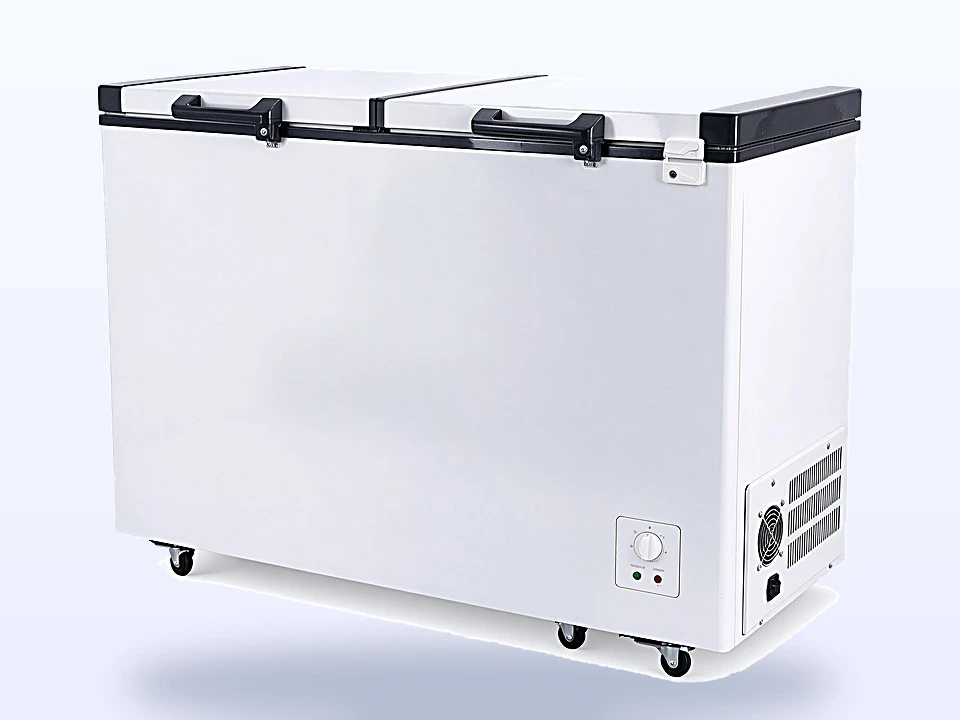
STOP 01 · the front face - 1.33 square metres of floor for 608 litres, and why the long cabinet wins
A 608 litre chest is a long box: 1785 mm of front face and 745 mm of depth, which is 1.33 square metres of floor once the castors are on it. Divide one number by the other and the cabinet returns about 457 litres for every square metre it occupies. A narrower twin of the same capacity would return less, because every extra lid edge and every extra end wall is a surface that leaks heat into a room you are already paying to cool.
That is the argument for buying the long version rather than two short ones: one cabinet, one compressor, one thermostat, one footprint. The front face is also the face a customer reads, so the paint matters. It is a white coil-coated steel sheet over a foamed body, and the only genuinely vulnerable line on it is the bottom edge, where a mop and a wet floor meet. Keep the castors turning and that edge stays above the water.
Two practical measurements before you commit: 1785 mm of wall, plus about 100 mm at the rear for the coil to breathe, plus the swing of the lid you intend to open most often. The cabinet weighs 72 kg net and 76 kg gross, so it is a two-person lift and a four-castor roll once it is upright and empty.
STOP 02 · the two lids - Two lids of roughly 0.6 square metres each, and the discipline they impose
The 608 is a double door chest: two independent lids over one foamed body, divided by a moulded centre bridge. Each lid is about 0.6 square metres of insulated panel with a steel hinge at the back and a moulded handle at the front. Independence is the whole point. A shop selling frozen chicken and ice cream opens one half twenty times a day and the other twice, and the half that stays shut keeps its cold air where it belongs.
Cold air is heavy and it pours out over the rim the moment a lid lifts. Two rules cover almost everything: open the half you need rather than both, and close the lid before you start weighing or bagging. A lid that is left open while an order is written is the single most expensive habit in a frozen shop, and no amount of foam compensates for it.
Check the gasket the way you would check a door seal at home: close the lid on a strip of paper, pull. If the paper slides out without drag, the gasket is either dirty, deformed, or past its life. Wipe the gasket and the rim with clean water monthly. Grease and sugar syrup on a gasket are what turn a two-year seal into a one-year seal.
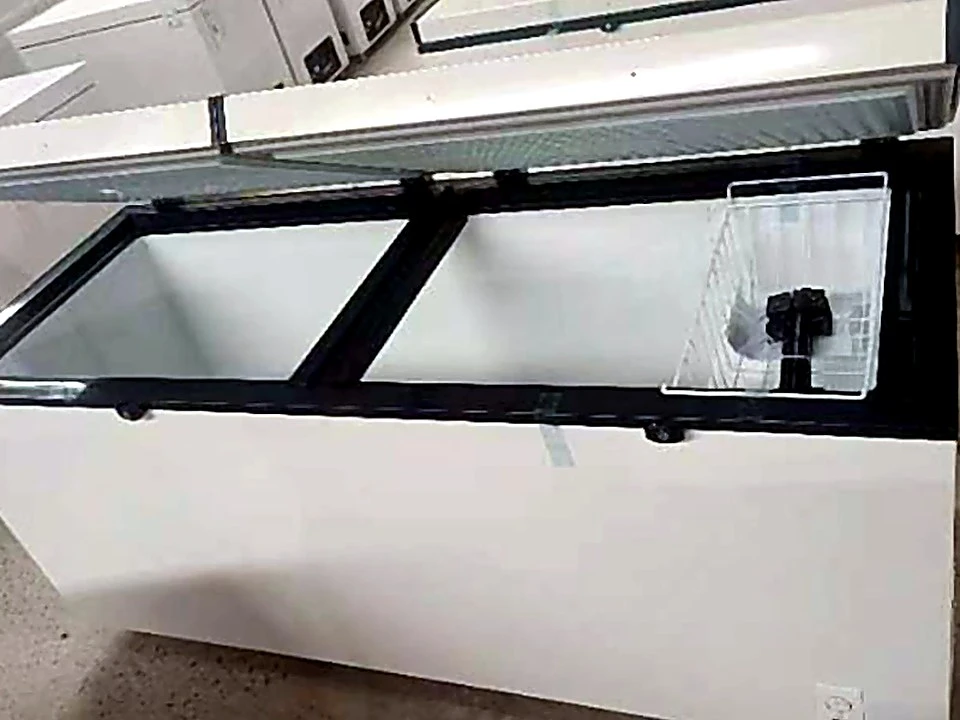
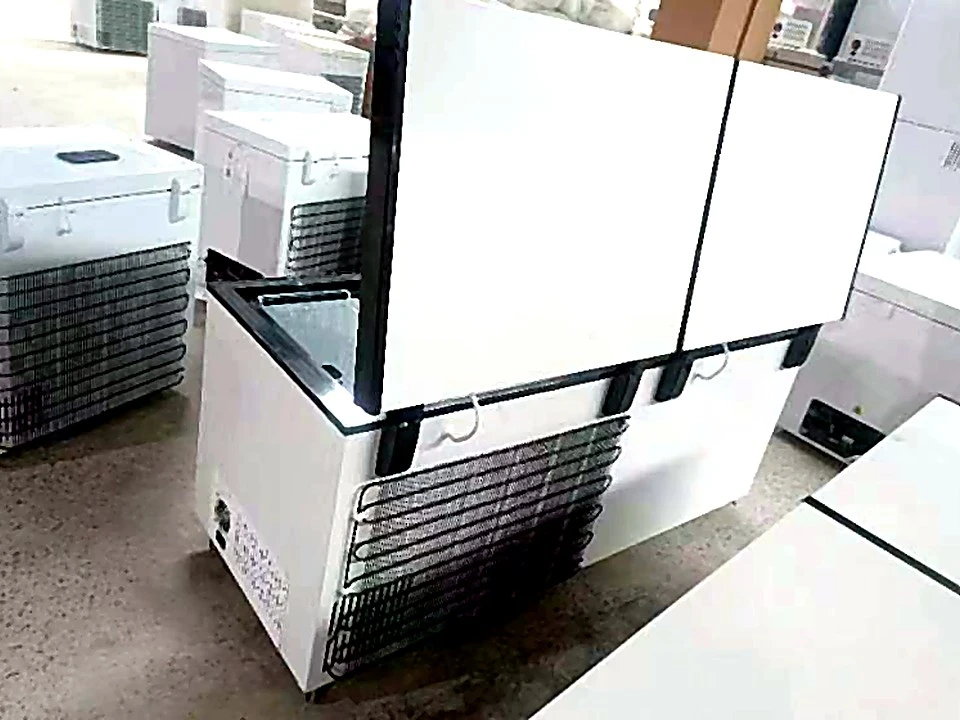
STOP 03 · the liner - 85 mm of foam, an white liner, and the thermal mass that buys you an evening
Lift both lids and the inside is a single white liner with a moulded step at each end and hooks for the wire basket. The walls are foamed to 85 mm, which is roughly a third more insulation than the thin commercial chests the same money used to buy. Foam is not a marketing number: it is the reason a loaded cabinet can sit through a six hour outage at ambient without the load going soft, and the reason the compressor runs shorter cycles at night when the array is asleep.
The liner is the part that gets abused. Baskets get dropped in, frozen cartons get levered out with a screwdriver, and a chipped liner becomes a place where moisture collects and ice grows. Load from the ends, not over the rim, and never use the rim as a fulcrum. Ice that builds to more than about 5 mm on the walls costs you capacity and compressor run time: defrost when the shop is closed, with the load in a second cabinet or a insulated box, and let the liner come back to room temperature before you restart it.
Deep and narrow is the right shape here. 608 litres in a cabinet of this height means the bottom of the liner is a long way from the top, so the basket is not an accessory: it holds the fast movers at the level where a hand can reach them without leaning into the cold.
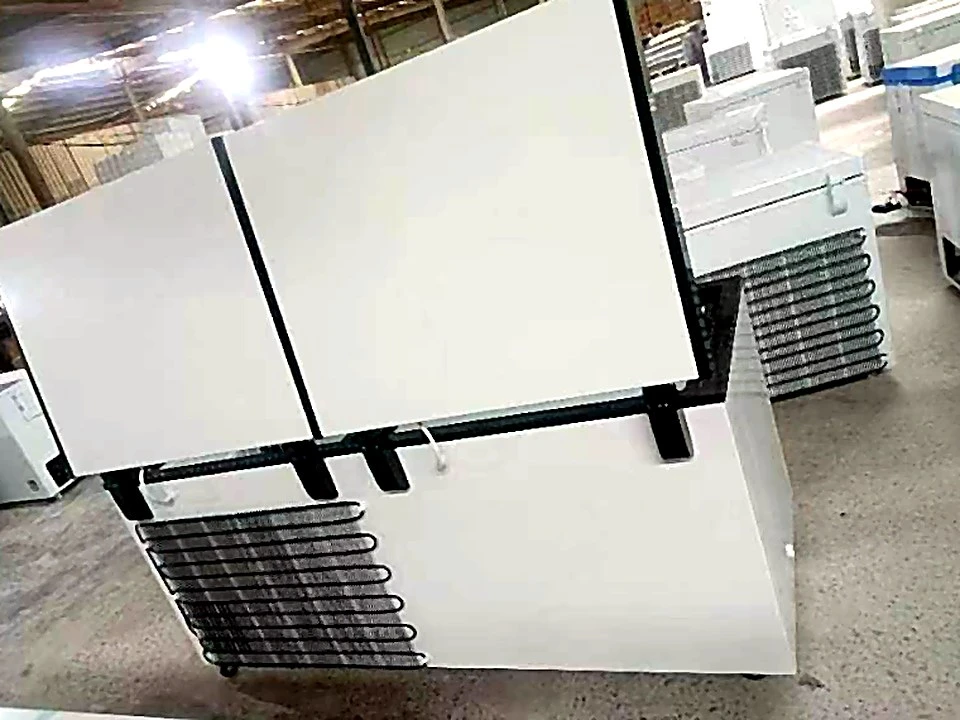
STOP 04 · the rear coil - A static wire tube condenser, 100 mm of air, and the cheapest efficiency you will ever buy
Turn the cabinet around. The condenser is a static wire tube grid across the back: no fan, nothing to seize, nothing to draw current at night, and nothing to rattle in a shop where people are trying to talk. Static means the heat leaves by natural convection, which is efficient exactly as long as the air can move, and inefficient the moment the grid is boxed in or furred up.
Give it 100 mm of clear air from the wall and keep cartons, brooms and pallet wrap out of that gap. Dust the grid every quarter with a soft brush from the top down, not upwards into the fins. In a flour-heavy or coastal environment, halve that interval. A dust-loaded condenser raises condensing temperature, raises current draw, and shortens compressor life in a way no warranty claim will ever attribute to the dust.
This is also the number that decides the room. A cabinet of this size rejects heat continuously, so a small back room with the door shut will run warmer than the shop it serves. If the room has no through draught, give it one before you blame the freezer.
STOP 05 · the end panel - 10–50 VDC in, 12 or 24 volts nominal, and a thermostat you can turn with a thumb
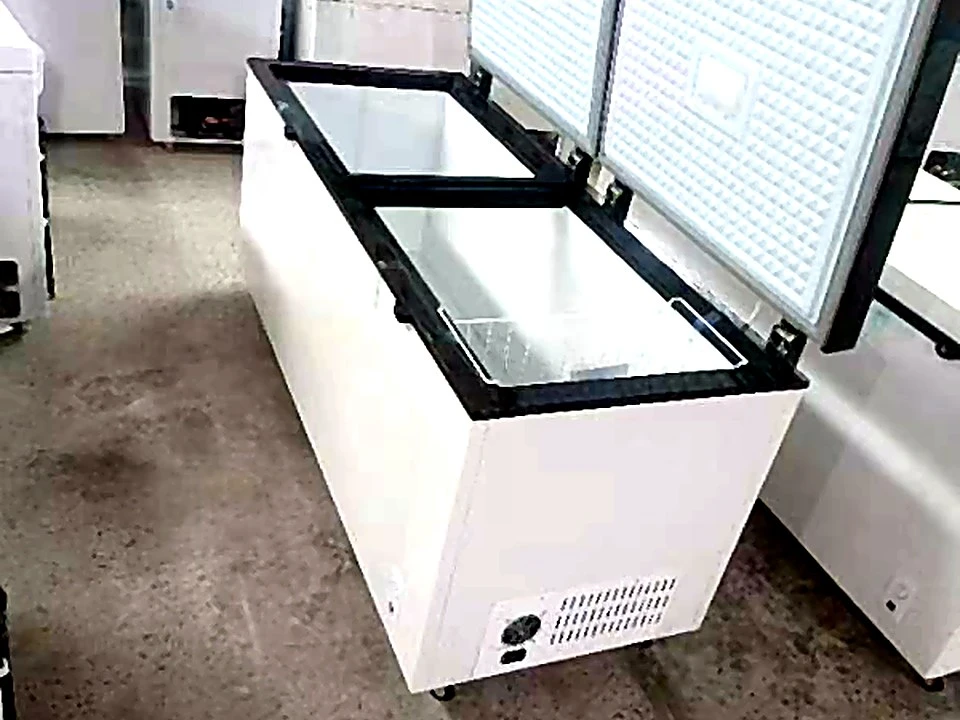
The end panel carries three things worth knowing: a louvred vent over the compressor compartment, a mechanical thermostat dial with a running lamp beside it, and the DC inlet. The dial is numbered rather than calibrated in degrees, which is honest: it sets a position, and the thermometer in the cabinet tells you what that position achieved. Set it once with a thermometer in the load, mark the position with a pencil, and stop moving it.
The wide input is the part that makes this a solar cabinet rather than a DC cabinet. Anything from 10 to 50 volts DC at the inlet will run the compressor, which covers a 12 volt bank in the morning, a 24 volt bank in the afternoon, and the sag that a long cable run adds between the two. Most installations here are 12 or 24 volts nominal from a panel and a bank, with no inverter anywhere in the chain, so the conversion loss that would otherwise sit between the array and the compressor simply is not there.
Three installation habits: keep the DC cable run short and the cable section generous, because a volt dropped in the cable is a volt the compressor never sees; fuse at the bank, not at the cabinet; and set the low voltage cut-out on the controller above the point where the bank is damaged, then live with the shorter run time. A cabinet that protects the bank keeps working next year. One that empties the bank does not.
STOP 06 · the floor of the plant - Fifty six cabinets to a 40 foot high cube, and what happens before they are packed
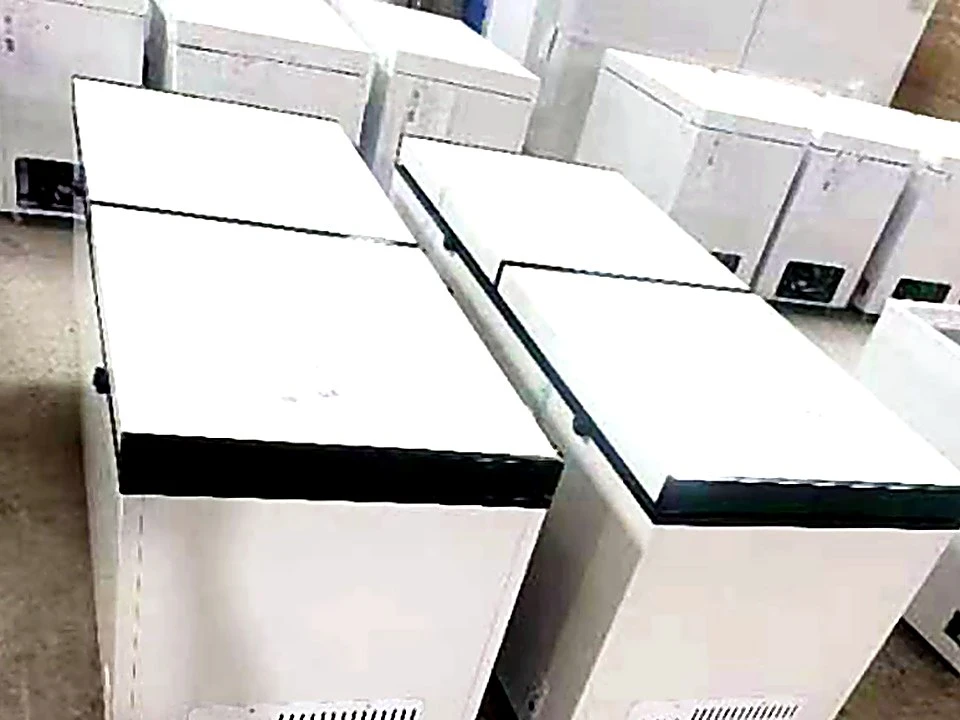
Every cabinet is run before it is packed: leak test on the circuit, a pull-down run to temperature, a thermostat sweep, then a check of the lid alignment and the castor tracking on a flat floor. The photographs on this page are of production units rather than samples, which is why the lids sit square and the vent grilles are straight. A cabinet that rattles out of the carton rattles in a customer's shop for a decade.
Loading is 56 units per 40 foot high cube, standing upright, with the cartons stacked to the container ceiling. That is 34,048 litres of capacity per container, which is the number to compare when you are quoted per unit by three suppliers. A slightly cheaper cabinet that loads 48 to the box is not cheaper.
Cartons and rating plates print to your own artwork from the second container; the first one ships in our livery so that the certification, the manual and the marking can all be checked in the field before your brand goes onto them. CKD and SKD kits are available from the same line for buyers who assemble locally.
The only arithmetic a solar freezer needs
A chest freezer on a solar array is three numbers in a row: what the cabinet takes out of the bank in a day, what the array puts back in a day, and what the bank can carry overnight. Everything else is marketing. The method below uses a meter reading rather than a brochure figure, because the same cabinet in a shop that opens one lid twice an hour and a shop that opens it sixty times will not read the same.
Step one - run the cabinet on the mains for a week with a plug-in energy meter and write down the daily figure in kWh. That number already contains your climate, your opening habits and your load. Do not estimate it, measure it; a meter costs less than one month of an undersized array.
Step two - divide the daily kWh by the peak sun hours at your site. Four hours is a fair working figure for most of southern Africa outside the winter Cape; five and a half suits the Sahel. One kWh a day over four hours is 250 W of panel, before you add anything for cable loss.
Step three - convert the daily kWh into amp hours at your bank voltage: kWh divided by volts, times one thousand. One kWh a day is about 83 Ah at 12 volts and about 42 Ah at 24 volts. Multiply by the days of autonomy you actually need, then add a quarter for depth of discharge.
| Measured consumption | Panel at 4 sun hours | Bank, 1 day at 12 V | Bank, 1 day at 24 V | Bank, 2 days at 24 V |
| 1.0 kWh / day | 250 W | 100 Ah | 50 Ah | 100 Ah |
| 2.0 kWh / day | 500 W | 200 Ah | 100 Ah | 200 Ah |
| 3.0 kWh / day | 750 W | 300 Ah | 150 Ah | 300 Ah |
| 4.0 kWh / day | 1,000 W | 400 Ah | 200 Ah | 400 Ah |
The table is arithmetic, not a specification: it says what the sums give, and it assumes a controller with a low voltage cut-out and cable sized for the current rather than for the budget. If your meter says 2.6 kWh a day, read between the second and third rows. If your site has three sun hours in June, use the three hour column and not the four.
Installation day: the six things that decide the first year
01 · the floor - Flat, and able to take 76 kg on four castors. A cabinet standing on two castors and a corner of its base will twist the frame and lift one lid corner off its gasket. Check with a spirit level across the front and along the side, and shim under a castor rather than under the body.
02 · the air at the back - 100 mm of clear space from the wall, and nothing stored in it. This is the single most common installation fault we are shown photographs of, and it costs compressor life quietly for years.
03 · the cable - Short, thick and fused at the bank. Measure the voltage at the cabinet inlet while the compressor is running, not while it is idle. A drop of more than about half a volt across a 12 volt run means the cable is too thin for the length, and no amount of extra panel fixes a cable problem.
04 · the cut-out - Set on the controller, not on hope. Choose the voltage that protects the chemistry of the bank you bought, and accept the shorter running time that follows. A cabinet that stops before the bank is flat is doing its job.
05 · the first pull-down - Load the cabinet empty for the first run, and let it hold for a full day before filling it. Loading warm stock into a warm cabinet on a hot afternoon is how a good compressor gets a bad reputation.
06 · the record - Write the installation date, the bank capacity, the panel wattage and the thermostat position on a card taped inside the lid. Two years later nobody remembers any of it, and every service conversation starts with those four facts.
Four complaints that are not faults
It is not cold after two hours - A 608 litre cabinet pulled down from ambient in a hot room needs most of a day to reach and hold minus eighteen with a load inside. The dial position that worked in the showroom is not the dial position that works in a shop at 38 degrees. Give it a night, then adjust once.
There is ice on the rim - Warm moist air meeting a cold rim, usually after a busy morning with the lids open. Wipe the rim and gasket dry at closing time, and check that the lid is not being propped open by a carton edge. Ice on the rim is a habit problem before it is a cabinet problem.
It runs for a long time at midday - That is the cabinet doing its work while the ambient is at its peak and the bank is at its highest voltage. Long runs at noon with short runs after dark is exactly the pattern a solar freezer is designed for.
The vent grille is warm - The end panel carries the compressor compartment, and warm air leaving that grille is heat that came out of your stock. What matters is that the air can leave. If the grille is hot to the point of discomfort and the cabinet is struggling, the condenser at the back needs cleaning.
BD/BC-608, one line per item
| Item | BD/BC-608 |
| Total storage volume | 608 L |
| Product size | 1785 × 745 × 834 mm |
| Carton size | 1835 × 755 × 885 mm |
| Net / gross weight | 72 / 76 kg |
| Holding temperature | −18 °C or lower |
| Cabinet foam | 85 mm, CFC free |
| Doors | 2 independent lids, steel hinges, moulded handles |
| Basket | 1 white wire basket as standard, 2 on request |
| Temperature control | Mechanical dial, running and power lamps |
| Input | 10–50 VDC wide range; 12 V / 24 V nominal; 220 V through an adapter |
| Refrigerant | R134a / R600a |
| Condenser | Static wire tube, about 100 mm clearance at the rear |
| Castors | 4, cabinet base about 40 mm off the floor |
| Loading | 56 units per 40 foot high cube |
Sizes and weights are the cabinet and its carton as built. Volume, temperature, refrigerant and container quantity follow the catalogue sheet for the double door chest freezer line.
Three sizes from the same double door line
| Model | Volume | Cabinet (mm) | Carton (mm) | Net weight | Per 40'HQ | Litres per container |
| BD/BC-608 | 608 L | 1785 × 745 × 834 | 1835 × 755 × 885 | 72 kg | 56 | 34,048 L |
| BD/BC-658 | 658 L | 1598 × 885 × 935 | 1660 × 895 × 1010 | 82 kg | 28 | 18,424 L |
| BD/BC-708 | 708 L | 1785 × 795 × 890 | 1835 × 895 × 965 | 86 kg | 26 | 18,408 L |
The 608 is the tallest loader of the three because it is the narrowest across the front, and a container pays for the metre it wastes at the side of a cabinet rather than the litre inside it. If your order is measured in containers, that is the column to read.
Before the order goes in: five questions we will ask you
Where does it stand - a wall of 1785 mm plus 100 mm at the rear, on a floor that will take 76 kg on four castors, in a room with some through draught.
What runs it - 12 volts, 24 volts, or mains through an adapter. Tell us the bank capacity and the cable length between bank and cabinet and we will reply with the cable section rather than a guess.
What goes in - frozen meat, ice cream, fish, or mixed. The holding temperature is the same for all of them, but how often the lid opens is not, and that changes the panel arithmetic far more than the litre count does.
How it arrives - complete cabinet, or CKD / SKD kit for local assembly. The kit version is packed by sub-assembly and ships with the foaming and charging instructions for your line.
Whose name is on it - carton, rating plate, manual and serial format. The first container usually goes out in our livery so the marking can be checked on site before your artwork is committed.
STOP 07 · the whole cabinet - Both lids up, an array behind it, and no inverter anywhere in the picture
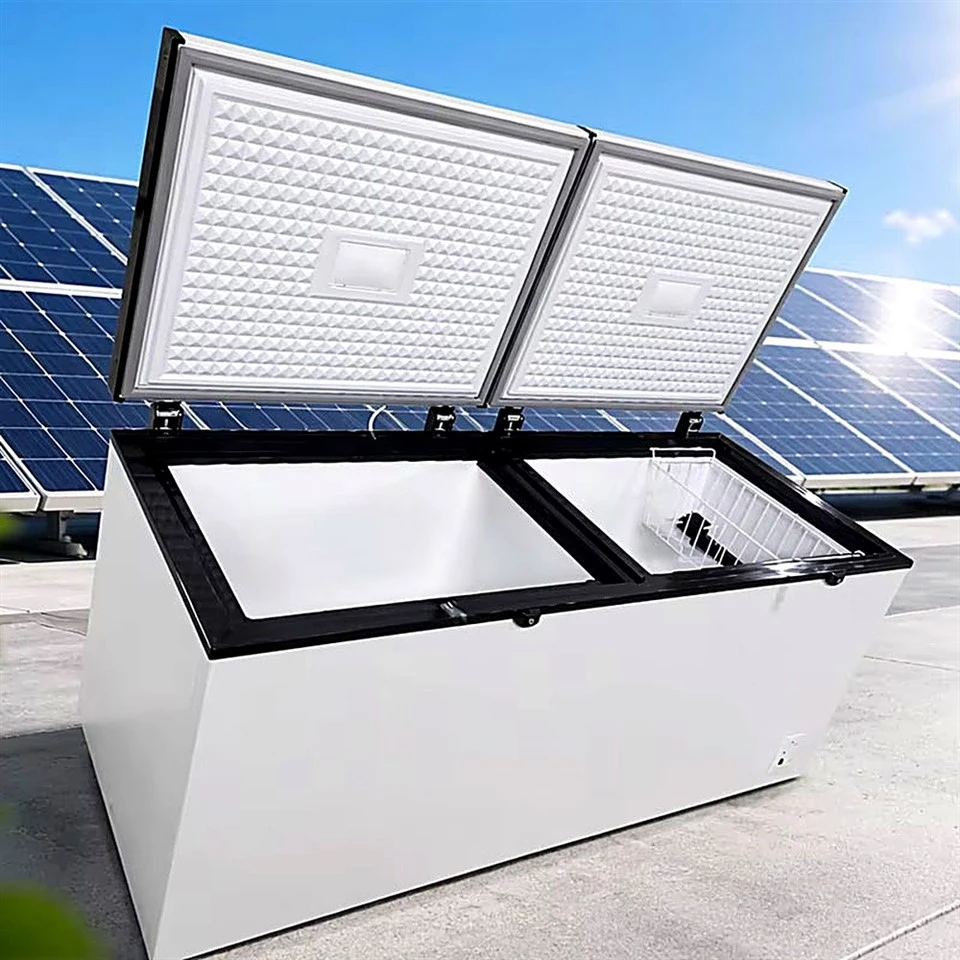
The last stop is the one the buyer actually sees: the cabinet standing where it will stand, with the array that feeds it behind the fence. The 608 in this photograph is a production unit on a test pad rather than a studio render, lids raised so that the compartments, the centre divider and the basket hooks are all legible.
What the picture cannot show is the part that decides the next ten years: the 100 mm of air at the back, the cable section between bank and inlet, the cut-out setting, and whether anybody wipes the gasket on a Friday. Those four decisions belong to the installation rather than to the cabinet, and they matter more than any difference between two boxes at this price.
If the cabinet goes outdoors under a lean-to, keep the end panel out of the driving rain and the lid frames clear of a leaking gutter. This is a shop floor cabinet, not a weatherproof one, and a roof over it costs less than the first service call.
WHO BUILDS THE 608 - One plant in Hangzhou, the whole DC chest freezer range, and the export paperwork that goes with it.
Zhejiang Juka Solar Technology builds the DC and solar chest freezer range in Hangzhou, from the 98 litre single lid cabinets up to the 1388 litre twins, and ships them as complete units or as kits for local assembly. The same plant builds solar air conditioners, ice makers, display coolers and refrigeration spare parts, so a mixed container is an ordinary order rather than a special arrangement. Cartons, rating plates, manuals and serials carry the buyer's brand from the second container onward.
WHAT WE NEED TO QUOTE - The litres you need, the sun hours you have, the wall length available, and the voltage of the bank.
Send those four and we reply with the cabinet size that fits the wall, the array and bank arithmetic for your site, the units to your container and the lead time on the 608. Samples ship from stock; the certification pack and the CKD packing list go out with the quotation rather than after it.
Hot Tags: solar powered freezer box, China solar powered freezer box manufacturers, suppliers, factory


