


Ten Questions Buyers Ask Before The Second Container,
Answered On 158 Litres
BD/BC-158 is a 158 litre single-lid chest freezer built into a 65 mm foamed cabinet, wired for anything from 10 to 50 volts DC, finished in white enamel and rated to hold −18 °C in a 43 °C room. This page is not arranged by feature, because a feature list is what a buyer reads before the first container and ignores afterwards.
The first container is bought on price and a photograph. The second container is bought by somebody who has already watched a cabinet run through a hot season, listened to a compressor at three in the morning, and explained a nameplate to an electrician who does not read English well. That buyer is not looking for adjectives. They are looking for the one number that settles the argument: the width that decides how many fit in the shop, the current draw that decides the cable, the kilowatt hours that decide the array, the carton that decides the freight.
So the page is ten questions, in the order they usually arrive, each one answered against the cabinet that leaves our line. Every value quoted here is either printed on that cabinet or measured on it, and nothing is rounded up to sound better.
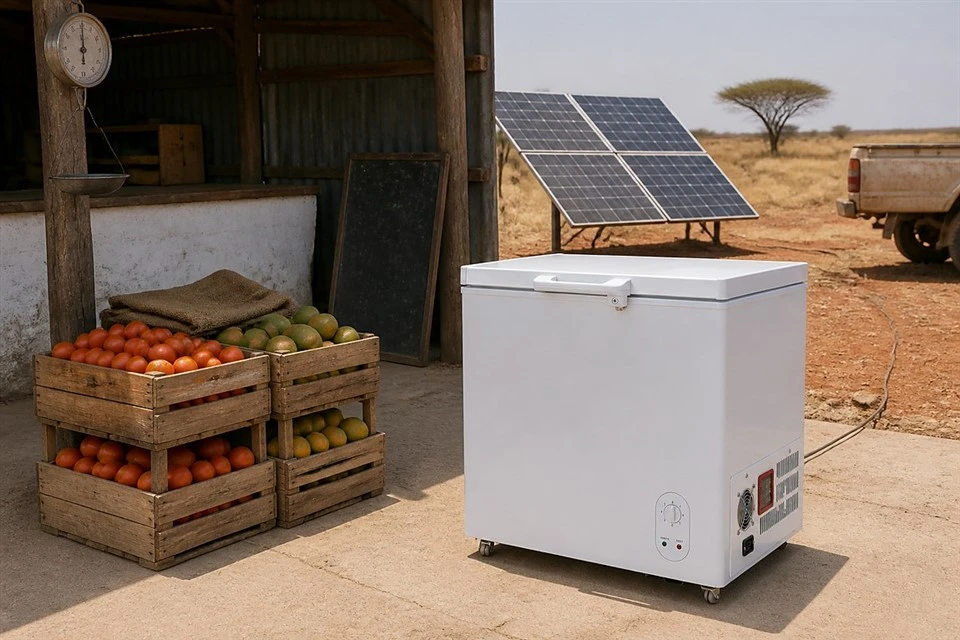
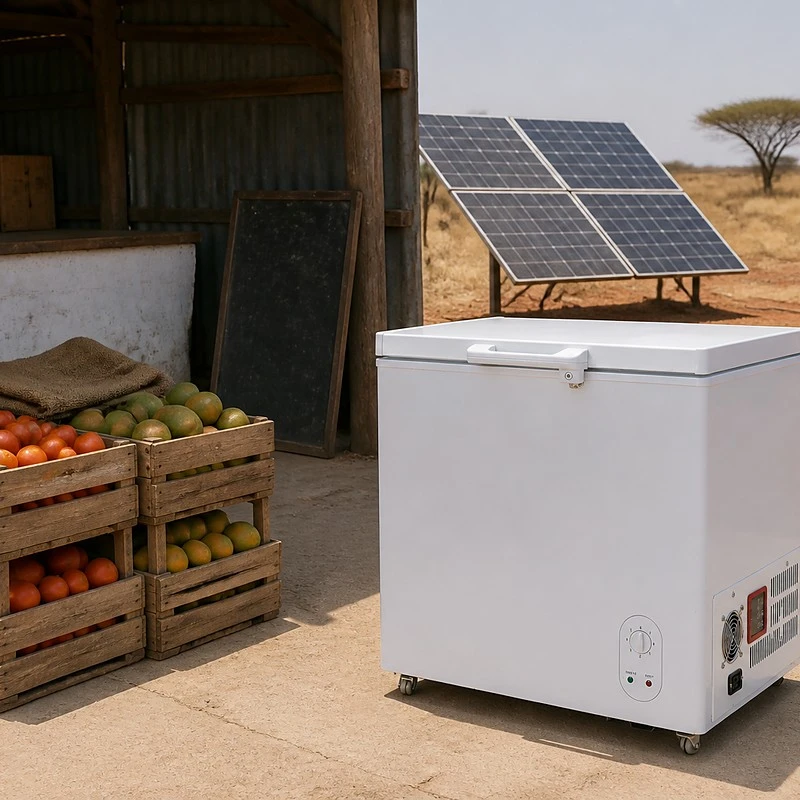
BD/BC-158 at a produce buying point: one cabinet, one array, one working day of stock. 750 mm wide, 555 mm deep, 840 mm tall.
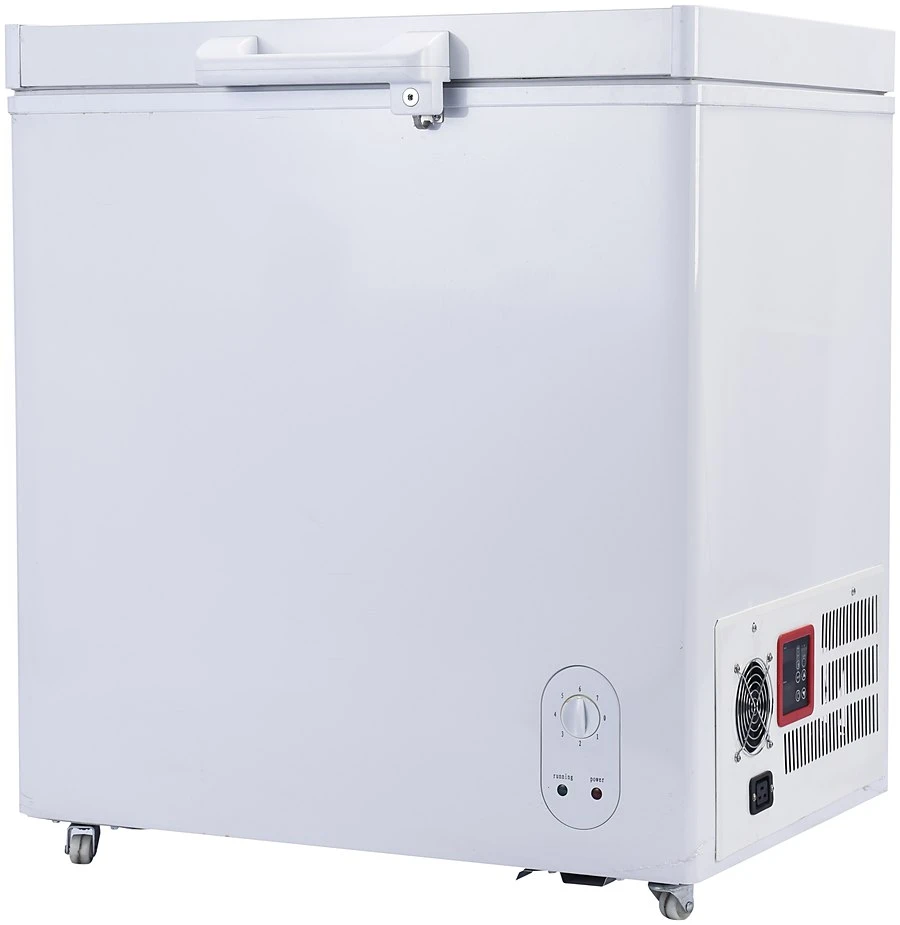
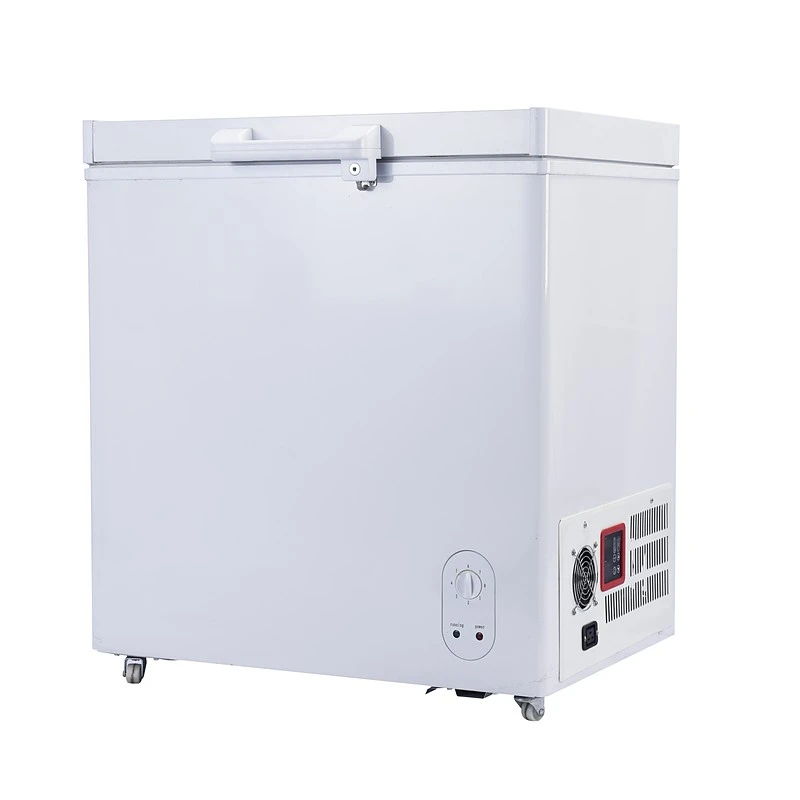
The cabinet measures 750 mm wide, 555 mm deep and 840 mm tall, and the lid opens upward, so the dimension that decides placement is not the floor plan but the empty air above the freezer. Allow 900 mm of clear height over the lid: that is enough for the lid to stand on its hinges and for a person to reach the bottom of the liner without leaning across the edge.
Depth is the quieter benefit. At 555 mm the cabinet passes a standard single doorway with the packaging off, and it sits against a wall without narrowing the aisle below trolley width. Four castors let one person move an empty cabinet, and two people move one that is loaded.
If you are replacing 580 mm units from the same 65 mm range, the extra 170 mm of width buys 50 litres more volume at exactly the same height and depth - the shelf, the wall and the loading bay you already use do not change.
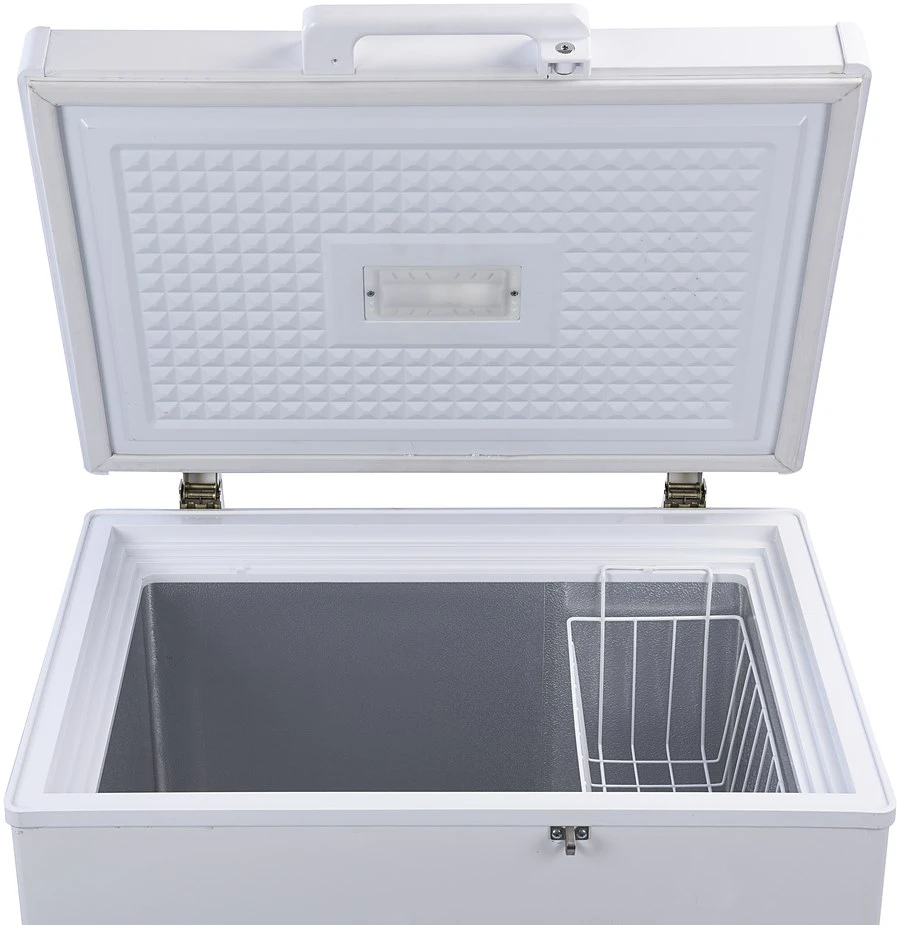
158 litres is the total storage volume printed on the plate, measured to the liner rather than to a shelf line. The cabinet is loaded from above, one layer and one shallow second layer, and that is why a chest freezer is more forgiving than an upright on a partial load: the cold air stays where it is put, and a half-filled cabinet does not pour its cold out every time the door opens.
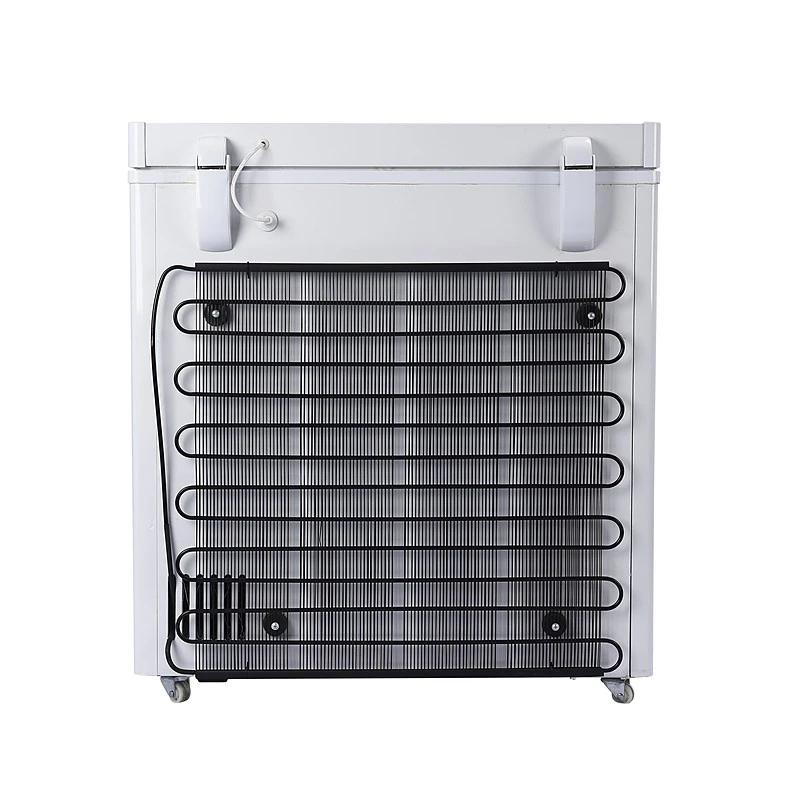
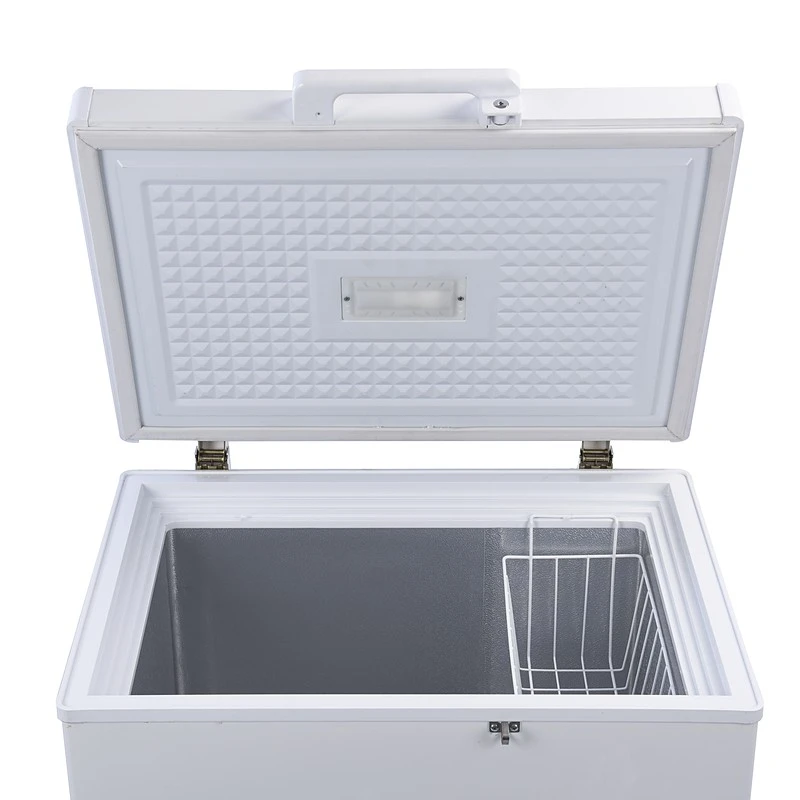
The wire basket takes the top of the liner. Treat it as the fast-moving zone - the two or three lines that leave the cabinet twenty times a day - and load the bulk beneath it in crates you can lift out by hand. Because the evaporator is formed into the cabinet walls rather than hung inside the liner, all four sides are smooth and nothing snags on the way in or out.
The drain plug sits at the liner floor. That one detail separates a cabinet that can be washed down in ten minutes from one that has to be defrosted with towels on the floor, which is why the plug is in every unit rather than on an option sheet.
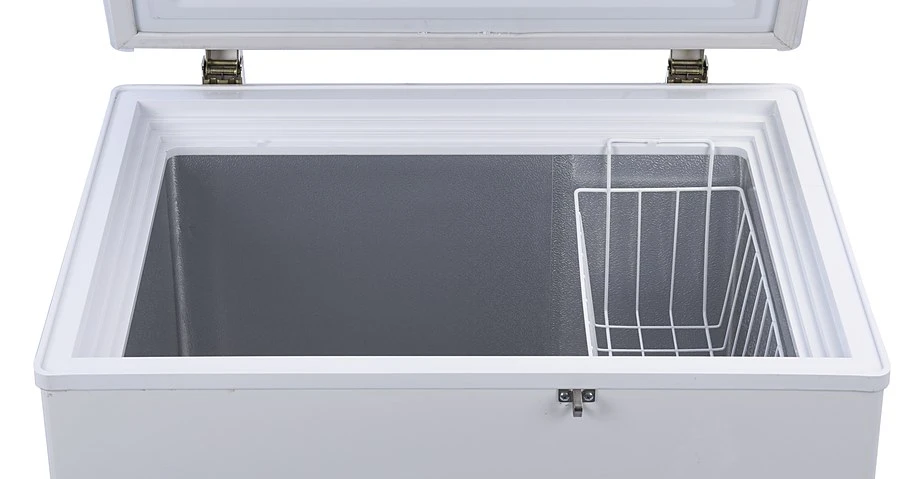
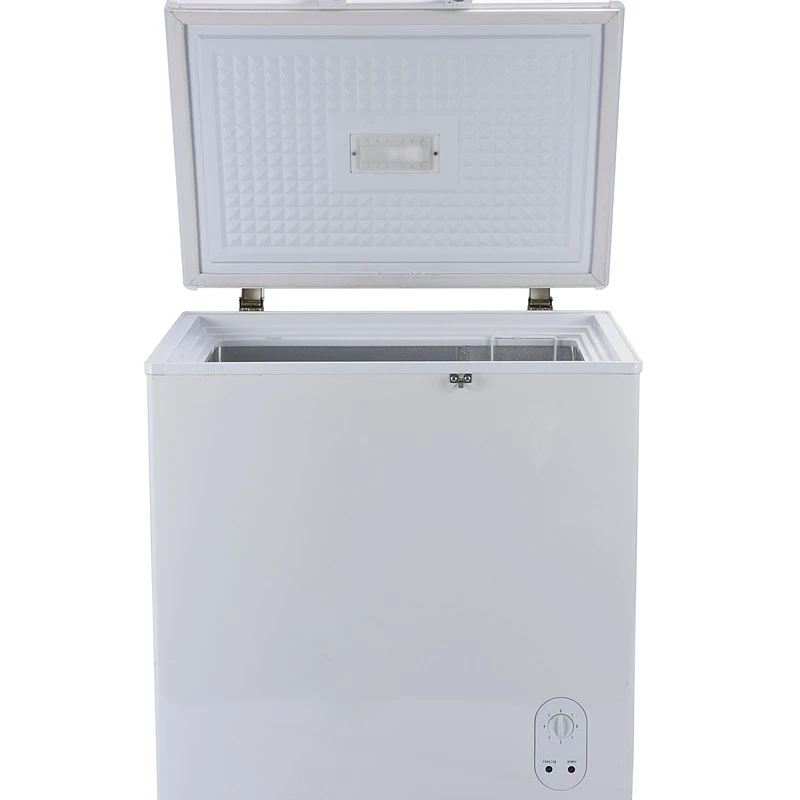
Sixty-five millimetres is the foam thickness in the walls, the lid and the base. You can see its edge as the wide white rim between the outer shell and the liner of an open cabinet: that rim is the top of the foam, and every millimetre of it is working.
Thicker foam changes the duty cycle before it changes the temperature. A cabinet that loses less heat through its own walls spends less of the day with the compressor running, and the compressor that runs less is the one that is still quiet in year four. On a solar direct system this counts twice, because every watt the cabinet does not draw is a watt the array does not have to put back into the battery.
Foam does not make a freezer frost-free. This is a manual defrost cabinet and it says so plainly: frost forms on the liner and is cleared by hand before it costs storage space. In humid coastal markets plan a defrost when the frost reaches about five millimetres and let the drain plug do the rest of the work.
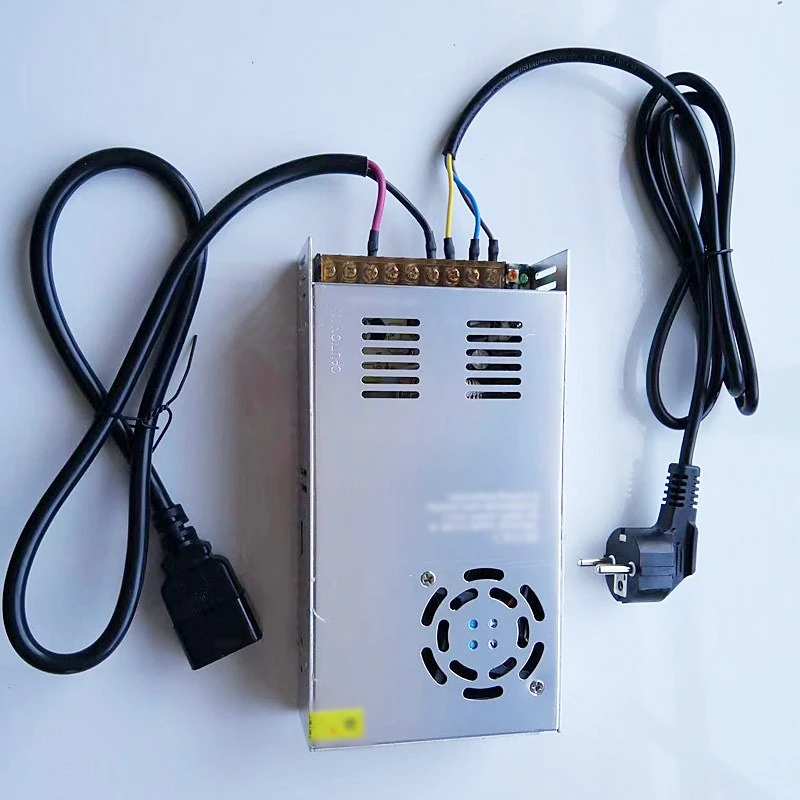
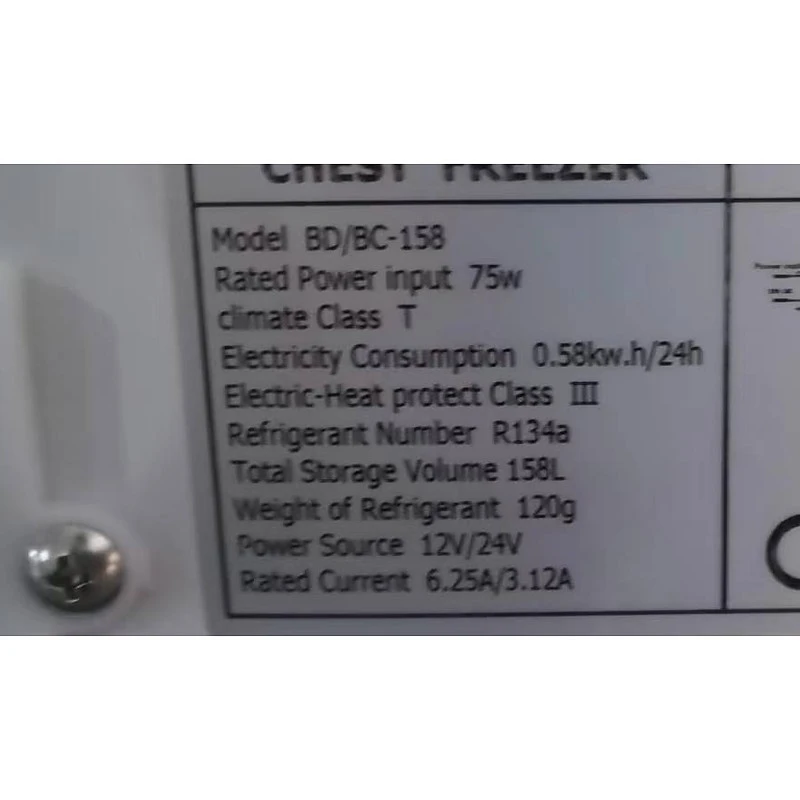
It means the cabinet keeps running while the battery does not. A wide-input controller accepts anything between 10 and 50 volts DC and holds the compressor at the speed it needs, so a 12 volt bank that sags to 11.2 volts under load and a 48 volt array sitting at 54 volts open circuit both fall inside the window. Most buyers order nominal 12 or 24 volts, and the plate prints the current for both: 6.25 A at 12 V and 3.12 A at 24 V.
Where mains is available the cabinet runs from an external 220 volt adapter, so one model covers a shop with a grid supply, a shop with a diesel generator and a farm with nothing but panels. The controller is set at the factory to the nominal voltage on your order and needs no laptop on site.
Two habits keep DC installations alive. Keep the cable run short and the cross-section honest, because voltage drop is a tax paid on every hour of the day. And connect panel, controller and battery in that order with the cabinet last, so the freezer is never the component that decides when the battery is flat.
Climate class T is the answer printed on the plate, and it means the cabinet is rated to work in a 43 °C ambient. That is not a laboratory courtesy. It is the temperature inside a metal-roofed shop at two in the afternoon in the markets where these cabinets actually work, and it is the number to quote when a customer says the last brand could not keep ice.
Rated power input is 75 W and the plate prints 0.58 kWh per 24 hours. Read that figure the way it was measured: lid closed, steady ambient, normal load. Open the lid forty times in an afternoon in a hot room and consumption climbs, because every opening trades cold air for warm air. Size the array on the plate figure plus a margin for the lid, never on the plate figure alone.
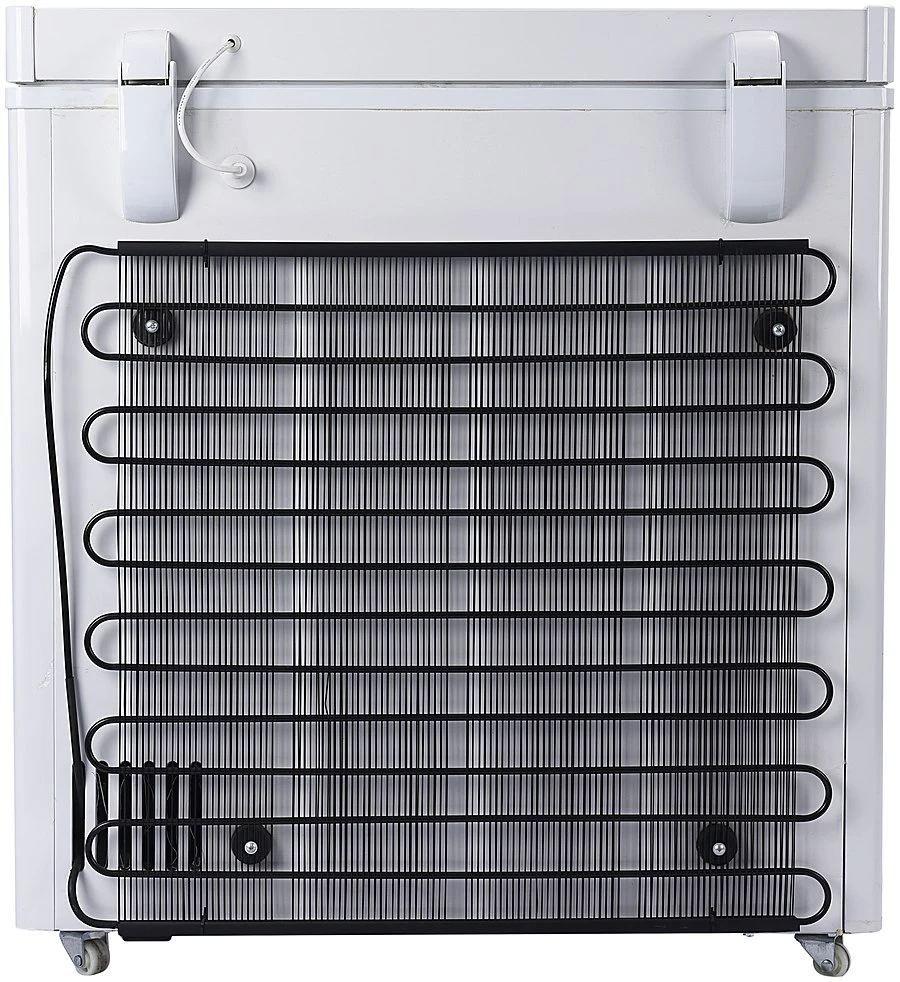
The condenser is on the back of the cabinet, exposed, with the fan behind the right-hand panel. The layout is deliberate, because an open coil can be brushed clean in a dusty market. It only works if the cabinet is not boxed into a niche: leave 100 mm behind the coil and never stack cartons against it.
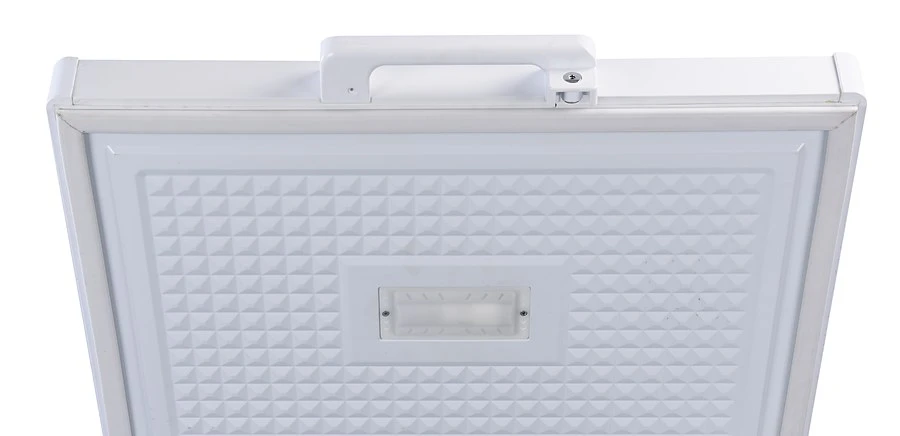
One lid, one magnetic gasket, two hinges and a stay that holds the lid open. The lid liner carries a moulded panel that stiffens it, which is why a 750 mm lid does not sag in the middle after a year of being dropped shut instead of closed.
The gasket is the part that fails first and also the cheapest part in the cabinet. Test it in ten seconds with a strip of paper: close the lid on the paper at four points along the front edge and pull. If the paper slides out with no resistance anywhere, the gasket is tired or the cabinet is not standing level - check the castors before ordering the part.
The lid stays where it is put, held by its hinges rather than by a shoulder, which matters when one person is loading the liner alone. Everything that touches stock is either the white liner or the wire basket, and both lift out for washing.
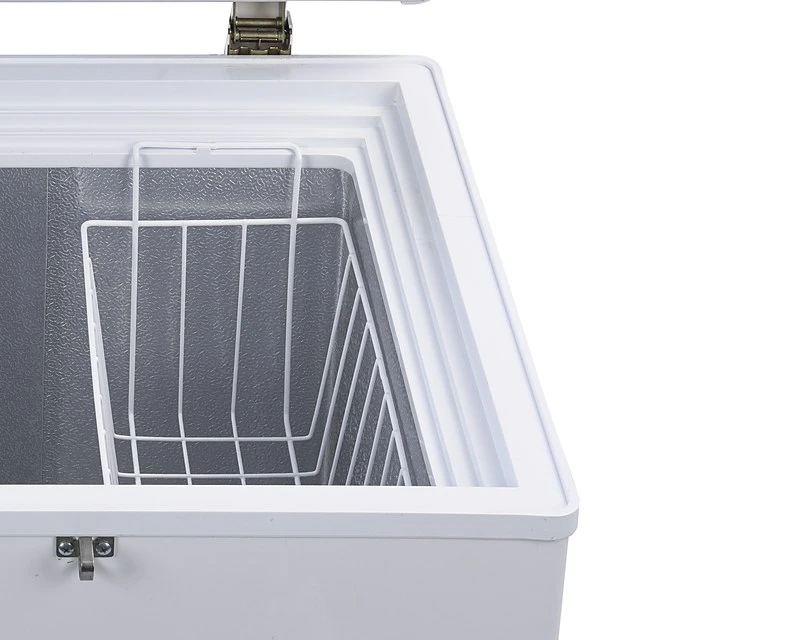
A smooth white liner, rounded corners, a drain plug, one wire basket, and a mechanical dial on the outside of the cabinet. There are no shelves to lose, no drawer runners to break and no inner fan to ice up, because the evaporator is formed into the cabinet rather than hung inside the liner.
The mechanical thermostat is a deliberate choice for the markets this cabinet is sold into. It has no firmware to version, no menu to mis-set and no display language to argue about. Turn it, listen for the compressor, and the cabinet is commissioned. When a customer says the freezer is too cold, the answer is a screwdriver, not a service visit.
Loading happens from above, and so does cleaning. Lift the basket out, take out the crates, let the frost go and the liner can be washed and drained without moving the cabinet away from the wall.
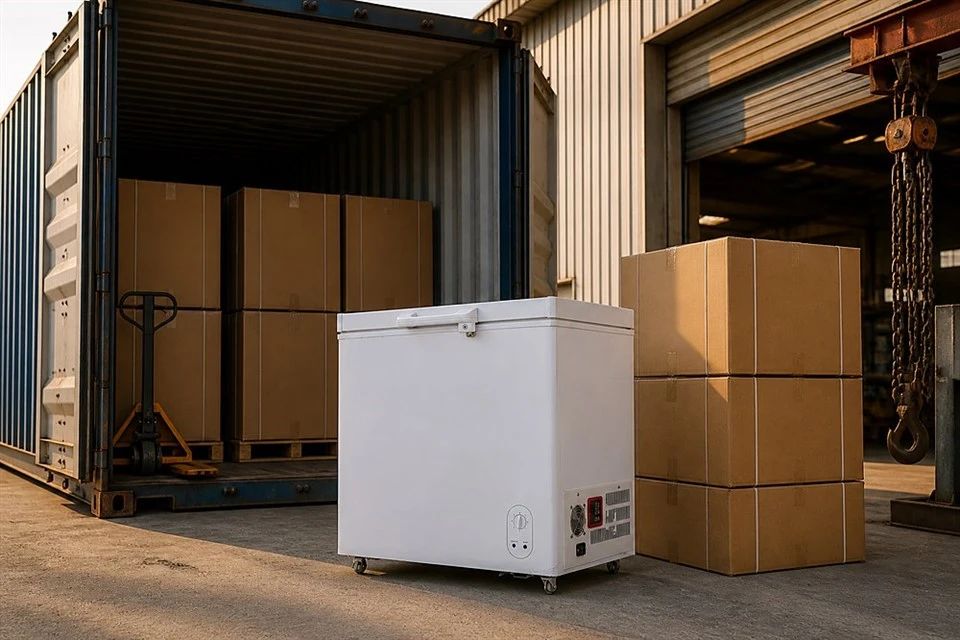
Each cabinet goes into a carton of 790 × 580 × 880 mm at 35 kg gross and 32 kg net. A 40 foot high cube takes 180 of them. Those three numbers are the whole freight conversation: the carton decides the stow pattern, the weight decides how many people unload a truck, and the loading decides the landed cost per unit that your own customer will argue about.
We pack in our own yard on our own line, and the carton carries the model and the voltage setting, so a mixed container can be split in the warehouse without opening every box to find out what is inside.
Where 158s travel with 108s and 208s in one container, the load is calculated per model and quoted as a mix rather than as a single headline figure, because a container that is loaded on a rounded number is a container with an empty corner.
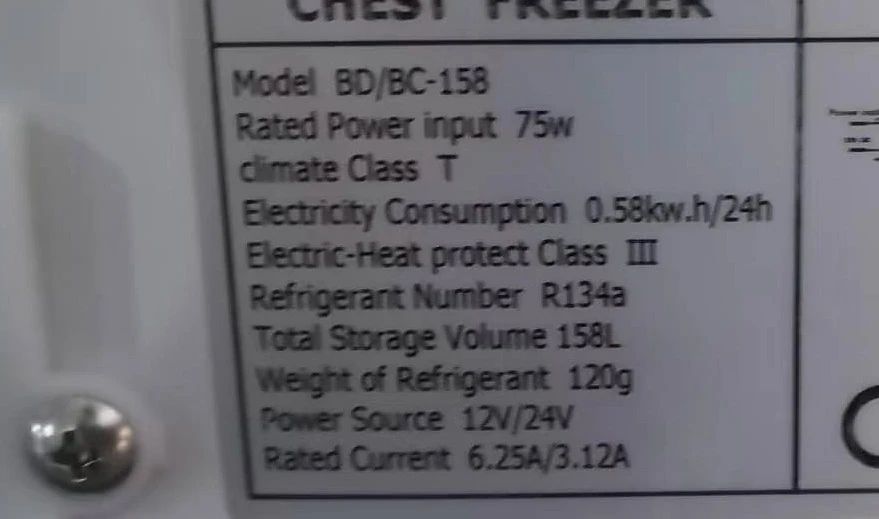
The nameplate is the last thing we change and the first thing that has to be right. Model, total storage volume, rated power input, climate class, energy consumption, protection class, refrigerant and charge weight, power source and rated current are printed on it. The plate in the photograph belongs to a production cabinet, not to a brochure mock-up.
Beyond the plate, five things change most often: the voltage preset, the carton print, the plug or terminal type on the DC lead, the panel graphic on the cabinet, and the controller brand where a market already stocks one. Each of those is a production instruction rather than a promise, and each is signed off on a specification sheet before the line starts.
If you need a compressor or a controller that your service network already carries, say so at quotation stage. Changing a part after the container is on the water is expensive for both of us, and it is the most common way a good first order turns into a difficult second one.
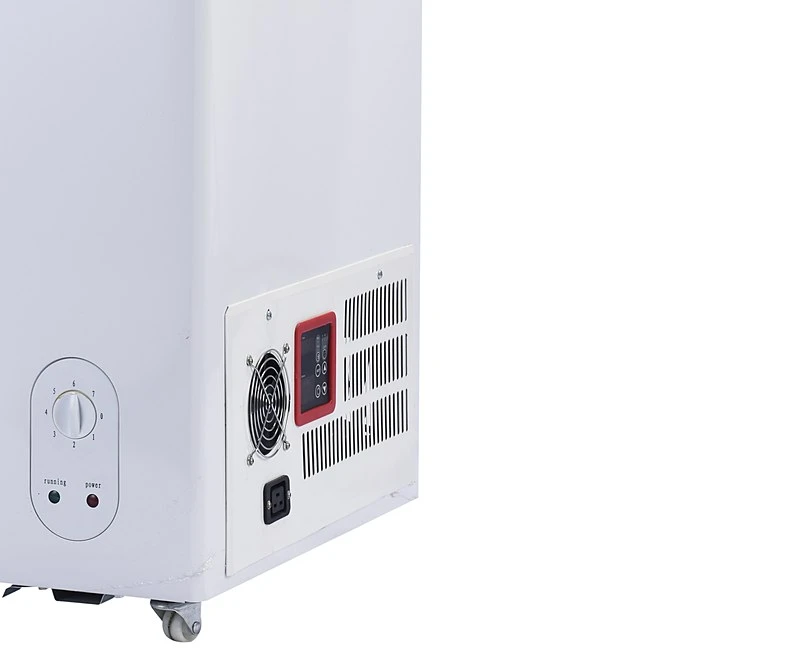
The parts that wear are known: the controller, the gasket, the thermostat, the castors and, rarely, the lid hinges. Every one is a bolt-on part with a part number, and none of them requires the cabinet to leave the shop.
The controller sits behind the right-hand panel next to the fan and is the only electronic component in the cabinet. That placement is a service decision: a technician takes out four screws, unplugs two connectors and swaps the board in the aisle while the stock stays frozen.
Spare controllers and gaskets can travel in the same container as the units. For a distributor running fifty cabinets, a box of five controllers costs less than a single emergency air shipment and removes the only reason a customer ever loses a day of stock.
The numbers, in one place
Everything below is taken from the production cabinet or from the plate riveted to it. Where a value is printed on the machine, it is repeated here in the same form.
| Item | BD/BC-158 |
|---|---|
| Model | BD/BC-158 |
| Total storage volume | 158 L |
| Product dimensions (W × D × H) | 750 × 555 × 840 mm |
| Carton dimensions | 790 × 580 × 880 mm |
| Gross / net weight | 35 kg / 32 kg |
| Loading capacity, 40 ft high cube | 180 units |
| Cabinet foam thickness | 65 mm - walls, lid and base |
| Cabinet type | Single door chest freezer, top opening lid |
| Holding temperature | ≤ −18 °C |
| Climate class | T (43 °C ambient) |
| Power source | 12 V / 24 V DC · 10–50 VDC wide input · 220 V through external adapter |
| Rated power input | 75 W |
| Rated current | 6.25 A at 12 V / 3.12 A at 24 V |
| Energy consumption | 0.58 kWh / 24 h |
| Refrigerant and charge | R134a, 120 g |
| Protection class | III |
| Defrost | Manual, with drain plug |
| Control | Mechanical thermostat |
| Basket | One wire basket |
| Finish | White enamel |
The same 65 mm cabinet, five sizes
158 litres is the middle of the 65 mm family. Buyers who start with one size usually add a second within a year, and the table below is the reason we keep the height and depth constant across the range: a mixed order stacks, ships and displays as one family rather than as four unrelated products.
| Model | Volume | Product size | Carton | G.W. / N.W. | 40 ft HC | Input |
|---|---|---|---|---|---|---|
| BD/BC-88 | 88 L | 750 × 555 × 640 | 785 × 580 × 690 | 31 / 28 kg | 229 | DC12V/24V |
| BD/BC-108 | 108 L | 580 × 555 × 840 | 620 × 580 × 875 | 30 / 27 kg | 228 | 12V/24V/220V |
| BD/BC-158 | 158 L | 750 × 555 × 840 | 790 × 580 × 880 | 35 / 32 kg | 180 | 12V/24V/220V |
| BD/BC-208 | 208 L | 906 × 555 × 840 | 946 × 580 × 885 | 39 / 36 kg | 148 | 12V/24V/220V |
| BD/BC-258 | 258 L | 952 × 668 × 840 | 990 × 680 × 855 | 44 / 40 kg | 125 | 12V/24V/220V |
65 mm or 110 mm - what the extra foam actually buys
We build the same 158 litre cabinet in two wall thicknesses, and the question that decides between them is not temperature. Both hold −18 °C. The question is how much of the day the compressor has to run, and how much space and freight the foam costs you.
| BD/BC-158 · 65 mm | BD/BC-158H · 110 mm | |
|---|---|---|
| Total storage volume | 158 L | 158 L |
| Product size | 750 × 555 × 840 mm | 840 × 661 × 840 mm |
| Carton | 790 × 580 × 880 mm | 880 × 681 × 882 mm |
| Gross / net weight | 35 / 32 kg | 45 / 41 kg |
| 40 ft high cube | 180 units | 132 units |
| Rated power input | 75 W | 49 W |
| Cabinet foam | 65 mm | 110 mm |
| Holding temperature | ≤ −18 °C | ≤ −18 °C |
The 110 mm cabinet draws 49 W against 75 W - roughly a third less on the plate - but it is 90 mm wider, 106 mm deeper and 10 kg heavier, and a container carries 48 fewer units. For a shop that runs off a modest array and never moves its freezer, the 110 mm wall is the cheaper system over five years. For a distributor paying freight and a buyer watching floor space, the 65 mm cabinet usually wins the argument, because 180 units per container is a landed cost the other one cannot match.
There is no universally correct answer, which is why we build both and quote both when a buyer is unsure. What is not negotiable in either version is the plate: volume, power input, current and refrigerant charge are printed honestly, so the array can be sized against a real number rather than a favourable one.
Four rooms we ship to most often
None of these rooms is a showroom. The cabinet is chosen for what it does at three in the afternoon in August, not for how it photographs in a catalogue - which is also why the plate on the back is the most useful page of this listing.
Six moves, in this order
- Stand it level. A cabinet on a sloping floor loses its gasket seal at one corner, and the first symptom looks like a failed gasket rather than a failed floor.
- Leave 100 mm behind the condenser. The coil on the back has to breathe; a cabinet pushed into a niche runs longer and consumes more than the plate says.
- Let it stand before you run it. If the cabinet has been on its side in transit, stand it upright for a few hours before switching on, so the oil in the compressor settles.
- Connect in sequence. Panel, then controller, then battery, then the cabinet. Never let the freezer be the component that decides the battery is flat.
- Set the dial once. Run it, listen for the compressor, confirm frost forms evenly across the liner, then leave the dial alone. A thermostat that is adjusted weekly is a thermostat that is blamed for everything.
- Load it cold. Bring the cabinet down to temperature empty, then load. A cabinet filled with warm stock and switched on has to do a day of work before it does a night of holding.
The freezer is one component of three
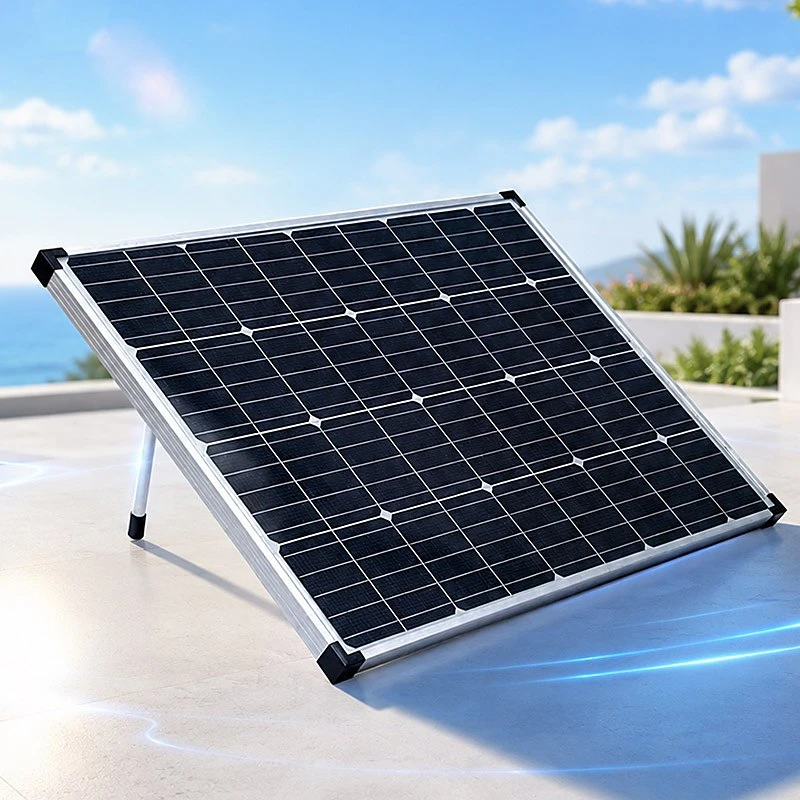
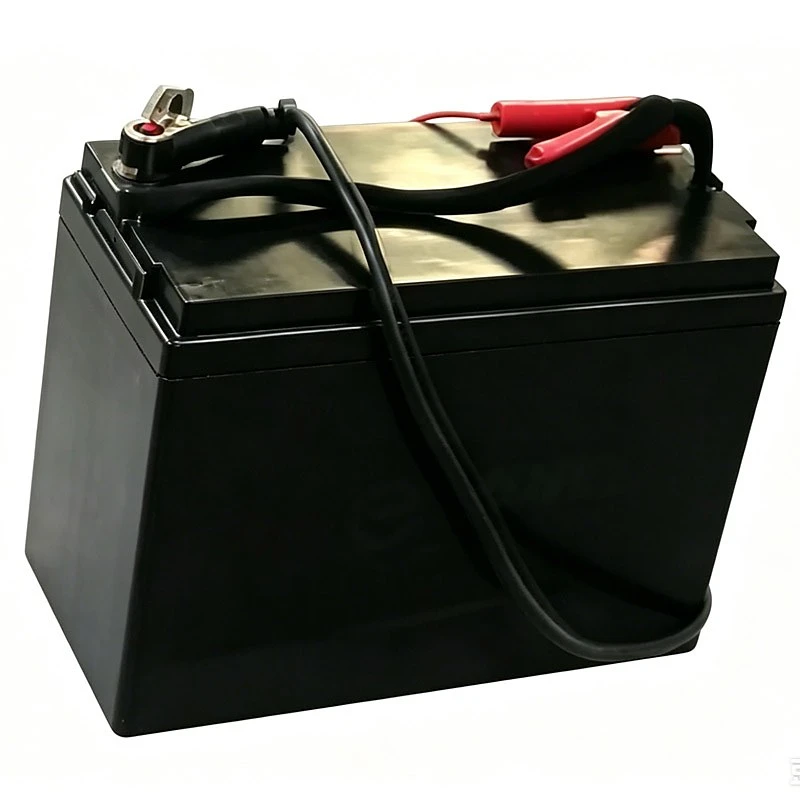
A solar freezer that disappoints is almost never a freezer problem. It is a panel that was sized on the sticker, a cable that was sized on what was in the truck, or a battery that was asked to carry the cabinet through two cloudy days without being asked first. We quote the cabinet, the array and the battery as one system when a buyer wants it that way, and we write the daily consumption figure into the quotation so the sizing argument happens before the order rather than after it.
Foaming, assembly, testing and packing under one roof
The cabinet is not assembled from bought-in finished boxes. Cabinet bodies are foamed on our own line, assembled on our own benches, run and checked before they are packed, and the same building holds the spares that go into the next container. That is what makes a plate with your model number on it a production document rather than a sticker applied at the port.
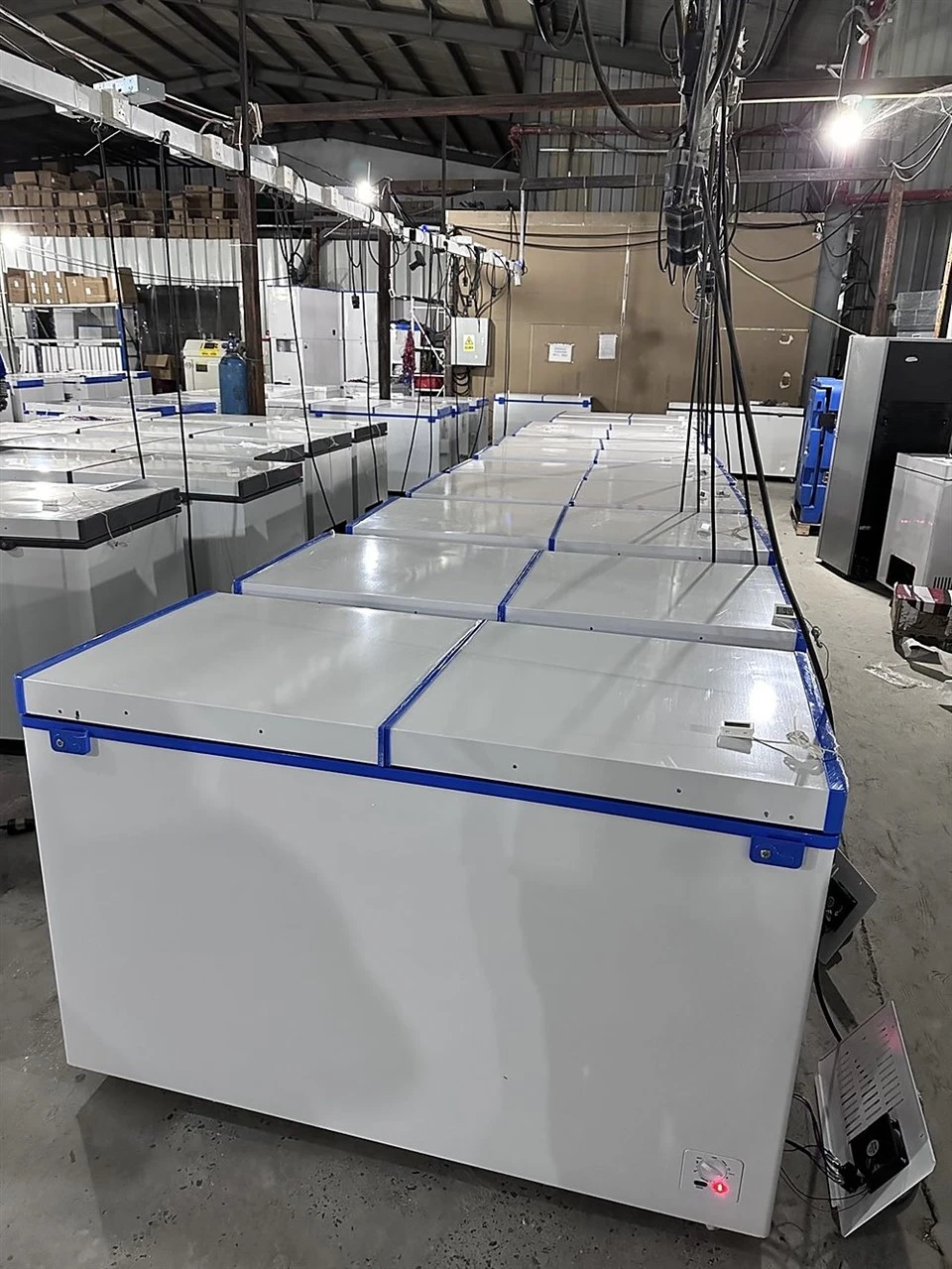
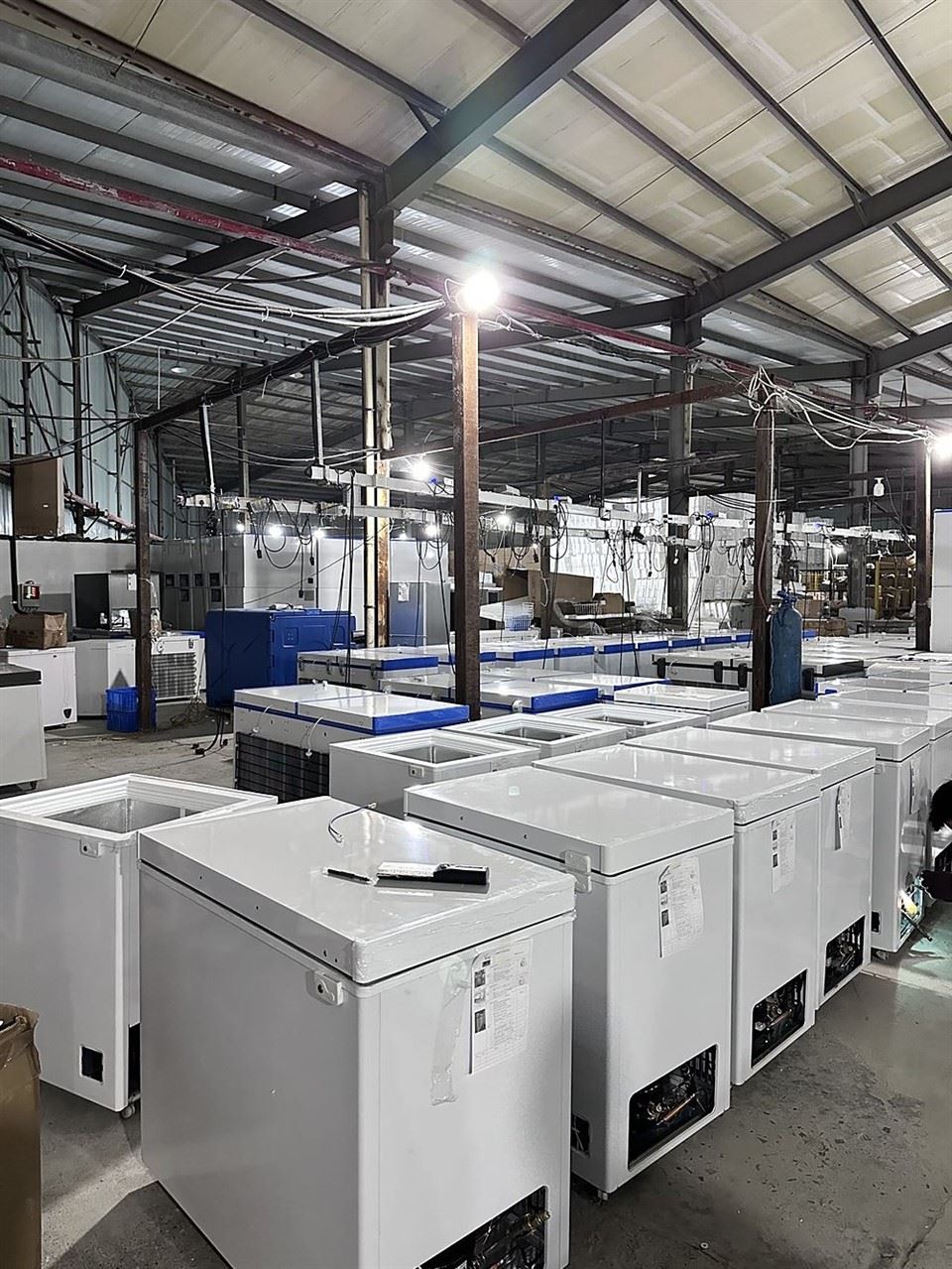
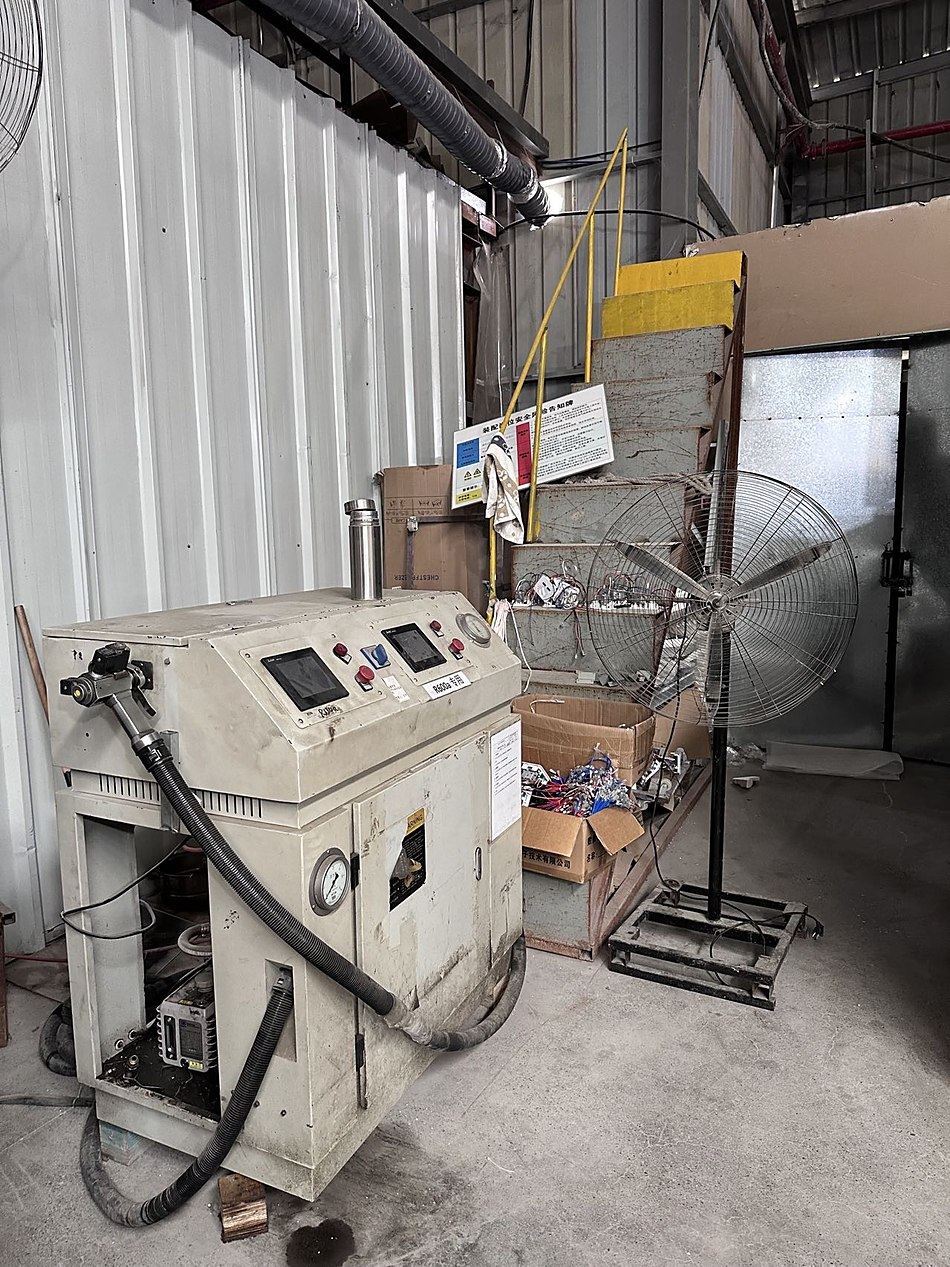
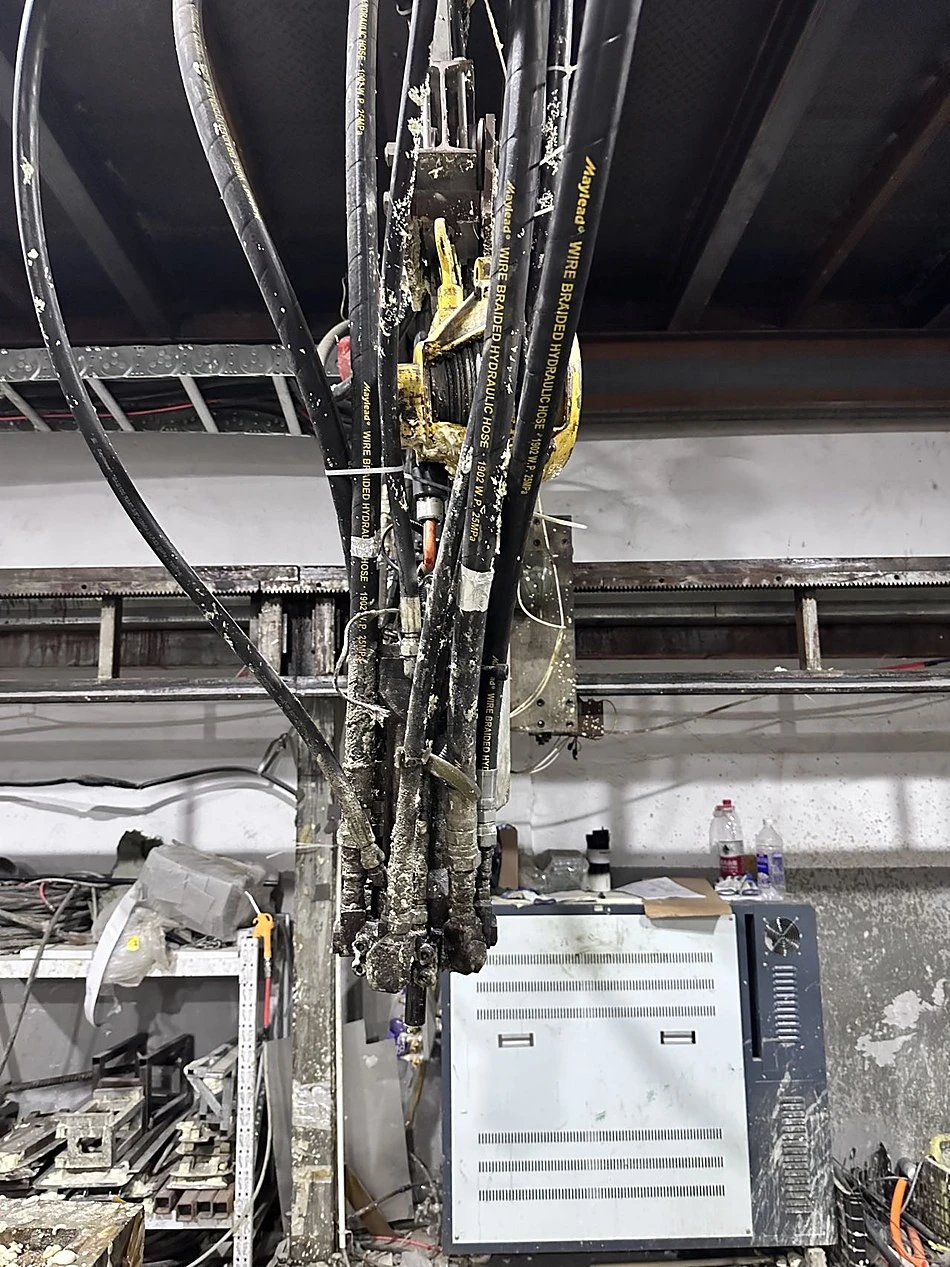
For buyers who need to see it rather than read it, we host factory visits in Hangzhou and we will walk a camera through the line for a customer who cannot travel. The certificate pack, the plate artwork and the carton print are all signed off in the same building as the cabinet.
Seven lines in the first reply, not four emails
Most of the delay in a freezer order is not production. It is the week spent establishing what the price actually covers. Our first reply is built to close that gap, so the numbers can be compared with another supplier on equal terms instead of on headline price alone.
- Unit price by quantity band, with the band boundaries written down rather than implied.
- Loading plan for the container, per model and for the mix you described, so the freight per unit is visible before the order.
- Carton and gross weight per unit, taken from the packing list rather than estimated, because inland trucking is quoted on both.
- Plate artwork for approval, showing model, volume, power input, climate class, refrigerant and charge weight exactly as they will be printed.
- Spare parts list with part numbers for the controller, gasket, thermostat and castors, priced separately so the after-sales budget is not a surprise.
- Lead time from deposit, stated in working days and tied to the quantity in the band you chose.
- Sample terms, including whether the sample is deducted from the first container.
If a supplier cannot answer four of those seven before you ask twice, the price is not the problem - the order is.
Hot Tags: solar power deep freezer, China solar power deep freezer manufacturers, suppliers, factory


