


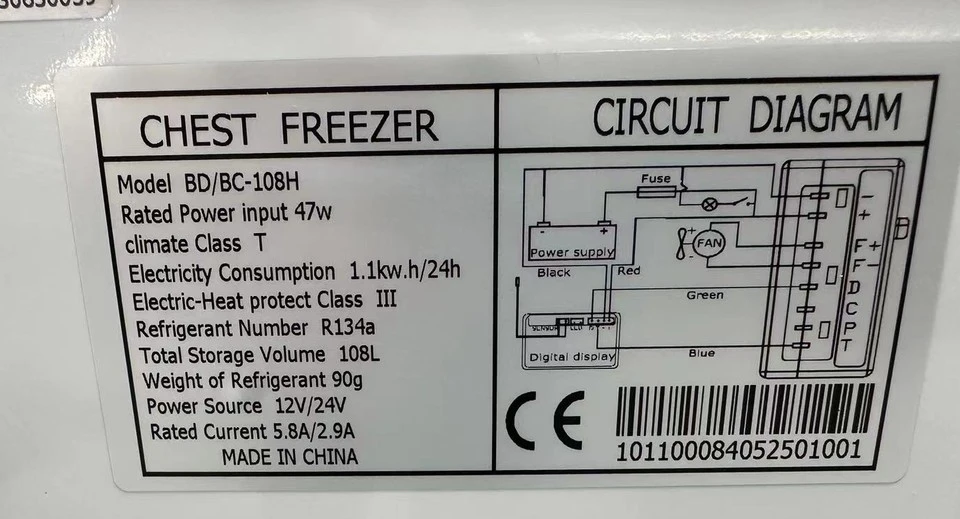
THE LABEL ON THE BACK, LINE BY LINE - a cabinet sold into a house is decided by the six lines printed on its rating label: 108 litres, 47 watts, 1.1 kilowatt hours a day, climate class T, 90 grams of R134a, 12 or 24 volts. This page takes each line in turn, explains what it does to an installation, and says plainly what it leaves out.
The hard numbers first, because they are the ones a buyer checks against a quotation: a 108 litre chest freezer with a 110 millimetre wall in every face, 670 millimetres wide by 661 deep by 840 high, 36 kilos net and 41 gross, drawing 47 watts from a 12 or 24 volt bank with no inverter anywhere in the chain, holding minus eighteen, and loading 153 units into a single 40 ft HQ container.
One warning about reading labels. A rating plate is written for a test cell, not for your kitchen. Every figure below is quoted exactly as the plate states it, and every figure we derive from it - panel watts, amp hours, cable section - is shown with the assumption attached, so that when your room turns out to be hotter than the cell you can see which number moves and by how much.
Line one: 108 litres, and the shape that makes it fit
THE TILE OF FLOOR IT TAKES - and the volume it returns from it
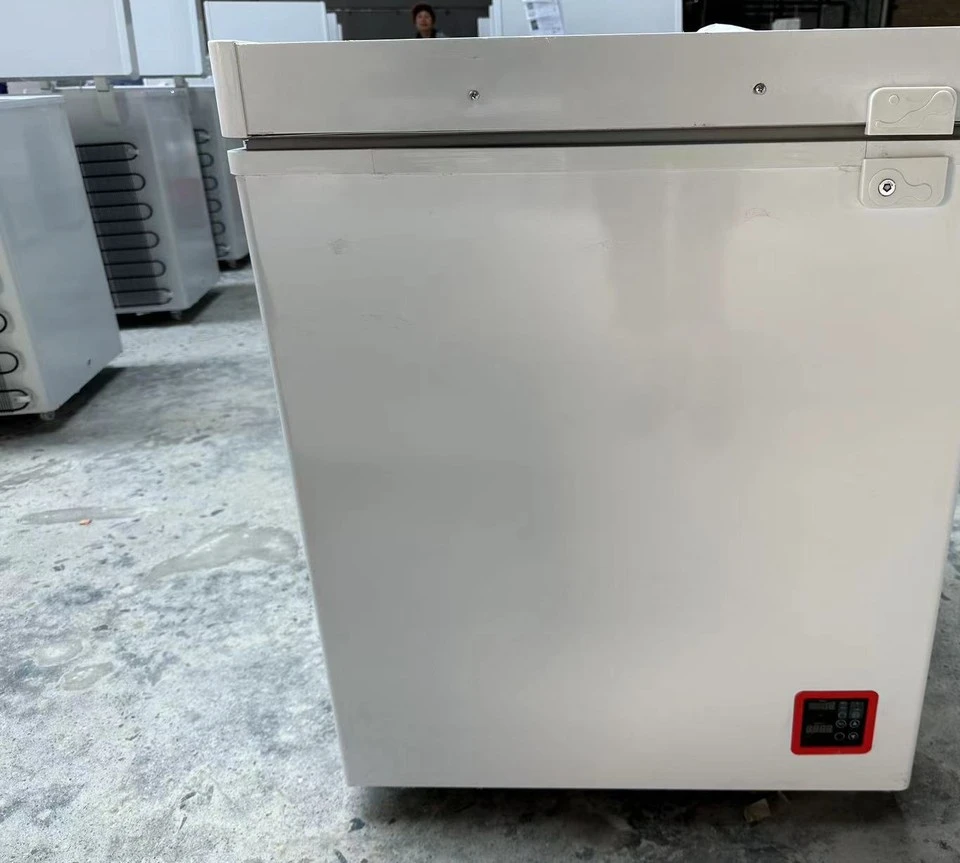
One hundred and eight litres gross, in a body 670 wide, 661 deep and 840 tall. The important part of that sentence is the second pair of numbers, because they describe a cabinet that is narrow and tall rather than wide and low: 0.443 of a square metre of floor carries the whole 108 litres, which is 244 litres for each square metre of ground it occupies.
That figure is the argument for this model in a house. A kitchen, a back room, a shop counter or a container cabin never runs short of height; it runs short of floor. Below it in the same body, the 68 litre model takes exactly the same footprint and returns 153 for the same 0.443; beside it, the 88 litre model spreads over 0.555 of a square metre for its 88 litres, which is 158. The 108H is the one that stacks the volume upwards.
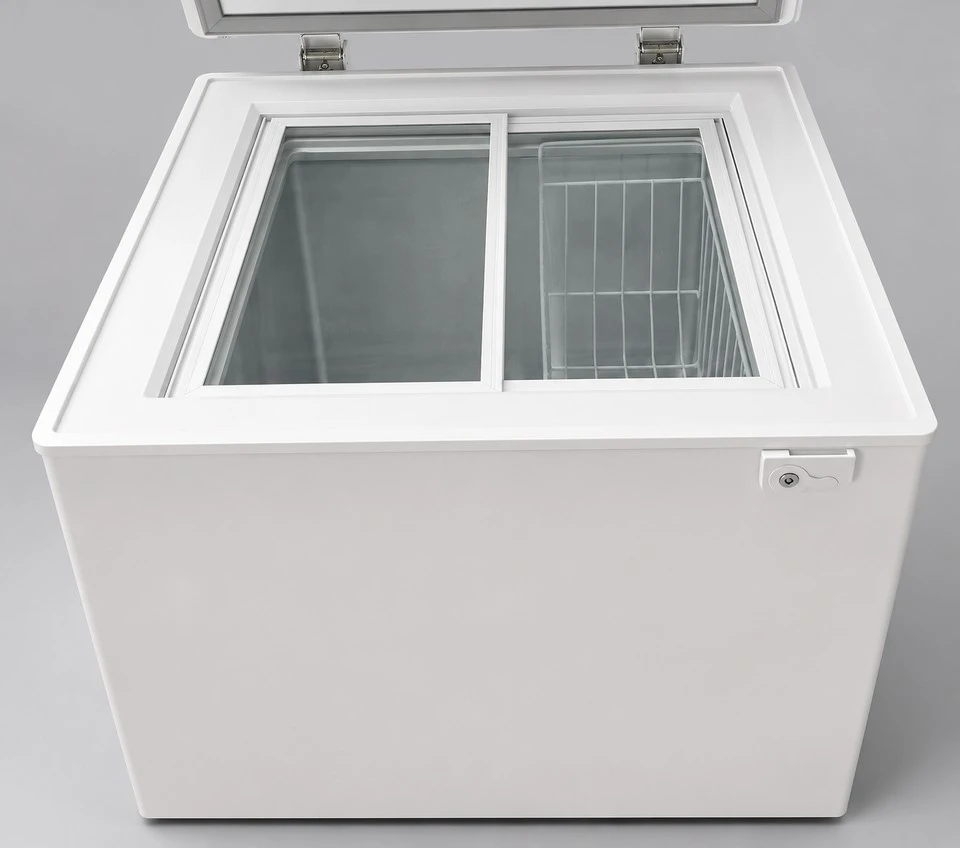
Inside, the lid lifts to reveal two sliding glass doors over the load and a coated wire basket at the right-hand end. The glass doors are the detail that earns their place in a house: a child, a customer or a carer can see what is in the cabinet without standing with the lid open in a warm room, and the cold air stays where it was. On a 108 litre box, that habit is worth more than any setting on the dial.
The proof sits in the freezing itself. Load it, shut it, and leave it alone for a day: the mass of cold product plus 110 millimetres of foam holds the box at temperature through a long evening of opening and closing, and the compressor spends most of its time off rather than chasing a lid that is never shut. Small cabinets fail in hot rooms for exactly this reason, and it is a behaviour problem before it is an equipment problem.
| Model | Volume L | Cabinet mm | Floor m² | Litres per m² | Net kg | Per 40'HQ |
| BD/BC-68H | 68 | 670 × 661 × 640 | 0.443 | 153.5 | 30 | 153 |
| BD/BC-88H | 88 | 840 × 661 × 640 | 0.555 | 158.5 | 34 | 132 |
| BD/BC-108H | 108 | 670 × 661 × 840 | 0.443 | 243.8 | 36 | 153 |
| BD/BC-158H | 158 | 840 × 661 × 840 | 0.555 | 284.6 | 41 | 132 |
Two readings of that table, and they point in opposite directions. Litres per square metre is the domestic measure, and it climbs with height: 68, then 88, then 108, then 158. Kilos per litre is the freight measure, and it falls the same way, because the compressor, the control plate, the lock, the basket and two steel skins are a fixed cost in mass that a small cabinet carries per litre rather than in total.
So the 108H is the model for a buyer who has a corner and no floor, and who is paying for storage rather than for steel. If what you actually need is cold volume per yuan of freight, the answer is further up the same family - and we would rather point at the 158 than sell you a 108 and let you discover it in year two.
Line two: 47 watts, and the 5.8 amps printed beside it
TWO FIGURES THAT ARE NOT THE SAME FIGURE - and the one you size cable on
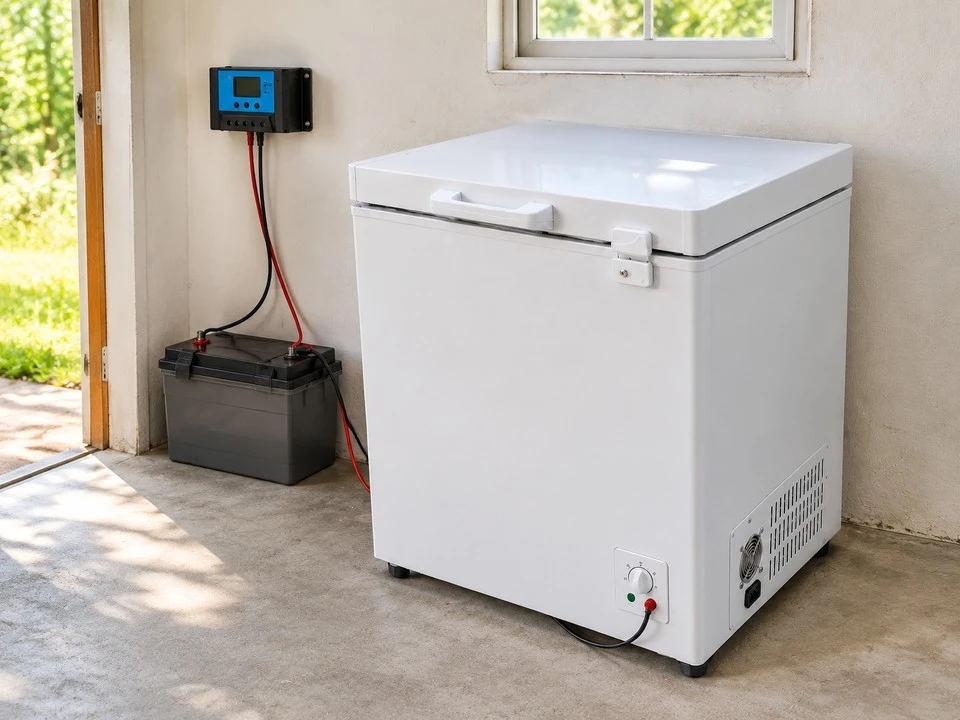
The plate gives a rated power input of 47 watts, and next to it a rated current of 5.8 amps on a 12 volt bank or 2.9 on a 24. Divide 47 by 12 and you get 3.9, not 5.8, and that difference is the single most common reason a small solar freezer is wired too thin. The rating allows for the compressor starting, for the moment a low bank sags under load, and for the tolerance of the control board - in other words it describes the worst case the cable will ever see, not the average.
So size on 5.8 amps, not on 3.9. Fuse at 10 amps on a 12 volt system or 5 on a 24, at the battery end of the positive run, never at the cabinet end. Keep the run short and the section generous: the table below is the minimum copper that holds the drop to three per cent at 5.8 amps, worked from 0.0175 ohm square millimetres per metre, and it is the one calculation in this whole article where a cheap answer costs a compressor.
Voltage drop is invisible until it is expensive. A cabinet fed at 11.2 volts instead of 12.6 will still run, but it will run longer to move the same heat, and the extra hours come out of the battery at night when nothing is charging it. On a small bank that separates a comfortable morning and a controller that cuts the load off at two in the morning.
One more line worth reading literally: power source 12 V / 24 V. The cabinet does not care whether the bank is flooded lead acid, gel, AGM or lithium, and it does not need an inverter, a mains charger or a changeover switch in the path. It does care that the charge controller is matched to the chemistry actually on the floor, because a controller left on a lead acid profile will cook a lithium pack and an under-set one will leave lead plates sulphating.
| One-way cable length | Minimum copper section | Drop at 5.8 A / 12 V | Drop at 2.9 A / 24 V |
| 3 m run | 2.5 mm² | 0.23 V | 0.24 V |
| 5 m run | 4.0 mm² | 0.30 V | 0.24 V |
| 10 m run | 6.0 mm² | 0.36 V | 0.24 V |
Line three: 1.1 kilowatt hours a day, and the room it assumes
DO THE MULTIPLICATION AND THE LABEL ADMITS SOMETHING - 47 watts for twenty-four hours is 1.128 kilowatt hours, and the plate declares 1.1. The two figures agree because the declared consumption is a standard-condition number taken at a defined ambient with the cabinet at holding temperature and nobody opening the lid. It is honest as far as it goes. It is not a promise about your kitchen.
What it is good for is sizing. Take 1.1 kilowatt hours a day, add the margin you believe in for a hot room and a family that opens the lid, and you have the load. At 12 volts that is 92 amp hours a day; at 24, 46. Three days of autonomy - two nights and one grey day - asks for 275 amp hours on 12 volts, or 138 on 24, a figure most buyers underestimate: the panel is rarely the expensive half of a solar freezer, the bank is.
On the generation side, 1.1 kilowatt hours a day on a site with 4.5 peak sun hours and a 0.75 allowance for heat, soiling and cable drop needs about 326 watts of panel, so one 350 watt module or two 200s. If that sounds like a lot for a 108 litre cabinet, compare it with what it replaces: a 200 litre mains refrigerator of the same era typically declares 300 to 400 kilowatt hours a year, which is 0.8 to 1.1 a day. The cabinet is not the upgrade in efficiency. It is the upgrade in where the electricity comes from.
Two honest qualifications. In a 43 degree room the declared figure is roughly what you will see; in a 25 degree room you will see less, and in a tin-roofed shop in the afternoon you may see half again as much. And the figure is per day, not per hour: there is no way to make the compressor efficient at the moment the sun is weakest except by holding temperature through it, which is exactly what a wall that thick is for.
Line four: climate class T, and the two things it does not promise
FORTY-THREE DEGREES IS THE TEST, NOT THE LIMIT - class T is the top of the usual scale and it means the cabinet is rated to operate in an ambient up to 43 degrees Celsius. It does not promise two things that matter more in practice.
The first is that it will hold minus eighteen in a hotter room than that. It will try, and it will run continuously while it tries, and in a 48 degree tin-roofed shop the honest answer is that you need more insulation or a different cabinet, not a bigger panel. The second is that the declared consumption applies at your ambient: class T consumption is measured in class T conditions, so a cabinet in a 30 degree room will use noticeably less than 1.1 kilowatt hours a day and one in a 45 degree room will use more. Both are the same cabinet working correctly.
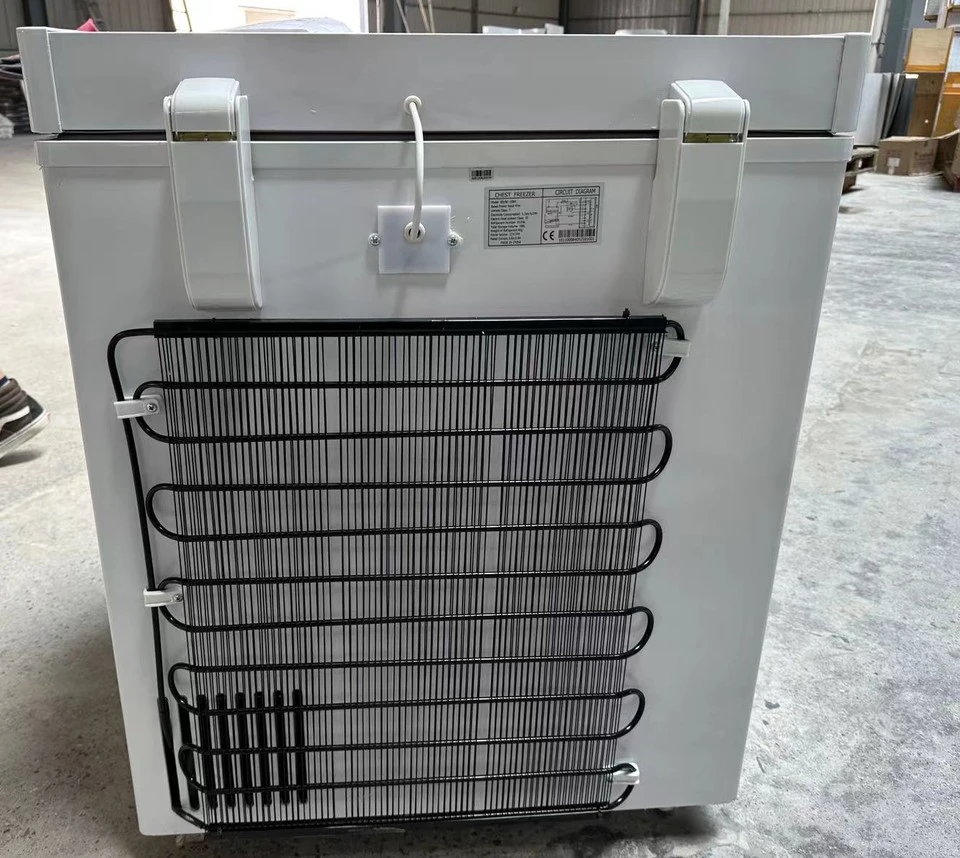
Where the heat goes is the part most installations get wrong. The condenser on this model is the full-width wire grid on the back, and it needs air moving across it. A cabinet pushed flat against a wall in a closed room recycles its own heat: the coil gets no cooler, the compressor runs longer, and the daily figure climbs until the battery notices. Leave a hand's width behind it, more if the room is small, and never box it into a cupboard with a door on it.
Dust is the slow version of the same problem. In a dry, dusty climate the wire grid matts over in a season and stops shedding heat efficiently; a soft brush twice a year is the whole maintenance schedule for the outside of the cabinet. The inside needs less: manual defrost, a scrape when the frost is thick enough to matter, and a wipe of the gasket so that the lid seals on a clean face rather than on a ridge of ice.
Line five: 90 grams of R134a, and the service call in year six
A SMALL CHARGE IS A STRICT CHARGE - ninety grams is roughly a third of what a household refrigerator carries, and that has one practical consequence: on a system this small, a leak that would be a nuisance on a big cabinet is a total loss of cooling here. It is also why the plant leak-tests and pulls each unit down before packing rather than sampling a batch.
For the technician who opens the cabinet in year six, the plate is the whole service manual: refrigerant R134a, 90 grams, rated current 5.8 amps, climate class T, and the wiring diagram printed alongside. Recharge to the stated mass rather than to a gauge reading, because on 90 grams the difference between a full charge and an overcharge is a few seconds of the tap. R600a is available as an alternative charge for markets that prefer it, and the label, the service documentation and the spare parts list follow whichever charge is built.
What normally fails on a cabinet like this is not the sealed system. It is the gasket, the hinge, the hasp and the thermostat dial, in roughly that order, and all four are in the parts catalogue. A clinic or a household that keeps a spare gasket and a thermostat on the shelf gets a decade out of the body; the same cabinet waiting three weeks for a part from another continent gets written off as unreliable, and the fault was a rubber seal.
We would rather say this plainly than let it be discovered: a 108 litre cabinet is not a low-maintenance object, it is a low-cost one. The maintenance it needs is small, predictable and cheap, and it needs to be somebody's job. Where there is no local technician and no spares, the sales argument for this model gets weaker, whatever the price list says.
Line six: 12 or 24 volts, and the four ways a household wires it
FOUR INSTALLATIONS THAT ALL USE THE SAME CABINET - a small off-grid house with one panel and one battery; a mains house that loses power often, with the cabinet on a battery and a charger rather than on the grid; a shop that already runs a 24 volt lighting system and simply adds the freezer to the same bank; and a vehicle or a boat, where the alternator or the engine does the charging and the cabinet is fed from the auxiliary circuit.
The first is the ordinary case and the one the numbers above describe. The second is more common than people expect: a cabinet on a small battery and a mains charger keeps frozen food through an eight hour outage, which is the whole reason a household buys it, and it costs a battery and a charger rather than an array. The third is the cheapest of all, because the bank already exists and the freezer is a load on it; check that the existing controller and cabling have headroom for another 5.8 amps before adding it.
The fourth needs one caution. A vehicle bank sits at 13.8 to 14.4 volts while the engine runs and sags to 12 or below when it stops; both are inside the cabinet's window, but a long thin run from the front of a vehicle to a cabinet in the back will lose more than the alternator gains. Run the pair in a proper section, fuse at the battery, and switch the cabinet off at the source when the vehicle is laid up for weeks rather than leaving it to flatten the starting battery.
Across all four, the wiring discipline is the same and it is short: a fuse at the source, a section chosen for 5.8 amps rather than for the average, a controller matched to the battery actually installed, and the cabinet's own cable kept out of the sun and off the floor of a wet room. That is the entire electrical installation of this cabinet, and it is the reason it can be specified in places where no refrigeration engineer has ever been.
The floor it stands on, and the door it has to pass
MEASURE TWICE, ORDER ONCE - 670 millimetres of width, 661 of depth, 840 of height, 36 kilos net. The body passes a standard 700 millimetre door frame with the carton off, and the shipped carton at 710 by 681 by 882 settles whether it goes into a lift, up a stairwell or through the back of a pickup.
Height is where installations go wrong, in three specific places. Under a counter, because the lid lifts and stands rather than sliding back, so the free space above the front half of the cabinet has to be real space and not a shelf. In a vehicle, because 840 plus a carton is not a car boot. And in a room with a low window or a sloped ceiling, where 840 is fine but the lid's swing is not.
Kilos matter less than they look. At 36 kilos net the cabinet is a two-person lift with the product in it, a one-person slide on a level floor, and a genuinely easy carry when empty - which is what makes it a sensible choice for an upstairs room, a clinic store behind a consulting room, or a shop that is rebuilt every season. The 158 litre model in the same family is 41 kilos and 840 wide; that is where the handling changes character.
Two placement notes that come from installs rather than from the catalogue. Keep the cabinet out of direct sun even in a cool room, because a white lid in a hot window works like a small heater on the one face you cannot insulate from the inside. And put it somewhere the floor can get wet: manual defrost means water, and a cabinet on a carpet is a cabinet that will be moved once and never cleaned.
Where 108 litres is the wrong purchase
THE THREE CASES WE TURN DOWN - a shop that opens the lid a hundred times a day; a household of eight that buys a whole animal at a time; and anyone who needs a cabinet they can see into from standing height while it is full. The 108H is a storage cabinet for a household, a clinic or a small counter, and it does that job well precisely because it is small: the compressor recovers quickly, the foam holds what little cold there is, and the panel that feeds it is affordable.
Push past that and the arithmetic fails quietly. Above roughly 30 kilos of frozen product a day moving through the cabinet, the lid is open more than it is shut, the duty cycle never recovers, and the daily consumption leaves the figure printed on the plate behind. In that case the answer is the 408 or the 608, which is wider, lower, easier to load with both hands and built for that rhythm.
The third case is a real one and it never appears in a specification. A chest freezer at 840 millimetres is at knee height for an adult and below the eyeline of a child; anyone with a bad back, or a shop where staff reach in all day, will hate it within a month whatever it costs to run. A low wide cabinet, or an upright, solves a human problem that no amount of insulation can.
One unit, or a hundred and fifty-three
CARTON, CUBIC METRE, CONTAINER - the shipped carton is 710 by 681 by 882 millimetres, which is 0.427 of a cubic metre. Twenty cabinets is eight and a half cubic metres, which is an LCL shipment in most lanes; a single unit is a pallet space, and the carton is small enough that a spare gasket and a thermostat can travel inside it without repacking.
A full container is where the model looks different. 153 cabinets fit a 40 ft HQ, which is 16,524 litres of cold volume in one box - and 153 cartons at 0.427 is 65 cubic metres, so the load is volume-limited, not weight-limited: the whole container weighs a little over six tonnes against a payload allowance several times that. The practical consequence for a distributor is generous: mixing 68s, 108s and 158s in one box costs slots, not kilos, so a first order can carry three sizes for different customers rather than betting the container on one.
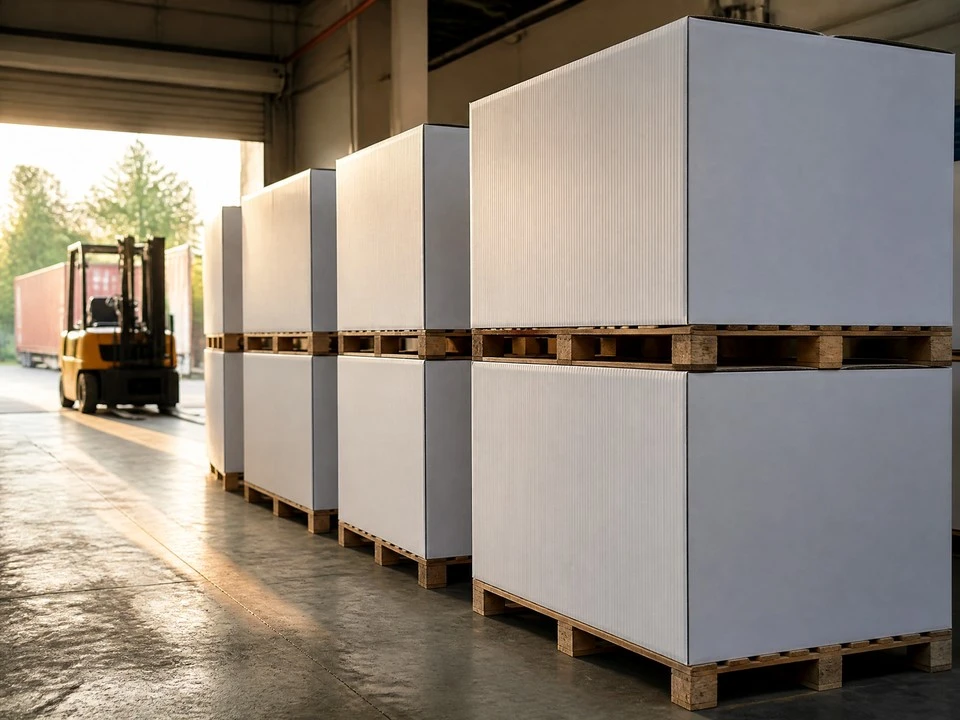
Loading is straightforward and the carton is designed for it: single wall, foam corner protection, cabinet strapped upright, lid taped shut. The one thing worth writing into a purchase order is that the units travel upright and stay upright for a day after arrival before they are switched on, because a compressor that has been on its side needs its oil to settle. It is a line in the shipping instructions that has saved more arguments than any warranty clause.
For a CKD or SKD programme the same cabinet travels as panels, liners, lids, compressors and a kit of fasteners, and the container count changes completely: a kit occupies a fraction of the volume of a built unit, which is what makes local assembly viable in markets where a finished cabinet attracts a duty it cannot carry. We build both, and the decision is usually made by the tariff line rather than by the factory.
The label, transcribed
| Field | BD/BC-108H |
| Model | BD/BC-108H, single lift lid, 110 mm super energy save body |
| Total storage volume | 108 L gross |
| Cabinet envelope | 670 × 661 × 840 mm |
| Shipped carton | 710 × 681 × 882 mm, 0.427 m³ |
| Mass | 36 kg net, 41 kg gross |
| Foam thickness | 110 mm in the walls, the floor and the lid |
| Holding temperature | −18 °C and below, mechanical dial |
| Rated power input | 47 W |
| Electricity consumption | 1.1 kWh per 24 hours, standard conditions |
| Power source | 10–50 VDC, 12 V / 24 V bank, no inverter |
| Rated current | 5.8 A at 12 V, 2.9 A at 24 V |
| Refrigerant | R134a, 90 g; R600a available as an alternative charge |
| Climate class | T, rated to 43 °C ambient |
| Fitted | Key and lock, twin sliding inner glass doors, one basket, castors |
| Optional | Inner light, own label, destination-language manual |
| Defrost | Manual |
| Loadability | 153 units in one 40 ft HQ |
| Delivery form | Built unit, or CKD / SKD kit for a local build partner |
Four rows carry the product. 108 litres on 0.443 of a square metre is the reason a house with no floor buys it. 47 watts, 1.1 kilowatt hours a day is the panel and battery you will need. 840 millimetres decides where it can stand and how the lid can open. 36 kilos decides who carries it. Everything else on the label is either a service detail or a decision we made in the factory so that you would not have to make it on site.
About the factory that builds the 108H
ZHEJIANG JUKA SOLAR TECHNOLOGY - the works behind this cabinet
Juka builds solar cold chain equipment in Zhejiang, China, for the places where mains power is absent, unreliable or simply too expensive to reach. The 108H belongs to the 110 millimetre family, which starts at 68 litres and runs past 500, and which exists as a separate range from our 65 millimetre cabinets because the panel and battery that a thick wall saves are frequently worth more than the foam costs.
The foaming, the cabinet assembly, the gas charging and the run-in test all happen inside our own buildings, and the tooling for the lid, the liner and the frame is ours rather than a supplier's. That is what allows a page like this one to quote a pour thickness and a container count in the same breath: both come from the same shop floor, and neither is a broker's estimate.
Every unit is evacuated, charged, leak tested and run to temperature before it is boxed, and that run-in reading is recorded. It is the single most useful thing a buyer can ask for on arrival, because a cabinet that reaches holding temperature in its stated time in a hot room has a correct charge and a sealing lid, and one that does not has neither. Five minutes with a thermometer at the receiving bay settles a whole container.
Most of what leaves goes to sub-Saharan Africa, South and South East Asia, the Gulf and Latin America, to importers, project contractors, aid agencies and refrigeration distributors who keep the cabinets running in country. We supply under our own name and as an OEM or ODM partner, with nameplates, manuals, cartons and tender documentation prepared in the language of the destination market, and we quote with the technical file and the packing list attached so that an approval does not wait on a reply.
SEND US THE ROOM AND THE BANK - the floor space you have, the height above the cabinet with the lid open, the voltage already on the wall and the worst month of sun where it will stand. Those four answers decide whether a 108H is the right cabinet, what panel and battery it needs, and how many travel in the container you are planning. If a wider body would serve you better, our reply will say so before the quotation does.
Hot Tags: Solar Freezer for Home, China Solar Freezer for Home manufacturers, suppliers, factory


