


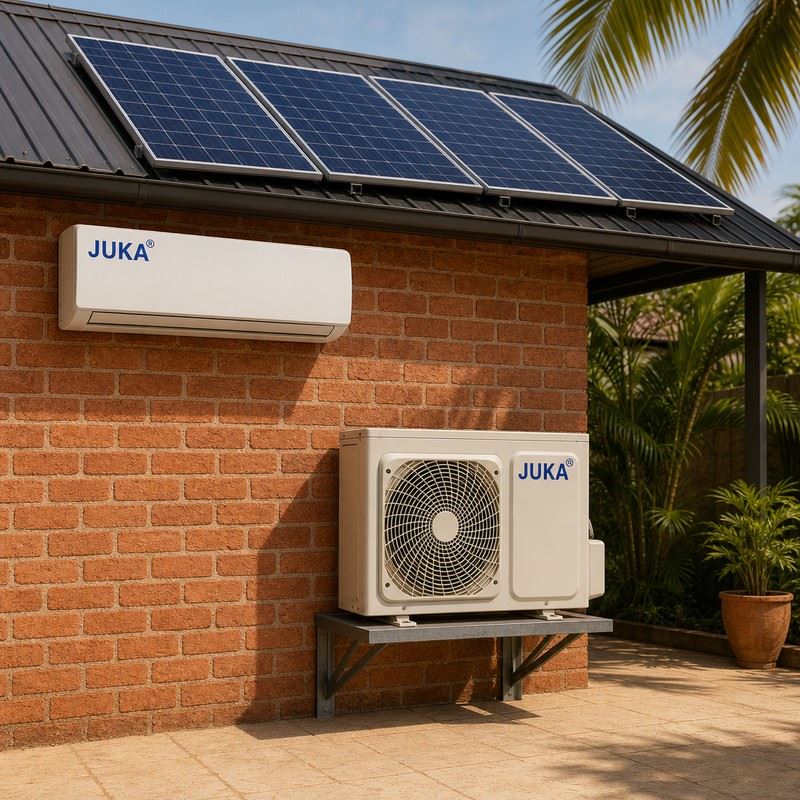
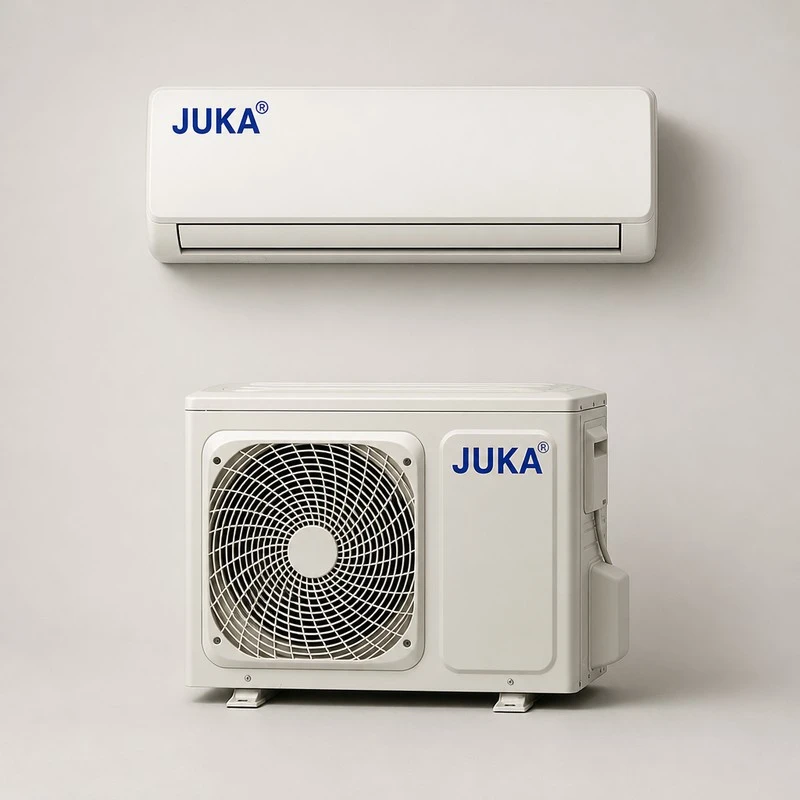
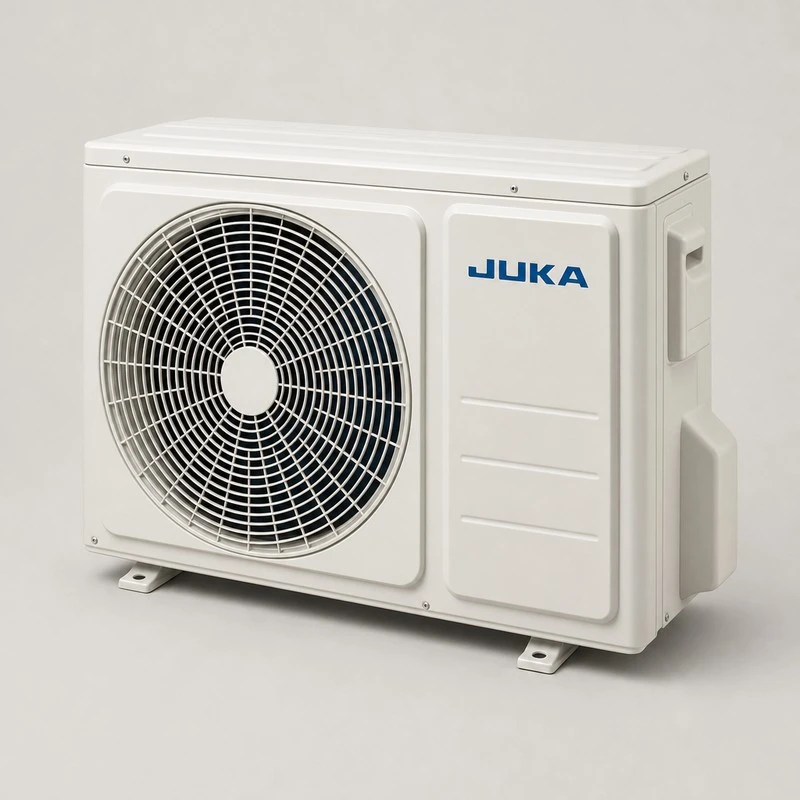
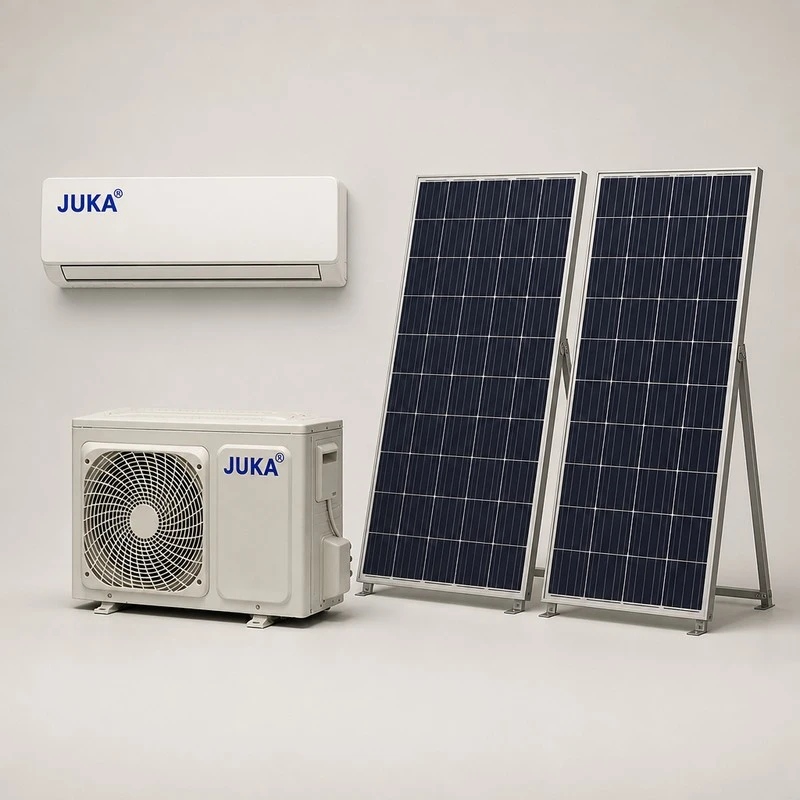
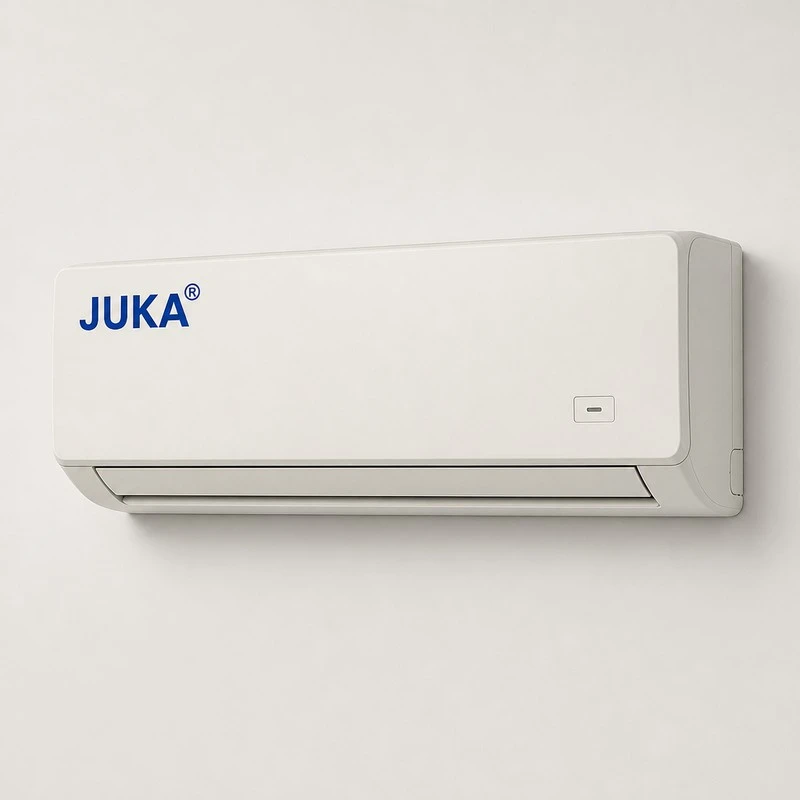
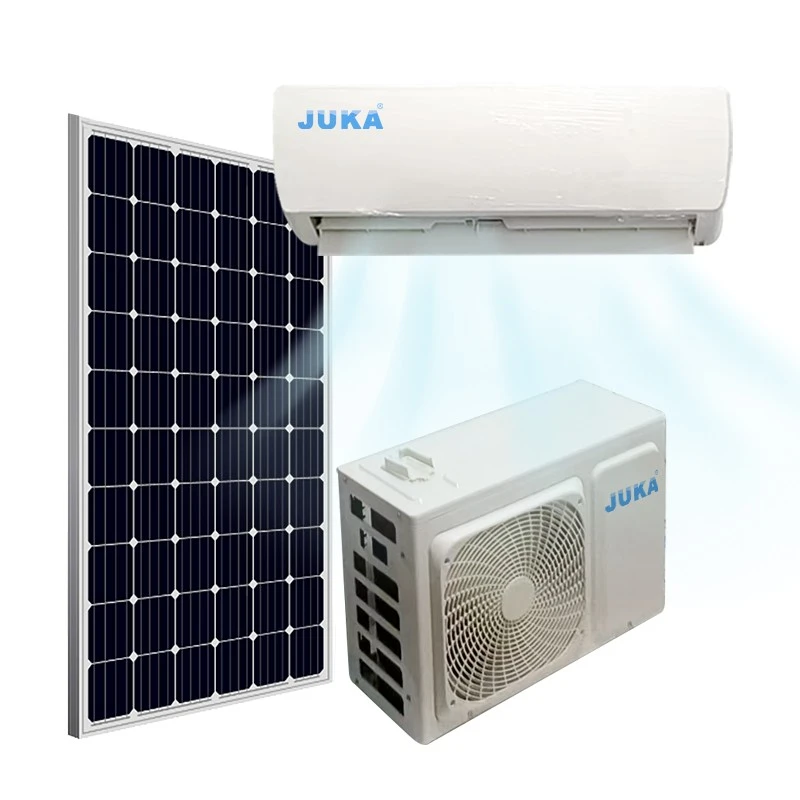
24,000 BTU nominal, about 7.0 kW |
5 building types covered below |
2 power sources, no switch-over |
2 x 40 A DC breakers on array and bank |
A 24,000 BTU split is the size where buyers stop asking what the unit costs and start asking what the building costs. At 12,000 BTU the roof is a nice extra. At 24,000 BTU the roof, the bank and the cable run are the project, and the head is the part you fit at the end.
So this page is organised by building rather than by feature. Each case states the load honestly, says what the array has to deliver, and says where the money actually goes. Where a number depends on the site, it is marked as a build value instead of an invented one.
The shop that opens at eight and closes at nine
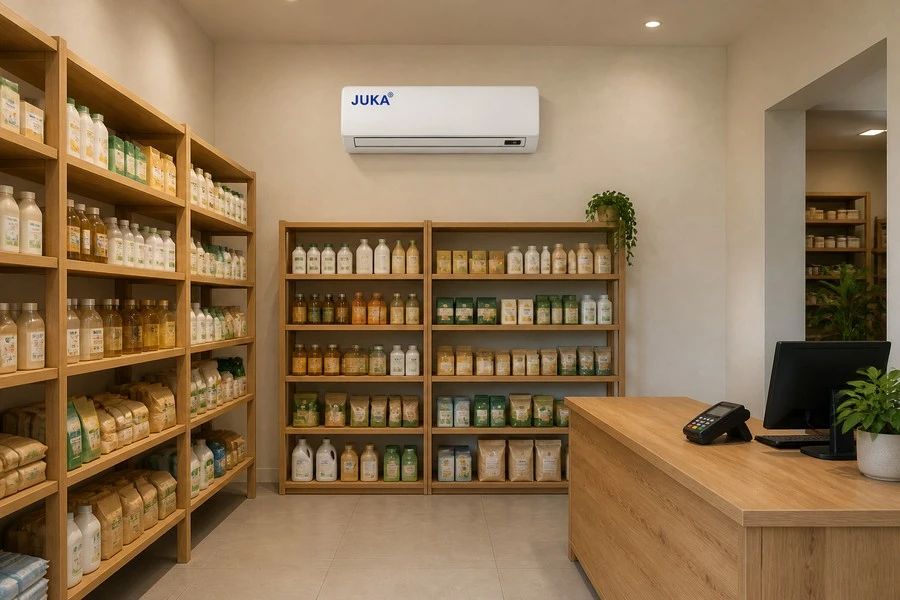
Steady load, glazed front, no tolerance for a warm afternoon
A grocery or household goods shop is a bad candidate for an undersized unit and a good candidate for hybrid. The load is steady rather than peaky: doors open all day, the glazing gains heat from ten in the morning, and the shelves hold that heat. An 18,000 BTU unit will cool it at seven in the morning and lose the argument by two in the afternoon.
Two habits make the shop case work. First, mount the head high on the back wall so the throw reaches the counter instead of dumping cold air on the first shelf it meets. Second, let the array run the unit directly while the sun is up, and keep the bank out of the daytime circuit. A shop that sells drinks and dairy cannot afford a bank that is already flat at opening time.
Most shops in this size class end up with four to six panels and a 24 V bank, with the grid covering the evening close-down. That is a planning figure, not a specification: the panel count follows the daily kilowatt-hours, which follow the door count and the glazing.
Long hours, moderate load, zero tolerance for a stoppage
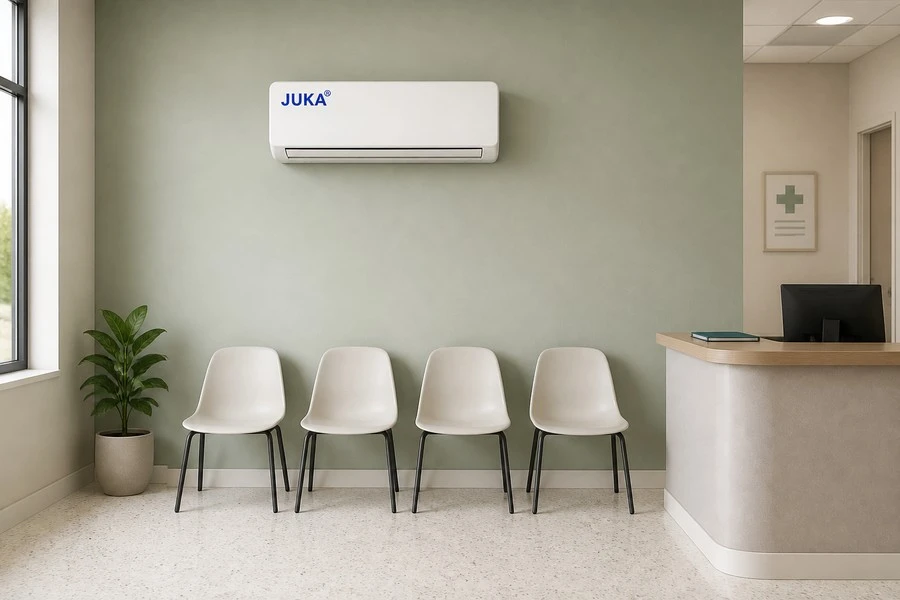
A clinic waiting area is the case where the system has to be boring. Nobody thanks you for cooling that works; everybody notices when it stops. The load is moderate, the hours are long, and the room is full of people who are already uncomfortable.
This is where the hybrid input earns its place. The unit takes photovoltaic DC when the roof is producing and mains AC when it is not, without a transfer switch and without a second indoor unit. A cloud passes, the compressor keeps running. The mains meter simply starts turning.
The specification detail that matters here is not capacity but stability: one controller deciding between sources, two 40 A DC breakers so either leg can be isolated, and a vacuum and leak test done properly, because a clinic will not tolerate a re-gas visit in three months.
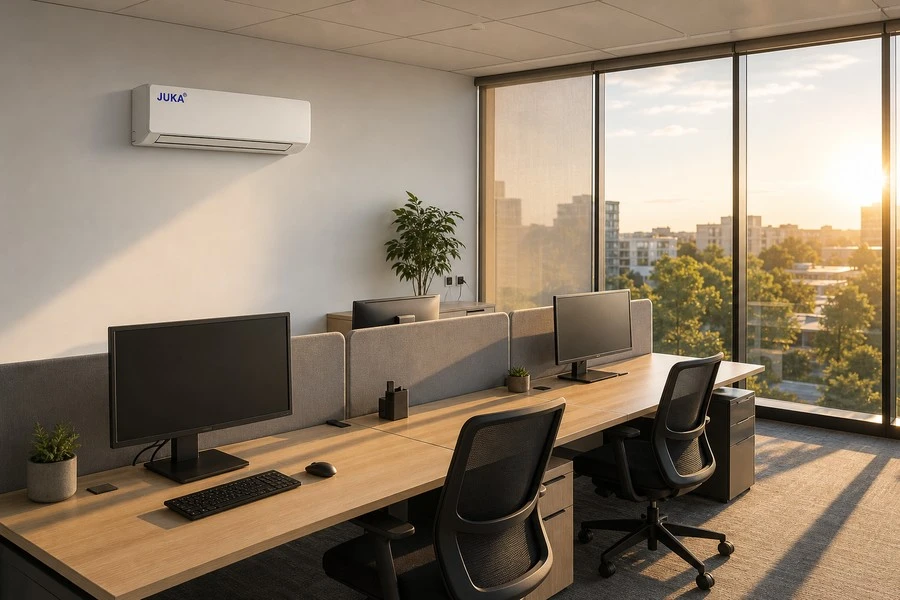
Same floor area, different load: the glass decides
An open-plan office is the case that punishes a floor-area rule of thumb. Two offices of the same size can differ by a third of their load depending on which way the glass faces. A west elevation in the afternoon is not a glazing detail, it is the dominant load in the room.
For a west-facing floor, 24,000 BTU buys comfort rather than luxury, and the honest advice is to shade the glass before buying a bigger unit. Internal blinds, an external screen or a film on the pane will do more per dollar than another 6,000 BTU. Once the glass is handled, the unit holds the room comfortably and the array has a load it can actually follow.
Where the office runs to six or seven in the evening, the bank does the last two hours. That is a smaller bank than most buyers expect, and the table in CASE 05 shows why: two hours of evening load is not the same purchase as eight.
Two loads in one room: seating and a kitchen that never stops
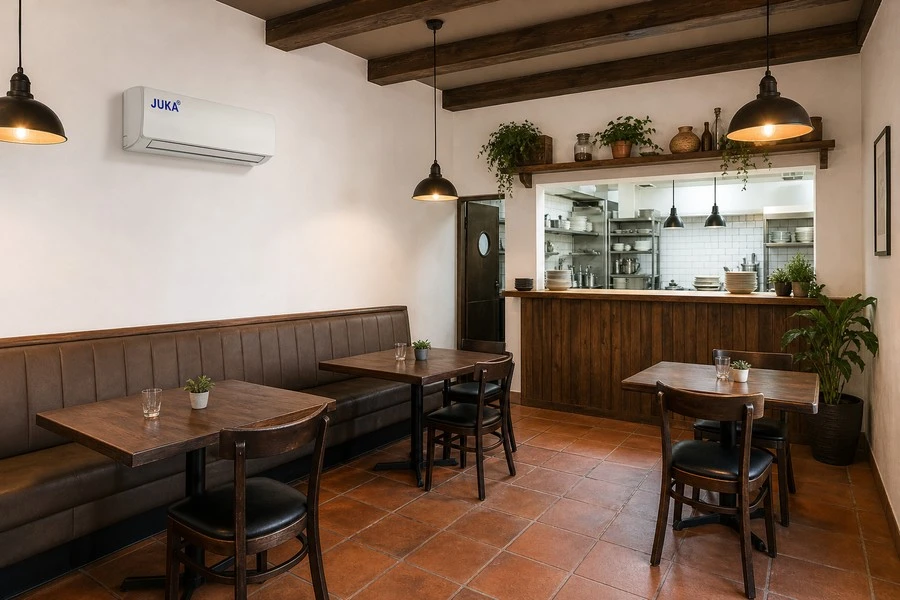
A restaurant is two loads in one room. The dining area is ordinary; the kitchen is a heat engine, and the extract hood only removes part of it. If the head is mounted where it can see the pass-through, it will spend the evening chasing kitchen heat that was never in the cooling calculation.
The practical fix is placement rather than capacity: keep the head over the seating, keep the return path clear, and let the kitchen have its own extract and make-up air. A 24,000 BTU unit that is positioned correctly will out-cool a 30,000 BTU unit aimed at an open kitchen door.
Restaurants also run latest. The evening is the money hour, which makes the bank the deciding purchase: four hours of cover through a dinner service is the usual target, and the array has to be sized for the daytime load plus whatever the bank needs to be refilled before service.
The bedroom that only needs the night
| Bank class (planning) | Evening and night cover | Typical setting |
| Small | about 2 to 3 hours of full load | Guest room, short evening use, mains tops up |
| Medium | about 4 to 5 hours | Bedroom through the night in a mild climate |
| Large | about 6 to 8 hours | Two rooms, or a hot night with a high setpoint margin |
The purchase that decides the night is the bank, not the roof
Here the arithmetic flips. A bedroom is used when the array is asleep, so the array is not the main purchase; the bank is. Buyers who quote a panel count first usually end up with a roof full of panels and a room that goes warm at eleven at night.
The useful question is not how many kilowatt-hours the bank holds, but how many hours the room has to be held at setpoint with the compressor cycling. A 24,000 BTU inverter head in a well-insulated bedroom draws a fraction of its rated input once the room is down, so the honest way to size the bank is to measure the average draw over a night rather than multiply the nameplate figure by eight.
The table below is a planning aid, not a quotation. Real hours depend on insulation, outdoor night temperature, door openings and how far the setpoint sits below ambient.
A metal box in the sun, and a shift that starts at 45 degrees
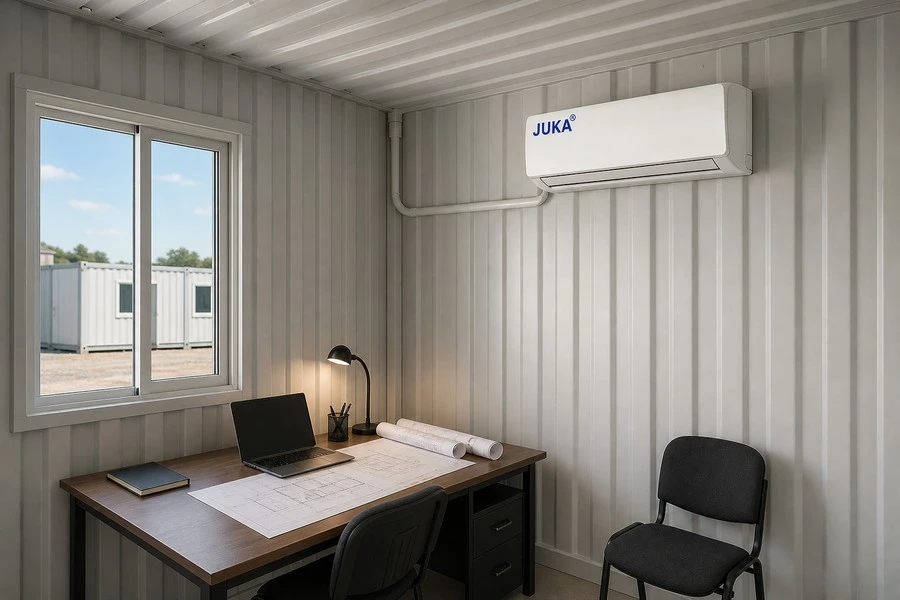
A container site office is the least forgiving installation in this list. The walls are 50 mm of sandwich panel, the roof is steel, the windows are small, and the unit is asked to pull a metal box down from 45 degrees at the start of every shift.
Two details separate a working installation from a complaint. The first is shading: if the container sits in full sun, no split unit wins, so a simple shade net over the roof does more than a bigger machine. The second is filtration and service access, because a site office collects dust and a blocked coil turns a 24,000 BTU unit into a 15,000 BTU unit within a season.
Where mains is unreliable, the hybrid input is the whole reason to buy this model. The array keeps the compressor alive through the working day, the mains covers the evening, and the bank is optional rather than mandatory.
| Building type | Running hours | Array implication (planning) |
| Bedroom, evening only | 4 to 8 | Small array or none; bank carries the load |
| Shop, 12 to 14 hours | 12 to 14 | Largest array in this list; direct daytime drive |
| Clinic waiting area | 10 to 12 | Medium array, mains kept as the fallback leg |
| Open-plan office | 8 to 10 | Medium array, west glazing shaded first |
| Restaurant | 10 to 12 | Medium array plus four hours of bank for service |
The roof has to match the hours, not the model number
This is the part buyers underestimate. 24,000 BTU is roughly 7.0 kW of cooling, and the electrical input that produces it is not a small number once the compressor is at full speed. The array does not have to cover the peak; it has to cover the daily energy, which is a different and usually smaller figure.
The method is three steps and no software. Take the hours the building actually runs. Take the average input over those hours, not the nameplate. Multiply, add a tenth for losses in the controller and cabling, and you have the daily kilowatt-hours the roof must deliver. Panel count then follows from local yield per panel, which depends on latitude, tilt and shading.
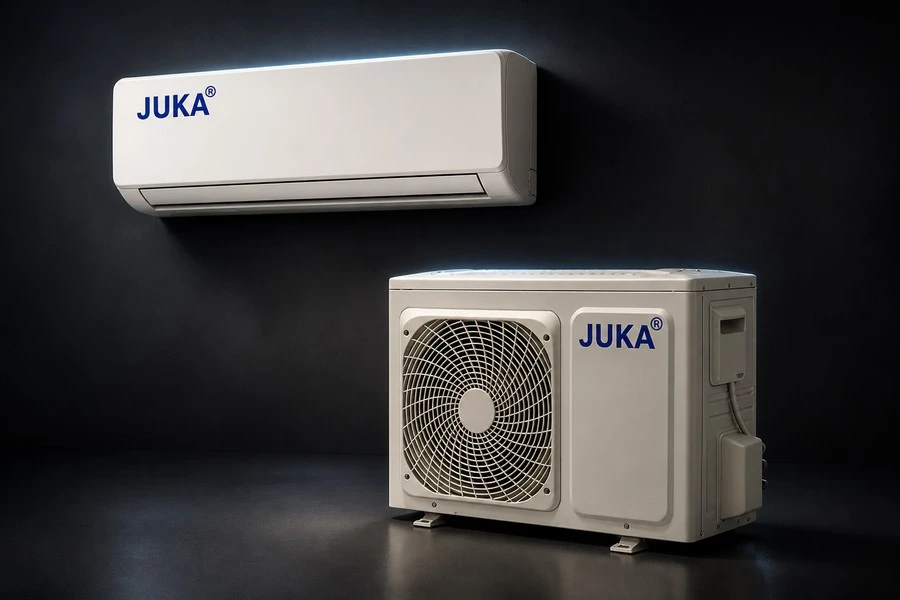
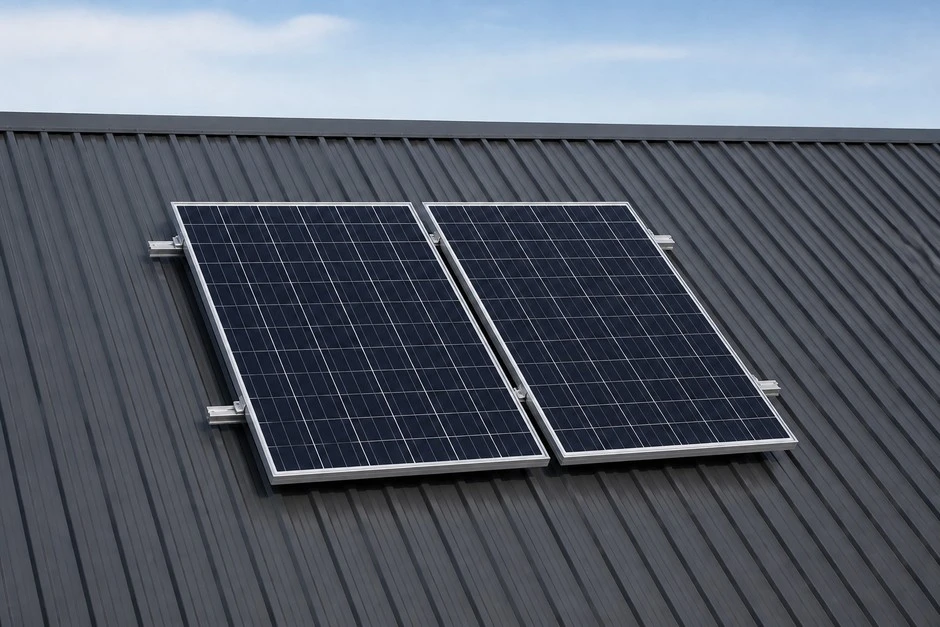
Two panels are shown in the photograph because that is a common starting point for a light-use room, not because the model carries a fixed number. On a shop running fourteen hours, the same unit needs a larger array; on a bedroom it may need none at all if the bank is charged from the mains overnight.
| Item | Ships with | Decided on site |
| Indoor head | Wall plate, remote, drain hose | Mounting height and throw direction |
| Outdoor condenser | Base feet, capped valves | Bracket or pad, clearance to the wall |
| Line set | Not included | Run length, flare sizes, insulation |
| Array | Not included | Panel count, tilt, cable route |
| Bank | Not included | Voltage, capacity, hours of cover |
Four items, and only one of them is decided in the factory
What arrives is a set, and it is worth knowing what is in each carton before the installer arrives, because site delays usually come from one missing bracket rather than a missing machine.
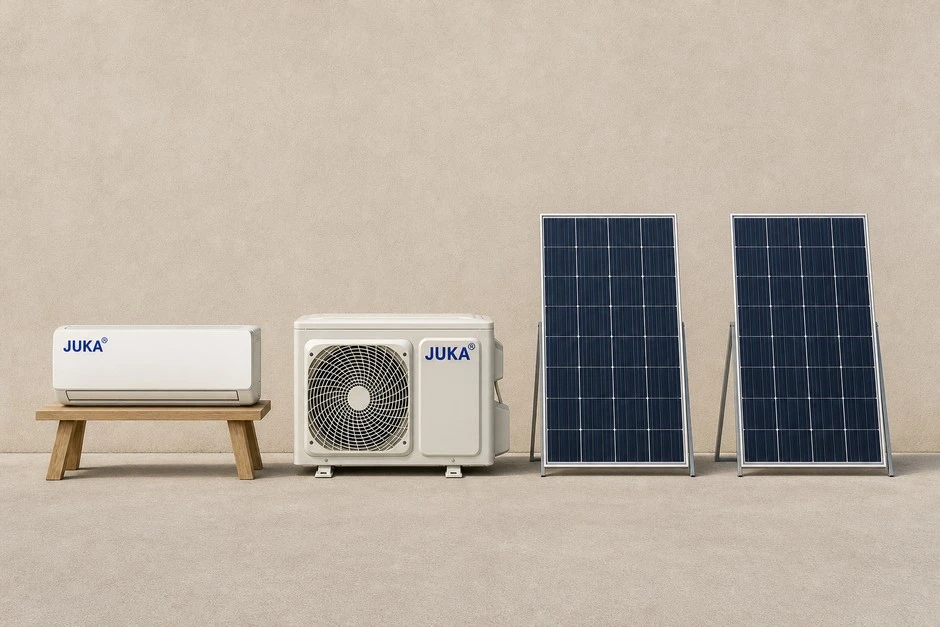
The indoor head ships with its wall plate, remote control and drain hose. The outdoor condenser ships on its base feet with the service valves capped. The line set is a separate item and is cut to the run on site, which is why the run length has to be known before the order is confirmed rather than after.
Panels and bank are quoted separately because they are site decisions. A buyer who already owns a photovoltaic array can use it, provided the DC input window matches; a buyer who does not should decide the array size before the unit ships, not after.
| Leg | Runs between | Protection | Note |
| Array DC | Panels to controller | 40 A DC breaker | Panels wired in groups, all facing the sun |
| Battery DC | Bank to controller | 40 A DC breaker | 4 mm squared minimum on this platform |
| AC feed | Mains to unit | Dedicated circuit breaker | Not shared with other heavy loads |
One controller, three cable sets, two DC breakers
The electrical side is where a good unit gets a bad reputation. There is one controller, and three cable sets meet it: the array DC, the battery DC, and the AC side that feeds the head. Each leg gets its own protection, and the two DC legs each need a 40 A breaker so that either can be isolated for service without shutting the room down.
Cable size matters more than buyers expect. The controller to battery run is specified at 4 mm squared on this platform, and undersizing it turns a working system into one that trips under load and gets blamed on the machine. Every DC cable should be labelled at both ends before the trunking goes on, because the next person to open that box will not be the person who wired it.
The AC side is a dedicated circuit. Sharing it with a water heater is the most common cause of a nuisance trip in the first week, and it is entirely avoidable at the planning stage.
Eight steps, and the order is not negotiable
Every failed installation we have seen failed in the same three places: the wall plate went up without checking the fall, the line set was flared after it was already through the wall, and the unit was started before the vacuum was finished. The sequence below is deliberately boring.
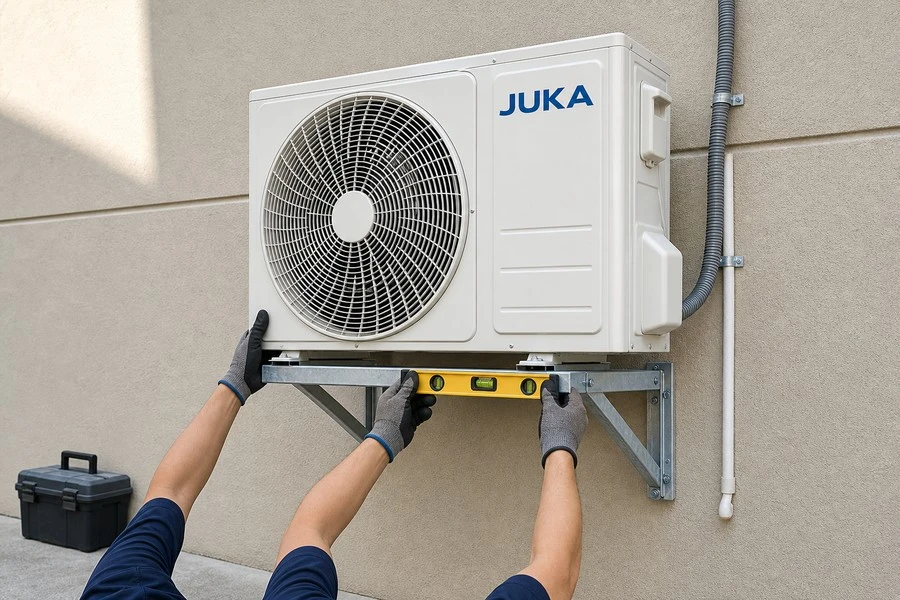
Two people are required for this size. The indoor head is long and the outdoor unit is not a one-person lift above shoulder height.
| Step | What happens | What is checked before moving on |
| 01 | Survey and mark the head and condenser positions | Throw reaches the far wall; condenser clearance both sides |
| 02 | Fix the wall plate with four expansion screws | Plate level; fall to the drain side confirmed |
| 03 | Drill the wall penetration and fit the sleeve | Sleeve slopes outwards so condensate cannot run back |
| 04 | Cut, flare and connect the line set | Both flares inspected before tightening, not after |
| 05 | Hang the head, connect drain and wiring | Head seated on the plate; drain falls continuously |
| 06 | Mount the condenser on bracket or pad, connect valves | Unit level; service valves accessible without removing panels |
| 07 | Run array to controller, controller to bank, AC to unit | Two 40 A DC breakers fitted; every DC cable labelled |
| 08 | Evacuate, open valves, leak test, first run on both sources | Vacuum held; no pressure drop; both inputs verified |
| Check | Target | Why it matters |
| Vacuum hold | Holds at the required level after isolation | Moisture in the circuit turns to acid in the oil |
| Leak test | No bubble growth at either flare or valve cap | A slow leak is the most common first-year failure |
| Run on PV only | Compressor starts and holds setpoint | Proves the DC leg and the controller logic |
| Run on mains only | Compressor starts with the array isolated | Proves the AC leg independently |
| Source changeover | No trip when the array drops out | Clouds must not restart the room |
| Drain | Water reaches the outside without pooling | The second most common call-out after leaks |
The second season is the only review that counts
The second season is the honest test. A unit that was installed with labelled cables, accessible valves and a clean coil takes an hour to service. A unit that was installed for the photograph takes half a day, and that cost lands on the buyer rather than the installer.
For spares, the list that actually moves is short: flare gaskets, valve caps, a remote control, the drain hose and the fan capacitor. Keeping those on the shelf turns a two-week wait into an afternoon. Everything else is a factory order.
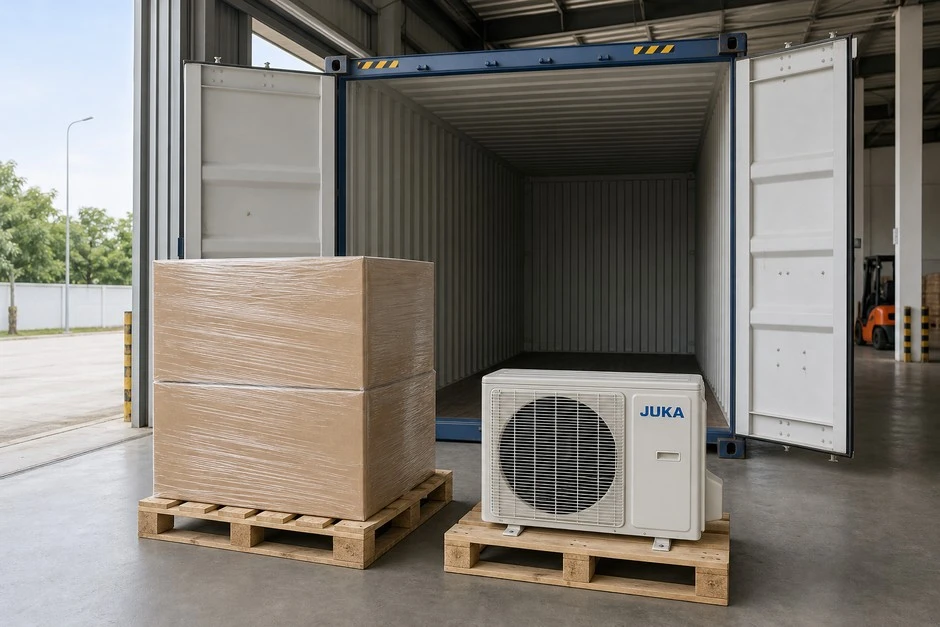
Shipping follows the same logic. The head and the condenser travel on separate pallets, panels travel upright and strapped, and the line set is coiled separately so it is not crushed under a carton. Mixed containers with other models from the range are normal, and the loading plan is agreed when the order is confirmed.
THREE SIZES
One architecture, three capacities
The same hybrid platform is built in three capacities. The difference is not only the cooling output: the array and the bank scale with the size, and the buyer who starts at 24,000 BTU is usually buying for a room that will not be reconfigured later.
| Model | Capacity | Typical room | What changes at this size |
| KF-35GWS | 12,000 BTU, about 3.5 kW | Bedroom or small office | One panel pair is often enough; bank optional |
| KF-50GWS | 18,000 BTU, about 5.3 kW | Shop or mid-size office | Array becomes the main purchase |
| KF-70GWS | 24,000 BTU, about 7.0 kW | Open-plan, restaurant, clinic | Array plus bank; wiring protection matters |
WHAT GOES WRONG
Five mistakes that cost more than the unit
These are the five we meet most often on 24,000 BTU projects. None of them is a manufacturing fault, and all of them are decided before the unit is switched on.
QUESTIONS
What buyers ask before the quotation
SPECIFICATION
KF-70GWS at a glance
Fixed values are stated. Anything that follows the build is marked, because a unit sold with an array and a bank is configured per project, not pulled off a shelf.
| Item | Value |
| Model | KF-70GWS |
| Type | Wall-mounted split, hybrid photovoltaic and mains input |
| Nominal capacity | 24,000 BTU per hour, about 7.0 kW cooling class |
| Power sources | Photovoltaic DC input plus mains AC input |
| Indoor unit | Wall head with remote control and adjustable louvre |
| Outdoor unit | Single-fan condenser, service valves on the side panel |
| Refrigerant | Type and charge set with the build |
| Rated current | Confirmed on the order confirmation |
| Line connections | Two flare connections; line set supplied per project |
| DC protection | 40 A breaker on the array leg and 40 A on the bank leg |
| Controller to bank cable | 4 mm squared minimum on this platform |
| Wall plate | Four expansion screws, supplied |
| Drain | Hose supplied; fall to the outside required |
| Dimensions | Confirmed on the order confirmation |
| Net and gross weight | Confirmed on the order confirmation |
| Packing | Head and condenser on separate pallets |
| Certification | CE for the unit as shipped |
| Branding | JUKA or private label, confirmed at order |
Hangzhou, where the panel and the compressor are specified in the same room
Juka has been building solar cold chain and solar air conditioning equipment since 2015, on a site in Hangzhou where the refrigeration side and the power side are engineered together rather than assembled from two catalogues. That matters most at 24,000 BTU, where the array, the bank and the compressor have to agree on a duty cycle.
Units ship to Ghana, Gabon, Cameroon, Nigeria, Kazakhstan and India, mostly to distributors and installers who specify the array themselves and need the unit to behave predictably on the DC leg. The test bench exists for that reason: every unit is evacuated, charged by weight and run on both sources before it is packed.
2015 building solar cooling since |
2 + 17 invention and utility patents |
CE unit certification as shipped |
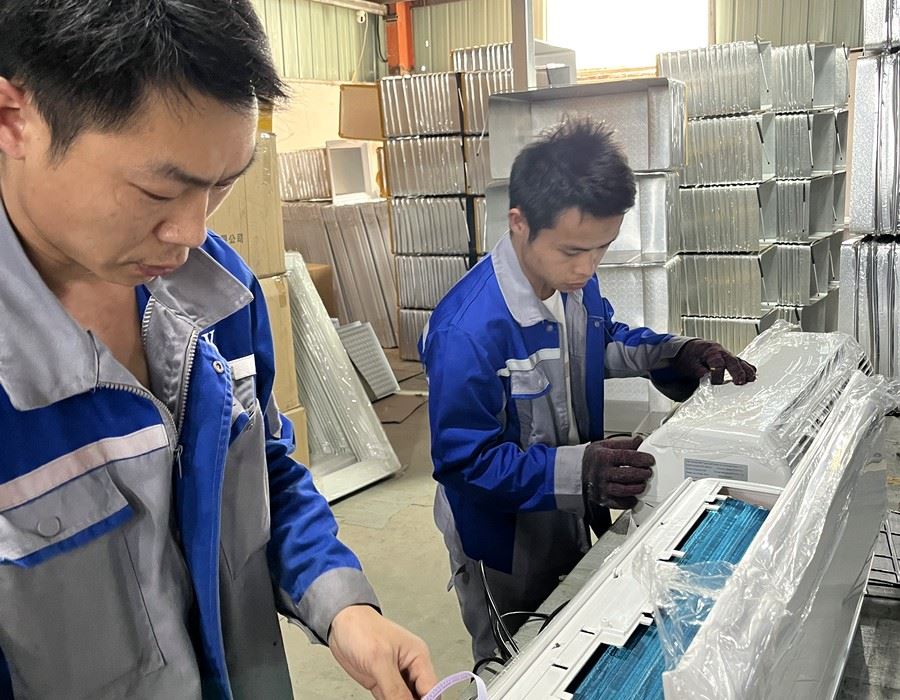
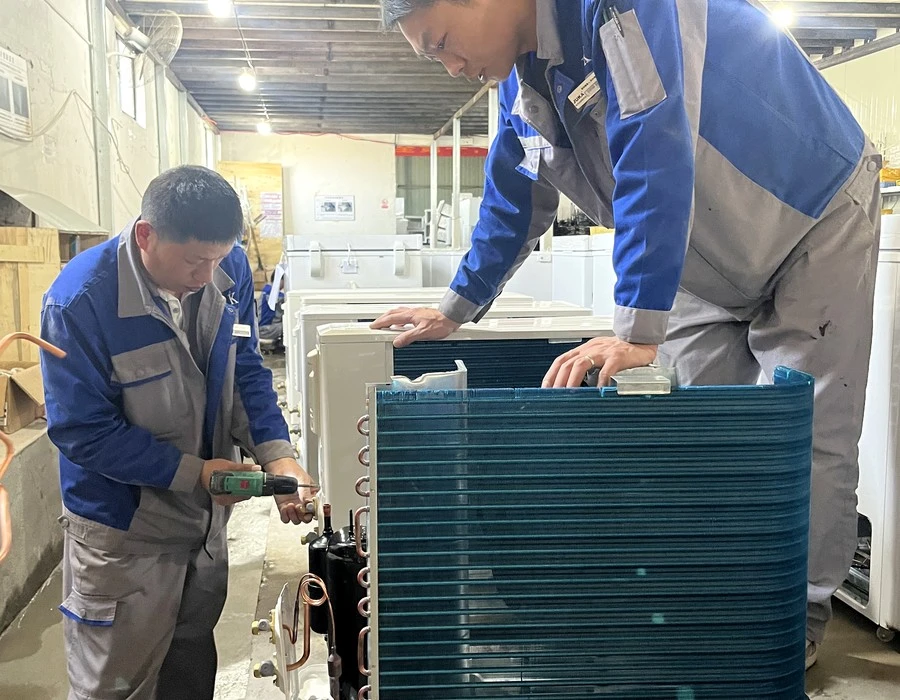
What the bench catches before packing
Evacuation before charge, charge by weight rather than by gauge, a run on both sources, and a final inspection that is separate from the assembly team. The last point is the one that changes outcomes: the person who signs off is not the person who built it.

Documents travel with the shipment: the CE declaration for the unit, the test record from the bench, and the packing list that matches the pallet markings. If a project needs a certificate of origin or a specific invoice format, say so when the order is placed rather than after the container is sealed.


OEM, ODM and local assembly
✓ Private label on the head, the condenser and the cartons
✓ Control logic and remote layout adjusted for a distributor programme
✓ Panel and bank bundles quoted as a set with the unit
✓ Spare parts kit packed with the first container
✓ Documentation in the buyer language on request
Hot Tags: hybrid solar air conditioner, China hybrid solar air conditioner manufacturers, suppliers, factory


