


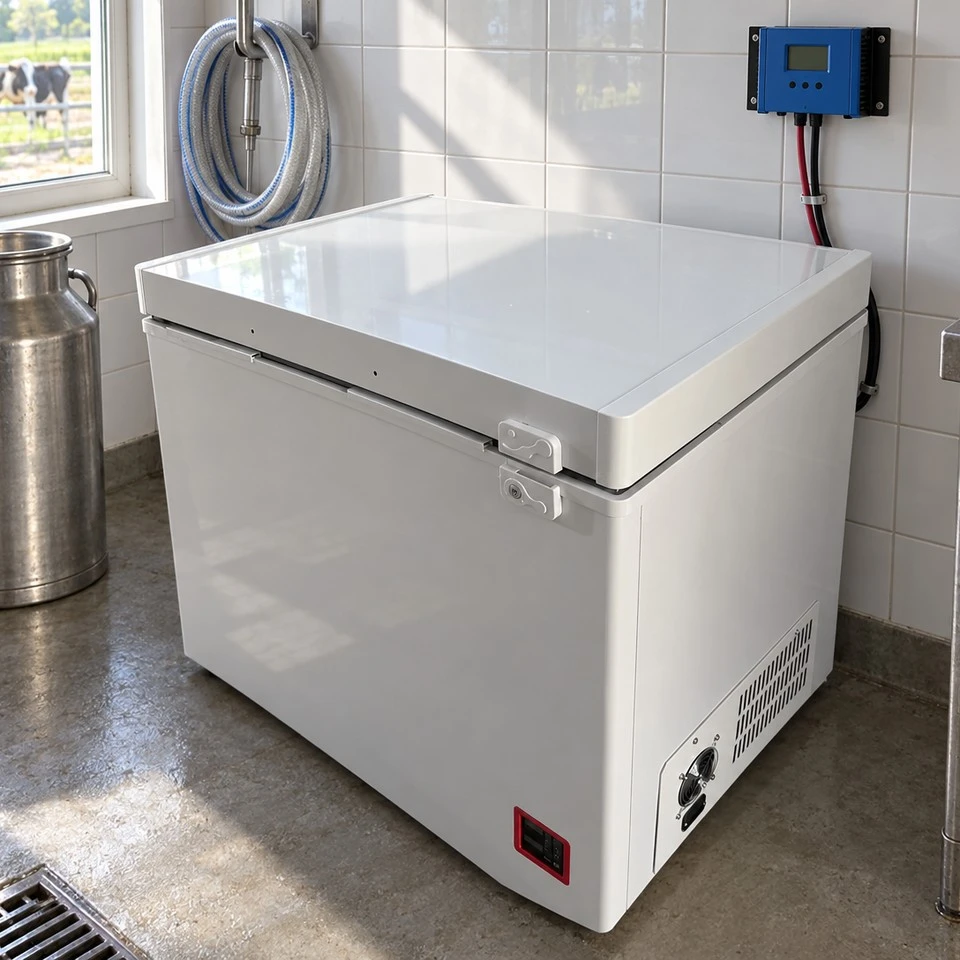
THE BOX THAT IS NOT IN THE PICTURE - every solar freezer installation has a second object in it, and that object is the battery: a steel enclosure bolted to a wall, two cables cut to length, a fuse holder, a changeover switch, and somebody who knows how to wire all of it. On this cabinet the second object is gone. A 158 litre chest freezer with 110 millimetres of foam in every face arrives with its lithium pack, its charge controller and its protection already inside the body, so what is left on the wall is the array isolator you would fit anyway, and the whole installation becomes a solar array, two cables, a switch and a cabinet.
The body itself is the middle of our 110 millimetre range: 158 litres in a cabinet 840 millimetres wide, 661 deep and 840 high, 41 kilos net against 45 gross, drawing from a 12 or 24 volt source with no inverter anywhere in the chain, holding minus eighteen, and loading 132 units into a single 40 ft HQ container.
This page is written for the buyer who has already decided to go solar and is now choosing between a cabinet plus a battery room and a cabinet with the battery in it. It quotes the plate, works the arithmetic in front of you, and says plainly which installations this cabinet should not be sold into. Three of the numbers below disagree with each other, and the disagreement is the most useful part of the page.
158 litres on 0.555 of a square metre
THE SHAPE OF THE CABINET DECIDES THE SHAPE OF THE ORDER - 840 wide, 661 deep, 840 high. That is a footprint of 0.555 of a square metre carrying 158 litres, or 285 litres for every square metre of floor it takes. In the same family the 108 litre model returns 244 from 0.443 of a square metre, and the 208 returns 316 from 0.658. The 158 is where the curve is steepest before the cabinet starts to need two people and a wide doorway.
The gain over the 108 is entirely horizontal. Height, depth and the lid are identical; the extra 50 litres is 170 millimetres of width, which is why the two cabinets load the same container count and why the jump costs 5 kilos rather than 10. For a household that has outgrown a 108 the 158 is the cheapest step up the range, because nothing about the site changes: same wall, same floor, same two cables.
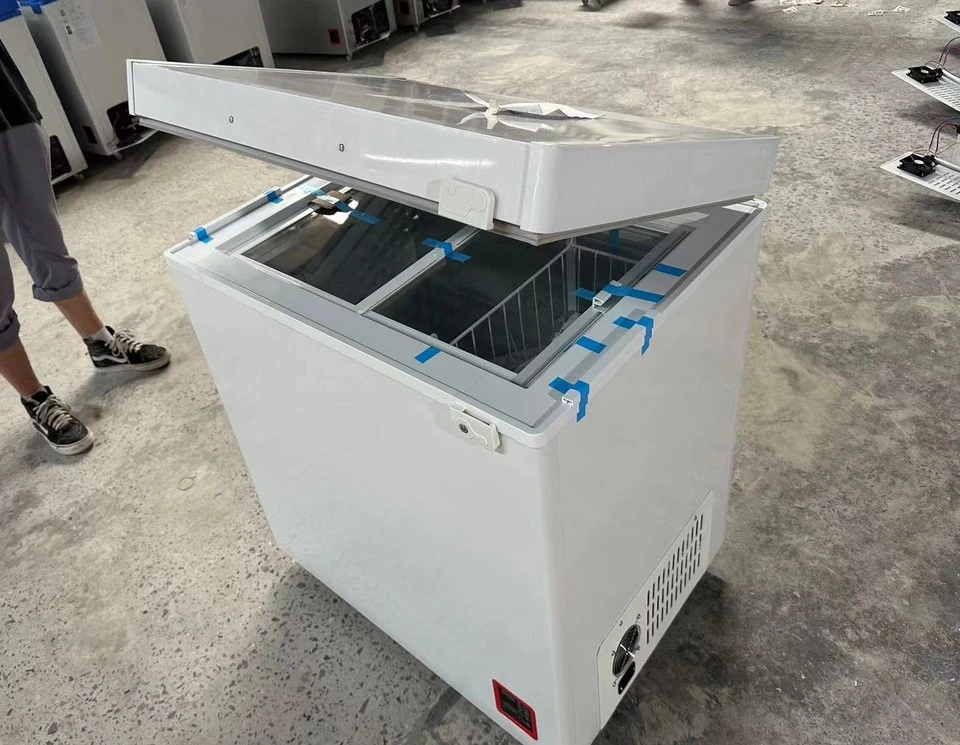
Inside, the load sits under two sliding glass doors that lift with the lid and stay in their tracks, with a coated wire basket at the right-hand end for the things that get lost at the bottom of a chest freezer. The glass is not decoration. On a cabinet this size the useful habit is to look before you open, and two panes over a 158 litre load make that possible in a way that a single lid never does. A key and lock are fitted as standard, because a freezer in a shared room, a clinic store or a shop back office is a freezer with a reason to be locked.
What the 110 millimetre wall buys you is time. Load the cabinet, let it pull down, and the mass of frozen product plus that much foam will ride through a long evening of opening and shutting, a cloudy afternoon, or a generator that is late being refuelled, with the compressor mostly idle rather than chasing a lid that never closes. On a 158 litre box in a hot room that behaviour is worth more than any difference in compressor specification, and it is the reason this range exists alongside our 65 millimetre cabinets.

| Cabinet | Gross litres | Width × depth × height | m² of floor | Litres per m² | Net weight kg | 40 ft HQ |
| BD/BC-68H | 68 | 670 × 661 × 640 | 0.44 | 153 | 30 | 153 |
| BD/BC-88H | 88 | 840 × 661 × 640 | 0.56 | 159 | 34 | 132 |
| BD/BC-108H | 108 | 670 × 661 × 840 | 0.44 | 244 | 36 | 153 |
| BD/BC-158H | 158 | 840 × 661 × 840 | 0.56 | 285 | 41 | 132 |
| BD/BC-208H | 208 | 996 × 661 × 840 | 0.66 | 316 | 47 | 123 |
| BD/BC-258H | 258 | 1038 × 745 × 840 | 0.77 | 334 | 50 | 99 |
Read that table down the litres-per-square-metre column and it looks as if width is free: 244, then 285, then 316, for half a square metre of extra floor between the smallest and the largest. Read the last column and it looks like the opposite, because every millimetre of width is a millimetre off the container. Both are true, and which one matters depends on whether you are paying for floor or for freight.
The 158 sits deliberately at the crossover. It is the widest cabinet in the range that still loads 132 to a 40 ft HQ, so a distributor can mix it with 88s and 108s without paying a penalty in slots, and it is narrow enough to pass a standard 700 millimetre door with the carton off. Above it, at 208 and beyond, containers start losing units and doorways start being measured twice.
Three numbers, three definitions, one cabinet
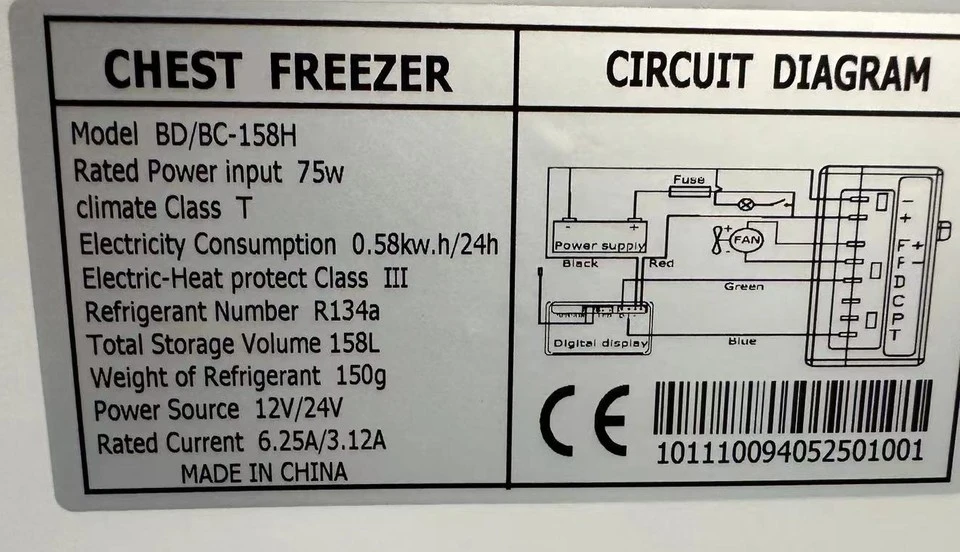
75 W, 49 W AND 0.58 KILOWATT HOURS - the rating plate on the back of this cabinet states a rated power input of 75 watts and a consumption of 0.58 kilowatt hours per 24 hours. The catalogue and this page quote a nominal 49 watts for the compressor. Three figures for one machine, and a buyer is entitled to ask which one is the lie. None of them is; they measure three different things, and knowing which is which is how you size a system without overbuying it.
The 75 watts is a rated input: compressor, condenser fan and control display running together at full load, which is what the cabinet draws during a pull-down, in the worst ambient it is rated for, with the board tolerances included. It is the number a fuse, a cable and a switch are chosen on, because those parts have to survive the worst minute rather than the average hour. It is not what the cabinet draws while it is simply holding temperature.
The 49 watts is the running draw of the compressor at holding temperature in ordinary conditions, which is the figure a specification sheet quotes and the figure that makes a cabinet comparable with another cabinet. And 0.58 kilowatt hours per 24 hours is what the whole machine actually consumed in a standard-condition test, lid shut, product already frozen, room at the test ambient.
Put the third number against the first and you learn something the first two cannot tell you. 0.58 kilowatt hours over twenty-four hours is an average draw of 24 watts. If the machine draws 75 watts while it is cooling, then it cools for roughly a third of the day and sits idle for two thirds. That is a duty cycle of about 32 per cent, and it is the single most persuasive figure on this page, because it is the foam doing the work.
| Quantity | Figure | What it actually measures |
| Rated power input | 75 W | Compressor, fan and display at full load. Size fuses and cable on this. |
| Running draw | 49 W | The compressor while holding temperature. The comparable figure. |
| Rated current | 6.25 A at 12 V, 3.12 A at 24 V | The current the supply must survive, worst case. |
| Declared consumption | 0.58 kWh per 24 h | What the cabinet used in a standard-condition test. |
| Implied average draw | 24 W | 0.58 kWh divided by 24 hours. Size panel and battery on this. |
| Implied duty cycle | about 32 per cent | 24 W average against 75 W full load. |
Two consequences follow, and they point in opposite directions for the buyer. Because the average is 24 watts and not 75, the solar side of the installation is smaller than a first reading of the plate suggests: a 200 watt module in a site with four and a half peak sun hours covers 0.58 kilowatt hours a day with a wide margin for the derating that heat and dust impose. Because the peak is 75 watts, the battery side cannot be skimped on cable and fuse, even though the average looks gentle. Generation is sized on the average; conductors are sized on the peak.
One warning about all three figures. They are measured in a test room, and a test room is not your room. In a 43 degree ambient the declared consumption is roughly what you will see; in a 30 degree ambient you will see less, and in a tin-roofed shop in the afternoon you may see half again as much, because the cabinet will simply run longer. That is not a fault, it is the duty cycle rising, and it is the reason the paragraph below sizes the pack on a night that is worse than the test cell.
Inside the wall: where a pack goes in a chest freezer
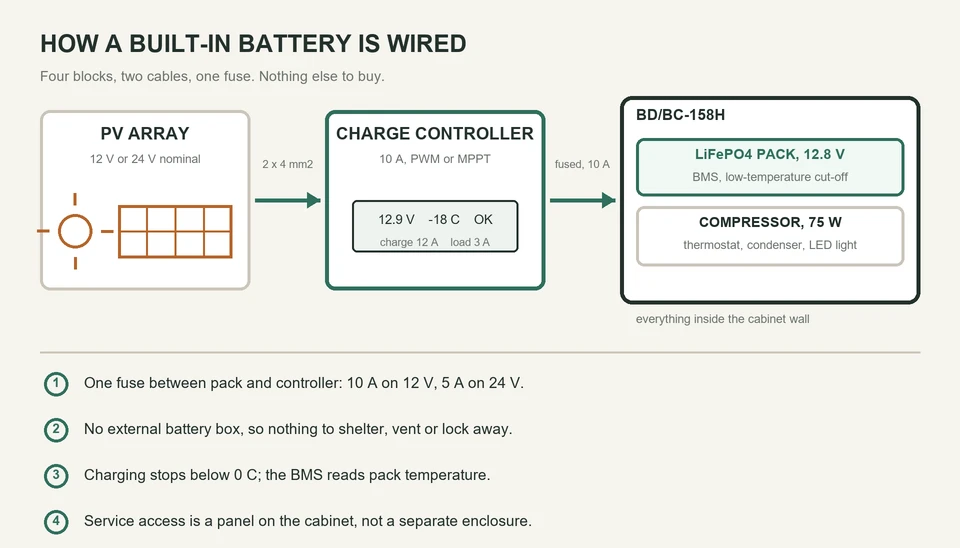
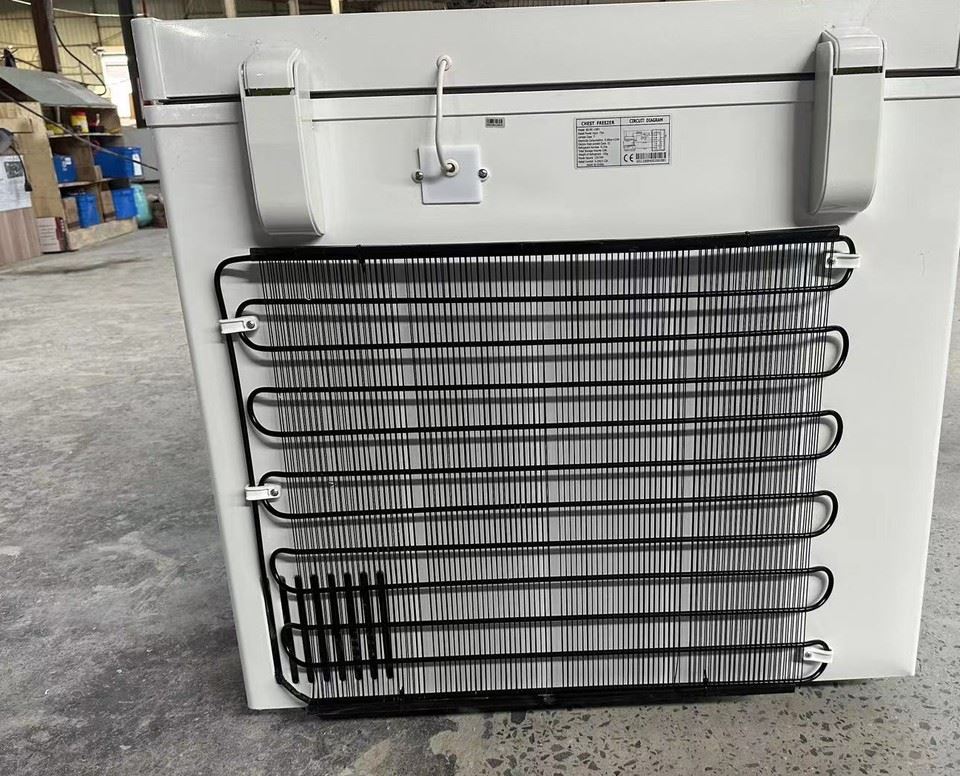
THE SPACE THAT COMPRESSOR COMPARTMENTS WASTE - a chest freezer already has a compartment at the back: a steel pan with the compressor, the condenser fan, the drier and the terminal box in it. It is ventilated because the compressor needs air, it is protected because the electrics need it, and on every ordinary cabinet most of it is empty. On this model that space carries the lithium pack, the charge controller and the fuse block, and the rear panel that closes it is a service panel rather than a lid.
The pack is a lithium iron phosphate assembly at 12.8 volts nominal, built as a sealed block with its own battery management board: cell balancing, over-current and short-circuit cut-off, over-temperature cut-off, and low-temperature charge protection, which is discussed further below because it is the single most important thing to understand about running a lithium pack in a cold room. Terminals are brought out to a labelled block, so the pack can be isolated for service without removing it.
Two things this arrangement is not. It is not a pack loose in a plastic box rattling around next to a compressor, which is how a good many built-in installations are actually built. The block is fixed, the cables are cut to length and crimped at the factory, and the run from pack to controller is measured in centimetres rather than metres, which removes the voltage drop that a separate battery room introduces. And it is not a pack the customer chose badly: the controller ships matched to the chemistry it is charging, so the classic failure of a lead acid profile left on a lithium pack cannot happen on this cabinet.
Cooling towers, clinics, shops and dairy collection rooms all have the same reason for wanting this: the cabinet is a single object that can be delivered, positioned, connected to two cables and left alone. No shelf to build, no enclosure to vent, no room to keep above five degrees, no second purchase order, and nothing in the building that a visitor can open.
| What a separate battery room needs | On a mains site | On the BD/BC-158H |
| Battery enclosure | Vented steel box, wall or floor mounted | None: the pack sits in the compressor compartment |
| Interconnecting cable | Two runs cut, lugged and crimped on site | One factory-made pair, centimetres long |
| Fuse and holder | Sized, bought and fitted at the battery end | Fitted in the compartment |
| Low-temperature charge protection | Usually absent on a lead acid set | On the pack management board |
| Floor space | 0.2 to 0.4 m² of wall and floor | None |
| Water and vermin | An enclosure in a wet room is a maintenance item | Sealed inside the cabinet |
| Procurement | Two line items, two datasheets, two lead times | One line item |
| Site skill required | Somebody who can wire a DC bank safely | Two cables to a labelled terminal block |
How many nights the pack carries
FROM KILOWATT HOURS TO NIGHTS - sizing a pack is not done on the daily figure, it is done on the night. A solar freezer spends the dark hours running off the battery and the daylight hours running off the panel while the battery refills, so the question is not how much energy the cabinet uses in a day but how much it uses between sunset and sunrise, and how many sunrises in a row may fail to arrive.
Half of 0.58 kilowatt hours is 0.29, and a night is roughly half a day, so 290 watt hours is the honest figure for one dark period, with the cabinet at holding temperature and the lid behaving itself. Add the usual allowance for a hot room, a family that opens the lid and a pack that is not new, and size on 350 to 400 watt hours per night. Anyone who has run a solar freezer for a season will recognise that as the conservative end of the range.
Against that, a 12.8 volt 100 amp hour lithium pack holds 1.28 kilowatt hours nominal, of which 80 per cent is normally treated as usable, which is a little over one kilowatt hour, or about three nights at 350 watt hours. A 200 amp hour pack is the rainy-season answer and buys a week. What a lithium pack gives you over the lead acid bank it replaces is that all of that capacity is actually available: a lead acid bank quoted at the same amp hours delivers about half of it before the voltage sags below the cabinet cut-off, so the comparison on the shelf is misleading by a factor of nearly two.
The panel is the other half of the same sum. 0.58 kilowatt hours a day on a site with four and a half peak sun hours, with a 0.75 allowance for heat, dust and cable loss, needs about 172 watts, so one 200 watt module is the natural match and two 100s are the flexible answer where part of the array will be shaded for an hour. If the pack is a 200 amp hour block and the site has a real rainy season, size the array at 300 watts and accept that on the worst weeks the cabinet will fall a little short of minus eighteen rather than flattening the pack.
| Pack | Nominal energy | Nights of 350 Wh carried, 80% usable | Where that pack belongs |
| 12.8 V 50 Ah | 0.64 kWh | One night, no reserve | A mains house that loses power for a working day |
| 12.8 V 100 Ah | 1.28 kWh | About three nights | Off-grid house with a 200 W module |
| 12.8 V 200 Ah | 2.56 kWh | About seven nights | Clinic, shop or dairy room with a wet season |
Two notes on that table. The figures assume the cabinet is already at temperature when the sun goes down, which is what happens in service but not on the first afternoon; a pack that has to pull down a warm 158 litre cabinet on its first night will use most of a 100 amp hour block doing it, and the installation should be commissioned on a sunny morning with the product already frozen. And the numbers are per night, not per day, so a site that is cloudy for a week does not need eight times the pack, it needs the cabinet loaded with frozen product and the lid kept shut, which is what the foam is for.
The one number that is not on the freezer plate: 0 °C
LITHIUM MUST NOT BE CHARGED FROZEN - charging a lithium iron phosphate cell below zero degrees plates lithium metal on the anode instead of intercalating it, and that damage is permanent, cumulative and invisible until the pack loses capacity a year later. Every serious lithium installation has to deal with this, and a solar freezer is the awkward case because the cabinet and the pack sit in the same cold room and the sun comes up while the room is at its coldest.
Three things follow for anyone specifying this cabinet. The pack management board on this model cuts charging below zero degrees and resumes when the cells warm, so a cold morning delays the charge rather than destroying the pack; the discharge path stays open, which means the freezer keeps running through the night and through the cold snap. The pack sits in the compressor compartment, not in the insulated box, so the waste heat of the compressor and the sun on the rear panel keep it warmer than the room; a separate battery box on a cold concrete floor does not get that help. And the cabinet should be placed where the morning sun reaches the rear panel, which is the opposite of the advice for the condenser and is the one genuine compromise in this design.
Where the room itself goes below zero for weeks, the answer is not a bigger pack. It is either a heated battery compartment, which we build to order, or a cabinet without an integrated pack, which this range also offers. We would rather write that down here than have a distributor discover it in a mountain clinic in February with a pack that will not accept a charge until ten in the morning.
Cold weather is not all bad news. The cabinet reaches minus eighteen more easily in a cool room than a hot one, so the pack works less in winter, and part of what the short charging day takes away the lighter load gives back. What cannot be recovered is the two hours between sunrise and the cells warming up, and that is the window a specification has to be honest about.
Two cables, one fuse, and what the cabinet refuses to need
THE WHOLE INSTALLATION, IN ORDER - array to controller, controller to pack, pack to compressor. On this cabinet the middle two joints are made in the factory and the customer makes the first one and the last one, which is why the site work is an afternoon rather than a day.
The rated current is 6.25 amps at 12 volts or 3.12 at 24, and those are the worst-case figures from the plate, so they are what the cable and the fuse are chosen on. Fuse at the source end of the positive run, never at the cabinet end, and size it at 10 amps on a 12 volt system or 5 on a 24. In copper, hold the drop to three per cent and the minimum sections come out as 2.5 square millimetres at three metres, 4.0 at five and 6.0 at ten, worked from 0.0175 ohm square millimetres per metre. If the array is more than ten metres away, move the controller closer to the pack, because the panel side tolerates a loss of volts that the pack side does not.
A cabinet with the pack inside changes one habit of planning. In a conventional installation the pack is a separate purchase with its own delivery date, its own warranty terms and its own failure mode, and it is frequently the item that is substituted at the last minute for a cheaper one of the wrong chemistry. Here there is one part number to order and one warranty to claim on, and no way for the two halves to be mismatched.
What the electronics still need from the installer is honesty about the array. The controller will accept anything from 10 to 50 volts DC and will not complain about a dirty panel or a long cable, it will simply charge more slowly, and a pack that is chronically undercharged is the beginning of a warranty conversation. Clean the modules, keep the cable out of the sun, and if the site has a season where the load and the sun disagree, size the array for that season rather than for the good one.
150 grams of R134a, and the parts that actually fail
A SMALL CHARGE IS A STRICT CHARGE - the plate states 150 grams of R134a on this cabinet, which is roughly half a domestic refrigerator charge and about two thirds more than the 108 litre model in the same family. On a system this small, a leak that would be a slow nuisance on a commercial cabinet is a total loss of cooling here, which is why every unit is evacuated, charged and leak tested individually rather than sampled from a batch.
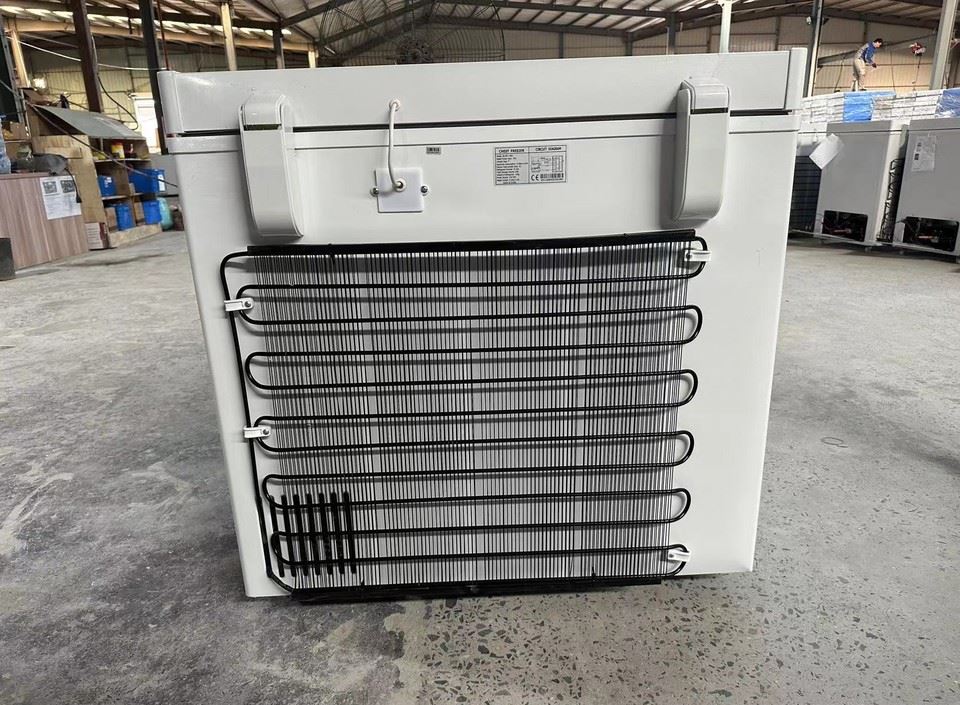
Anyone who opens this cabinet in year five has the whole service manual printed on the back of it: gas type, charge mass, both current figures, the ambient class, the protection class, and a circuit diagram that shows the fuse, the fan, the display and the pack terminals in one drawing. Recharge by weight rather than by pressure, because at 150 grams the window between correct and overcharged is a few seconds of the tap.
What wears out first on a chest freezer is mechanical rather than sealed: the rubber seal, the hinge pin, the latch and the dial. All four are catalogue items and none of them needs a refrigeration engineer. The two new assemblies this model adds are the controller and the pack, and both lift out through the rear panel as complete units, so a distributor holding spares for a hundred cabinets does not have to hold a compressor to keep them running. The failure that actually costs a customer is the one that cannot be repaired inside the country.
The electrical class deserves a sentence of its own. Protect class III means the cabinet is designed to run from a safety extra low voltage supply, which is exactly what a 12 or 24 volt bank is, and it is the reason a cabinet in a wet dairy room does not need the earthing and residual current protection that a mains freezer would. Do not defeat that by putting an inverter in the line to run a 220 volt cabinet nearby from the same bank: the moment the installation contains mains voltage, the whole room needs mains protection again.
The doorway, the floor and the lid
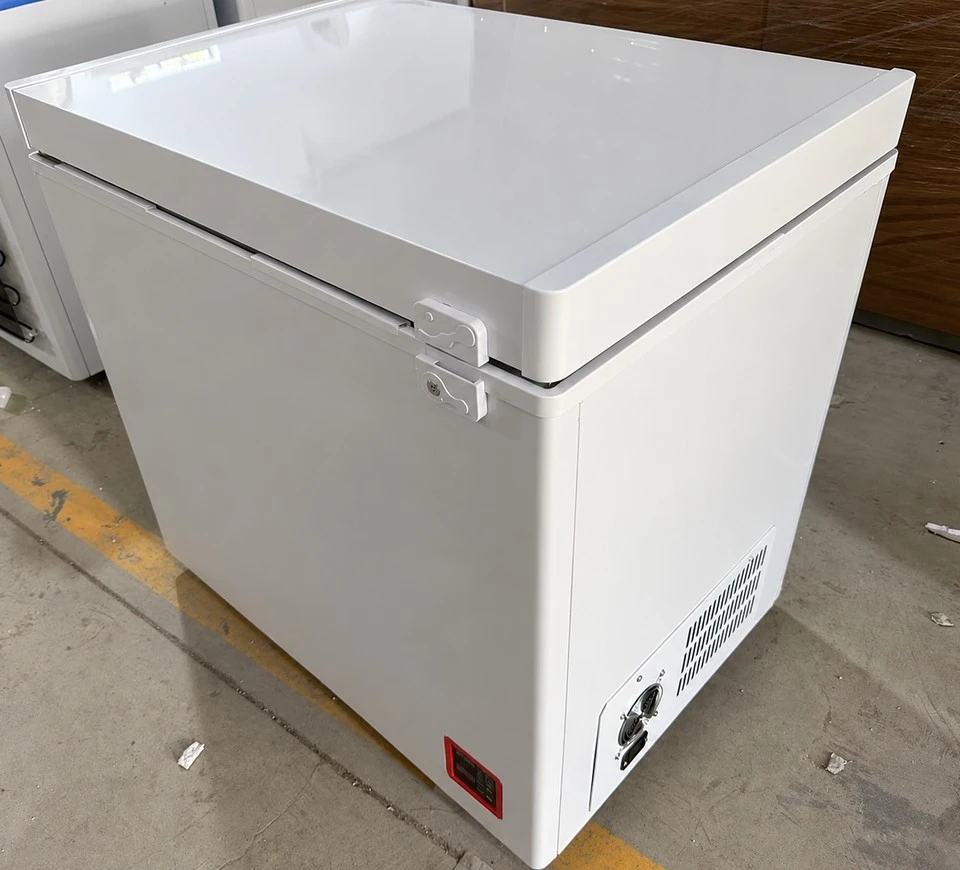
MEASURE THE ROOM, NOT THE CABINET - the body is 840 millimetres across, 661 front to back and 840 tall, and it weighs 41 kilos empty. Uncartoned and strapped, it clears a standard 700 millimetre internal door; cartoned at 880 by 681 by 882, it decides for itself whether it is going into a lift, up a stair or onto a trailer.
Three height traps catch almost every wrong installation. Tucking it beneath a worktop, because the lid rises and stays up rather than sliding back, so the clearance over the front half must be genuine open air and never a shelf. Trying to carry it in a car, because a carton 882 millimetres tall is not luggage. And pushing it hard against a wall barely taller than itself, which buries the rear service panel behind a freezer that then has to be dragged out every time the pack or the controller is looked at.
At 41 kilos net the cabinet is a two-person lift with product in it and a one-person slide on a level floor. That is the practical difference between this and the 208 litre model at 47 kilos and 996 millimetres wide, which needs a wider door and a second pair of hands for anything more than a slide. Below this size the family is light enough to be moved by one person, which is what makes the 158 worth the width: it is the largest cabinet in the range that one person can still reposition.
Two siting notes that come from site visits rather than from a data sheet. Keep the lid out of a sunlit window, because a white steel top in direct sun behaves like a panel heater on the only surface that cannot be insulated from the inside. And stand it where a wet floor is acceptable: defrosting by hand produces water, and a freezer installed on carpet is one that gets relocated once and cleaned never.
Where a built-in pack is the wrong purchase
THREE INSTALLATIONS WE TURN DOWN - a site that already owns a large battery bank; a site where a technician will service the pack twice a year anyway; and a site that needs more than three or four hundred watt hours of nightly storage. In the first case the cabinet should be bought without a pack and run from the existing bank, because a second pack in the same room is money spent twice. In the second case the integrated cabinet is still convenient but the saving is smaller, and a standard cabinet with a well-chosen external pack will do the same job.
The third case is arithmetic rather than preference. The compartment behind this cabinet holds a pack up to about 200 amp hours and no more, and the way to serve a load larger than that is more cabinets or a bigger external bank, not a larger pack crammed into a space designed for a compressor. A distributor selling into a project with a central battery room should be quoting the non-integrated version, and we would say so before the quotation goes out.
There is also a supply-chain reality worth naming. A cabinet with a lithium pack inside it is a different customs and freight object from a cabinet without one, and a market with restrictions on lithium imports or no channel for servicing a pack is a market where the integrated model is the harder sale. We build both versions from the same body, and the decision is usually made by the import rules rather than by the customer.
132 to a container, and why the pack travels inside it
CARTON, CUBIC METRE, DECLARATION - the shipped carton is 880 by 681 by 882 millimetres, 0.529 of a cubic metre, 45 kilos gross. A hundred and thirty-two units fill a 40 ft HQ, which is 69.8 cubic metres of cartons against a little under 76 of usable space and just under six tonnes against a payload allowance several times that: this cabinet is volume-limited, not weight-limited, and mixing it with 88s or 108s costs slots rather than kilos.
The pack changes the paperwork, and the change is in the customer's favour. Lithium cells shipped loose travel as a separate dangerous goods entry with the full declaration that goes with it; a pack installed in equipment and shipped with it travels under the equipment entry, which is a simpler and more widely accepted declaration in most lanes. That is a real advantage of the integrated design for a distributor, but it is the forwarder who decides, not the catalogue, so confirm the classification for your lane and your carrier before the first order rather than after it.
Packs are built and shipped at a partial state of charge rather than full, because a lithium pack stored at 100 per cent for months ages faster than one stored at half. A cabinet that arrives with a partly charged pack is not a short shipment; it is the pack being looked after. Commission on a sunny morning, let the array bring the pack up, and the first pull-down will happen with the sun on the panel.
Loading is ordinary: single wall carton, foam corner protection, cabinets upright, lid taped, and a line in the shipping instructions that the units travel upright and stand upright for a day before being energised. For a CKD or SKD programme the same body travels as panels, liner, lid, compressor and a fastener kit, with the pack and the controller as separate boxed items if the destination assembles and charges them locally, and the container count changes completely because a kit occupies a fraction of the volume of a built cabinet.
| Item | BD/BC-158H |
| Refrigerated body | BD/BC-158H, one lift lid, 110 mm super energy save construction |
| Volume, gross | 158 litres |
| Carcass, W × D × H | 840 × 661 × 840 mm |
| Export carton | 880 × 681 × 882 mm, 0.529 m³ |
| Weight | 41 kg net, 45 kg gross |
| Insulation | 110 mm polyurethane, walls, floor and lid |
| Set point | −18 °C and below, mechanical dial |
| Input, rated | 75 W |
| Draw while holding | 49 W |
| Energy, per day | 0.58 kWh at standard conditions |
| Supply window | 10–50 VDC, 12 V or 24 V nominal, no inverter |
| Current, rated | 6.25 A at 12 V, 3.12 A at 24 V |
| Gas and charge | R134a, 150 g |
| Ambient limit | class T, 43 °C |
| Electrical class | III, safety extra low voltage |
| Energy store | LiFePO4, 12.8 V nominal, managed, charge cut-off below 0 °C |
| Included | lock and key, twin sliding inner glass doors, one wire basket |
| On request | inner light, customer label, manual in the destination language, heated battery compartment |
| Defrosting | by hand |
| Container load | 132 units, 40 ft HQ |
| Shipped as | built cabinet, or CKD / SKD kit for a local build partner |
Four of those lines decide the purchase. 158 litres on 0.555 of a square metre is the reason a household, a clinic store or a dairy room steps up to this body instead of the one below it. 0.58 kilowatt hours a day at a 32 per cent duty cycle is what a 200 watt module has to replace, and why the array can be modest. The pack behind the rear panel separates an afternoon of installation from a week of building a battery room. 41 kilos, 840 millimetres wide decides who lifts it and which doorway it clears. Everything else is a service detail, or a choice we made in the works so that no one would have to make it on site.
About the works that builds this cabinet
WHO BUILDS IT - Zhejiang Juka Solar Technology, a cold chain manufacturer working out of Zhejiang in eastern China, and a company that exists because a good part of the world pays more for a kilowatt hour than it pays for a freezer. Our 110 millimetre range, of which this cabinet is the middle size, was drawn up for exactly those customers: it carries more foam than a 65 millimetre body and it earns that foam back in panels and batteries that never have to be bought.
Four processes stay under our own roof, and they are the four that decide whether a cabinet like this can be specified honestly: foaming, carcass assembly, gas charging, and the run to temperature. The lid tooling, the liner moulds and the frame jigs belong to us rather than to a supplier, and the battery compartment, its service panel and the harness to the controller are assembled on the cabinet line instead of being bolted on afterwards by somebody else. That is why one page can quote a pour thickness, a duty cycle and a container count with none of the three being a guess.
Before anything is boxed it is evacuated, charged, leak checked and run until it reaches temperature, and the reading is written against the serial number on the plate. On an integrated cabinet that test doubles as the first trial of the pack and the controller, so a unit which pulls down in its stated time has three things right at once: gas mass, lid seal, and a pack that accepts charge. A buyer with a thermometer and a receiving bay can repeat the whole test in five minutes, which is the cheapest incoming inspection in this trade.
The export book is mostly sub-Saharan Africa, South and South East Asia, the Gulf and Latin America, sold to importers, project contractors, aid agencies and refrigeration distributors who service what they sell. We ship under the Juka name and as an OEM or ODM partner, with nameplates, manuals, cartons and tender documents produced in the language of the destination, and quotations leave with the technical file and packing list attached so that an approval does not sit waiting on a reply.
TELL US FOUR THINGS - the floor area available, the clearance above the cabinet with the lid raised, the sun in the worst month at that site, and whether a battery bank is already installed there. With those we can say whether the built-in pack saves you money or duplicates something you own, how many watts of module to order, and how many cabinets fit the container you are booking. Where the right answer is the plain cabinet or the 208 litre body, that is what we will quote.
Hot Tags: Solar Freezer with Built in Lithium Battery, China Solar Freezer with Built in Lithium Battery manufacturers, suppliers, factory


