


A solar freezer is not a household freezer with a panel bolted to the roof. It is an energy system built around one hard constraint: every watt-hour has to be harvested on site, stored, and spent without waste. Get that balance wrong and the cabinet still reaches -18 °C on a sunny afternoon - and drifts to -2 °C by the third cloudy morning.
This guide covers what actually determines performance in off-grid cold storage: the compressor and control electronics, the insulation package, the sizing arithmetic, and the installation details where most field failures originate. It is written for distributors, project contractors and buyers who have to specify equipment that keeps working after the commissioning report is signed.
What Makes a Freezer a Solar Freezer
Three design decisions separate an off-grid freezer from a mains unit. First, the compressor runs on direct current, typically 12 V or 24 V, so it can work from a battery bank without an inverter in the loop. Second, the control board manages the whole energy chain: photovoltaic input, battery voltage, compressor speed and a low-voltage cut-off that protects the battery before it is damaged. Third, the cabinet is insulated far beyond domestic standards, because every millimetre of foam is cheaper than the panel capacity needed to replace the heat that leaks through it.
Running the compressor directly from DC removes an inverter conversion loss of roughly 10 to 15 percent, and removes a component that fails silently in hot, dusty enclosures. That is why nearly every serious off-grid cabinet uses a DC rotary or reciprocating compressor rather than an AC compressor with a standalone inverter.
How the Cooling Cycle Runs on Sunshine
A photovoltaic array charges the battery through a maximum power point tracking controller. The controller holds the panels at the voltage where they deliver the most power, which matters most in exactly the conditions off-grid sites see: high cell temperature, partial shading, and long stretches of diffuse light. The battery buffers the load, and the freezer thermostat and control board decide when the compressor runs.

In a well-matched system the compressor does not run continuously. At ambient temperatures between 25 °C and 32 °C a typical cabinet holds its set point with a duty cycle of 30 to 45 percent, which is why daily energy consumption - not compressor wattage - is the number to design around. A unit drawing 60 W at a 40 percent duty cycle consumes about 0.58 kWh per day; the same cabinet in a 43 °C yard can climb past 1.0 kWh per day without any change to the equipment.
Sizing the System: Four Numbers Decide the Outcome
Sizing is arithmetic, but the inputs are where projects go wrong. Work through four figures in order, and write them down before choosing a cabinet.
A worked example: 0.9 kWh per day, three days of autonomy and 80 percent usable depth of discharge call for about 3.4 kWh of nominal battery capacity. With four peak sun hours in the worst month, the array needs roughly 0.9 ÷ 4 ÷ 0.78, about 290 W of panels before any allowance for soiling and ageing.
Insulation, Refrigerant and Cabinet Construction
Polyurethane foam density and thickness do more for off-grid runtime than any electronic feature. Cabinets built for solar duty commonly use 60 mm to 100 mm walls with cyclopentane-blown foam, and a well-sealed magnetic gasket. Thin walls, poor gasket contact and an unsealed compressor compartment are the usual reasons a unit underperforms its datasheet.
On the refrigerant side, R290 has become the default in this class of equipment: it has a very low global warming potential, good volumetric efficiency, and it suits the small charge sizes used in compact cabinets. Service technicians should still treat it as flammable and follow the manufacturer's charging procedure rather than topping up by gauge pressure alone.
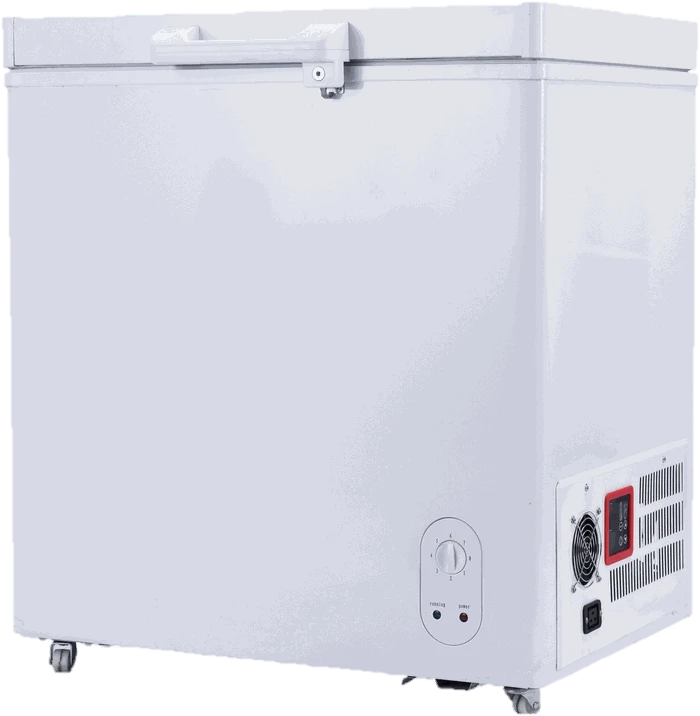
Installation: Where the Kilowatt-Hours Are Lost
Most underperforming installations are not equipment failures. They are siting and wiring decisions made in an afternoon.
Maintenance and the Faults That Matter
Off-grid freezers fail in a small number of predictable ways, and almost all of them announce themselves early in the data.
Where Solar Freezers Earn Their Cost
The economics work where the alternative is lost product or a diesel generator. Health posts storing vaccines, fishing cooperatives holding catch, village shops selling frozen goods, and agricultural projects chilling produce before transport all share the same profile: a load that must run every day, in a place where grid power is absent, unreliable or prohibitively expensive to extend.

What to Check Before Buying
How JUKA Supports Off-Grid Projects
JUKA builds solar cold-chain equipment and supports partners who deliver it: solar freezers and refrigerators in chest, upright and glass-door configurations, solar direct-drive units, and CKD / SKD programmes for assembling cabinets and cooling systems locally. Projects are specified against the site's load profile, ambient conditions and autonomy requirement rather than a catalogue default.