


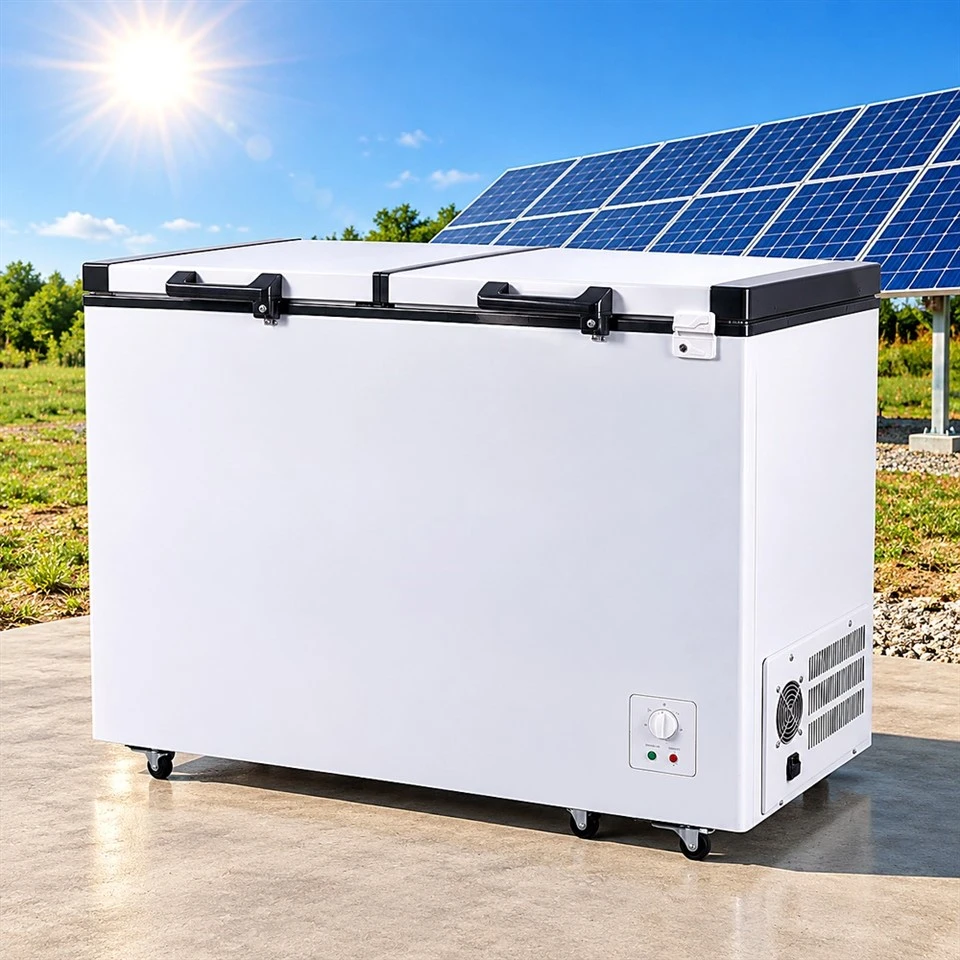
MODEL BD/BC-658 - 658 L double lid solar chest freezer | 1598 mm long | 885 mm deep | 935 mm high | 85 mm foam | 10–50 VDC wide input | 24 V nominal | holds −18 °C
Solar powered chest freezer · a purchase memo in six clauses
Six clauses, one cabinet: read the numbers before the photograph
This page is written as a memo rather than a brochure. Each of the six clauses takes one measurement off the BD/BC-658 and follows it to the decision it forces - where the cabinet goes, how the bank is wired, how many fit in a container, how a shift loads it. If you only have two minutes, read the first clause and the specification table at the end. Everything between them is the reasoning, so that a colleague who was not on the call can see why a number was chosen.
The cabinet is the deep one in the range. It is 187 mm shorter, 140 mm deeper and 101 mm taller than the 608, holds 50 litres more, and a 40 foot high cube takes 28 of them instead of 56. Those four sentences are the whole product. The rest of the page is what they mean in a shop, a village store or a fishing harbour.
Capacity 658 L | Footprint 1598 × 885 mm | Foam 85 mm | Bank 10–50 VDC, 24 V nominal | Per 40'HQ 28
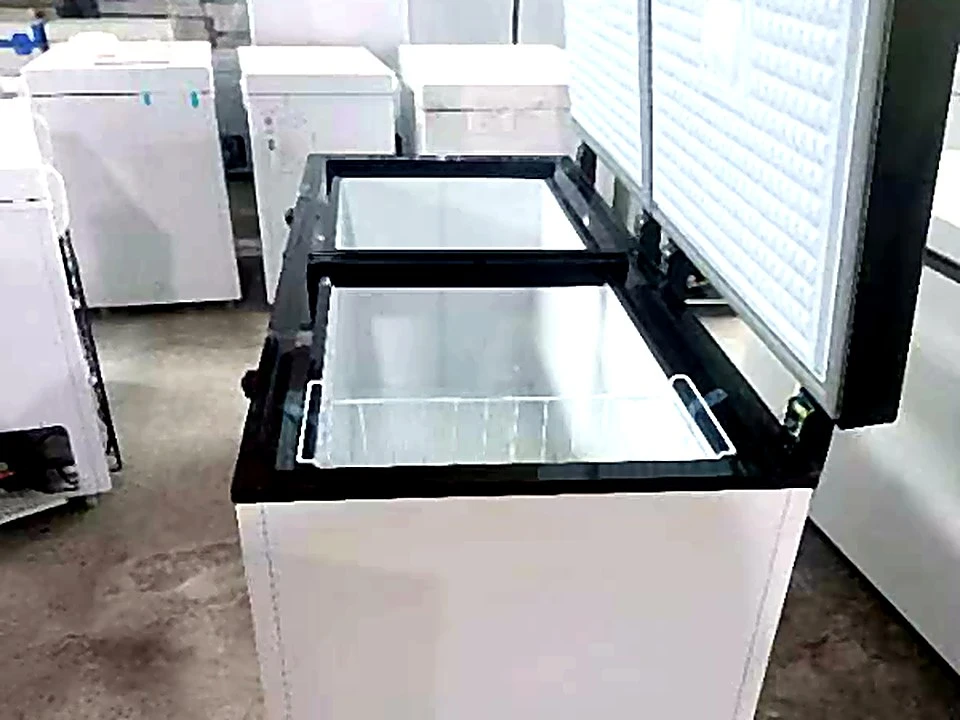
CLAUSE 1 · the footprint - 658 litres standing on 1.41 square metres, which is a wall decision, not a cabinet decision
1598 mm of length by 885 mm of depth is 1.41 square metres of floor once the four castors are down. Divide the litres by the square metres and the cabinet returns 465 litres for every square metre it takes. The 608 returns 457 and the 708 returns 499 on the same arithmetic, so the 658 sits in the middle of the range - it is not the most efficient box per square metre, and pretending otherwise would be a mistake a buyer notices on the second visit.
What the 658 does better than the long cabinets is fit a wall that was never designed for a chest freezer. A shop with a 1700 mm gap between a doorway and a shelving run cannot take an 1785 mm cabinet however good the price is; it can take 1598 mm with 50 mm of air at each end. In a market stall the same 187 mm saved is the width of the walkway behind the counter. That is the trade: you give up 187 mm of length, you gain 140 mm of depth, and the volume goes up by 50 litres rather than down.
Two measurements to take before the order rather than after: the gap itself, and the distance from the gap to the nearest 900 mm doorway. A cabinet that fits the wall but cannot be turned into the room is still the wrong cabinet.
The floor deserves its own line. 82 kg standing on four castors is about 21 kg a wheel before anyone leans on the lid, and a wheel is a point load. On a tiled shop floor that is nothing; on a raised timber deck, a mezzanine or a truck bed it is the number that decides whether the cabinet stays level after a month. If the floor is not flat, put a sheet of 18 mm board under the castors rather than shimming one corner: a cabinet standing on three wheels twists the body, and a twisted body is where lid seals start to leak warm air.
| Number on the sheet | What it actually decides | What to measure on site |
| 1598 mm length | whether it fits the wall between two fixed objects | gap between the obstructions, plus 50 mm each end |
| 885 mm depth | how far the open lid reaches into the aisle, and whether the far end of the compartment can be reached by hand | aisle width, and the height of the lid when it is standing open |
| 935 mm height | the working height for staff loading from the front | bench height if the cabinet is set on a plinth |
| 1660 × 895 × 1010 mm carton | whether it goes through the door on its own castors or has to be unpacked outside | the narrowest door on the route in, and the lift dimensions |
CLAUSE 2 · the working depth - 885 mm is 185 mm past a comfortable reach, so the load plan has to know it
A chest freezer is loaded by hand, and a hand reaches about 700 mm from the shoulder before the lift becomes a lean. At 885 mm of depth the last 185 mm of the BD/BC-658 is past that line. It is not a fault in the cabinet - two more litres of depth is two more litres of cold air that does not spill out when the lid opens - but it does change how a shift works, and buyers who ignore it end up with stock frozen into the bottom corners that nobody rotates.
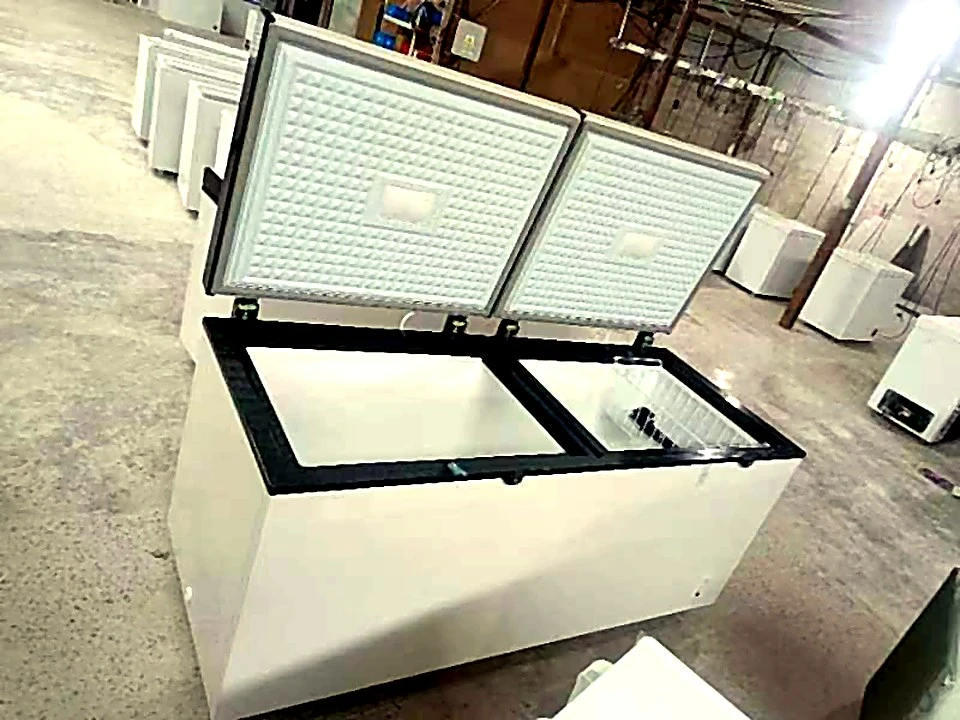
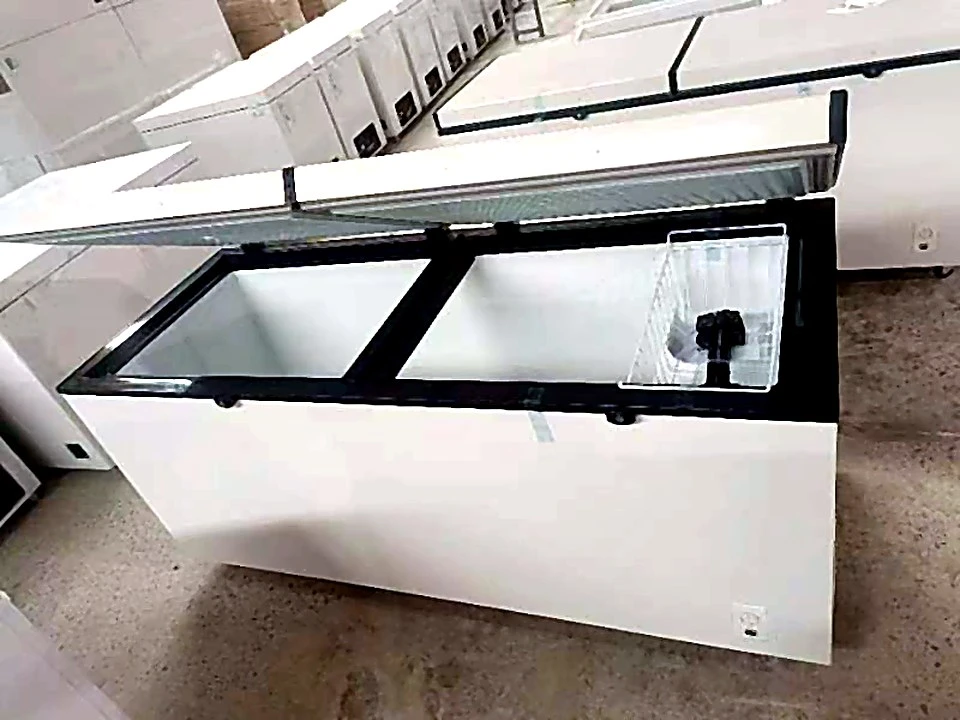
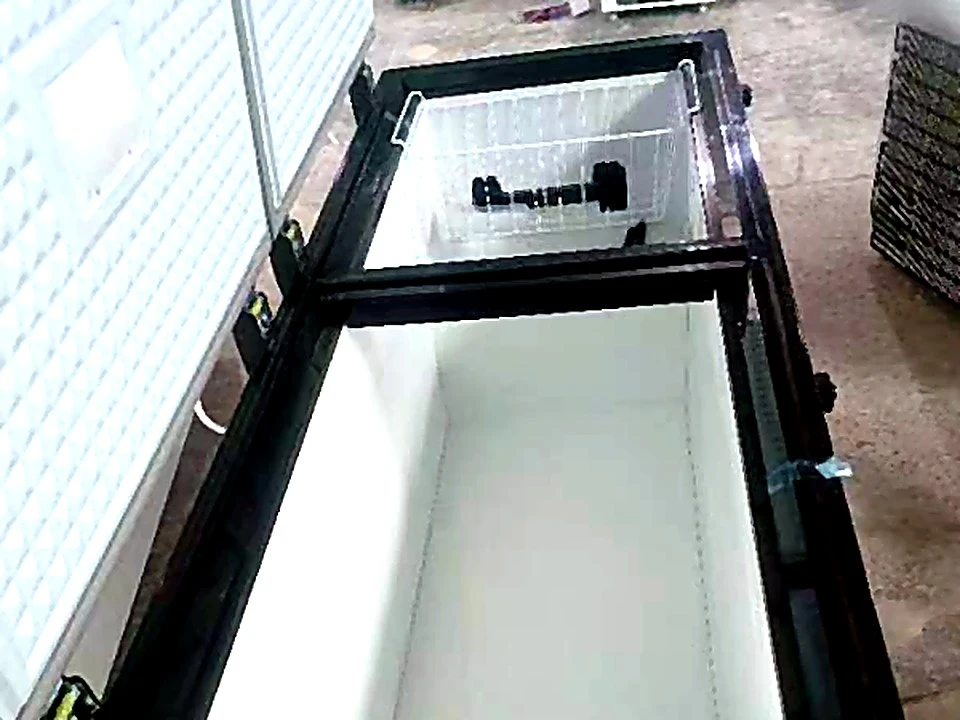
Three ways to load a deep box, in the order we recommend them. First, baskets. The 658 ships with a wire basket and takes a second one; slow movers go over the far wall in the basket, fast movers stay within reach of the near wall, and rotation happens without anyone climbing into the cabinet. Second, load from both long sides. If the cabinet stands on an island rather than against a wall, each compartment is reachable from its own side and the depth stops mattering. Third, part-load with a divider: the centre bridge gives two independent lids, so a half-filled compartment keeps its cold air under a closed lid while the other half is being worked.
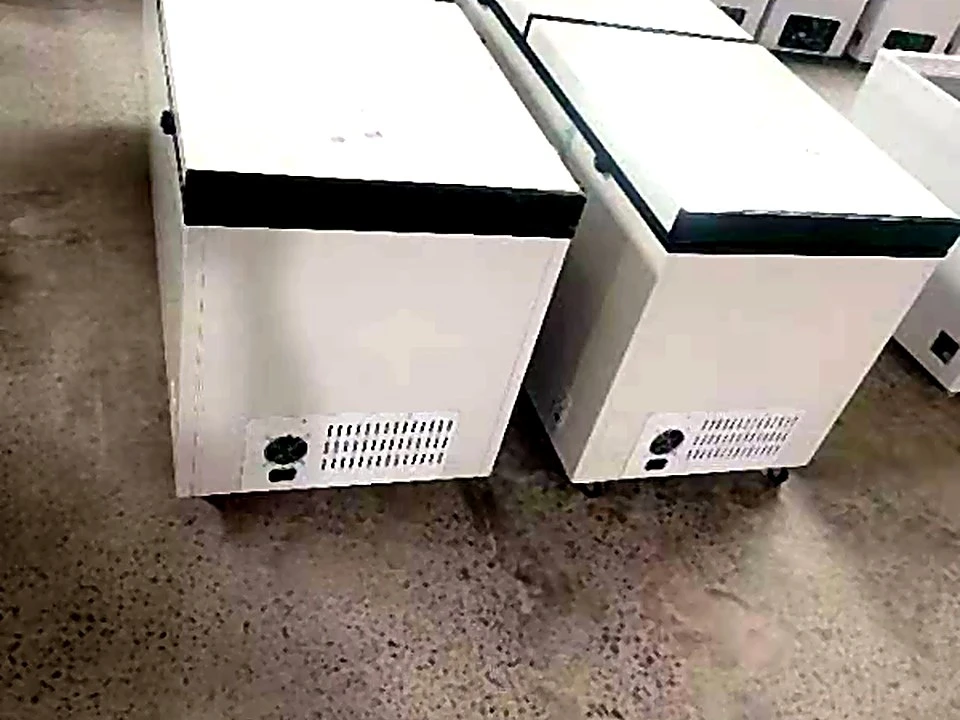
The castors matter in this clause too. 82 kg net, 87 kg gross, four castors and a moulded grab at each end: one person moves it on a flat floor, two people lift it, and nobody should be dragging it over a threshold without a ramp.
CLAUSE 3 · 24 volts - Why the wide input window matters more on this cabinet than on a 12 volt one
The 658 runs from a 10 to 50 volt DC supply and its nominal bank is 24 volts. That single word - nominal - is where most off-grid installations are won or lost. A 24 V bank is two 12 V batteries in series. It is charged by a controller whose input has to sit above the bank voltage, and it feeds a compressor whose driver accepts anything from 10 to 50 volts, so no inverter sits between the panels and the cold.
The reason to prefer 24 volts on a cabinet this size is copper. For the same compressor power, doubling the voltage halves the current, and half the current through the same cable loses three quarters of the heat - or, seen the other way round, the same run can be done with a quarter of the cross-section. On a village store where the array is 15 metres from the cabinet, that is the difference between a 6 mm² cable and a 2.5 mm² one, and between a voltage drop you never notice and one that makes the compressor chatter at the end of a hot afternoon.
Two wiring points that catch people out. A single 36-cell panel cannot charge a 24 V bank through a PWM controller, because its maximum power voltage is barely above the bank voltage; either use two panels in series, use a 60 or 72-cell panel, or use an MPPT controller. And a 24 V string is only as good as its weaker battery: mix an old and a new block in series and the pair ages at the rate of the older one.
In a humid climate the electrical side is usually fine and the habits are not. A chest freezer left open while stock is counted pulls in moist air, and that moisture ends up as frost on the liner wall and, eventually, as ice welded around the basket hooks. The cure is not a bigger array, it is a defrost that happens on a schedule: empty one compartment, lids shut on the other, warm air and a cloth rather than a scraper, and the drain bung open into a tray. Twice a year in a dry climate, three or four times a year on a coast.
| Same compressor load | 12 V bank | 24 V bank | What it means on site |
| Current in the cable | twice the 24 V figure | the reference figure | smaller fuse, thinner cable, less heat in the conduit |
| Voltage drop over a 15 m run | four times the 24 V figure at equal cross-section | the reference figure | the array can stand further from the cabinet |
| Battery blocks in series | 1 | 2 | an even number of identical blocks, same age, same brand |
| Charging from one 36-cell panel | works with a PWM controller | needs two panels in series, a 60/72-cell panel, or an MPPT controller | the most common ordering mistake on a 24 V system |
| Behaviour as the bank goes flat | compressor slows, then cuts out | same, but from a higher usable energy base | size the bank on the worst week, not the best one |
CLAUSE 4 · 28 per container - How 1660 mm of carton turns into fourteen on the floor and fourteen on top
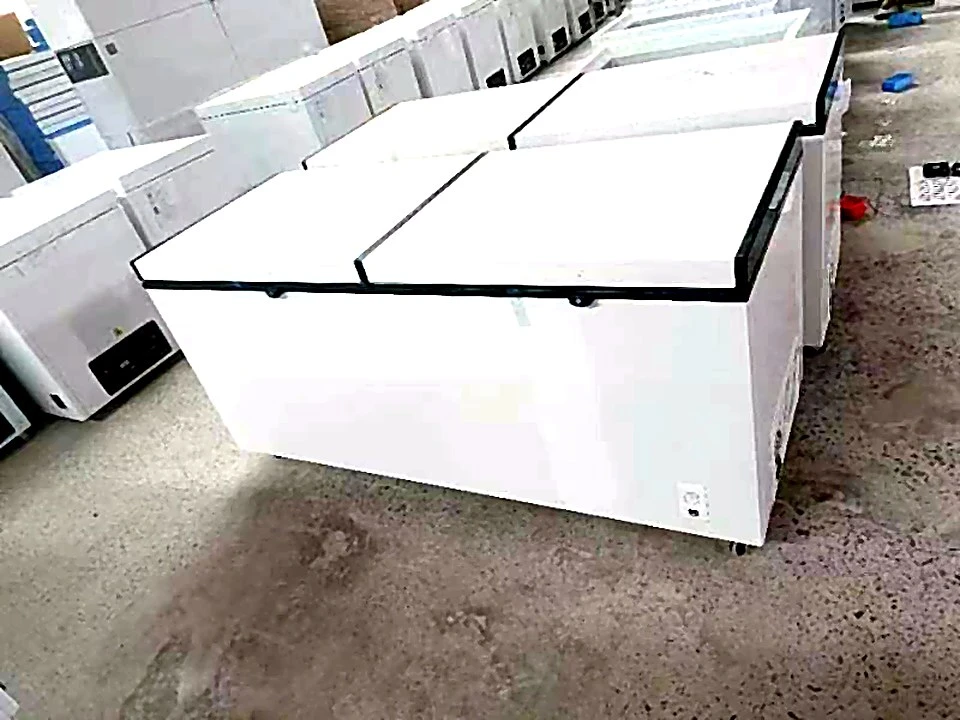
The carton is 1660 mm long, 895 mm wide and 1010 mm high. A 40 foot high cube has about 12 metres of deck and 2.35 metres of internal width. Lay the cartons two abreast and seven deep and you have fourteen; put a second tier on top and you have 28, which is exactly the loading figure on the catalogue sheet. Nothing is squeezed and nothing is turned on its side - the lids stay flat and the paint stays unmarked, which is why the count is 28 and not a rounder number.
That arithmetic has a commercial consequence worth stating plainly: per unit of freight, the 658 costs about twice what the 608 costs, because half as many fit in the same box. If the container is being filled with one model and the budget is fixed, the 608 wins on landed cost per unit. If the container is mixed - chest freezers, an upright cooler, a few ice makers - the 658 is the cabinet that fills the awkward space left over, and the freight argument disappears.
The 895 mm carton width is the number to give the forwarder. It passes a 900 mm opening with almost nothing to spare, so on a narrow site the carton comes off outside and the cabinet goes in on its castors at 885 mm. Tell the receiving site that in advance and the delivery takes twenty minutes instead of an argument.
CLAUSE 5 · what 658 litres holds - Two compartments, one divider, and a load plan that changes with the season
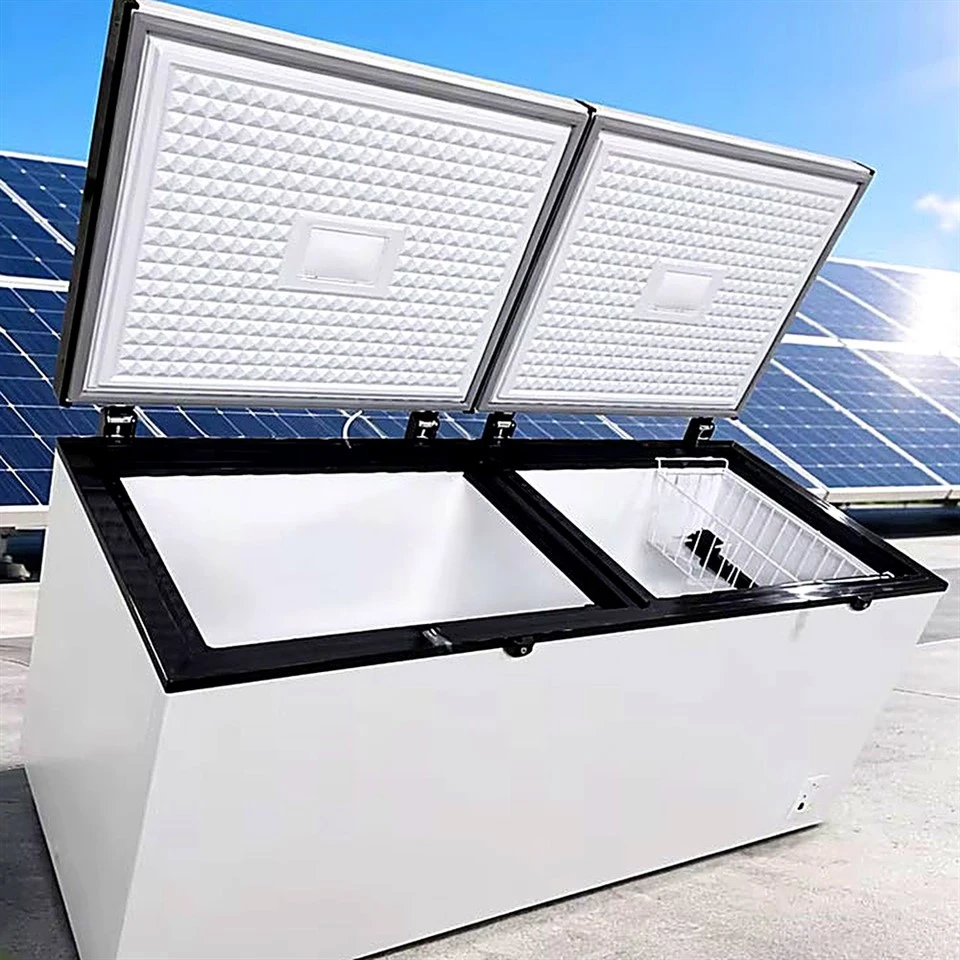
658 litres is not one volume in practice, it is two: the centre bridge splits the cabinet into a compartment under each lid, and each lid opens on its own hinge. In a shop that is a promotion cabinet - ice cream under one lid, frozen meat under the other, no cold air lost when only one range is being served. In a household or a small lodge it is bulk storage on one side and daily stock on the other, which is why the divider is the feature people remember after a year of use.
As a working figure, 658 litres of mixed frozen stock at retail packing density is roughly a fortnight of turnover for a neighbourhood store, or two to three weeks of family shop. The interior is a deep white liner with radiused corners so a scraper reaches the bottom, basket hooks at the top of each compartment, and a drain bung for the defrost. Holding temperature is −18 °C and below, on a mechanical thermostat with a running lamp and a power lamp on the end panel - no menu, no board, nothing that fails in a humid room.
Rotation is the part that decides the electricity bill. A deep box loaded once a month with a solid block of cartons forms one cold mass and runs efficiently; the same box loaded every morning with warm ambient stock runs all day. Keep the new stock in the basket above the old, close the lid between customers, and the compressor stops arguing with the weather.
CLAUSE 6 · the first two days - Six steps from a carton on the ground to a cabinet holding temperature
These are the steps that decide whether the cabinet is praised or blamed in its first month, in the order we would do them on site.
Stand it level. Two days upright after transport, on a floor that takes 87 kg on four castors, with the castors locked once it is in place. A cabinet that rocks hums, and a hum is what the customer hears.
Give the coil air. About 100 mm behind the rear panel, and nothing stacked on top of the lids. The condenser is static wire tube: it rejects heat to the room, so a cupboard built around the back of the cabinet is a warranty claim waiting to be written.
Wire the bank before the array. Battery to controller, controller to array, cabinet last, fuse at the battery. A DC cabinet switched on while the bank is still being connected can see a spike, and the driver is the part that pays for it.
Check the polarity twice. A 24 V bank reversed on the inlet will destroy a compressor driver in under a second, and it is the single most common installation failure we are asked to price.
Run it empty for a few hours. Lid closed, thermostat at the middle detent, until the liner is cold to the touch and the running lamp has cycled off at least once. Only then load stock, and load it in batches rather than in one go.
Write the date on the plate. Commissioning date, bank size, array wattage and the thermostat detent, on the rating label or in the shop's own log. The next person to service the cabinet will thank you, and the conversation about a fault becomes a two-minute read instead of a site visit.
Six questions we answer before the second container
Will it run on 12 V - Electrically yes, because the input window starts at 10 volts, but the cabinet is built around a 24 V bank and on 12 volts it draws twice the current for the same cooling. That means a heavier cable, a bigger fuse and a shorter run from the battery, which is often the point at which a customer decides to buy two blocks and go 24 V after all.
Can it stand outside - The cabinet is a room appliance: a roof over it, a dry floor under it, and no sun falling on the lid or the rear coil. The condenser rejects heat to the surrounding air, so a cabinet in a closed lean-to works harder than the same cabinet in a ventilated room, and a cabinet in direct sun works harder still. Shade the box before you enlarge the array.
How long in a power cut - We do not print an hours figure, because the honest answer depends on how full the cabinet is, what is in it and how hot the room is. A full 658 holds temperature far longer than an empty one, since the frozen stock is the thermal mass. Keep both lids shut, do not open it to check, and treat the number as something to measure on your own cabinet rather than read off a page.
Which refrigerant - The line is built on R134a or R600a depending on the run, and the rating plate on the individual cabinet is the document that matters for a service engineer or a customs declaration. Quote the plate, not this page, when the cabinet has to be re-gassed locally.
Mixed container - Normal order, not a special arrangement. The 658 shares a compressor family, liner finish and spares list with the 608 and the 708, so a container can carry all three plus upright coolers, ice makers or spares, and the packing list is built around the load rather than around a minimum quantity per model.
658 or 708 - Choose the 658 when the constraint is the length of a wall and the cabinet has to come through a normal door; choose the 708 when the constraint is floor area, because it returns 499 litres per square metre against 465. Choose either when the alternative is two small cabinets, because one body means one compressor, one thermostat and one lid seal to look after.
Specification: BD/BC-658
| Item | BD/BC-658 |
| Total storage volume | 658 L |
| Cabinet size (W × D × H) | 1598 × 885 × 935 mm |
| Carton size (W × D × H) | 1660 × 895 × 1010 mm |
| Net / gross weight | 82 / 87 kg |
| Holding temperature | −18 °C or lower |
| Cabinet foam | 85 mm, CFC free |
| Lids | 2 independent lids, steel hinges front and rear, moulded handles |
| Basket | 1 white wire basket as standard, second basket on request |
| Temperature control | Mechanical dial, running lamp and power lamp |
| Input | 10–50 VDC wide range; 24 V nominal bank, AC through an adapter on request |
| Refrigerant | R134a / R600a |
| Condenser | Static wire tube, about 100 mm clearance at the rear |
| Castors | 4, cabinet base 40 mm off the floor |
| Loading | 28 units per 40 foot high cube |
Dimensions and weights are the cabinet and carton as they leave the line. Volume, holding temperature, refrigerant charge and the quantity per container follow the printed sheet for the twin lid chest freezer range; where this page and the plate on the unit disagree, the plate wins.
Where the 658 sits: 608, 658 and 708 on one sheet
| Model | Volume | Cabinet (mm) | Floor area | Litres per m² | Net weight | Per 40'HQ |
| BD/BC-608 | 608 L | 1785 × 745 × 834 | 1.33 m² | 457 | 72 kg | 56 |
| BD/BC-658 | 658 L | 1598 × 885 × 935 | 1.41 m² | 465 | 82 kg | 28 |
| BD/BC-708 | 708 L | 1785 × 795 × 890 | 1.42 m² | 499 | 86 kg | 26 |
The three cabinets share a compressor family, a liner finish and a spares list, so a distributor can stock one set of thermostats and hinges across the range. They do not share a footprint, and that is deliberate: the 608 is the long low one for a wall, the 658 is the short deep one for a corner or an island, and the 708 is the widest volume per square metre when floor space is the binding constraint.
WHO BUILDS THE 658 - One plant in Hangzhou, the full DC chest freezer range, and the paperwork that travels with it
Zhejiang Juka Solar Technology has built DC refrigeration in Hangzhou since the range started, and the chest freezer programme now runs from a 98 litre single lid box up to 1388 litre twins. Cabinets ship assembled, or knocked down as kits for a local line. Alongside the freezers the plant builds solar air conditioners, ice makers, display coolers and refrigeration parts, which is why a container rarely leaves with one model in it.
For an importer the practical part is the paperwork: carton print, rating plate, manual and serial series can all be put in the buyer's name, from the second container onward. Certification documents are sent out with the quotation, because a buyer who has to ask for them twice rarely places the order.
FOUR ANSWERS WE NEED - With these four we can quote cabinet, power and freight together instead of in three rounds.
How many litres of frozen stock you are holding at the busiest week. The length and depth of the space the cabinet can occupy. The sun hours in your worst month, not your best. And the bank voltage you already own, if you own one. The reply states the model that fits the space, the array and battery arithmetic for that site, the combination that fills a container, and the date the 658 can be on the water. Sample cabinets come out of stock.
Hot Tags: solar powered chest freezer, China solar powered chest freezer manufacturers, suppliers, factory


