


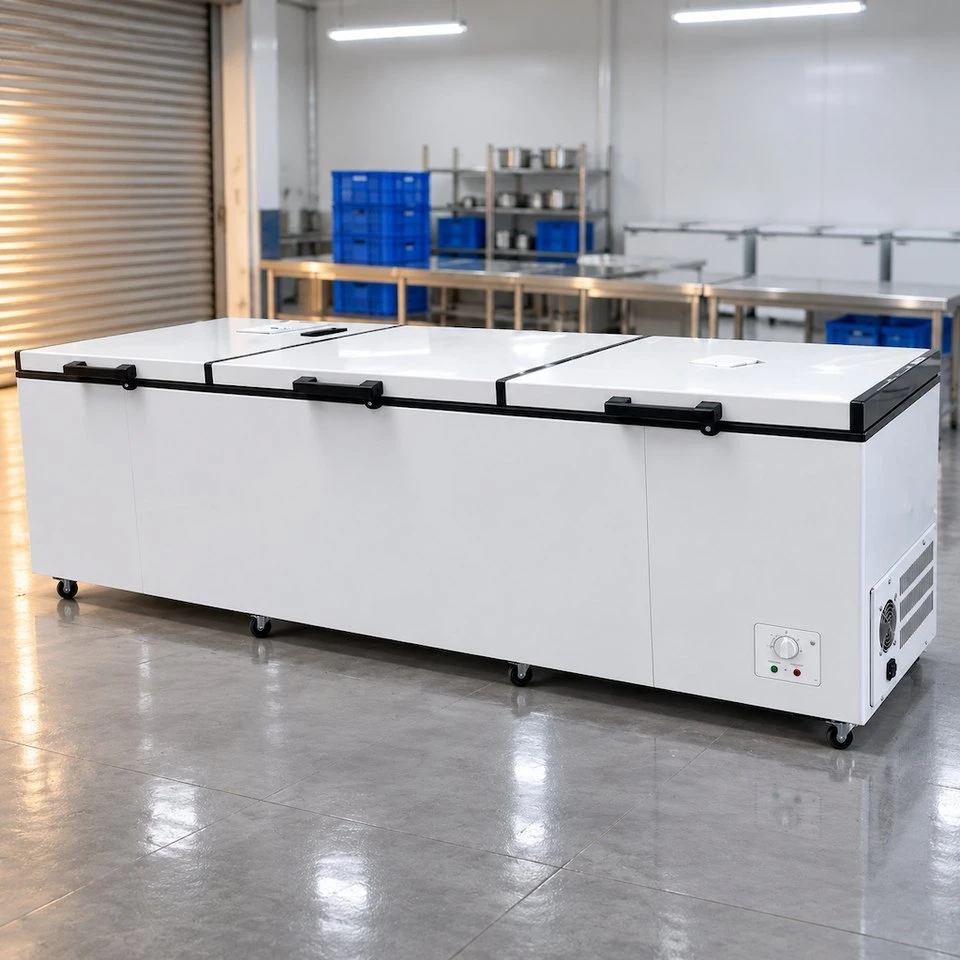
THE CABINET IN ONE LINE - 1688 litres held at minus eighteen, in a cabinet 3175 millimetres long, 1025 wide and 950 high, under three lift lids, wrapped in 85 millimetres of foam, fed from a 10–50 VDC bank, and shipped twelve to a forty foot high cube.
This page is written for the person who has to fit that cabinet into a building, which is a different job from choosing one. Length settles most of the arguments on site: three metres and seventeen centimetres of wall, three and a quarter square metres of floor, and a cabinet heavy enough that it arrives on castors and gets rolled rather than carried. What follows is how the 1688 behaves once it is standing up - where it goes, what it holds, what it draws, who fills it, and what it costs in freight.
Two things before the detail. The 1688 is not a stretched 1388: the shell is deeper in section and taller in the body, the lid line runs in three sections rather than two, and the kilos per litre come out lower than any other chest in the family, which is the opposite of what most buyers expect at this size. And every figure used below is the figure on the plate near the bottom of the page, not a rounded one for the brochure.
Lid one, lid two, lid three
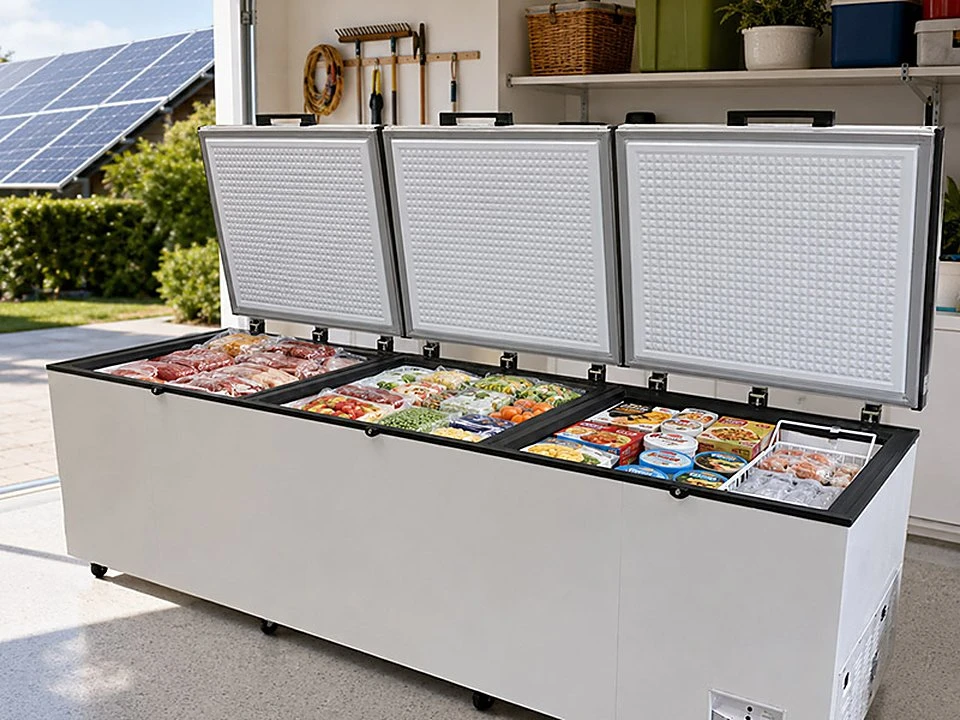
THREE SECTIONS, NOT ONE - and why that is the reason to buy this length
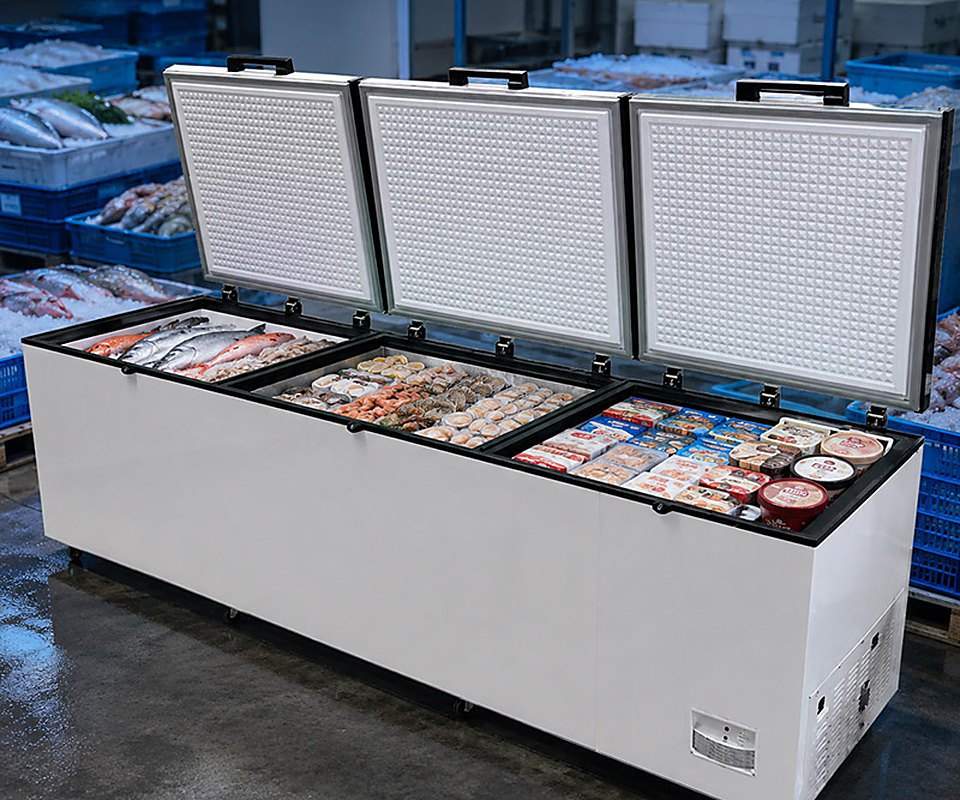
A 3.17 metre chest with a single lid would be opened twenty times an hour in a busy hall, and every opening would drop cold air over the whole load. The 1688 is divided into three sections by two internal partitions, each under its own lid with its own handle, hung on its own pair of hinges at the back. A keeper lifts the lid over the section he is working in and the other two thirds stay shut. The saving is not foam, which is the same all over; it is air exchange, and air exchange is what the compressor pays for at the end of the day.
The partitions earn their money commercially too. Where one counter sells carcass beef and the next sells frozen vegetables, the same cabinet can serve both without either reaching into the other's stock. Pack a section by product family rather than by date and the layout survives the morning rush: red meat at the left-hand end, prepared and breaded lines in the middle, ice cream and small packs at the end where the basket hangs and the cashier can reach without walking the length of the cabinet.
It changes loading as well. Three people can fill a 1688 at the same time from three positions and none of them waits for the others, which is not true of a single-lid cabinet this long. On a delivery morning that is the difference between a forty minute job and a ninety minute one.
Three metres of wall, and what it asks back
The footprint is 3.25 square metres, and the wall it wants is 3.18 metres of clear run - in practice a run of 3.5 metres or more once the machine end is allowed for. Buildings that take a 1688 without argument: a market hall with a rear service wall, a butchery with a cold room door on the same wall, a commissary with a loading bay, a container shop with a long side, and a fishing or abattoir landing where the cabinet sits parallel to the sorting table.
What the wall has to give back is access. Two people need to stand side by side along the front while it is being filled, so plan on a metre of clear floor, and keep that metre clear of pallets, trolleys and the stack of crates that appears in front of any freezer within a month of install. The rear face needs its own gap and so does the machine end, for reasons set out further down the page.
Doorways are the other measurement. The cabinet is 1025 millimetres across, and with the trim the practical figure to quote a builder is 1050 millimetres of clear opening; a standard single door is narrower, a double door or roller shutter is wider. If the only route in is a 900 millimetre door, the 1688 does not go in, and it is better to learn that from a tape measure than from a crane hire invoice. Castors help on a level floor and are useless on two steps, so count the steps before counting the litres.
Ten point four kilos for every hundred litres
| Model | Volume L | Cabinet mm | Net mass kg | kg per 100 L | Per 40'HQ |
| BD/BC-608 | 608 | 1785 × 745 × 834 | 72 | 11.8 | 56 |
| BD/BC-658 | 658 | 1598 × 885 × 935 | 82 | 12.5 | 28 |
| BD/BC-708 | 708 | 1785 × 795 × 890 | 86 | 12.1 | 26 |
| BD/BC-798 | 798 | 1950 × 885 × 935 | 106 | 13.3 | 24 |
| BD/BC-1088 | 1088 | 2035 × 1020 × 930 | 125 | 11.5 | 22 |
| BD/BC-1388 | 1388 | 2335 × 1025 × 930 | 152 | 11.0 | 16 |
| BD/BC-1688 | 1688 | 3175 × 1025 × 950 | 176 | 10.4 | 12 |
The last two columns are the reason this table exists. Net mass divided by volume gives a figure buyers rarely calculate and site engineers always feel: how much steel, foam and copper is being moved for every hundred litres of holding space. The 1688 comes out at 10.4 kilos per hundred litres, the lowest in the family, against 13.3 for a 798 and 11.0 for a 1388. The saving is in the shell rather than the walls - every cabinet here carries the same 85 millimetres of foam - it comes from spreading one set of end panels, one control plate and one compressor over a longer body.
On site that number decides three things. Whether the cabinet can travel in a goods lift rather than through a window, because 176 kilos plus two people still fits inside most of them. Whether a mezzanine or a timber floor is a problem, because 3.25 square metres carrying 176 kilos is 54 kilos per square metre, inside the design load of nearly any commercial floor. And how many hands are needed to move it: on castors, two people and a flat floor, in that order.
For freight the same table reads the other way round. Twelve cartons to a forty foot high cube is fewer units per box than any shorter model, so a container of 1688s carries slightly less total volume than a container of 1388s. The 1688 does not win on freight density. It wins on installs: one cabinet, one feed, one commissioning sheet, one thermostat to watch, where the same volume in small cabinets would be two of everything.
Where the cold actually leaves
THE WALLS ARE NOT THE WEAK POINT - the lid is, and here is what is done about it
Eighty five millimetres of insulation, foamed in place, runs through the wall, the floor and every lid on every cabinet in this range, and on a body this size that thickness does more work than on a small one, because the surface-to-volume ratio falls as the cabinet grows. Less wall for each litre inside means a lower standing loss per litre, so the compressor spends a smaller share of the night holding temperature. That is the quiet advantage of buying long instead of buying two.
What does not improve with size is the lid. A lid is a slab of foam with a steel skin top and bottom, and where it meets the cabinet a gasket seals against a flat frame. Three lids mean three gasket runs rather than one, and the honest answer is that gaskets need attention: the cheapest part on the cabinet, and the one that decides whether the compressor runs forty minutes an hour or twenty. Keeping them clean, keeping ice off the frame and never standing on a lid matters more than any specification on this page.
The pattern visible inside each lid is the foam bond between liner and outer skin, made in a single pour in a jig rather than glued in afterwards. It is what lets a lid be picked up by one corner without the liner letting go, and what keeps the lid flat in transit. Comparing suppliers, look inside a lid: a glued-in liner shows a smooth face and a soft edge, and it will delaminate after a season or two in a hot climate.
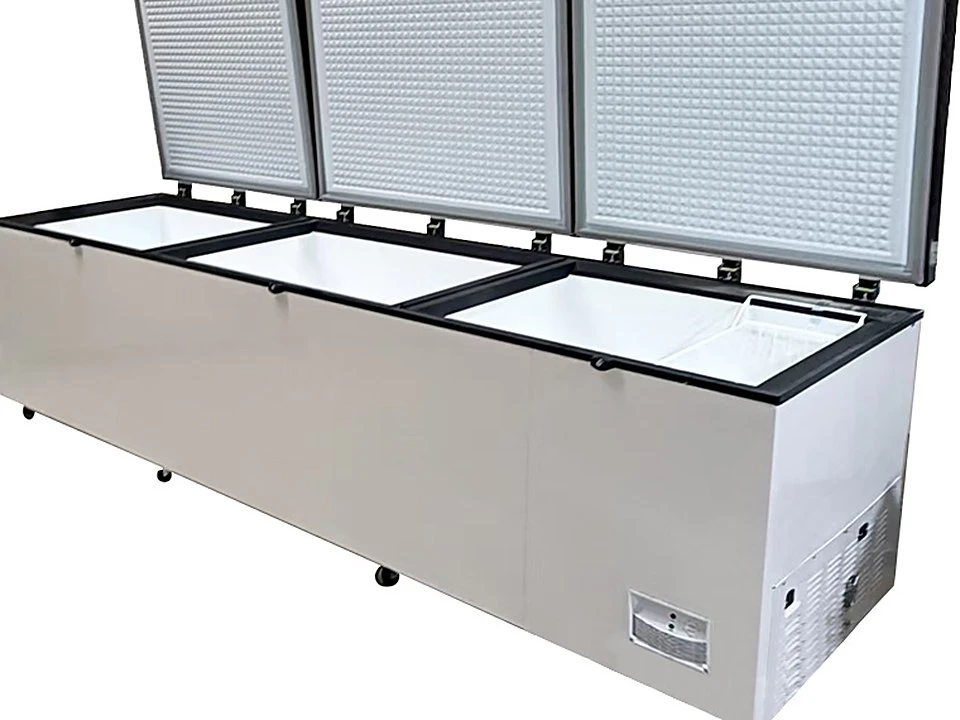
One feed for three sections
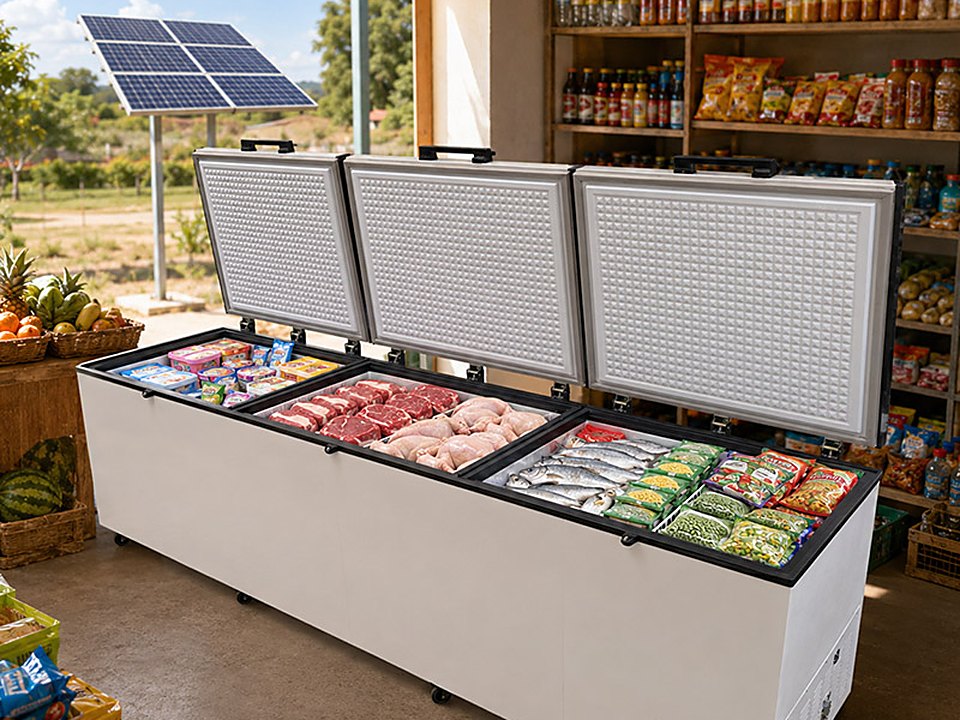
The compressor is DC, and the cabinet takes anything from 10 to 50 volts at the terminals, with 24 volts the nominal figure quoted for a solar bank. No inverter sits in the chain, which removes one of the three things that usually fail on an off-grid cold store, and there is no per-section wiring: three sections share one refrigerant circuit, one control plate, one supply. Smaller cable bill, fewer breakers, a shorter commissioning sheet than three separate cabinets of the same total volume.
Sizing the array and the bank is a five-line calculation rather than a guess, and it starts from the worst month at the site instead of the best. Cabinet draw at your bank voltage, multiplied by the hours the compressor actually runs in a day rather than the hours the shop is open; divided by peak sun hours for the worst month; derated for panel heat, dust and cable loss; plus the energy to pull down a warm delivery on the busiest day of the week. What is left is the array. The bank covers two nights plus one overcast day, sized on the depth of discharge you will accept rather than on the nameplate.
Two notes from cabinets already running. Dust on a panel in a dry market costs more yield than the difference between one panel size and the next, so plan the cleaning before the array. And a 1688 left open through a delivery morning will pull more energy in that hour than it does in a normal night, so the pull-down allowance is not a formality at this size.
Heat has to leave, and dust is the enemy
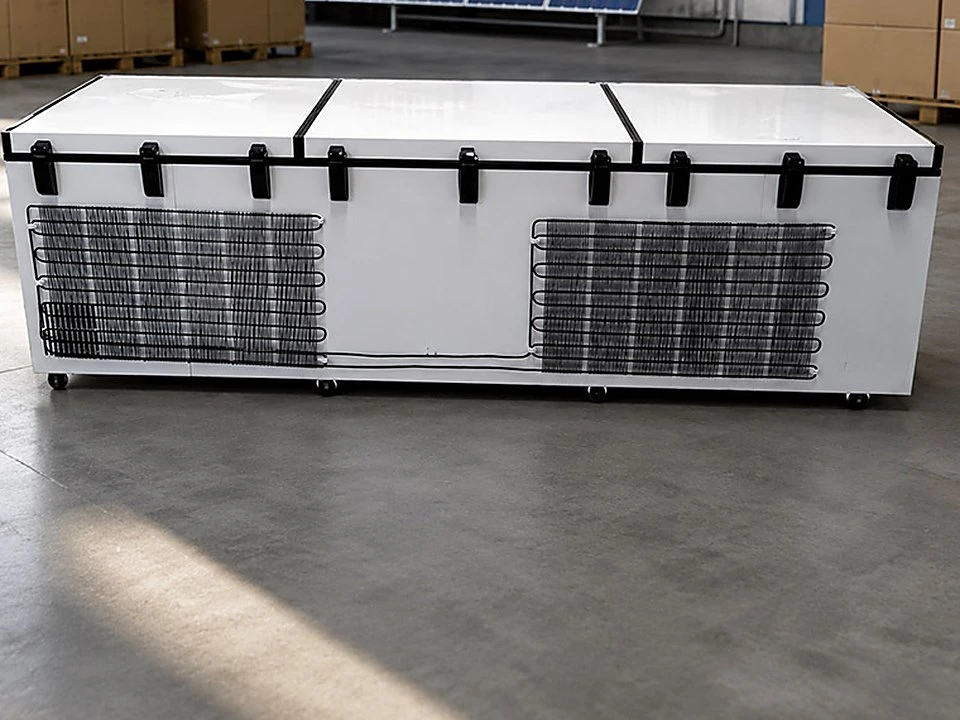
TWO COILS, ONE FAN, AND A GAP - the part of the install that gets forgotten
The rear face carries two wire-on-tube condenser banks, and the machine end holds the fan, the control plate and the terminal box. Heat taken out of the food leaves through those coils, so the cabinet has to stand far enough off the wall for air to cross them - a hand's width minimum, a forearm better - and the machine end has to stay open so the fan can discharge. Cabinets pushed flat against a wall in a hot hall are the commonest cause of a complaint that a freezer "does not hold temperature", and no amount of extra foam fixes it.
Dust is worse than distance. In a flour store, a feed mill, a fish market or anywhere cardboard is being cut, the coils load with fibre and the cabinet loses capacity slowly enough that nobody notices until the stock softens. A soft brush or a vacuum across the coils monthly, and a proper wash twice a year in a dusty yard, keeps a 1688 at the consumption it was designed for. Put that in the handover sheet, not the manual nobody reads.
Position matters for a second reason here. Three metres of steel in a room with one door and no cross-draught will hold a pocket of warm air along the wall behind it, so in a hot hall turn the rear face to the cooler side of the building rather than into the sunniest corner, and in a container shop keep the coils away from the door that stands open all day.
The first hour of a market morning
A 1688 is usually filled by three people at once, and the order decides how hard the compressor works. The pattern that works is to load the sections that sell late first and the sections that sell early last, so the cabinet is coldest where the first customers are. Pull-down capacity is finite: a warm delivery pushed into all three sections at eight in the morning leaves the cabinet above holding temperature until midday, and the stock that suffers is whatever went in first.
Keep the load below the liner line. A chest freezer cools by contact and by air moving inside the box, and a section packed to the lid cannot circulate; the top layer stays warm while the thermostat, which reads the wall, reports that all is well. Where a section is only part filled the empty space costs almost nothing to hold, but it does let more air spill each time the lid opens - one more argument for grouping product families instead of spreading them thin.
Baskets help more than buyers expect. Hanging one in the end section gives the cashier a place for the small fast-moving lines without lifting a lid over the main stock, and it stops the awkward packs - bagged ice, portioned fish, loose tubs - migrating to the bottom of the cabinet where nobody finds them until stocktake.
Twelve cartons and a loading plan
Each 1688 ships in a carton measuring 3235 by 1035 by 1020 millimetres and weighing 182 kilos gross, which is a two-person job with a pallet truck and an unreasonable one without. The carton is what a forwarder works from and what decides whether units travel alone or with spares, and at twelve to a forty foot high cube there is room in most plans for gaskets, baskets, thermostats and a few CKD kits alongside.
Mixed containers are how these normally leave. A distributor taking a first order will often book one box of 1688s for the wholesale accounts and fill the rest with 1388s, 798s and spares for smaller shops, because not every site can take three metres of cabinet and no single model covers a country. Building that plan is easier from a count of sites by size than from a single quantity: the distribution across the box comes back with the plan.
Delivery form is a choice rather than a specification. The cabinet ships built, tested and charged, or as a CKD or SKD kit for a partner who foams and assembles locally - the same panels, numbered, with the jigs and sequence our own line uses. Kits make sense where duty on a finished appliance or the freight on air is the bigger number; built units make sense where the destination has no workshop and needs a cabinet that works out of the carton.
When a 1688 is the wrong cabinet
FOUR CASES WHERE WE SAY NO - and what to sell instead
A shop with one counter and a three metre wall is not a 1688 site. Where the daily turnover fits a 608 or a 798, the long cabinet costs more, draws more and puts a metre of unopened lid in the customer's way. Small shops do better with two shorter cabinets either side of the counter than with one long one across the back wall.
A building with a 900 millimetre door, a tight stair turn or a goods lift under 1.2 metres wide is also a no, however much volume the project needs. Where access is the constraint the answer is a pair of 798s or 1088s moved in on their sides, not a crane and a removed window. Upper floors with timber joists fall in the same group: the mass is fine spread over 3.25 square metres, but only if the cabinet can get there.
Sites with a short, repetitive selling day - a school kitchen, a clinic store, a single-vendor kiosk - rarely open three sections in a week, and there the third lid is dead capital. Where the sun is marginal, or the array is already committed to lighting and a pump, a 1688 on a bank sized for one 798 will sit above holding temperature all afternoon; the smaller cabinet with an honest bank beats a room full of steel.
The plate, in full
| Field | BD/BC-1688 |
| Description | Solar deep freezer, chest format, three lift lids over two internal partitions |
| Holding volume | 1688 L gross |
| Cabinet envelope | 3175 × 1025 × 950 mm |
| Shipped envelope | 3235 × 1035 × 1020 mm |
| Unit mass | 176 kg net, 182 kg gross |
| Foam thickness | 85 mm, foamed in place in wall, floor and lid |
| Holding temperature | −18 °C and below, set on the dial at commissioning |
| Input voltage | 10–50 VDC, 24 V nominal, array or battery bank |
| Refrigerant | R134a / R600a, charged and sealed at the plant |
| Lid arrangement | Three counterbalanced lids, two partitions, wire basket in the end section |
| Loadability | 12 cabinets per 40'HQ |
| Delivery form | Built unit, or CKD / SKD kit for a local build partner |
| Options | Own label, destination-language manual, packing list for tender submission |
Read the first three rows against each other and the cabinet explains itself. 3175 millimetres decides the building; 182 kilos gross decides the unloading; 176 kilos net decides how many people are needed and whether the floor is asked a question. The rest is specification that a receiving inspector can check with a tape and a thermometer on arrival, which is exactly what will happen.
About the factory that builds the 1688
ZHEJIANG JUKA SOLAR TECHNOLOGY - the works this cabinet comes out of
Juka builds solar cold chain equipment in Zhejiang, China, around one premise: cooling should run from a panel and a battery on sites where the grid is missing, weak or too expensive to extend. The range starts at 108 litre solar chest freezers and reaches the 1688 on this page, and includes solar refrigerators, upright coolers, glass door display freezers, ice makers, air conditioners for solar sites, and the spares and CKD kits that keep a fleet serviceable a decade after the invoice.
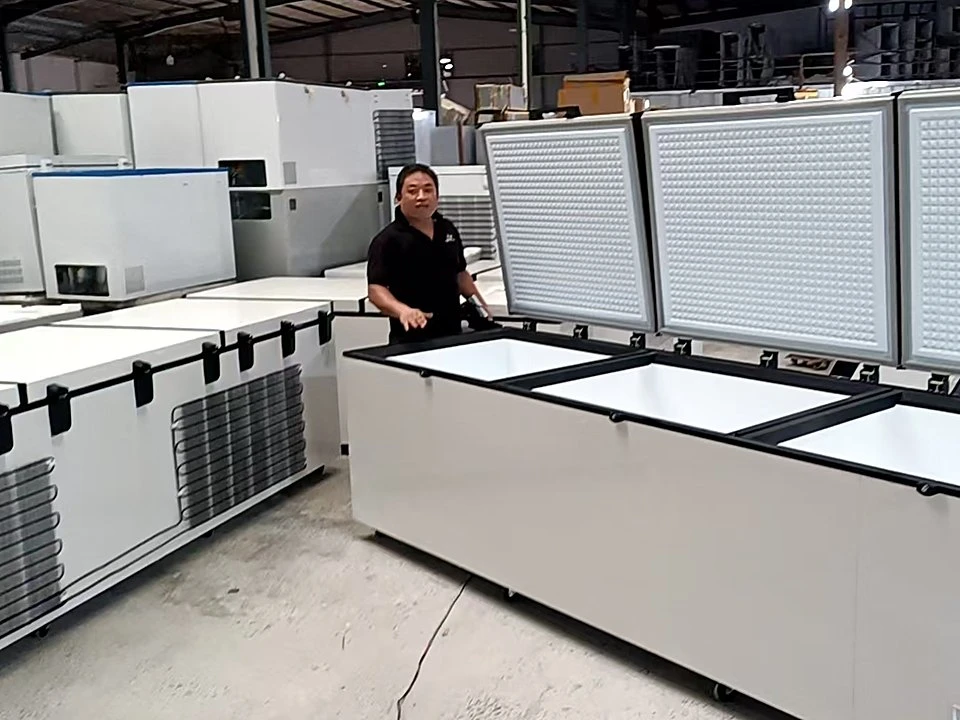
Being able to quote foam thickness and container counts on a web page comes from the work happening here. Foaming, panel assembly, gas charging and the pull-down test are in our own shops, and the tooling for the lid, the liner and the frame belongs to the factory rather than to a supplier. That matters most in a CKD programme: a kit is only as good as the factory that numbered its own panels, and a partner assembling a 1688 in another country needs our sequence, our jigs and our tolerance, not a subcontractor's.
Most of what leaves goes to sub-Saharan Africa, South and South East Asia, the Gulf and Latin America, to importers, project contractors, aid agencies and refrigeration distributors who look after the cabinets in country. We build under our own label and as an OEM or ODM partner, with nameplates, manuals, packaging and documentation prepared for the destination market in the language that market reads. Tenders go out with a full technical file and a packing list attached to the quotation, because those are the two things a project engineer requests next.
How an order usually runs: send the site conditions and the wall measurements; the reply is a model, an array and bank sizing, and a loading plan. A sample ships from stock when you need one in hand. Production is then booked against that loading plan, with spares riding on the same box.
MEASURE THE WALL BEFORE THE LITRES - the run you can clear, the narrowest door on the route in, the count of sites by size, and the bank voltage you already run. Four measurements turn a 1688 enquiry into a loading plan, an array size and a delivery date. If the tape says the cabinet will not pass the door, say so in the first email: the answer will be a pair of shorter cabinets rather than a 1688 that has to come back.
Hot Tags: large commercial chest freezer, China large commercial chest freezer manufacturers, suppliers, factory


