


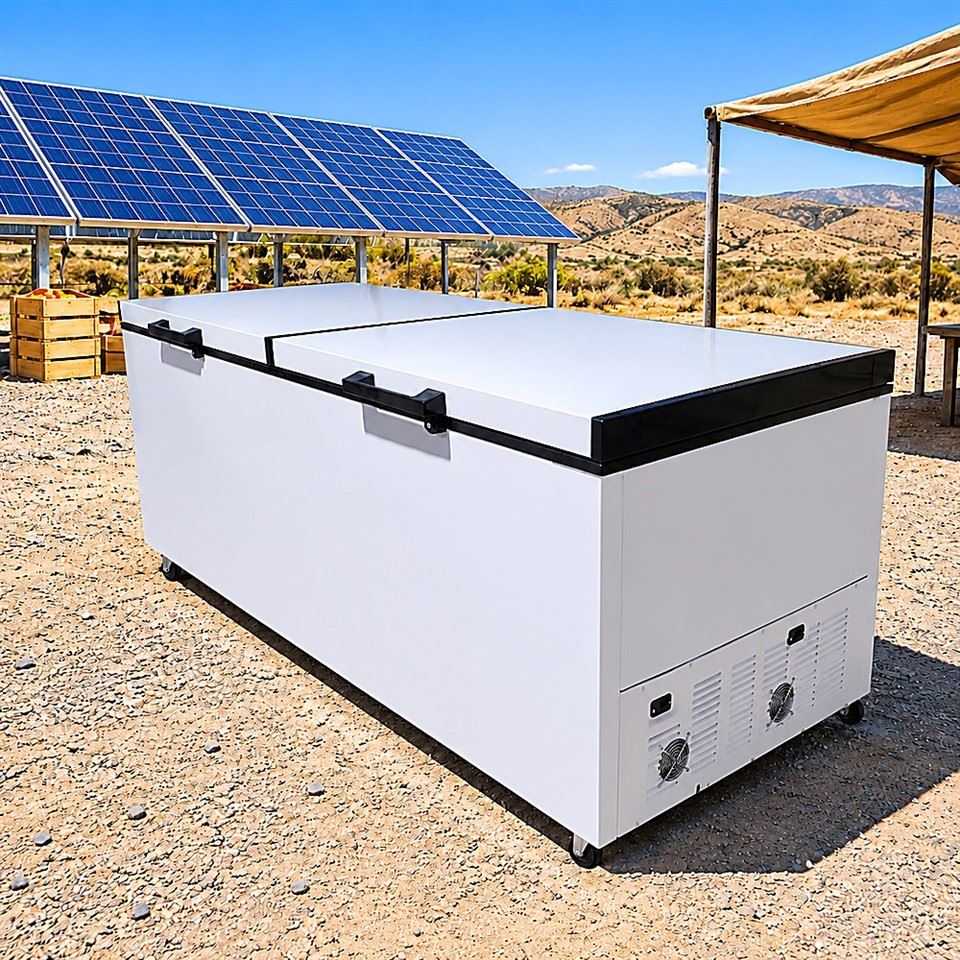
BD/BC-1388 at a glance - a 1388 litre holding volume in a cabinet of 2335 by 1025 by 930 millimetres, 85 millimetres of foam on all six faces, a 10–50 VDC input window at 24 volts nominal, minus eighteen degrees holding, and sixteen units to a forty foot high cube.
Deep freeze on solar · eight questions a distributor asks before the container is booked
THE SHORT VERSION - what this page is, and who it is written for
This is not a feature sheet. It is the eight questions that arrive by email in the week before a container is booked, answered in the order they are usually asked, by the person who has to install the cabinet rather than the person who buys it. Each answer is specific to the 1388, because the 1388 is the cabinet in the range where the answers change: at 2335 millimetres it is the longest twin we build, it holds 1388 litres, and sixteen of them fill a forty foot high cube.
If you are quoting a project, the first three answers will decide the model. If you have already bought, the last four are the ones the site will ring you about. Either way, the numbers used here are the ones on the plate, and the plate is at the bottom of the page for anyone who wants to check them.
1388 litres, 2335 millimetres, 85 millimetres of foam, 24 volts nominal, sixteen to a container. Those five figures are the whole product. Everything below explains what they cost you in a real building.
Question one: why one 1388 instead of two smaller cabinets?
Because floor is the scarce thing on most sites, and cabinets are the cheap thing. A 1388 stands on 2.39 square metres and returns about 580 litres for every square metre it takes. Two 658s stand on 2.83 square metres and return 465 litres per square metre between them; two 708s take 2.84 square metres and return 499. The long cabinet is the most space-efficient twin in the range, and it is the only one that gives a landing or a commissary a single cold volume large enough to hold a whole delivery without splitting it across two thermostats.
There is a second reason that has nothing to do with floor. Two cabinets mean two supply runs, two isolators, two sets of battery fusing and two places where a gasket can fail unnoticed. On a site where the maintenance visit happens twice a year, one cabinet is one set of things to check. Distributors who quote projects in remote districts almost always end up here: the 1388 costs more on the invoice and less over five years, because it halves the number of failure points the customer owns.
WHEN TWO SMALLER ONES STILL WIN - the honest exception
There are three situations where we tell a buyer to take two cabinets instead. The first is a site with two distant pick-up points: if the food leaves the store in two directions, one long cabinet forces a walk, and a walk turns into a lid left open. The second is a building with a narrow route and no way to widen it - the 1388 will not pass a standard single leaf, and no amount of care changes that. The third is a site that sells from the cabinet rather than storing in it, because a 1388 is a cold store and not a display, and a customer cannot see what is inside a shut lid.
Everything else points at the long cabinet. The 1388 is the model for a landing quay, a market cold room, a camp kitchen, a distributor's back hall and a processing plant's holding bay, because in all five the load arrives in one vehicle and leaves in many small ones, and a single volume is what makes that work.
The arithmetic, written down: 2.39 square metres of floor, 1388 litres of volume, 580 litres per square metre. Two 658s need 0.44 square metres more floor and return 72 litres less. On a wall of fixed length, that difference is a whole extra cabinet's worth of stock.
Question two: what does 2335 millimetres do to a building?
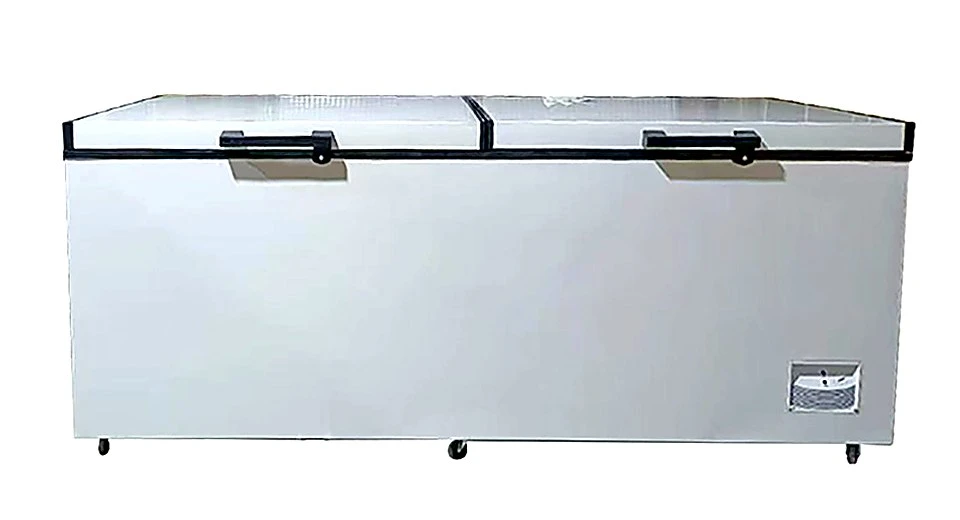
It changes the door, the corner and the floor. The cabinet presents a cross-section of 1025 by 930 millimetres to any opening it has to pass, so a clear width of about 1080 millimetres is the practical minimum and 1150 is comfortable once the route turns a corner. Measure the door frame, not the door; measure the narrowest point of the corridor, not the room; and measure it with the cabinet on its castors, because a cabinet that only fits when lifted is a cabinet that never comes out again.
The corner is the part people forget. A 2335 millimetre box needs a diagonal swing of roughly 2.6 metres to turn through ninety degrees, which means the last metre of the corridor and the first metre of the room both have to be clear at the same moment. If they are not, the cabinet goes in through a window, a shutter or not at all. We have shipped 1388s into all three of those routes, and the buyers who measured first are the ones who did not need a crane.
The floor is the third. At 152 kilograms net the cabinet is heavy but not structural: any ground floor slab, any loading bay and any concrete apron takes it. What matters is the point load under the four castors, which turns a 152 kilogram cabinet into four small pressure points, and a suspended timber floor or a mezzanine is where that becomes a question for an engineer rather than a salesman. On a hard floor the castors roll; on gravel they do not, and the cabinet is walked into place on planks instead.
Question three: how much array and how much battery?
Start at the load, never at the panel. A freezer that holds minus eighteen in a thirty degree room runs a duty cycle rather than a continuous draw: the compressor works, the cabinet coasts, and what the array has to replace by sunset is the sum of those working hours plus the recovery after every lid opening. Working from the plate, the cabinet takes 10–50 VDC at 24 volts nominal, which is the middle of the window and the voltage most solar banks are built around. Ask for the consumption figures at your voltage before you size anything - we publish them per voltage, because a 24 volt cabinet on a 48 volt bank through a converter is a different calculation from a 24 volt cabinet on a 24 volt bank.
The second number is the site, not the cabinet. Four peak-sun hours is a good dry-season figure for most of Africa and the Middle East, three is honest for a coastal monsoon month, two and a half is what high cloud and harmattan dust leave you. Multiply the array's rated watts by the peak-sun hours and divide by a factor for wiring, heat and dust - 0.7 is a working number in a hot yard. A 1000 watt array at four hours therefore delivers about 2.8 kilowatt hours a day to the terminals, not the 4 that the arithmetic on the box promises. The gap between those two numbers is the whole reason cabinets disappoint their owners.
The third is the buffer. A freezer is a thermal battery: a loaded 1388 at minus eighteen will hold its temperature for many hours without power if the lids stay shut, and that is the number to quote to a customer who is worried about a cloudy week. The electrical battery is there for the nights, not for the season. Size it for two nights and one cloudy day, fuse it properly, and let the foam do the rest - 85 millimetres on every face is what turns a bank from a purchase into a formality.
| Measure | Where it comes from | How it is used |
| Cabinet draw | Consumption figure for your voltage, from us | Multiply by working hours a day to get daily energy |
| Peak sun hours | Site latitude and the worst month, not the best | Multiply by the array rating for daily yield |
| Derating | Panel heat, dust, cable run, controller loss | Apply 0.7 in a hot dusty yard, 0.8 in a temperate one |
| Recovery allowance | Lid openings a day and the load brought in warm | Add the pull-down energy for the busiest day of the week |
| Night buffer | Bank voltage and depth of discharge allowed | Two nights plus one cloudy day, then fuse for the surge |
| Thermal buffer | Loaded cabinet at holding temperature, lids shut | Quote it as hours of hold, not as a battery size |
WHY THE FOAM IS THE FIGURE THAT MATTERS - 85 millimetres on every face
Insulation is what converts a solar array into a smaller array. Every millimetre of foam on the wall, the lid and the floor buys the compressor time between cycles, and time between cycles is what a battery bank can actually deliver. A cabinet with thin walls and the same compressor needs a bigger array, a bigger bank and a longer daily run, and the invoice for all three arrives long before the invoice for the cabinet.
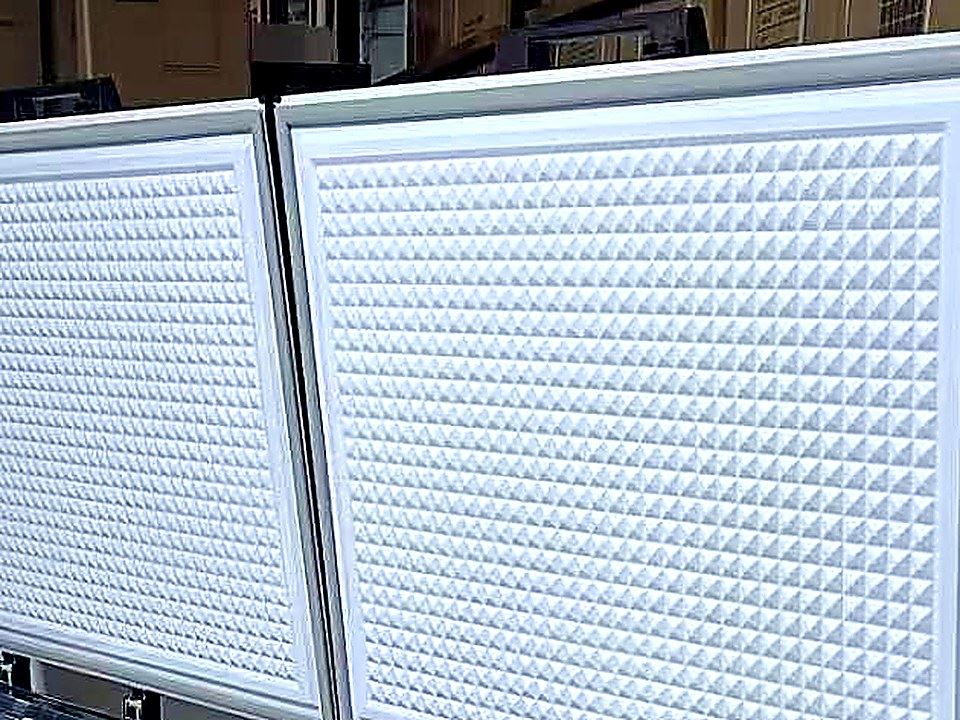
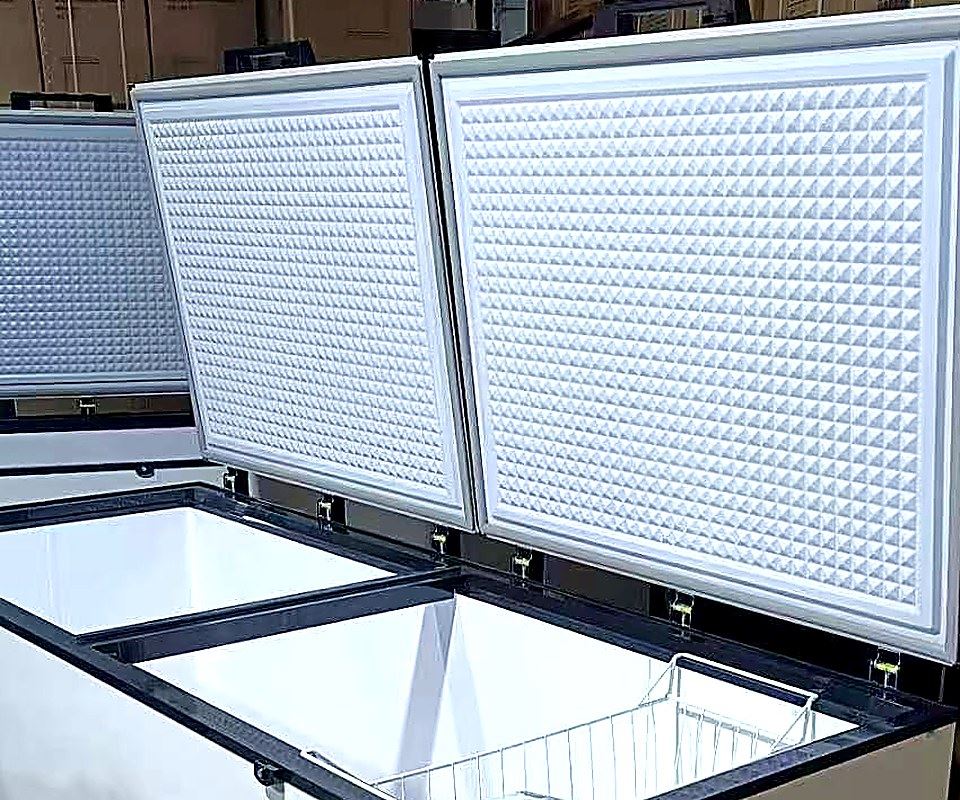
The 1388 uses the same 85 millimetre foam as the rest of the twin range, which is why the family shares a duty cycle even as the volumes climb from 608 to 1388 litres. On the two lids the foam is bonded to the liner and the frame in one pour, so the lid is a solid slab rather than a frame with a panel in it - the pattern you see inside a lid is the bond, not decoration, and it is why a lid can be lifted by one corner without twisting the gasket out of line.
What that means on site is unglamorous and worth saying: the lid is the weakest face of any chest freezer, because it is the face that opens. 85 millimetres, a counterbalanced hinge and a gasket that closes on a flat rim are the three things that keep the weakest face from becoming the expensive one.
Question four: what does one lid opening cost?
COLD AIR IS A LIQUID - it pours out of the bottom of the opening
Ninety per cent of the argument for a chest freezer over an upright is in this one sentence: cold air is heavier than warm air, so it stays in the box while the lid is open, and only the layer within a hand's width of the rim is lost. An upright spills its whole contents every time the door opens, which is why an upright in a hot shop runs twice the duty cycle for the same volume. A chest freezer is not better insulated than an upright; it is better shaped.
The 1388 takes that shape and adds a centre divider, which turns one long opening into two short ones. The busy side - the one the staff reach for forty times a day - loses a hand's width of cold air each time; the reserve side loses nothing, because it is not open. On a cabinet this long the difference is not academic: it is the difference between a duty cycle the array can support and one it cannot.
Three habits pay for themselves in the first month. Put the basket where the traffic is, so the day's picking happens in the air and not in the box. Close the lid between picks, even between the ten-second ones, because recovery is the expensive phase and it does not care how brief the opening was. And never store above the rim: a crate standing proud holds the gasket off its seat, and a held-off gasket leaks continuously instead of intermittently.
What to tell a customer who asks about a bad week: with the lids shut and the cabinet loaded, the foam holds the load for hours, not minutes. The number to give them is hours of hold at their ambient, and we supply it with the pull-down figures for the exact voltage. That is a better answer than a battery size, and it is the one that stops a site buying a bigger bank than it needs.
There is a fourth habit that belongs to the installer rather than the user. A cabinet is levelled on its castors before it is loaded, because a cabinet standing on three castors twists its frame, and a twisted frame holds one lid slightly open at one corner. That single corner is worth more energy over a year than any other fault on the list, and it takes a spanner and two minutes to prevent.
Question five: what wears out first, and when?
THE FIRST FIVE FAILURES, IN THE ORDER THEY ARRIVE - a service list, not a warranty page
Gaskets first. A lid gasket that closes on a dusty rim loses its seal within two years in a windy yard, and the symptom is not a warm cabinet but a wet one: condensation on the rim, then ice at the hinge end. The fix costs a gasket and ten minutes. The cost of not fixing it is a compressor that runs all night.
Hinges second. A counterbalanced hinge that has been lifted three hundred times a week develops play, and play lets the lid sit off square. It is adjustable, and it is worth adjusting before the gasket takes the load. Condenser dust third: the two fan grilles on the machine end pull in everything the yard has, and a matted condenser adds run time on every cycle. A brush and a hose twice a year is the whole maintenance programme for that part.
Castors fourth, and always on the same site profile - gravel, mud, unsealed thresholds. A castor that seizes is a cabinet that gets dragged, and dragging takes the frame out of level. Fifth is the battery bank, which is not ours but is always blamed on us: a bank sized for two nights and cycled to the floor every night will fail in three years, and the customer will describe it as the freezer losing temperature.
None of those five is exotic. All five are cheaper to prevent than to repair, and all five are avoided by the same visit - the one where somebody looks at the gasket, lifts the lid, brushes the condenser and reads the bank voltage. Two visits a year, twenty minutes each, and the cabinet meets its service life.

Question six: how do you load a cabinet this long?
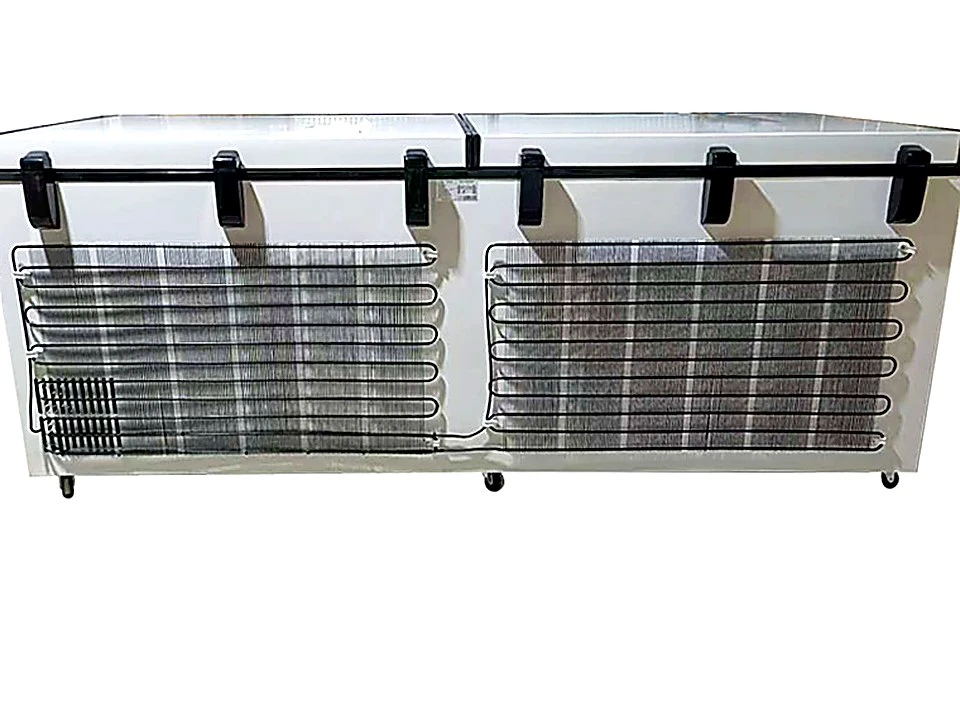
LOAD IT AS TWO ROOMS, NOT ONE BOX - the divider is an instruction as much as a part
A cabinet this long invites the mistake of filling it like a container. Loaded front to back, shoulder to shoulder, the middle of the load sits in still air and the thermostat reads the outside of the stack instead of the product. The 1388 is 2335 millimetres long precisely so that it does not have to be packed that way: a long compartment down each side of the divider takes crates in a single row, and a single row is a row the cold air can move around.
The wire baskets are the second half of the system. They hold the day's fast-moving stock above the reserve, so the reserve is touched once a day and the fast stock is picked out of the air. Two baskets, one per compartment, is the configuration we ship; a site that runs one product family can leave them side by side in one compartment and treat the other as a deep reserve. Both arrangements work, and both keep the lid shut for the twenty seconds that a hand-search would have cost.
Rotation is the third habit. Write the delivery date on the case, put the newest at the far end and the oldest at the near end, and check the far end once a week, because on a 2335 millimetre cabinet the far end is a place things go to be forgotten. The one thing never to do is to use the cabinet as a shelf between deliveries: an empty cabinet left running in a hot room is an expensive dehumidifier.
The loading rule in one line: one row deep, nothing above the rim, the basket for the traffic, the deep end for the reserve, and a date on every case.
Question seven: what actually arrives in the crate?
A cabinet in a carton of 2395 by 1020 by 1010 millimetres, or a numbered kit of panels, lids, foam sections, compressor set, harness and fixings. Whichever you order, the same three documents come with it: a packing list keyed to what is inside, a wiring diagram that matches the harness in the box, and a commissioning sheet already carrying the pull-down numbers recorded at the plant. Those three are what a distributor needs to answer an installation question without sending an email to Zhejiang.
Assembled cabinets ship with lids locked down, castors fitted, and the compressor set charged and sealed. CKD kits ship flat, which is how sixteen cabinets become a shipment that fits a mixed container rather than a container of its own. The local work in a kit build is mechanical: panels to frame, foam injection, pipe connection, gas charge, leak test, pull down, then the same commissioning sheet. That sequence is deliberately inside the reach of a workshop with a foaming jig and one trained technician, not a refrigeration engineer - if a build partner can service a chest freezer, they can assemble one.
Spares are the part buyers ask about last and value most. Gaskets, hinges, castors, baskets, thermostats, lid handles and fan motors are all catalogued as separate lines, because a cabinet with a two-decade service life needs a parts list that outlives the model year. Order them with the container, not after the first failure: freight on a gasket bought alone costs more than the gasket.
Question eight: what does the plate say?
| Field | BD/BC-1388 |
| Description | Solar deep freezer, chest format, twin lift lids over a centre divider |
| Holding volume | 1388 L gross |
| Cabinet envelope | 2335 × 1025 × 930 mm |
| Shipped envelope | 2395 × 1020 × 1010 mm |
| Unit mass | 152 kg net, 157 kg gross |
| Wall and lid foam | 85 mm, foamed in place on wall, lid and floor |
| Holding temperature | −18 °C and below, dial set at the factory |
| Input voltage | 10–50 VDC, 24 V nominal, solar array or battery bank |
| Refrigerant | R134a / R600a, sealed at the plant |
| Lid arrangement | Two counterbalanced lids, centre divider, one wire basket per compartment |
| Loadability | 16 cabinets per 40'HQ |
| Delivery form | Built unit, or CKD / SKD kit for a local build partner |
Two figures on that table decide more than the rest. The 2395 millimetre carton is what a container plan works from, and at sixteen units to a forty foot high cube the 1388 is a volume product rather than a sample product - a mixed container of 1388s, 798s and spare parts usually beats a container of one model. The 152 kilogram net mass is what a site works from, and it is the reason the cabinet is delivered on castors: two people can move it on a hard floor, nobody should lift it.
About the factory behind the 1388

ZHEJIANG JUKA SOLAR TECHNOLOGY - who builds this cabinet, and how to work with us
Juka is a manufacturer of solar-powered cold chain equipment based in Zhejiang, China. The catalogue is built around one idea: cooling that runs from a panel and a battery rather than a grid, on sites where the grid is absent, unreliable or simply too expensive to extend. That covers solar deep freezers and chest freezers from 108 to 1688 litres, solar refrigerators and upright coolers, glass door display freezers, solar ice makers, solar air conditioners, and the spare parts and CKD kits that keep all of them serviceable in the field.
We are a factory rather than a trading house, which is why this page can talk about foam thickness, hinge play and the number of cabinets in a container instead of adjectives. Foaming, assembly, gas charging and testing happen in our own works; the tooling for the lid, the liner and the frame is ours. That is what makes a CKD programme possible at all - a kit is only as good as the factory that numbers its own panels.
Most of our volume leaves for Africa, South East Asia, the Middle East and Latin America, sold to importers, project contractors, NGOs and cold chain distributors who then support the cabinet locally. We work as an OEM and ODM partner as well: our own labels, or yours, on the same cabinet. Documents, nameplates, manuals and packaging can all be produced for the destination market, in the language the site reads.
How a first order usually runs: you send the site conditions, we answer with a model, an array and bank sizing and a loading plan; a sample ships from stock if you need one in hand; the production order is confirmed against the container plan. If you are tendering, ask for the technical file and the packing list with the quotation - both are ready, and both are what a project engineer will ask you for next.
START WITH FOUR NUMBERS - the doorway width, the crates in a working day, the worst month of sun at the site, and the bank voltage you already run. Send those four and you get back a single page: the model that fits the route, the array and battery sized for that latitude and season, the mix that fills a forty foot box with the 1388 inside it, and the date the next units can sail. If the answer is a smaller cabinet or a pair of them, the page will say so - a 1388 sold into a building that cannot take it is a return, not an order.
Hot Tags: Deep Freeze on Solar, China Deep Freeze on Solar manufacturers, suppliers, factory, 65mm Foaming Thickness Normal 10v 50vdcsolar Deep Freezer Single Door BD BC 208, 65mm Foaming Thickness Normal 10v 50vdcsolar Deep Freezer Single Door BD BC 68, 85mm Foaming Thickness Normal 10v 50vdcsolar Deep Freezer Double Doors BD BC 508, commercial solar freezer, cool box solar freezer, off grid solar freezer


