


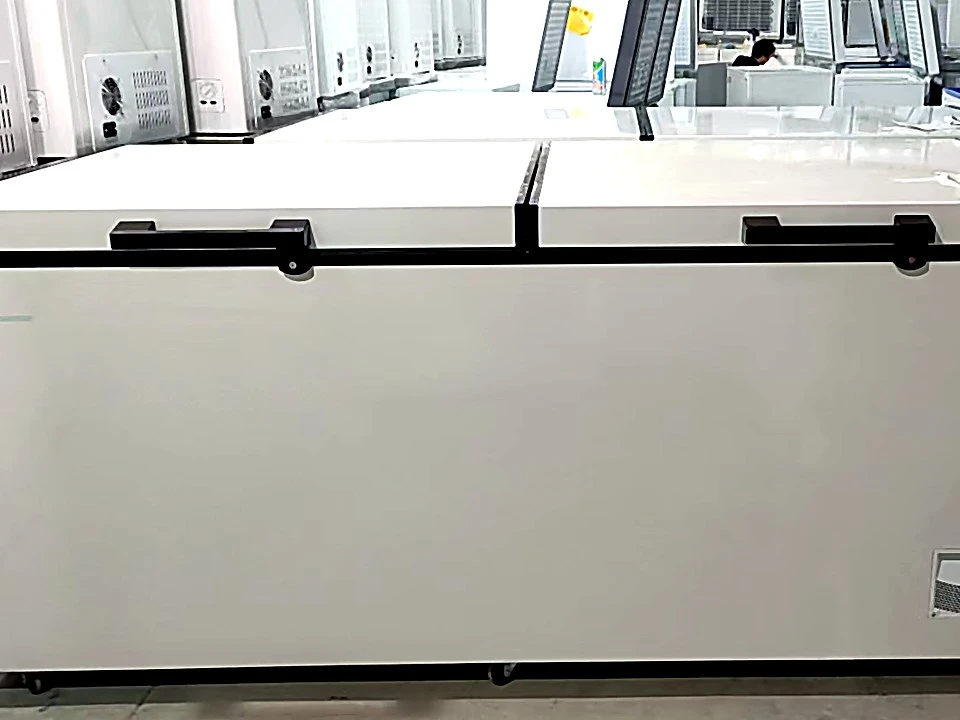
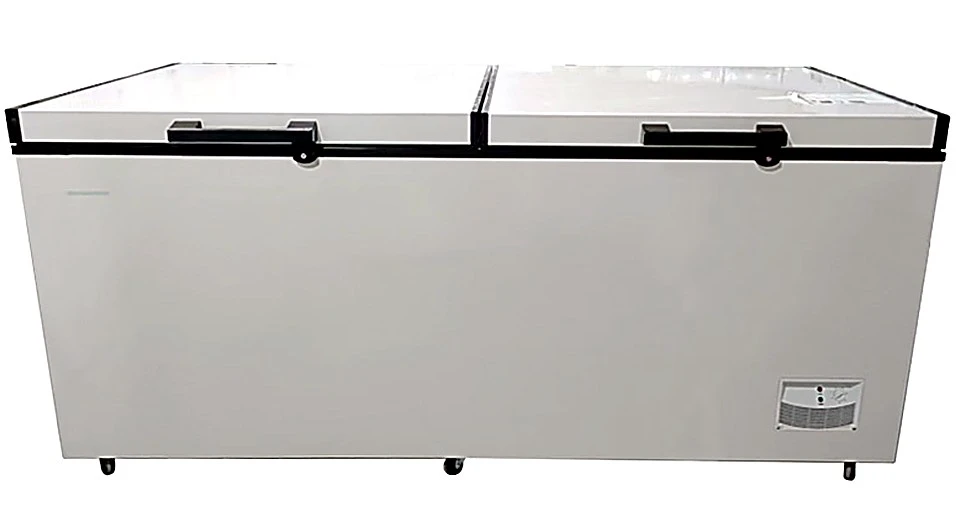
MODEL BD/BC-1088 - 1088 L twin lid solar freezer | 2035 × 1020 × 930 mm cabinet | 85 mm foam | 10–50 VDC input | 24 V nominal | holds −18 °C | 22 per 40'HQ
Portable solar powered freezer · five cargoes, and what each one asks of the same cabinet
Five cargoes, and what each one asks of the cabinet
Two freezers with the same compressor and the same foam behave completely differently once they are loaded, because the load is the part of the system nobody specifies. A pallet of glazed fish and a shelf of ice cream both want frozen, and they punish the cabinet in opposite ways: the fish brings water, the ice cream brings air. Cartons of poultry insulate themselves; a tray of par-fried product breathes through its film. This page is written around the five cargoes that most often end up in a 1088, one section each, because the setting that suits one is the wrong setting for the next.
The BD/BC-1088 is the largest twin in the 10–50 VDC range: 1088 litres under two lift lids, a 2035 by 1020 millimetre footprint and 85 millimetres of foam on every face. It exists for sites that hold stock rather than display it - a landing quay, a commissary kitchen, a distributor's back room, a camp that takes one delivery a fortnight. What follows is not a feature list. It is the five loads, in the order a site usually meets them, and the four sentences that have to be said out loud before each one goes in.
Key figures - 1088 litres gross under two lift lids, a cabinet envelope of 2035 by 1020 by 930 millimetres, a shipped carton of 2095 by 1035 by 1010, 125 kilograms net against 130 gross, and twenty-two cabinets to a forty foot high cube.
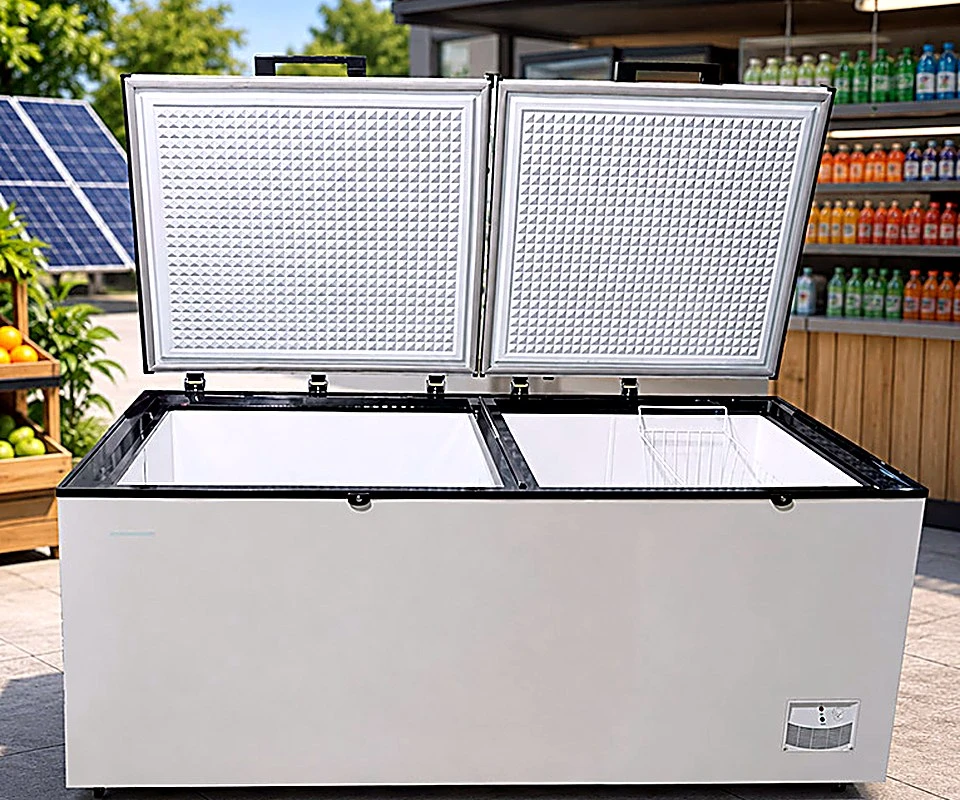
CARGO ONE · ice cream and frozen desserts - the load that measures the cabinet by how fast it recovers
Ice cream is the only cargo on this list that is judged by softness at the point of sale. It is held at minus eighteen in most markets, and it will survive a short excursion, but every lid opening in a thirty degree shop costs the top layer texture before it costs the thermometer anything. That is why the 1088 is set up as two compartments: the busy side gets opened forty times an afternoon and the reserve side gets opened twice, and the cold air that falls out of one never leaves the other.
Four rules travel with this cargo. Nothing is stored above the liner rim, because the lid seal closes on a flat face and a tub standing proud holds the lid off the gasket. Stock is rotated by hand, not by wish: new deliveries go to the bottom of the long compartment and the front of the short one. Lids are shut between customers, even between the ten-second gaps, because the recovery cycle is the expensive part. And the cabinet is loaded cold, never warm - a pallet of soft ice cream put straight into the 1088 will pull the whole load down overnight and look like a refrigeration fault by morning.
If a customer requires minus twenty-two, say so before the container ships rather than after. The cabinet holds minus eighteen and below as standard, and asking it for a lower holding temperature changes the duty cycle, the daily energy and the defrost rhythm. That is a decision for the order, not for the thermostat on site.
What to write on the commissioning sheet: the compartment that gets the traffic, the holding temperature at the start and end of a shift, and the number of times the lid was opened on the busiest afternoon. Three lines that explain every future complaint before it is made.
There is an arithmetic worth doing before the cargo question, because it decides which model answers it. Measured on external dimensions, the 1088 returns about 524 litres for every square metre of floor it stands on, against 499 on the 708, 465 on the 658 and 457 on the 608. The largest cabinet in the range is also the most efficient per square metre - the volume grows faster than the footprint - which is why a site that has one wall of space and no more should look at the biggest twin first instead of buying two smaller ones.
CARGO TWO · frozen fish and cephalopods - the cargo that brings its own water inside
Fish lands wet. Whole fish carry surface water, fillets carry a glaze, and both release moisture into the liner every time the lid is opened in a humid yard. That moisture does not disappear, it plates itself onto the coldest surface in the cabinet, which is the liner wall behind the load. Within a fortnight the walls carry a white frost, within six weeks it is ice, and the cabinet starts running longer for the same holding temperature. None of that is a refrigeration fault; it is the cargo behaving exactly as physics says it will.
Four sentences carry this load safely. Drain and glaze on shore, not inside the cabinet, so the water that leaves the fish leaves the box. Load in crates or trays with gaps between them rather than as a solid wall, because the liner needs an air path to read the load instead of the lid. Keep the wire basket for the fast moving species and leave the long compartment for the deep stock. And defrost on a calendar, not on a symptom: five millimetres of frost on the walls is the trigger, and a full defrost is faster and cheaper than the fortnight of long run times that follows if it is postponed.
The scale of the 1088 is what makes this cargo worth the model. A landing with six boats needs the whole morning's catch held while the truck is loaded, and 1088 litres takes twenty-four thirty-litre crates with the divider standing, which is the working unit on most quays. A smaller cabinet means two cabinets, two banks, two sets of isolators, and a crew that has to remember which one was defrosted.
Write down the water discipline: drain point on shore, crate gap, frost depth at each weekly check, and the date of the last defrost. On a fish site those four notes are the whole maintenance file.
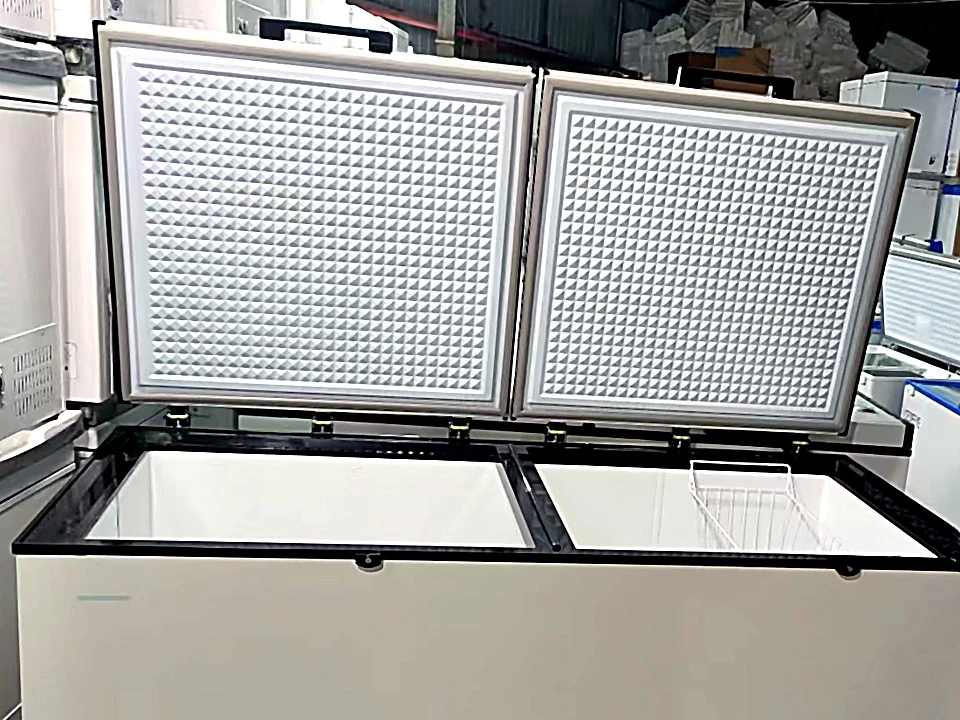

CARGO THREE · meat and poultry in cartons - the cargo that insulates itself
Cartons are the cheapest packaging in the cold chain and the most misleading. A cardboard case of frozen poultry holds a layer of still air inside it, so the outside of the case reaches holding temperature hours before the centre of the load does. Load a cabinet with cases stacked shoulder to shoulder and the thermostat reads the case, the case reads the air, and the middle of the stack stays a few degrees warmer than the number on the wall. Nothing appears wrong until a customer finds a soft bird in the centre of a pallet six weeks later.
The rules for this load are about geometry rather than temperature. Leave a hand's width between the case stacks and the liner on the long sides. Stack no higher than the divider height, so the lid closes on the cabinet rim and not on cardboard. Put the case that will be opened next on the top and the front, not at the bottom of the deep end. And give a mixed delivery its own compartment: cartons of poultry and trays of portioned product do not need the same air movement, and separating them halves the number of times the whole load is exposed.
There is one field habit worth copying. A distributor who runs several 1088s writes the delivery date on the end of every case with a marker and keeps the oldest case at the front of the short compartment. It costs a marker pen and saves the weekly argument about which case is which - and on a cabinet this size, where a case can sit at the back for a month without being seen, that argument is the difference between rotation and waste.
Write down the case footprint, the stack height used on site, and the date marking convention. A photograph of the loaded cabinet on day one is worth more than a paragraph of instructions, because it is what the next shift will copy.
CARGO FOUR · par-fried, bakery and prepared product - the cargo that carries flavours between compartments
Prepared product is the most demanding load on this list, and not because of temperature. Par-fried chips, breaded portions, dough and pastry all release fat and moisture into the air of the cabinet, and a chest freezer has one air space per compartment rather than a sealed package per shelf. Put an open tray of fish next to an open tray of dough and by the end of the week both smell of the other. The 1088's centre divider limits the damage to one half, which is why a mixed kitchen should treat the two compartments as two different cupboards rather than one big box.
Packing is the answer, not temperature. Everything closed, everything labelled, nothing stored in the tray it was delivered in unless that tray has a lid. Product that has been opened for service goes back into a sealed container before the lid closes, and nothing is left standing above the rim. Fat is the second issue: a cabinet that holds par-fried product needs its liner wiped monthly with a mild detergent, because a film of fat on the walls acts as an insulator and quietly costs run time for the rest of the year.
The third issue is the one that catches kitchens out at the busiest hour. Prepared product is picked in small quantities many times a day, so the lid discipline that works for a quay does not work here. The answer is the wire basket: put the day's service items in it, lift the basket out, close the lid, pick, put the basket back. Four movements instead of forty, and the load sees one lid opening instead of a hand in the cabinet every ninety seconds.
Write down which compartment is which, the container standard used on site, and the date of the last liner wipe. On a kitchen cabinet the divider is a hygiene tool as much as a thermal one.
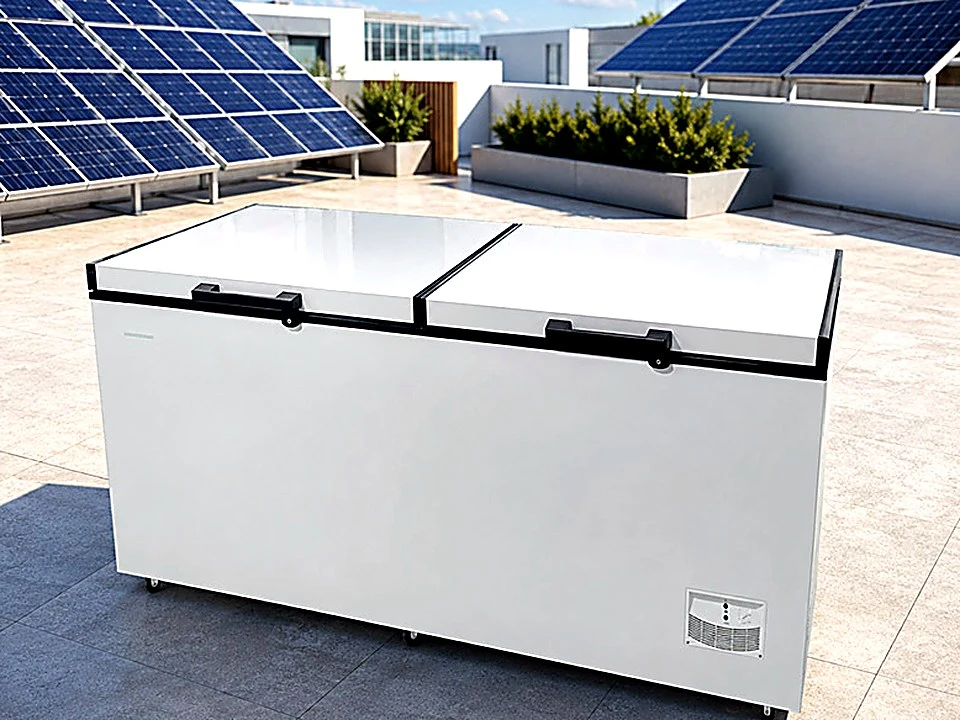
What this freezer is not for
THE REFUSAL · vaccines, drinks and fresh produce - three enquiries we answer with a different product
A chest freezer is a very good cold store and a poor instrument. Vaccines are the clearest case. A vaccine cold chain is judged on a documented temperature history, a validated load pattern and an alarm that survives a power cut; a cabinet with a dial and two lamps gives none of those, and no amount of solar input changes the answer. When an enquiry arrives for a vaccine carrier we quote a purpose-built unit, even though the 1088 would hold the boxes perfectly well.
Drinks are the second. Bottles and cans want 4 to 8 degrees, not minus 18, and a freezer will shatter glass and bulge cans. The right product is a display cooler or a solar fridge, both of which sit in the same catalogue and run off the same bank. Fresh produce is the third: vegetables and fruit need high humidity and a temperature above freezing, and a freezer will ruin them in a night. Those three refusals are free. They cost a line in an email and save a customer.
There is a fourth, softer case: a site that wants a freezer as a shop window. A chest freezer with a shut lid shows nothing, and a customer who has to be shown the product by opening the lid loses the cold air every time. If the stock is sold from the cabinet rather than stored in it, a glass door display is the correct answer; the 1088 is what goes behind the counter.
Being clear about this is not modesty. It is the reason the range has eight different shapes in it, and the reason a distributor can quote one site with two models instead of forcing one model onto two sites.
The plate, the footprint and the container
THE PLATE · 1088, 2035 and 22 - what the three largest numbers on the label commit you to
1088 litres is the capacity, and it is the easiest of the three to sell and the hardest to place. At 2035 millimetres long and 1020 deep the cabinet presents a cross-section of 1020 by 930 to any doorway it has to pass, which is the widest in the family: a clear opening of 1050 millimetres is the practical requirement - plan for 1100 if the route has a corner - and a standard single leaf door will not take it. This is a cabinet for a shutter, a loading bay, a double door or a wall that can be opened. Where the route is a 900 millimetre frame, the 798 or the 708 goes through and the 1088 does not.
Twenty-two cabinets fill a forty foot high cube, against twenty-four for the 798 and twenty-six for the 708, in cartons of 2095 by 1035 by 1010 millimetres. The carton adds sixty millimetres of length and eighty of height over the cabinet, which is the whole protection budget: enough for a container loaded and unloaded by machine, not enough for a carton that is rolled off a tail lift. Gross weight is 130 kilograms against 125 net, so this is a four-person lift on site and never a two-person one, and the castors do the work on any hard surface.
The footprint is the argument for the model. One 1088 covers 2.08 square metres of floor and returns about 524 litres per square metre, the best ratio in the range. Two 658s cover 2.83 square metres and return the same 1316 litres between them, which is more volume than most sites can fill and 0.75 square metres of floor they cannot spare. On a wall of limited length the largest twin is the efficient answer; in a room with several small pick-up points, two smaller cabinets still are.
Write down the clear opening on the route, the number of cabinets the container plan carries, and the floor area allocated to the box. Those three decide the model before the price does, and they are the three that cannot be changed after the container is booked.
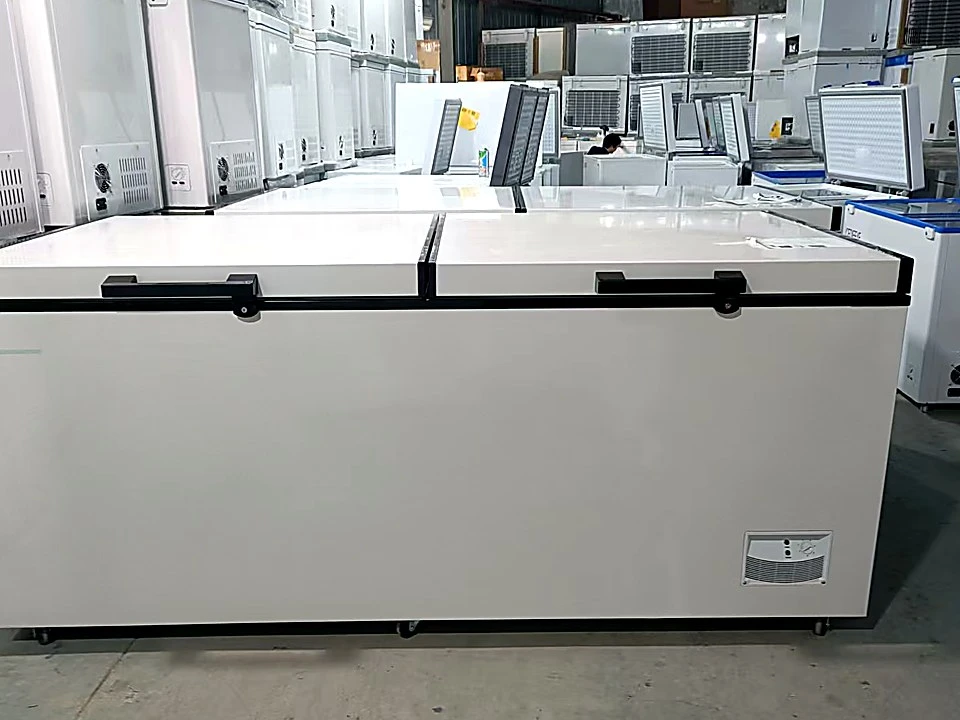
BD/BC-1088 technical data
| Field | BD/BC-1088 |
| Description | Portable solar powered freezer, chest type, two lift lids on a centre divider |
| Holding volume | 1088 L gross |
| Cabinet envelope | 2035 × 1020 × 930 mm |
| Shipped envelope | 2095 × 1035 × 1010 mm |
| Unit mass | 125 kg net, 130 kg gross |
| Insulation | 85 mm foamed wall, lid and floor |
| Working temperature | −18 °C and below, dial set at the factory |
| Supply window | 10–50 VDC, 24 V nominal, solar array or battery bank |
| Refrigerant | R134a / R600a, charged and sealed |
| Lid arrangement | Two hinged lids, flush counterbalanced, centre divider, wire basket on the right |
| Loadability | 22 cabinets per 40'HQ |
| Delivery form | Assembled cabinet, or CKD / SKD kit for local assembly |
The commissioning ledger
Nine entries, written on the day the cabinet is switched on, in the order a technician would actually measure them. Every one of them is a number a customer can be shown later, and every one of them is cheaper to write down now than to argue about in six months.
| Entry | What is written down | What it proves later |
| 1 | Array open circuit voltage and short circuit current, measured at midday | Whether the supply window was ever wide enough for this site |
| 2 | Bank voltage at rest and under compressor load, ten minutes apart | Cable gauge and connection quality, not just battery capacity |
| 3 | Ambient temperature in the room at the warmest hour | The duty cycle the cabinet was asked to hold, not the one in the brochure |
| 4 | Pull down time from ambient to −18 °C, empty, lids shut | A baseline every future service visit is compared against |
| 5 | Liner temperature at three points in each compartment after twelve hours | Whether the load sits in an even field or against a warm wall |
| 6 | Frost depth on the long side wall at the first weekly check | The defrost interval this particular cargo actually needs |
| 7 | Which compartment takes the traffic, and the busiest hour | Where the divider earns its place and where the basket belongs |
| 8 | Clear opening on the route, measured rather than estimated | That the cabinet can leave the room it is in |
| 9 | Name and number of the person who signs the sheet | One owner for the cabinet, instead of a site wide assumption |
HOW IT TRAVELS - assembled, or knocked down for a build partner
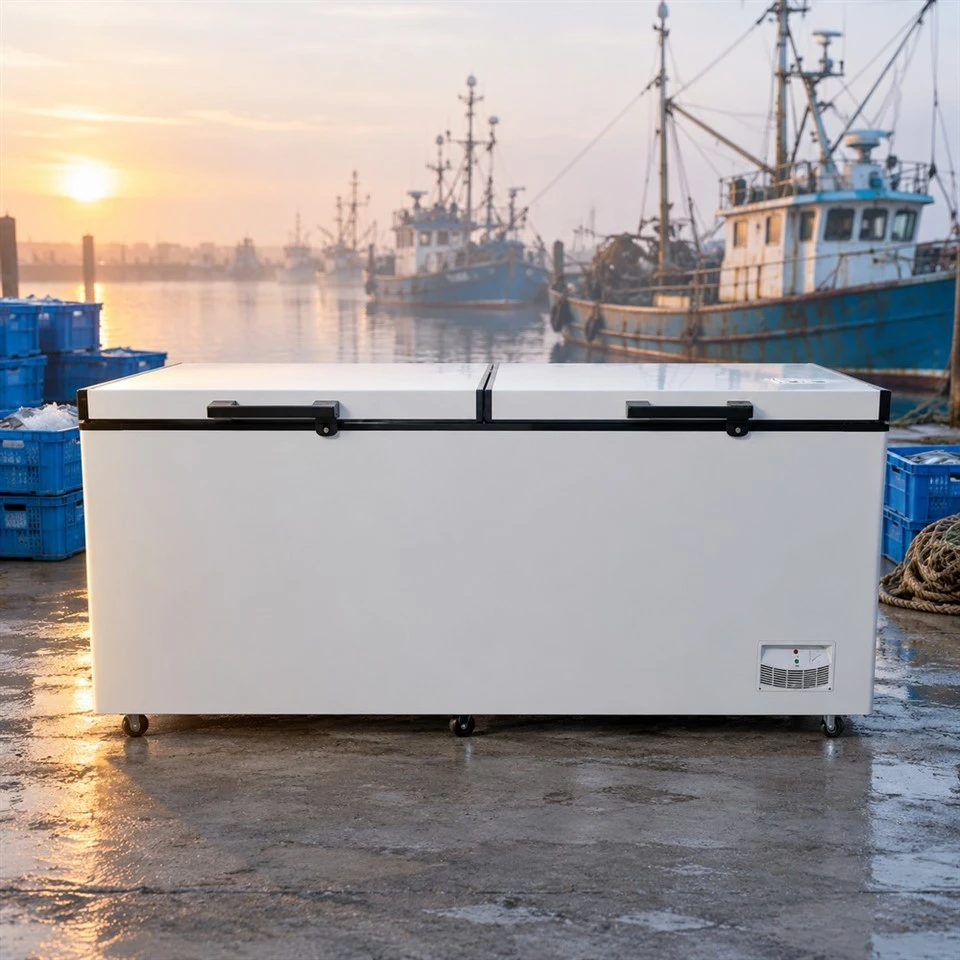
The 1088 is the one cabinet in the range that most buyers order knocked down. Not because it is difficult, but because of what it costs to move air: assembled, a 2095 millimetre carton occupies the same forty foot slot as a small car, while CKD packs the same cabinet into a fraction of that cube as panels, foam sections, lids, compressor set, harness and fixings. A build partner with a foaming jig and one trained technician can turn a kit into a cabinet locally, and the freight saved pays for the jig more than once.
The kit arrives as a numbered set with a wiring harness and a gasket bag marked per panel. Assembly is panel to frame, foam injection, pipe connection, gas charge, leak test, pull down test, then the same commissioning sheet that an assembled cabinet gets. The compressor set is charged and sealed at the plant; the local work is mechanical, not refrigeration engineering. Assembled cabinets ship in a single carton with the lids locked down and the castors fitted.
Either way the cabinet leaves with the same three documents: a packing list keyed to the numbered panels, a wiring diagram that matches the harness in the box, and the commissioning sheet with the factory pull down figures already written on it. Those three are what a build partner needs to answer a customer without calling the factory.
A model is chosen by the route, not by the price list
Four cabinets in this range share the same compressor family, the same 85 millimetres of foam and the same 10–50 VDC window. They differ in length, and length is what a building decides. The 658 is the shortest at 1598 millimetres and goes where a wall is short. The 608 and the 708 are both 1785 long, and the difference between them is depth: 745 against 795, which is the difference between a narrow passage and a normal aisle. The 798 stretches to 1950. The 1088 at 2035 is the one that needs a way in sized on purpose - a shutter, a loading bay or a double leaf - and in exchange it is the only cabinet in the family that holds a whole landing's morning catch with the centre divider still standing.
So the first question is not how many litres. It is what the cabinet has to pass to get into the room it will live in, and whether it ever has to come out again. Measure that once, in millimetres, with the door frame and the nearest corner included, and the model names itself. Sites that answer that question before ordering do not send containers back.
WHAT WE NEED FROM YOU - the clear opening on the route, the crate or case count of a busy day, the worst month sun hours at the site, and the bank voltage already installed. Send those four and the reply names the model, sizes the array and battery against that location, and lays out the mix that fills a forty foot box, with a sailing date against the BD/BC-1088 and samples available from stock. Nothing in that reply is a guess about your building, because nothing in it was assumed.
Hot Tags: portable solar powered freezer, China portable solar powered freezer manufacturers, suppliers, factory


