


Wall thickness is the least glamorous number on a freezer specification sheet, and it is the one that decides how much solar capacity a project has to buy. A 110 mm foamed cabinet does not just hold temperature better - it changes the size of the array, the battery bank and the generator backup that never has to be installed.
This article sets out what 110 mm foaming thickness actually changes, with the heat-leak arithmetic behind the claim, the numbers printed on a real unit's nameplate, the duty cycles measured at different ambient temperatures, and the installation details that quietly give back the savings. It is written for distributors, tender writers and project engineers who have to defend a specification in front of a client.
What 110 mm Foaming Thickness Actually Means
On a chest freezer, the figure refers to the average thickness of the polyurethane foam between the inner liner and the outer skin - through all four walls, the base and the lid. A conventional export cabinet measures 55 to 65 mm. The thick-wall version takes that to 110 mm, an increase of roughly 45 mm, or 69 percent more foam on every surface that faces the sun.
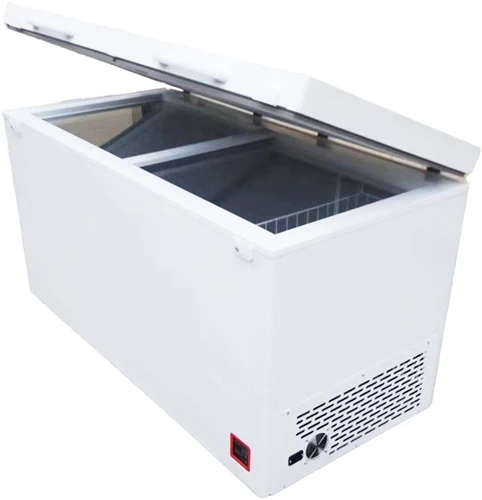
The number is easy to misread. It is not the depth of the plastic trim, and it is not a marketing figure measured at the thickest corner. On a properly built cabinet you can see it in the open lid: the foam section between the liner and the outer shell should measure the stated value with a rule, at the middle of the lid, not at the reinforced edge. That is the check to make on a sample before a container is booked.
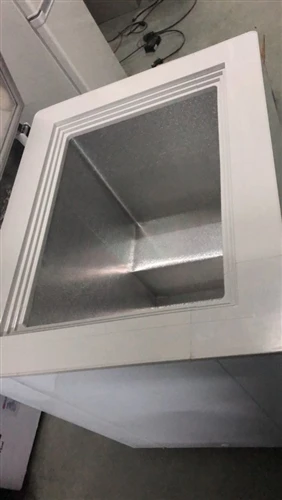
Foam quality matters as much as thickness. Cabinets in this class are blown with cyclopentane and injected at a free-rise density of 38 to 42 kg/m³, into a jig that holds the liner and shell square while the foam cures. Under-filled cabinets show up as soft patches around the compressor step and the hinge line - the two places where heat leak and condensation first appear after a year in service.
The Heat-Leak Arithmetic Behind Those 45 Millimetres
Insulation performance is not a matter of opinion; it is a U-value, and a U-value can be calculated from three numbers. Take polyurethane foam with a conductivity of about 0.022 W/m·K, a 258 litre chest cabinet with roughly 4.6 m² of external envelope, a 32 °C yard and a −18 °C set point - a temperature difference of 50 K across the wall.
Real cabinets leak a little more than that through the gasket, the compressor compartment and the lid joint, and they also have to remove the heat that enters every time the lid is opened. But the direction and the scale of the figure are correct, and they are what an energy audit will reproduce: on this envelope, 45 mm of extra foam removes about 40 percent of the wall gain.
What the Saving Buys in Solar Hardware
A freezer that needs 0.75 kWh less per day does not merely run cheaper; it shrinks everything upstream of the cabinet. With four peak sun hours in the worst month and 78 percent system efficiency, 0.75 kWh per day is roughly 240 W of photovoltaic capacity that does not have to be bought, mounted, cabled and cleaned. At three days of autonomy and 80 percent usable depth of discharge, it is also about 2.8 kWh of battery capacity that does not have to be purchased and replaced every few years.
For a single cabinet that is a modest saving. For a clinic store of eight units, a fishing cooperative ice house or a distributor's village-level cold room, it is the difference between a two-string array and a three-string array, a 24 V bank and a 48 V bank, and a project that fits the grant budget and one that does not.
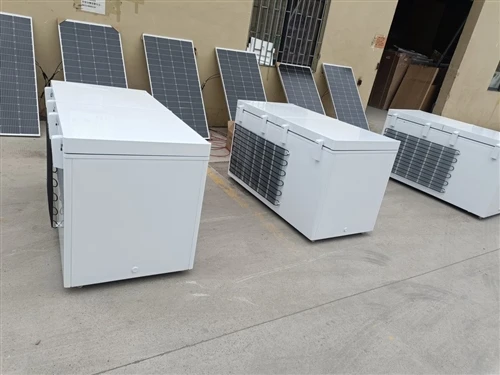
There is a second, less obvious gain. A cabinet with a low heat gain spends less time at full compressor speed, so the duty cycle drops and the battery sees a gentler discharge profile. In lead-acid installations that alone can add a year or more to service life, because the bank is no longer asked to deliver long, deep pulls through the night.
How a 110 mm Cabinet Is Built
Adding foam is not simply pouring more chemicals into the same shell. The liner, the outer skin and the frame all have to move, and the cabinet gains 8 to 14 kg of mass depending on volume. Builders who do it properly reinforce the base, because a 400 litre cabinet with a deep foam section in the floor needs a stronger platform and better castor mounts to survive being dragged across a concrete yard.
The lid deserves separate attention. In a chest freezer the lid is a horizontal surface facing the sky, and in direct sun it can run 20 K hotter than the walls. A thick-wall cabinet uses a deep foamed lid with a stepped gasket land, so the magnetic seal closes on a flat, rigid surface rather than on a thin plastic lip. That is where most of the condensation complaints on cheap cabinets originate: a lid that has warped 3 mm and no longer seals at the front edge.
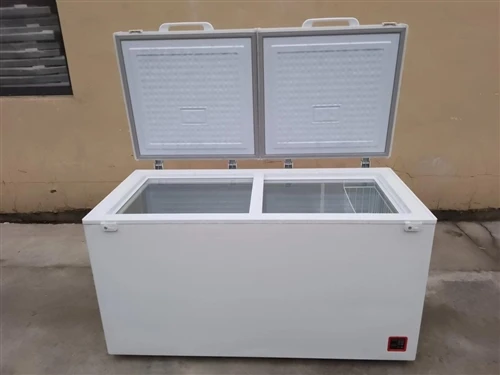
Double-door configurations matter more than they appear to. Every lid opening dumps a layer of cold, dense air onto the floor and pulls in warm humid air that must then be dehumidified on the evaporator. Halving the exposed area per opening roughly halves that loss, which is why two-door cabinets out-perform single-door units of the same volume in field trials even when their insulation is identical.
Reading the Nameplate: What the Numbers Really Say
A specification is only as good as the plate on the back. The label below belongs to a 258 litre thick-wall chest freezer, and it is worth reading line by line, because every figure on it changes how the system is sized.
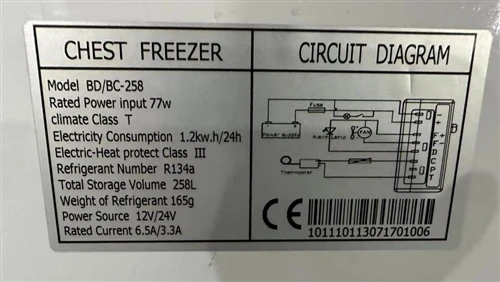
Two mistakes are common when this plate is read in the field. The first is to multiply 77 W by 24 hours and conclude the unit needs 1.85 kWh a day; that number assumes the compressor never stops, which never happens in a working cabinet. The second is to treat 1.2 kWh as a site figure. It is not: it is measured at a defined ambient and duty pattern, and a cabinet standing in a 43 °C yard with warm product loaded into it will exceed it.
Duty Cycle at Real Ambient Temperatures
Because the load is dominated by the temperature difference across the wall, ambient temperature drives consumption almost linearly. The table below models a 258 litre thick-wall cabinet holding −18 °C, and compares it with the same cabinet built to a 65 mm wall on the same envelope. Figures are indicative and should be replaced by test data for a specific model.
The last two rows are the reason projects fail in hot climates. A cabinet specified on a mild-climate datasheet, installed in a coastal yard at 43 °C, draws nearly double the energy the array was sized for. The compressor is not at fault and the controller is not at fault; the wall simply leaks more heat than the specification assumed.
Holdover: What Happens When the Sun Stops
Thick foam buys time, and time is the real currency of an off-grid installation. With the compressor off, cabinet temperature rises at a rate set by the heat gain, the thermal mass of the load and the number of times the lid is opened. A 110 mm cabinet carrying a full load of frozen product will typically stay below −10 °C for well over a day with no power at all; a 65 mm cabinet on the same duty will not.
Eutectic holdover packs are the standard way to extend that window. The packs freeze while the compressor runs and release their latent heat during outages, flattening the temperature curve for a further 8 to 24 hours depending on mass. The combination - thick wall plus holdover packs - is what vaccine cold-chain tenders in high-outage markets ask for, because it protects the load through the two failures that actually happen: a cloudy week and a dead battery.
Where the Extra Insulation Pays for Itself
Thick-wall cabinets cost more per litre than conventional ones, and there are four situations in which that premium is recovered quickly.
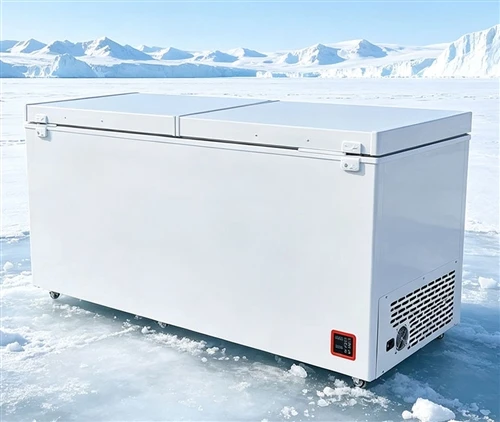
In temperate markets with reliable grid power, the argument is weaker. There the thick wall still reduces running cost and holds temperature through short outages, but the payback is measured in years rather than in avoided hardware. Being honest about that is part of specifying well.
Installation Details That Give the Savings Back
A thick wall can be undone on site in an afternoon. The following list covers the mistakes seen most often on commissioned installations.
How to Verify a Thick-Wall Claim Before You Buy
Because 110 mm is a premium claim, it should be verified rather than accepted. Five checks are enough for a first assessment, and all of them can be done on a sample in a warehouse.
A supplier who can answer all five with documents is a supplier who controls the foaming process. A supplier who answers only the first is selling a number.
The Range: From 68 to 718 Litres in a Thick Wall
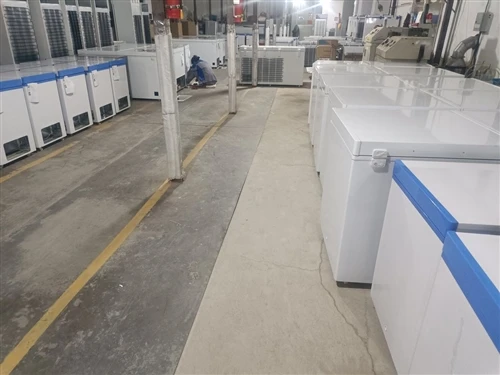
Thick-wall cabinets are built across the full chest freezer range, so a project can hold one insulation specification from a small vaccine box to a bulk store. In this series the model code follows the nominal volume in litres, and both mechanical and digital control versions are available at most sizes.
Building the Specification
For a project that has to work in year five without a service call, the specification should name five things explicitly: foam thickness and density, envelope area at the stated set point, daily consumption measured at the site's design ambient, holdover time with a stated load, and the DC input range of the control board. Everything else - the colour of the liner, the number of baskets, the badge on the front - is detail.
Thick-wall cabinets are not the right answer everywhere. They are the right answer wherever the energy to run a freezer has to be harvested on site, or where the load has to survive a grid that cannot be trusted. In those two cases the extra 45 mm is usually the cheapest kilowatt-hour in the whole bill of materials.