


JUKA has added the ZB-500 to its solar ice machine range: a vertical, double-door cabinet that turns 48 V direct current into 500 kg of ice columns every 20 to 24 hours, with no inverter between the photovoltaic array and the compressor.
The model is aimed at the part of the ice market where mains power is expensive, unreliable or simply not there - fishing ports and aquaculture, municipal and market ice supply, cold-drink retail, produce pre-cooling and disaster-relief staging. This article covers what the cabinet is, the four power configurations it can be ordered in, how the freezing stack and the inverter compressor work together, and what the array arithmetic looks like before a project commits to a DC system.
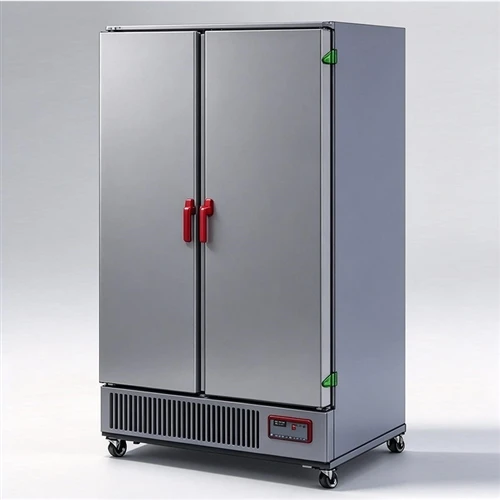
What the ZB-500 Is
The ZB-500 is a 4,727 litre ice-column machine built as a two-door upright. Ice forms on eight layers of flat quick-freezing plates inside the cabinet, is released as solid columns of 150 mm diameter, and drops into the same insulated body, which is held at or below −18 °C so the harvest stores instead of melting. The machine is a single unit: refrigeration, controls and ice storage share one foamed cabinet, which is what makes it practical to install in a shed, a container office or a market stall.
Four Power Configurations on the Same Cabinet
The same ZB-500 body can be ordered with four different power architectures, and the choice is made from the target market's solar radiation and grid reliability rather than from the cabinet itself. This matters for distributors: one model number, one spare-parts list, four commercial offers.
Two of the four schemes carry a fixed array count - four 590 W modules on the hybrid, sixteen on the battery-based version - because their energy balance is defined. The other two are quoted with an array sized on site. In every case the module count, battery capacity and backup hours are confirmed against local sun hours and grid behaviour before the order is released.
Ice Columns, Not Cubes
Column ice is the format that fits fishing, markets and cold-drink service, and it behaves differently from a cube. A 150 mm column has far less surface area per kilogram than a small cube, so it melts slowly, stacks without welding into a single block, and can be broken to the size a customer actually wants. For a harbour operator selling ice to boats, that combination - slow melt, stackable, crushable - is worth more than a faster freezing cycle.
The trade-off is time. Latent heat has to be pulled out through a thicker section of water, so the harvest cycle is longer than on a cube machine of equivalent output, which is why the ZB-500 is specified as 500 kg per 20 to 24 hours rather than per 12-hour shift. Plan ice supply around a full-day cycle, not around a shift.
The Inverter Compressor at the Centre
A 48 V DC system cannot afford a hard start. The ZB-500 uses an inverter compressor from Zhonghang Sanyo that starts at low frequency and then runs at high power, so the initial current stays small relative to the running current. On a direct-drive solar system that difference decides whether a passing cloud trips the machine out, and on a generator it decides whether the generator has to be twice the size of the load.
Inverter control also lets the machine match output to available power instead of running flat out and then stopping. When the array is producing less - early morning, high cloud, a hot afternoon when panel output drops - the compressor can slow rather than shut down, and ice production degrades gracefully instead of stalling.
A 4,727 Litre Body With 100 mm Walls
Ice costs energy twice: once to freeze it and again to keep it frozen until it is sold. The ZB-500 body is foamed to 100 mm in the walls and doors, holds the cabinet at −18 °C or colder, and uses two independently sealed doors so that opening one half does not expose the whole store. On a machine that may produce for twenty hours and then stand for four, that insulation is what protects the day's output overnight.
The 100 mm specification also buys tolerance. A cabinet with thin walls in a 40 °C shed loses much of its freeze capacity to heat leaking in through the envelope, and the compressor spends its duty cycle fighting the wall instead of making ice. Thick foam is the cheapest way to make a DC machine's output predictable.
What the Array Has to Deliver
Ice is the most energy-intensive product in the cold chain, and the arithmetic is worth doing before a project assumes a small array will be enough. Freezing one kilogram of water that arrives at about 25 °C takes roughly 334 kJ of latent heat plus about 105 kJ of sensible cooling, so about 440 kJ per kilogram. Five hundred kilograms a day is therefore close to 220,000 kJ - around 61 kWh of cooling.
Divide that by the machine's coefficient of performance. At a realistic 1.4 to 2.0 for a −23 °C evaporator in a hot ambient, the electrical demand lands somewhere between 30 and 45 kWh per day, which is consistent with a 2.2 kW machine running 55 to 85 percent of the time. The 52.8 kWh that 2.2 kW would consume in a full 24 hours is the ceiling, not the expectation.
Installation: Water, Air and Load
Three things decide whether a 500 kg machine performs: the water going in, the air coming out of the condenser, and the conductor feeding it. Get any of them wrong and the cabinet will look like a refrigeration fault when it is an installation fault.
Container and CKD Logistics
At 600 kg gross and 2,210 mm tall, the ZB-500 is a freight item, and the design accounts for it: 12 sets load into a 40HQ container, and the model is supplied in CKD form when a partner wants to assemble locally rather than import finished cabinets. Knock-down supply changes the freight maths substantially on a machine this size, because volume rather than weight is what fills a container.
For distributors building a local assembly business, the same engineering package travels with the kit: cabinet panels, foaming specification, refrigeration circuit and the control configuration chosen for that market. That is the practical argument for keeping one model number across four power schemes.
Inside the JUKA Factory
JUKA is a group rather than a trading office. Hangzhou Juka Intelligent Technology Co., Ltd. is the headquarters, connecting refrigeration manufacturing, solar cold-chain development and international project support. Cabinet production sits with Zhejiang Gangtong Electrical Appliance Co., Ltd., which carries in-house research and development and the full production process for chest freezers and refrigerators, while Huzhou Transtec Electrical Appliance Co., Ltd. handles CKD and SKD project development with local partners.

The production line is built around controlled processes rather than assembly by eye. Automatic laser cutting, punching and bending equipment forms the panels; twin-gun high-pressure foaming machines fill the cabinets; refrigerant is charged with CACL equipment and every circuit is checked with INFICON leak detectors, with refrigeration and control components tested in the laboratory before a design is released. The company mission is stated plainly: a genuine team, trustworthy products.
Beyond finished units, the group supports partners who want to manufacture locally: plant layout, production equipment and tooling, installation and commissioning, on-site engineer training, product upgrades and refresher training for local teams, with the local partner owning the building, recruitment, sales channels and government relations. Ice machines, solar freezers, display coolers and mobile refrigeration all travel through the same structure.
Where the ZB-500 Fits
Service, Spares and Commissioning
Each order is quoted with its own warranty terms, spare-parts package and commissioning scope, because the right answer depends on the configuration and the market. What is consistent is the support model: installation and commissioning guidance, an engineer training option for partners assembling locally, and a spares list that covers the compressor, controller, expansion device, door seals and ice moulds.
If you are evaluating the ZB-500 for a tender or a distribution programme, the useful next step is to send the site conditions - ambient temperature range, feed-water temperature and quality, target daily ice output, available array area and whether a grid or generator is present. Those five inputs decide which of the four power configurations fits, and they are enough to size the array and battery against real numbers.